Old Huang Returns: But the Old Nvidia Is Unlikely to Come Back


- Core Viewpoint: Jensen Huang's return to the CEO role at Nvidia stabilized market confidence, but the company's governance structure has undergone fundamental changes—a formal board chair was established for the first time, the independent investigation and compliance system have been retained, and the old model of the founder's personal credibility driving the industrial chain is being replaced by institutionalized review.
- Key Elements:
- Jensen Huang resumed his position 11 days after resigning, and Nvidia surged 31.48% in a single day, with market capitalization surging by $952 billion, marking the largest single-day gain since May 2003.
- Unlike Altman, who quickly purged OpenAI's board after returning, Jensen Huang faces checks and balances such as Harvey Jones remaining as board chair, the independent investigation continuing, and the newly established National Security and Export Controls Committee.
- Nvidia's total future commitments amount to as much as $518 billion (including $390 billion in capacity supply, $102 billion in cloud services and leasing, and $20 billion in equity investments), with a maximum guaranteed exposure of $118 billion, reflecting deep involvement in AI infrastructure capital formation.
- Tighter governance means that the past "handshake agreement" model relying on the founder's personal credibility will shift toward contractual and compliance-based review, and the threshold for credit support to AI cloud providers with weak balance sheets will rise.
- Jensen Huang cannot resolve macroeconomic constraints: the 10-year U.S. Treasury yield remains at a high of 4.92%, CoreWeave bonds are yielding close to 15% in the secondary market, and Nvidia's accounts receivable have risen from $38.5 billion to $81 billion.
- Investment opportunities across the AI industrial chain will diverge: the core semiconductor supply chain has the strongest certainty, Neoclouds face financing reshuffling pressure, infrastructure segments such as power and cooling will benefit in the long term, and large cloud providers will expand on the strength of their cash flow advantages.
11 days. The market finally got the reversal it most wanted to see.
On November 23, Eastern Time, just 11 days after his resignation—and less than a week after the board publicly rejected his return—Nvidia's board suddenly announced the immediate reinstatement of Jensen Huang as President, CEO, and Director.
The news instantly set off global capital markets. Nvidia closed up 31.48% that day at $165.05, with its market cap surging by $952 billion in a single day—the largest one-day gain since May 2003. This sentiment is not hard to understand: the valuation premium Nvidia has long enjoyed was never just for GPUs and AI compute—a large part of it was a price on Jensen Huang's personal strategic judgment, industry credibility, and execution capability.
Amid the chorus of "the king has returned," many investors also instinctively recalled the script from three years ago—at the end of 2023, Sam Altman likewise made a swift return to OpenAI after a dramatic boardroom battle, then quickly purged the old board and consolidated his power more firmly than before he left.
But a look at the filing Nvidia submitted to the SEC on November 23 reveals that the two scripts are not the same—this time, Huang returns to face an entirely new corporate governance framework that has already been implemented.
The man is still the same man, but Nvidia is no longer the Nvidia it was before November 12.
1. Both Were "Swift Returns," but Huang Is Not Altman
First, let's review the key timeline of this episode.
On November 8, after media reports that Jensen Huang had become a target of foreign intelligence activity, Nvidia's board announced that a committee of independent directors would launch an independent investigation; two days later, the independent directors formally engaged an external legal team.
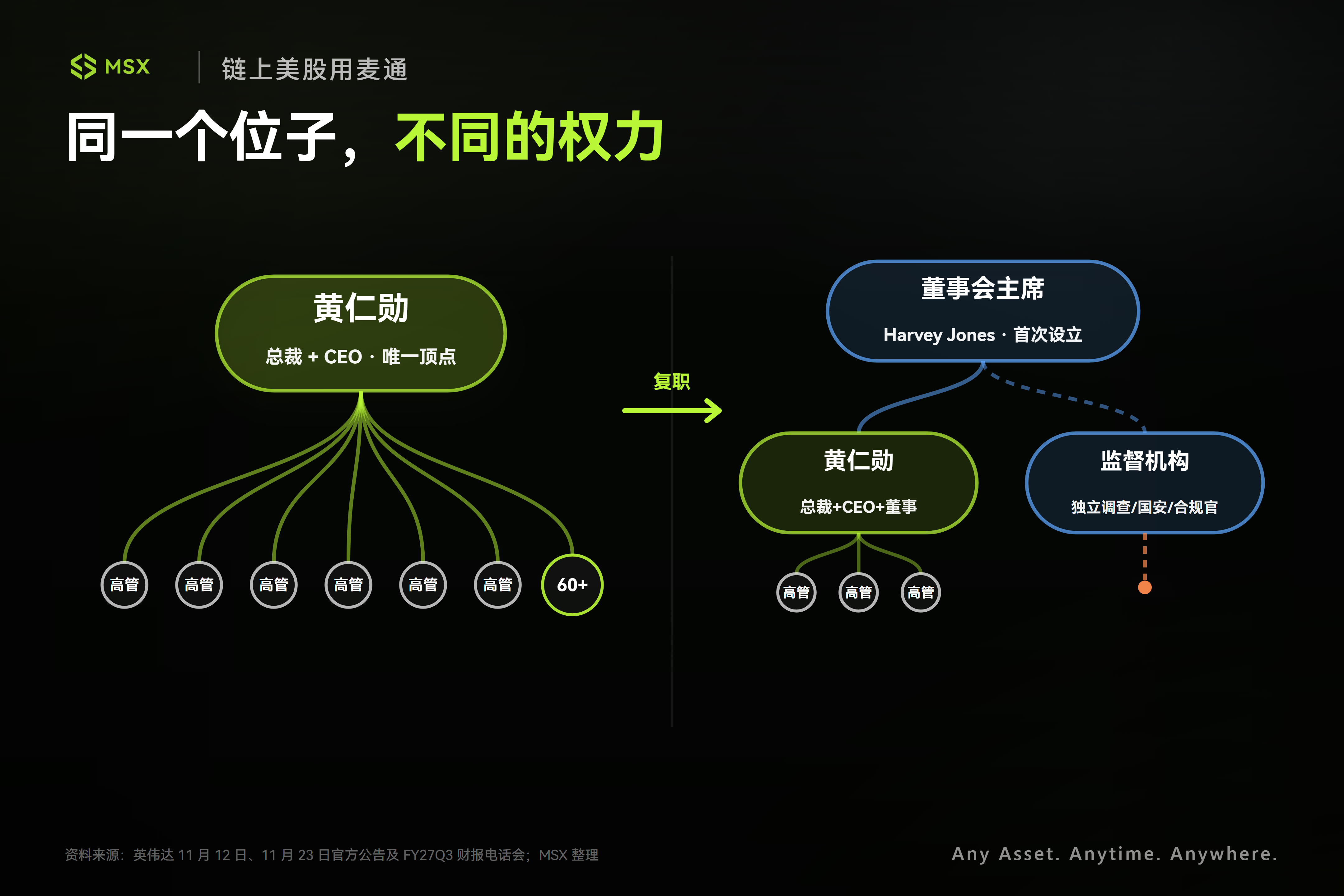
On November 12, Huang resigned as President, CEO, and Director, with long-serving CFO Colette Kress taking over as interim CEO; at the same time, Harvey C. Jones was appointed as the first formal Board Chair in Nvidia's history.
On November 23, the board announced the reinstatement of Huang's positions, but Harvey Jones remains Board Chair, and all prior independent investigation and compliance remediation arrangements are retained.
On the surface, this is a dramatic reversal from resignation to reinstatement, but what truly deserves attention is that the power architecture formed after November 12 has not been dismantled with Huang's return.
The most direct change is that Nvidia has, for the first time, a formal Board Chair.
A common misconception needs correcting here: before the episode, Huang was not Board Chair. According to Nvidia's 2026 annual proxy statement, the company had long operated under a "Lead Independent Director" system, held by Stephen C. Neal, and the board had even explicitly concluded that the existing structure was sufficient and that no separate chair was needed.
Under that framework, the CEO led strategy and operations, while the Lead Independent Director coordinated oversight—so although in legal form it was not "one man holding all power," in practice it relied heavily on founder Jensen Huang making the final calls himself.
Now, Harvey Jones remains as formal Board Chair, giving the board's oversight and coordination a clearer center of authority. This of course does not mean the chair will meddle in day-to-day business, nor that Huang must seek approval for every operational decision; but on major risk control, strategic oversight, and corporate governance matters, there is for the first time a clearly empowered check above him.
The more tangible constraint is that neither the investigation hanging overhead nor the compliance system has been withdrawn.
In the November 23 announcement, several details deserve particular attention:
- The independent director investigation committee will continue to pursue the investigation, and Huang must cooperate;
- The board has established an independent National Security and Export Controls Committee specifically focused on trade compliance and national security risks;
- The company is recruiting a new Chief Compliance Officer (CCO), who will report directly to the board's Nominating and Corporate Governance Committee, bypassing the CEO's reporting line;
- In addition, the company must continue to respond to government inquiries and the upcoming December 3 Senate hearing.
In any case, the board clearly does not intend to let everything be swept under the rug simply by restoring the CEO position.
From a governance perspective, Nvidia is undergoing a fairly significant institutional transformation, with national security, export controls, compliance review, and management oversight in particular having been elevated entirely to the board level.
What Huang has regained is the CEO position and operational responsibility, but it will be hard for him to return to the old environment where his personal credibility alone could clear every path.
2. A Deeper Change Than Personnel: The Era of "Verbal Agreements" May Be Ending
Over the past two weeks, as multiple sources have gradually disclosed information, the outside world has been able to glimpse the most hidden operational underpinnings of Nvidia under Huang—its ability to sweep through the entire AI industry chain relied not only on leading chips, but also on a business playbook highly bound to the founder's personal credibility.
In particular, Huang used his personal influence to organize suppliers, cloud providers, data center operators, and AI model companies—originally scattered across various links of the industry chain—into a highly coordinated commercial network.
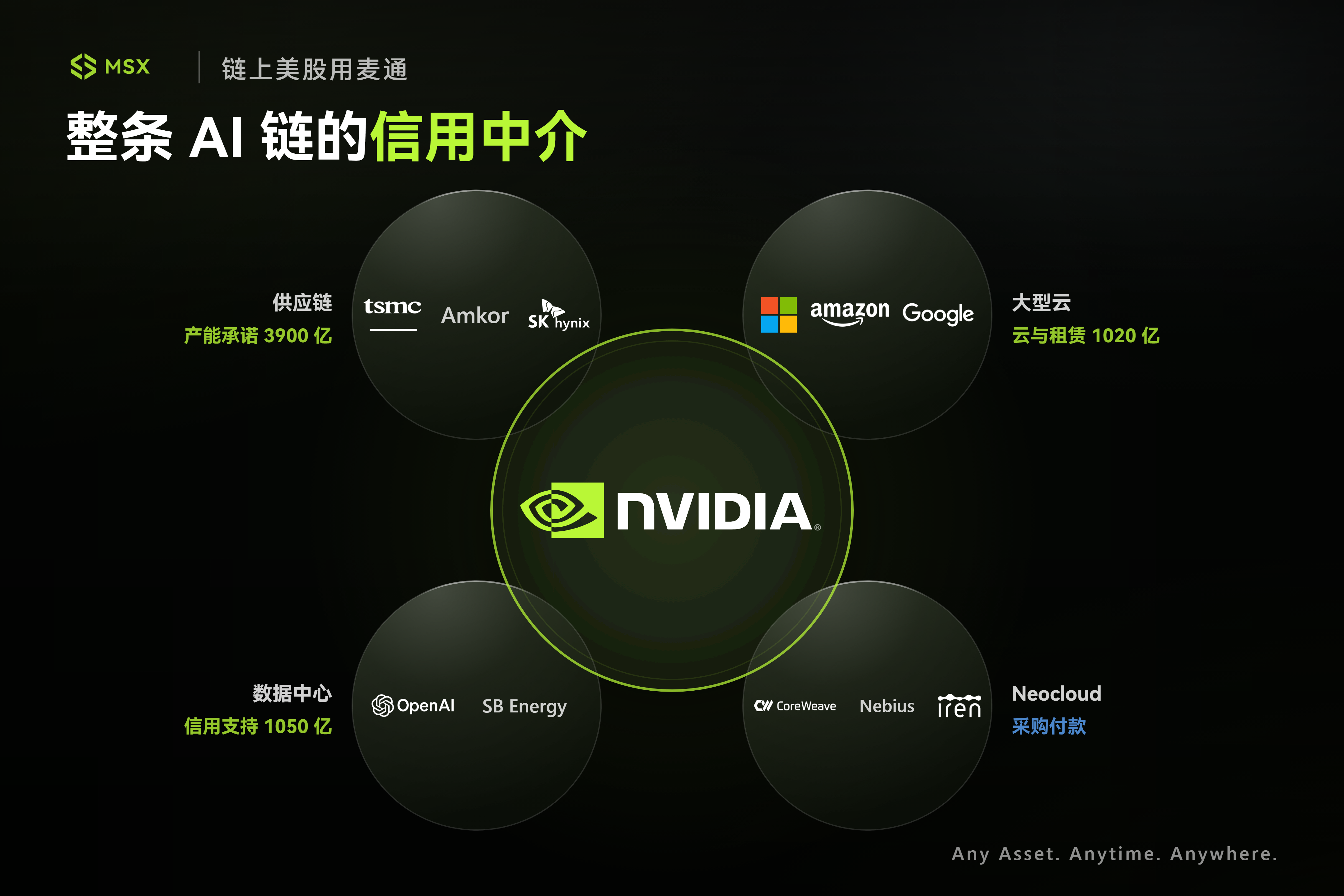
It could be said that over the past few years, Huang played far more than the CEO of a chip company; he was more like the organizer of the entire AI infrastructure industry chain—even its "chief incubator" and "master liquidity gate."
From GPUs, HBM, and advanced packaging to complete servers, data centers, and cloud providers, and further to frontier model companies like OpenAI—during an expansion period of extreme compute scarcity, Nvidia's cooperation with upstream and downstream partners had long exceeded ordinary buying and selling, deeply binding capacity reservations, long-term procurement, prepayments, and even backstop financing.
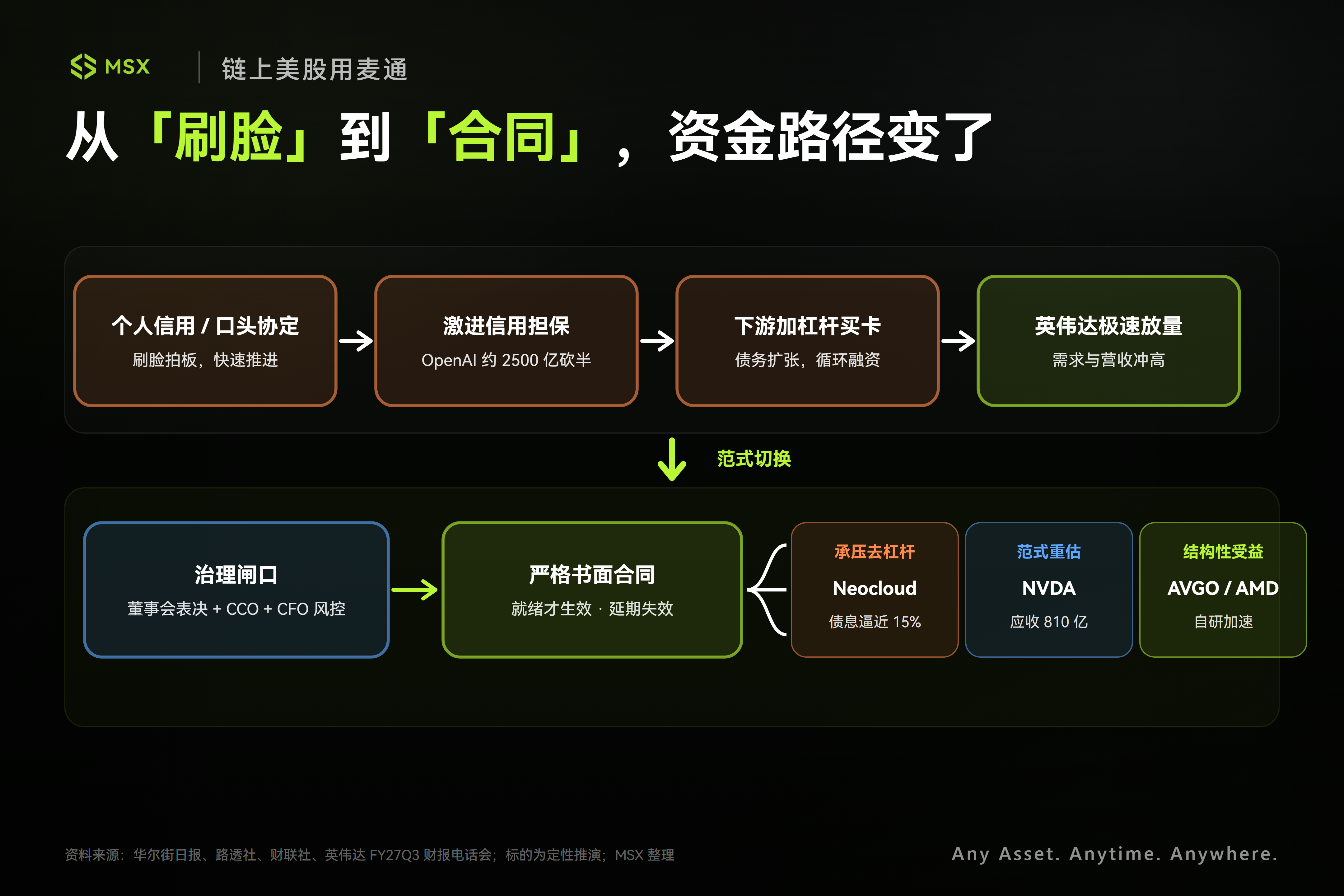
The widely discussed "verbal agreements" are precisely an intuitive summary of this strongman model: with Lao Huang nodding based on personal judgment and credibility, downstream players dared to lock in compute capacity in advance and increase capital expenditure, suppliers were more willing to invest funds ahead of time to expand production, and some small and mid-sized startups could directly obtain expansion chips.
And this is precisely where the governance structure changes may have an impact.
The flexible commitments that could once be rapidly leveraged through the founder's personal credibility must now undergo stricter contractual, financial, and compliance review. Precisely for this reason, the board restructuring is by no means merely an internal personnel reshuffle; what it truly shakes is the business playbook on which Nvidia previously relied to leverage the entire AI industry chain.
A look at the books Nvidia has disclosed shows just how much weight this carries.
As of October 25, 2026, the total amount of various future commitments disclosed by Nvidia for its third fiscal quarter had reached as high as $518 billion, with the three core components being:
- $390 billion: supply commitments for key components and manufacturing capacity over the coming years;
- $102 billion: cloud service agreements and data center lease commitments not yet effective;
- $20 billion: future equity investment commitments;
This scale is enough to show that Nvidia has long gone far beyond the role of a traditional chip supplier and is deeply involved in capacity allocation, capital investment, and commercial ecosystem building for AI infrastructure.
In addition, Nvidia's maximum aggregate guarantee exposure has also reached $118 billion, including $105 billion in credit support for SB Energy's PORTS-Pike data center project, which involves approximately 4.25GW of compute infrastructure and will ultimately be used by OpenAI over a 20-year lease term—although the guarantee takes effect in stages as the project is built and declines as OpenAI makes payments, this volume alone is enough to show that Nvidia has become deeply involved in the capital formation of AI infrastructure.
So when corporate governance is comprehensively tightened and national security and compliance review are elevated to the board, this kind of hundred-billion-dollar capital operation will inevitably place greater emphasis on black-and-white delivery milestones and liability for breach; for AI cloud providers with weaker balance sheets that rely heavily on external financing to build data centers, Nvidia's prepayments and guarantee support may not come to an abrupt halt, but the risk-control threshold will certainly rise.
In fact, during Huang's temporary absence, Nvidia's business did not stall.
On November 17, the company still announced further expansion of cooperation with supply chain partners including Kinsus, Samsung Electro-Mechanics, Amkor, SPIL, TSMC, and Foxconn. Among these, Nvidia supported Amkor through multi-year agreements to expand advanced packaging capacity in the United States and South Korea, with related agreements worth close to $3 billion and including prepayment arrangements.
This at least shows that Nvidia's supply chain organizing capability does not rely entirely on Jensen Huang alone; the company has already built a fairly mature commercial cooperation system capable of continuing to drive business when management changes.
So objectively speaking, this brings both costs and benefits to Nvidia.
On the one hand, more review and approval may increase decision-making time and make some capacity arrangements that previously required rapid sign-off more complex; on the other hand, clearer boundaries of responsibility also help reduce overcommitment, duplicate investment, and potential financial risks.
For a company that has become a core supplier of global AI infrastructure, this transformation may also be a process it must go through after expanding in scale.
3. Lao Huang Can Save NVDA, but Not Inflation or the Bond Market
To be realistic, Huang's return is absolutely one of the best outcomes Nvidia could have achieved.
In the third quarter, the company's revenue reached $115.8 billion, up 103% year-over-year; data center business revenue reached $107.6 billion, up 110% year-over-year. Whether in terms of product roadmap, customer demand, or industry chain orders, Nvidia's fundamentals remain strong (further reading: "Revenue Doubles: Stripping Out the "Jensen Huang Premium," How High a Valuation Can Nvidia Support?").
This also explains why the market was willing to quickly repair the prior leadership risk after Huang's return, but short-term sentiment pulses and medium-term pricing logic are two different things.
A look under the hood of Monday's 31.48% surge reveals the clue: even with a single-day market cap increase of $952 billion, it only recovered part of the roughly $1.5 trillion in market value that had evaporated since the episode began on November 8. A large amount of short covering and pent-up emotional release was mixed in—it was not long-term capital indiscriminately sweeping up shares at any cost.
The more realistic problem is that Huang can at most solve the confidence and financing problems of Nvidia and even most of the AI industry chain, but he cannot solve U.S. inflation, still less hold down the U.S. Treasury market.
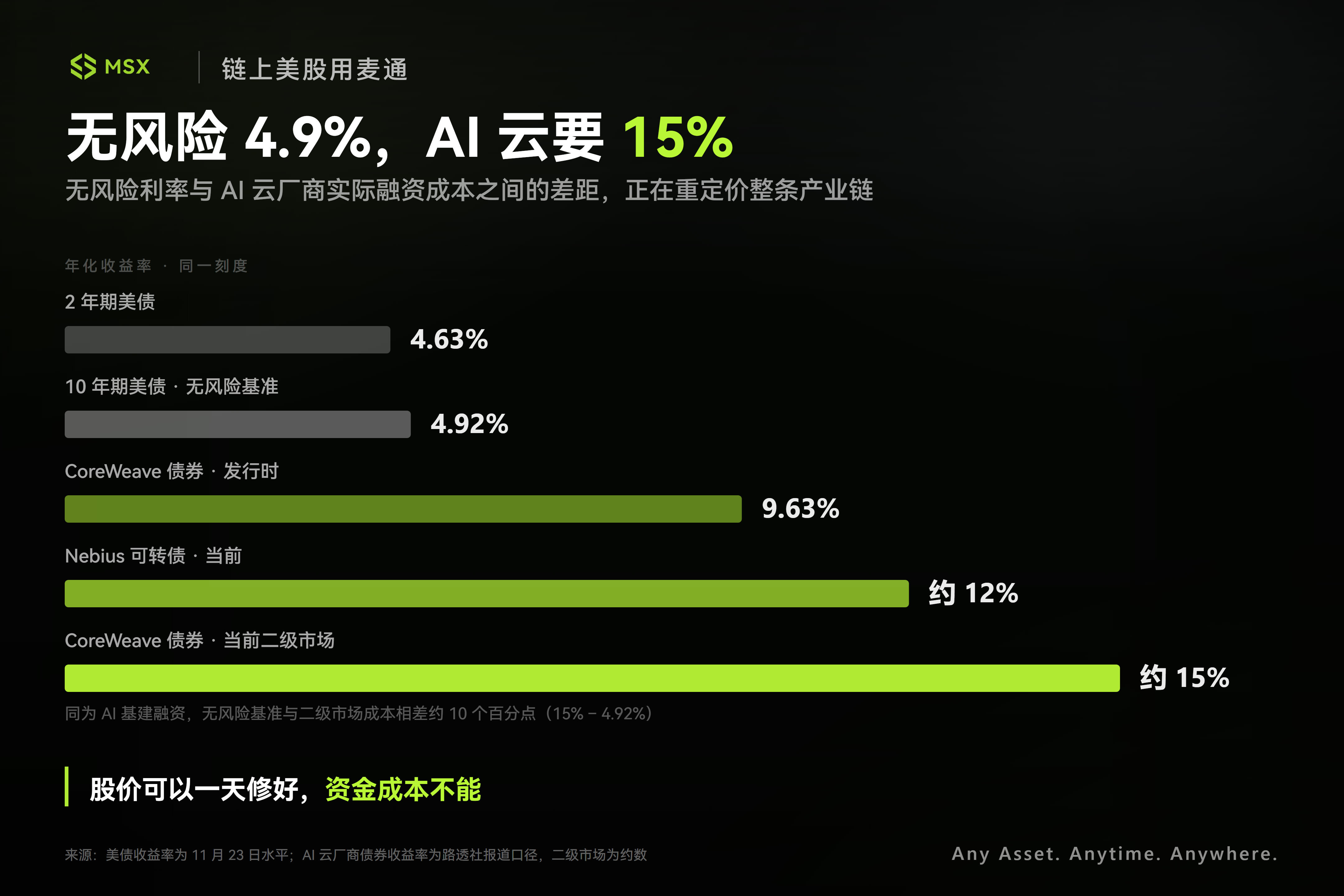
The AI capital expenditure boom and stubborn inflation reinforce each other, continuously limiting the Fed's room for easing. In particular, October CPI once again came in above market expectations, the 10-year Treasury yield briefly broke through 5.1% on November 13, and as of November 23 it was still at a high of 4.92%, while the 2-year yield also reached 4.63%.
What does this mean for the AI industry chain?
A persistently high risk-free rate will not only suppress the valuation center of high-valuation tech stocks, but also directly push up financing costs for AI infrastructure companies—especially those that need to issue bonds, take out loans, and raise external equity to build data centers and purchase GPUs. Every step up in capital costs forces the sustainability of their business models to be re-examined.
Reuters previously reported that a batch of CoreWeave bonds issued at a yield of 9.625% had seen secondary-market yields climb to nearly 15%; Nebius's convertible bonds once fell to about 70% of face value, with yields exceeding 12%.
At the same time, Nvidia's own accounts receivable also rose from about $38.5 billion at the end of fiscal 2026 to $81 billion at the end of the third quarter.
Huang can use his personal charisma to reassure engineers and stabilize TSMC, and even trigger a round of short covering in the short term, but he can neither sign an executive order to cool CPI nor directly lower financing costs across the entire AI industry chain.
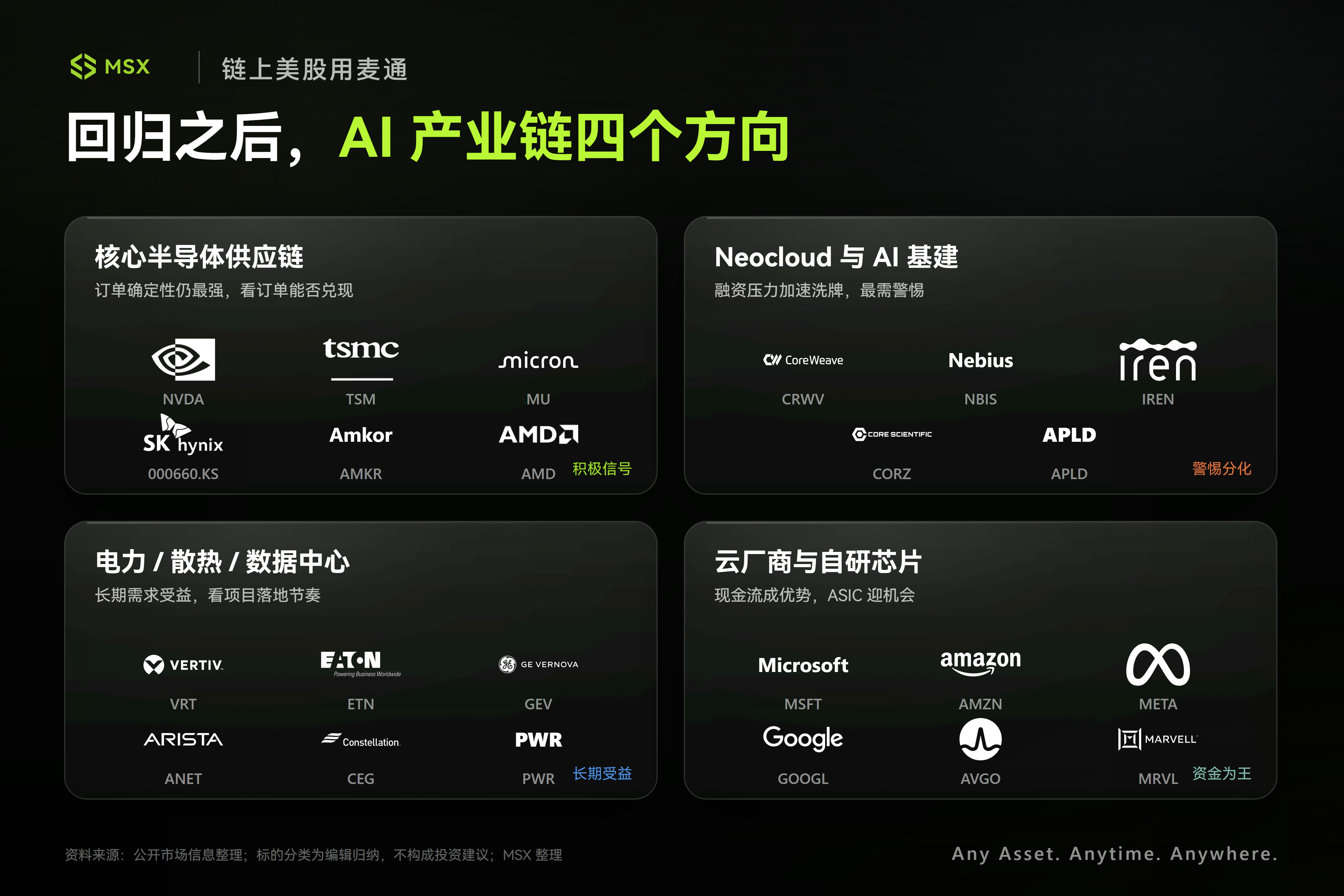
Following the logic above, future investment opportunities in the AI industry chain may show clear divergence, with four directions deserving particular attention:
Core Semiconductor Supply Chain: Order Certainty Remains Strongest
Representative names: NVIDIA (NVDA), TSMC (TSM), Micron (MU), SK Hynix (000660.KS), Amkor (AMKR), ASE Technology (ASX).
Huang's return has restored market confidence in Nvidia's product roadmap and supply chain coordination. For core suppliers with long-term orders, actual capacity, and delivery capability, this remains a positive signal.
But what needs attention is whether orders can truly convert into revenue and profit, rather than relying solely on AI capital expenditure expectations.
Neocloud and AI Infrastructure: Financing Pressure May Accelerate Industry Consolidation
Representative names: CoreWeave (CRWV), Nebius (NBIS), Applied Digital (APLD), IREN (IREN), Core Scientific (CORZ).
This is the group that warrants the most caution. They generally require large amounts of external funding to build data centers and purchase GPUs, and their business models are highly sensitive to financing costs and long-term customer contracts.
If Nvidia becomes more prudent about credit support and large procurement commitments in the future, and this is combined with a high-interest-rate environment, companies lacking stable customers and cash flow may face higher financing thresholds. Conversely, companies with long-term orders and reliable financing channels have the opportunity to further expand market share.
Power, Cooling, and Data Centers: Long-Term Demand Still Benefits
Representative names: Vertiv (VRT), Eaton (ETN), GE Vernova (GEV), Quanta Services (PWR), Arista Networks (ANET), Constellation Energy (CEG).
No matter how GPU suppliers change, AI data centers' demand for power, liquid cooling, power distribution, and high-speed networking will not disappear. These companies benefit from the long-term expansion of AI infrastructure, but in the short term they also need attention on the financing and construction progress of data center projects.
Compared with companies that rely solely on GPU orders, these infrastructure links have the opportunity to benefit from broader compute construction demand.
Large Cloud Providers and In-House Chips: Financial Strength May Become a Competitive Advantage
Representative names: Microsoft (MSFT), Amazon (AMZN), Alphabet (GOOGL), Meta (META), as well as Broadcom (AVGO) and Marvell (MRVL).
If high interest rates continue to suppress AI infrastructure financing, large cloud providers with ample cash flow and financing channels may gain stronger expansion capacity and bargaining advantages compared with Neoclouds that rely on external financing.
At the same time, cloud providers' requirements for compute costs and supply chain diversification may also further drive the development of ASICs and in-house chips, creating opportunities for companies such as Broadcom and Marvell.
Final Thoughts
So how should we understand this "Jensen Huang return"?
Without question, it allowed Nvidia to avoid the worst-case scenario of "no leader and a disordered supply chain," but it did not turn back the clock to before November 12.
Jensen Huang remains Nvidia's most irreplaceable strategic leader. His return helps reunite the management team, stabilize customer and supplier confidence, and re-establish certainty in the market about Nvidia's future product roadmap and industry chain coordination.
But at the same time, board oversight, national security and export control review, and a more institutionalized compliance system have already become part of Nvidia's next-stage governance structure. And he is equally unable to change the financing conditions of the entire AI industry chain.
Especially in the current market environment, the variables the AI sector truly needs to face still include inflation, interest rate expectations, long-end U.S. Treasury yields, and overall liquidity.
What Lao Huang and NVDA can do is take care of their own business; but there are some problems in the market that, ultimately, are not theirs to solve.