US Stocks Daily | S&P Sees Rare Six-Day Losing Streak; Anthropic's Mega IPO Debut Drags Down AI Trade (November 20)

This article is about 5924 words, reading the full article takes about 9 minutes
The Dow fell 1,101 points, losing the 50,000 level; the S&P dropped 2.02% for a six-day losing streak; the Nasdaq fell 2.25%, with the VIX at 28.44. Anthropic rose 17% on its first day but failed to reverse the AI selloff; AMD fell 7.72%, and Nvidia hit a 52-week low. The October minutes point to another rate hike in December, with the 10-year Treasury yield at 5.04%. Crypto-related US stocks came under pressure: MSTR fell 4.64%, with its market cap below the value of its holdings and mNAV dropping below 1. Watch Anthropic and ETF fund flows the next day.

AI Summary
- Key Takeaways: US stocks suffered an "AI trade reset"-style selloff, with the Dow losing the 50,000 level and the S&P posting a six-day losing streak; even Anthropic's record-breaking IPO failed to rescue the AI sector, as a hawkish rate pivot, tightening regulation, and pressure on the crypto treasury model created a resonance of multiple bearish factors.
- Key Elements:
- The Dow fell 2.19% to 49,097.06, the S&P dropped 2.02%, and the Nasdaq fell 2.25%, with the VIX surging 15.80% in a single day to 28.44.
- Anthropic's record-largest US IPO raised over $81 billion and rose 17.07% on its first day, but semiconductors and neoclouds continued to be sold off; Nvidia shed $669 billion in market cap over six days.
- AMD plunged 7.72% following a short-seller report, which alleged that over 20% of its revenue comes from China; House documents show the Commerce Department approved the sale of more than 879,000 AI chips to Chinese companies.
- The Fed's October minutes were hawkish, with the vast majority of participants seeing a need for further rate hikes, and AI viewed as a dual risk source for inflation and financial stability.
- MSTR fell 4.64% and was removed from the MSCI index, with mNAV dropping below 1; Bitcoin fell to $61,344, and spot ETFs saw nearly $2.9 billion in net outflows in November.
- Bitcoin has fallen 26.0% over the past month, and passage of the CLARITY Act within the year is essentially hopeless, with legislative stagnation intensifying market pressure.
1. Top Headlines
- Dow loses 50,000 mark, S&P falls for sixth straight session: The Dow dropped 1,101.11 points (-2.19%) to 49,097.06, closing below 50,000 for the first time since June; the S&P 500 fell 2.02% and the Nasdaq dropped 2.25%, while the VIX jumped 15.80% in a single day to 28.44. The core of the selloff is an "AI trade reset," not a single piece of bearish data.
- Anthropic's record IPO fails to rescue the AI sector: The largest U.S. IPO in history (raising over $81 billion) closed up 17.07% at $97.17 on its first day, yet the market read it as "AI is no longer a no-brainer buy," with neoclouds and semiconductors continuing to be sold off.
- AMD plunges 7.72% on short-seller report: Hunterbrook Media alleged that its firmware continues to flow to Chinese server maker IEIT Systems, which is on the U.S. entity list, and that China (including Hong Kong) accounts for over 20% of its revenue; AMD denied the claims and said it is compliant. Separately, House documents showed a Commerce Department sub-agency approved the sale of over 879,000 AI chips to Chinese firms.
- Fed October minutes lean hawkish: The vast majority of participants believed "further rate hikes may be appropriate," with AI seen as a dual risk to inflation and financial stability; Governor Waller reiterated that a 50-basis-point move could be considered in December.
- Crypto treasury model under pressure: MSTR fell 4.64%, hit by its removal from MSCI indexes and mNAV dropping below 1; Bitcoin fell to $61,344, with spot ETFs seeing nearly $2.9 billion in net outflows in November.
2. U.S. Stock Market and Macro
2.1 The Three Major Indexes (Nov 19 Close, U.S. Eastern Time)

- The S&P 500 fell for a sixth consecutive session, its longest losing streak since June; the Dow closed below 50,000 for the first time since June.
- By structure: semiconductors, neoclouds, and hyperscalers all weakened across the board, while cybersecurity bucked the trend (see Section 3 for details).
2.2 Drivers
- The AI capex narrative is loosening: Nvidia's first earnings report after its "CEO transition" (Q3 revenue of $115.8 billion, doubling year-over-year) beat expectations, yet the stock still hit a new low, shedding $669 billion in market value over six trading days; CoreWeave is down 76% from its record high.
- Rate and policy uncertainty: The October FOMC meeting voted 10-2 to hold the federal funds rate at 3.75%–4.00%, with Cook and Hammack dissenting in favor of a 25bp hike; the minutes showed "almost all participants" saw the need for further hikes, with "some" officials favoring a hike at this meeting and a minority seeing a possibly larger move in December.
- Sticky inflation: October CPI rose 0.4% month-over-month (expected +0.3%), with core up 0.3%; October PPI rose 6.5% year-over-year, the highest in nearly four years.
- Other data this week: October retail sales rose 0.2% month-over-month (expected +0.1%), with core retail up 0.6% (expected +0.4%); industrial production fell 0.4% (expected 0.0%), with capacity utilization at 76.4%.
2.3 Rates, the Dollar, and Commodities
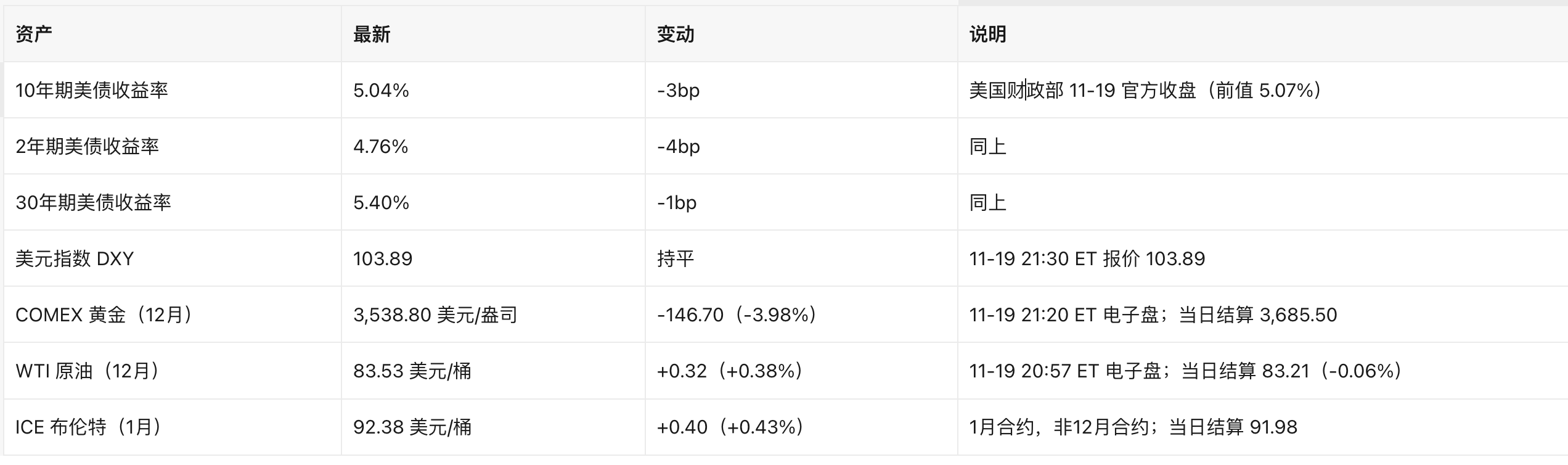
- Gold: After hitting an all-time high of $5,589.38/oz on January 28, it has since retraced more than a third; the main driver of this pullback is rising real rates and a stronger dollar raising holding costs, with gold instead being sold as a "source of liquidity" in wartime conditions.
- Crude oil: Restored Middle East exports combined with Trump-Xi-Putin trilateral statements on plans to raise output suppressed the risk premium; WTI settled at $83.21, down 19.4% from its October 22 high of $103.27.
3. Hot Stocks and Sectors
3.1 Anthropic (ANT) | Closed at $97.17, +17.07%
- Listed on Nasdaq in the largest U.S. IPO in history, raising over $81 billion; closed up 17.07% on its first day.
- Why it matters: The market had expected this to be a "clearing event for the AI trade," yet the index kept falling — showing that valuation/competition (the price war with OpenAI) dominates pricing more than whether there is a new leader. Niles Investment data: combined OpenAI + Anthropic revenue growth slowed from 75% in Q2 to 48% in Q3, with combined losses widening from $7.9 billion to $8.4 billion.
- Options begin trading Monday (11/23), seen by traders as the real test of retail confidence.
3.2 AMD | Closed at $489.19, -7.72%
- Hunterbrook Media disclosed a short position and published a report alleging that AMD firmware continues to flow to Chinese server maker IEIT Systems and related entities, which are on the U.S. entity list, and that China (including Hong Kong) customers account for over 20% of its revenue, with most chips relying on Chinese partners for packaging and testing.
- AMD responded: "The allegations mischaracterize AMD's business practices and relationships; the company complies with U.S. export control regulations."
- Transmission: If export controls tighten further, AMD's Asia growth logic as an "Nvidia alternative" would be undermined; on the same day, House Foreign Affairs Committee documents showed a Commerce Department sub-agency approved the sale of over 879,000 AI chips to Chinese firms, with policy risk spreading from individual stocks to the entire supply chain.
3.3 Nvidia (NVDA) | Closed at $145.98, -3.30%
- Hit an intraday low of $145.71, a 52-week low; shed $669 billion in market value over six trading days.
- Q3 revenue of $115.8 billion, doubling year-over-year, but the "Jensen Huang not returning as CEO" transition and compliance probes (the California Attorney General issued a subpoena over chip flows to China; Moody's cut its outlook) overshadowed the results.
- Transmission: Nvidia is the anchor of the "buy the dip" strategy, and its continued breakdown has weakened dip-buying confidence across the entire AI sector.
3.4 PDD Holdings | Closed at $86.00, +11.04%
- Q3 profit beat expectations with marketing expenses declining; however, revenue stagnated and transaction services revenue reversed markedly, with Temu facing new regulatory scrutiny in Europe.
- A rare strong performer in a weak market, reflecting capital seeking "low valuation + cash flow" safe havens outside of AI.
3.5 Cybersecurity sector: Palo Alto (PANW) +6.42%, CrowdStrike gains
- PANW closed at $361.73, with Q1 (fiscal year) results beating expectations, guidance raised, and the announcement of a $4.5 billion acquisition of Applied Compute, betting on "protecting open-weight models."
- Transmission: More AI vulnerabilities exposed → rigid security budgets → the sector gains relative returns in a valuation-compression environment.
3.6 After-Hours / Other Notable Moves
- Intuit (INTU): Closed at $310.02 (-1.03%), fell 9.95% after hours (as of 21:00 U.S. Eastern Time). Announced the sale of Mailchimp to Bending Spoons for $3.7 billion, which Reuters said is one-third of its 2021 purchase price, and cut guidance.
- Walmart (WMT): Closed at $126.04 (-1.04%), beat Q3 expectations and raised full-year guidance for the third time this year, but failed to hold its gains amid the systemic selloff.
- CoreWeave (CRWV): Closed at $44.91 (-6.11%), extended losses after hours, with the neocloud high-leverage financing model continuing to be repriced.
4. Crypto-Related U.S. Stocks
4.1 Key DAT (Digital Asset Treasury) Developments
Strategy (MSTR) | Closed at $86.13, -4.64%
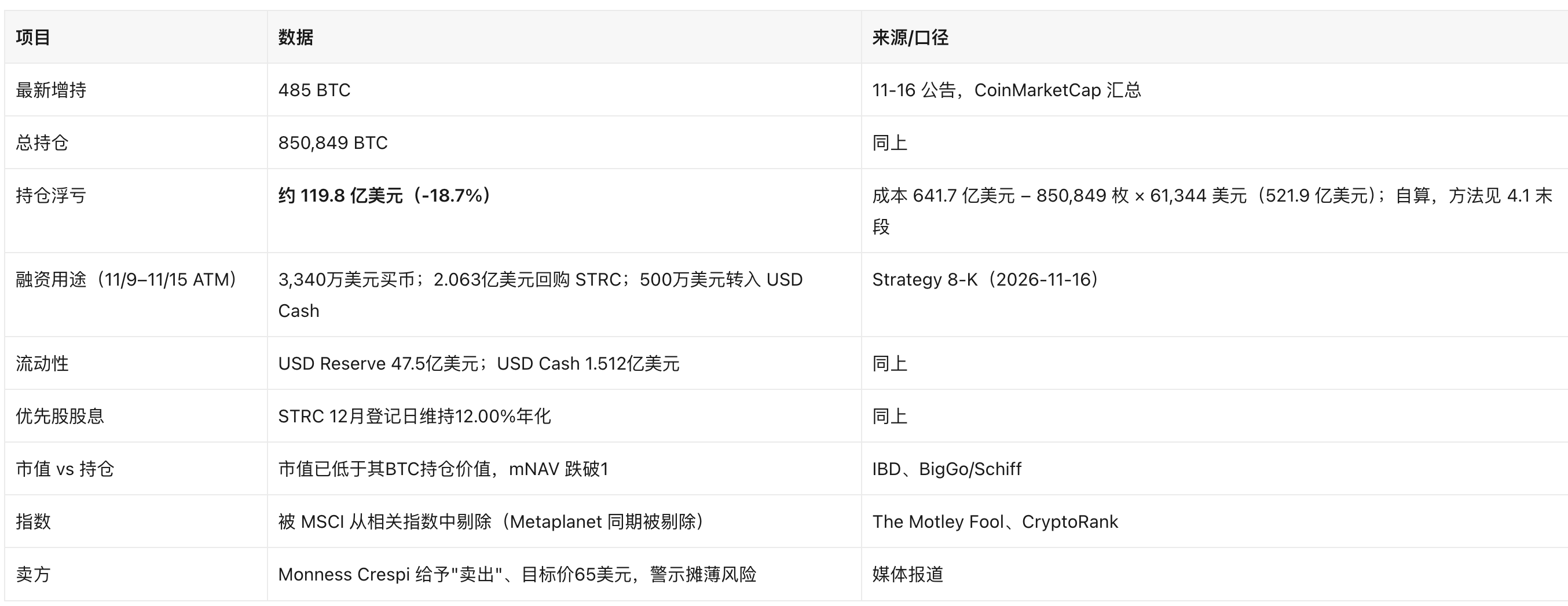
- Signal significance: Strategy has shifted from "issuing shares at a premium to buy coins" to "issuing shares to repurchase its own preferred stock," i.e., using equity financing to repair its capital structure rather than expand holdings; mNAV falling below 1 means continued issuance to buy coins would directly dilute BTC per share. Its 52-week range is $203.95 / $81.81, with the current price down 57.8% from its 52-week high.
- mNAV estimate (not company-disclosed): Backing out from Nasdaq's latest market cap implies about 396 million shares, with $86.13 corresponding to a common equity market cap of about $34.1 billion; 34.1 ÷ 521.9 (market value of coin holdings) = about 0.65x, a discount of about 35%. This measure does not account for debt, preferred stock, or cash, and is not equivalent to a full EV/NAV; it is used only to illustrate the direction of the discount.
Other DAT / Holding Companies
- Bitmine Immersion (BMNR) | $15.07, -2.59%: Holds 5.93 million ETH, with crypto assets + cash totaling $15.7 billion; disclosed $6.3 billion in ETH-related losses this quarter, with ETH's decline directly eroding net asset value.
- Strive (ASST) | $16.61, -3.15%: Bought another 251 BTC on 11-17; Morgan Stanley increased its stake (Crypto Briefing cited a corresponding $32 million Bitcoin exposure).
- Trump Media (DJT) | $4.09, +0.99%: $884 million in debt matures on November 30; the company said it will prioritize drawing on its credit facility and will not sell Bitcoin; it has repurchased $100 million in note principal.
- Avalanche Treasury Corp (AVAT): Disclosed on 11-19 the signing of a master agreement with Galaxy Digital for a "digital currency collar loan," paving the way for future crypto-collateralized financing — DAT financing tools continue to innovate.
- Digi Power X: Added 42 BTC, bringing total holdings to 259 BTC.
4.2 Crypto U.S. Stocks Watchlist Additions
- No new names found this trading day: A full-text search of SEC EDGAR was conducted (2026-11-18 to 11-19, Form 8-K, keywords bitcoin / digital asset treasury / ether), and no new announcements of U.S. companies for the first time disclosing the addition of BTC/ETH to reserves or renaming/transitioning to a DAT appeared.
- The watchlist remains: MSTR, BMNR, ASST, SBET, DFDV, AVAT, DJT, BTBT, HUT, GLXY. Changes to the list are based on accumulation/financing/debt events; see 4.1 for details.
4.3 Broad Crypto U.S. Stocks (Nov 19 Close, U.S. Eastern Time)
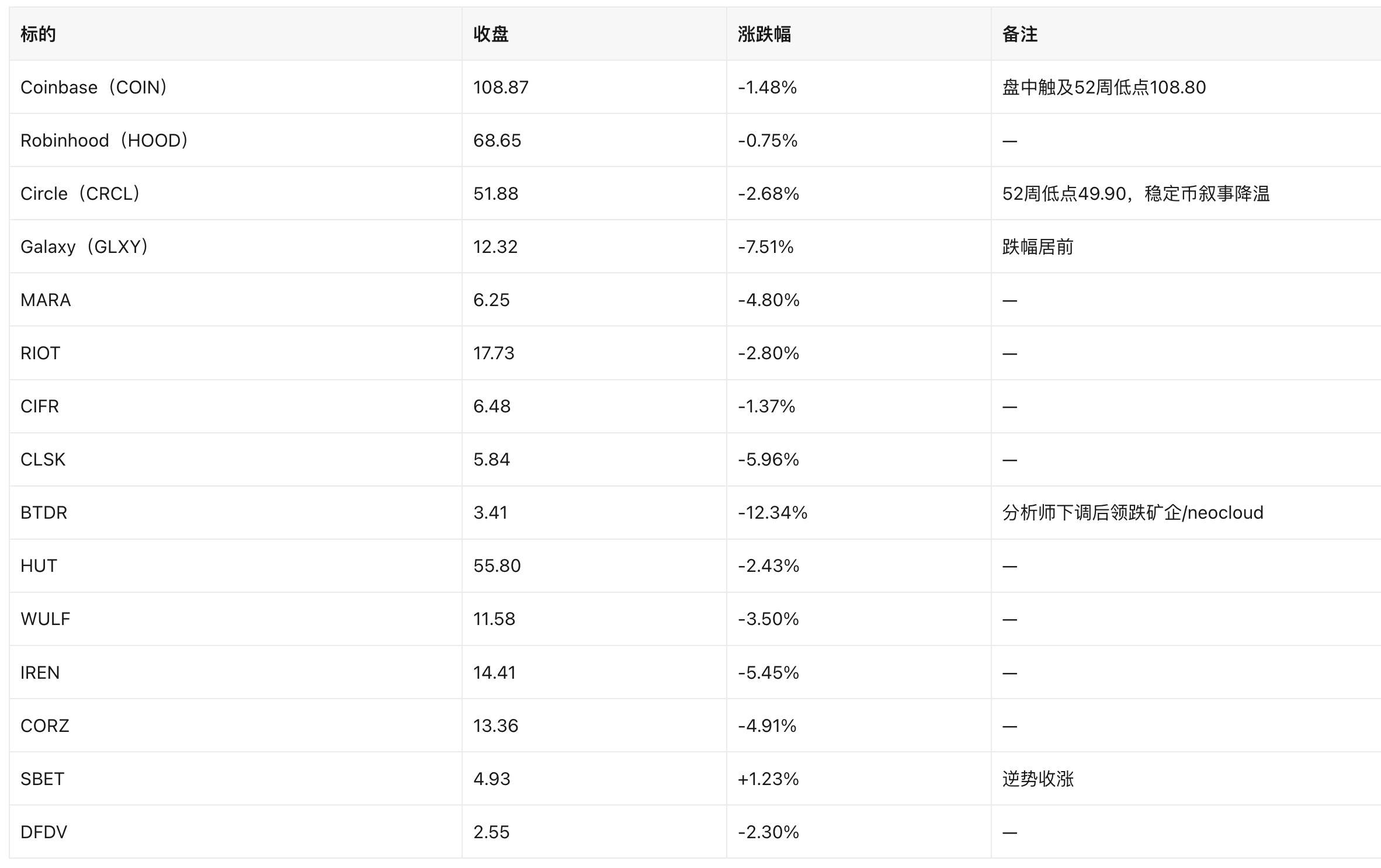
Spot ETFs (price, Nov 19 close, U.S. Eastern Time): IBIT 35.08 (-0.79%), FBTC 53.90 (-0.83%), ETHA 39.74 (+0.40%).
ETF Fund Flows (as of 11-18; flow data lags by one trading day)
- November 18: The 12 U.S. spot Bitcoin ETFs saw a combined net outflow of $306 million, with all 12 recording outflows.
- Cumulative net outflow of $2.89 billion in November; over $2.5 billion in cumulative redemptions year-to-date in 2026.
- November 17 saw a single-day net outflow of $240 million, led by IBIT.
4.4 Regulatory and Accounting Drivers
- Legislation: After Democrats won the House (Jeffries secured the Speaker nomination), passage of the CLARITY Act this year is essentially hopeless, with multiple lawmakers expecting a delay to 2027; Warren is expected to become chair of the Senate Banking Committee, and the industry fears the regulatory path will be rewritten.
- Regulatory appointments: Trump's nominee for the Democratic SEC commissioner slot said tokenization policy "should go through the full rulemaking process," suggesting no aggressive guidance in the near term.
- Indexes and passive flows: MSCI removed Strategy (and Metaplanet) from relevant indexes, creating passive selling pressure on the DAT sector — one of the direct drivers of the widening mNAV discount this round.
- Financing environment: Rising rates → higher preferred stock/convertible bond costs → DAT shifting from "equity premium arbitrage" to "balance sheet defense" (repurchasing preferred stock, controlling issuance), a new feature of the crypto U.S. stock and coin price linkage this round.
5. Crypto Market

- Bitcoin fell 26.0% over the past month (from $82,941.00 on October 20 to $61,343.86 on November 19), and is down 20.8% since November began; interpretation: the Fed turning to rate hikes, continued ETF net outflows, and legislative stagnation ("the midterm landslide instead stalled crypto legislation").
- ETH fell even more, with leveraged ETH treasury companies (BMNR) acting as risk amplifiers.
- Exchange/industry consolidation: Kraken's parent company acquired Tribe Capital; the California Attorney General fined CoinFlip $5 million (Bitcoin ATM compliance).
6. Geopolitical Impact
6.1 Strait of Hormuz and the U.S.-Iran Conflict (Escalating)
- Iran continues to attack ships in the strait and has expanded its strike range to U.S. military bases in Kuwait and targets inside Bahrain; Bloomberg said the risk of U.S. military action against Iran is rising, with negotiations stalled; Iran said an agreement is "close" but it will not unilaterally open the waterway.
- Transmission path: Conflict escalation → crude oil risk premium → but currently offset by "restored Middle East exports + oil producer output increase statements," with oil prices instead weakening → energy stocks diverging (XOM -1.03%, CVX +0.30%) → inflation expectations staying elevated → reinforcing the Fed's hiking path → suppressing growth stocks and crypto asset valuations.
6.2 U.S.-China-Russia Trilateral and Trade/Tech Controls
- Trump, Xi Jinping, and Putin held trilateral talks in Shenzhen, stating plans to increase oil production and reform the United Nations; the Ukraine war was the core agenda item.
- Chip controls on China became one of the market's main threads: the California Attorney General issued a subpoena to Nvidia investigating chip flows to China; House documents showed the Commerce Department approved the sale of over 879,000 AI chips to Chinese firms; Treasury Secretary Bessent publicly criticized Commerce Secretary Lutnick for inadequate oversight of "chip outflows."
- Transmission: Tightening controls → downward revision of Asian AI chip demand expectations → semiconductor valuations under pressure (SOX -2.42%) → Asian tech stocks catching down (SoftBank fell over 16% during the Asian session).
6.3 Other
- Denmark's parliament approved a Greenland security agreement with the U
US stocks
Welcome to Join Odaily Official Community


Recommended Articles