Anthropic IPO: Same Offering Price, Yet Retail Investors End Up Paying More Per Share?


- Key Takeaways: Anthropic is about to go public at a valuation of approximately $1 trillion, becoming the first frontier AI lab to IPO. But its IPO structure allows ordinary investors to buy in at the same price as strategic suppliers while receiving fewer rights, and exposes them to tail risks along the AI circular financing chain.
- Key Details:
- The offering price range is $70 to $78 per share, with 825 million shares offered publicly to raise up to approximately $64.4 billion, plus $26 billion in private placement to seven strategic investors, for a total of up to approximately $90.4 billion.
- The seven buyers are AMD, Broadcom, Google, Micron, Microsoft, Nvidia, and TSMC, all of which are Anthropic's compute or chip suppliers; the Class N shares they purchased carry no voting rights, are subject to resale restrictions, are exempt from underwriting fees, and are price-insensitive.
- Strategic placement accounts for approximately 28.8% of the entire funding round, meaning nearly 30% of the capital comes from buyers who do not care about price, weakening the issuer's pressure to price at the upper end and reducing the tradable float.
- About 20% of the offering is allocated to retail investors, and most ordinary investors can only buy in the secondary market after listing, with their actual cost including the first-day gain.
- Circular financing structures are widespread: Microsoft, Nvidia, Amazon, AMD, and others all bind AI customers through an "investment-for-orders" approach, creating a closed funding loop.
- Common shareholders' rights rank behind the company's contractual obligations; if compute procurement commitments exceed its ability to pay, retail investors bear the brunt, and they do not participate in compute contract negotiations.
Original | Odaily (@OdailyChina)
Author | jk
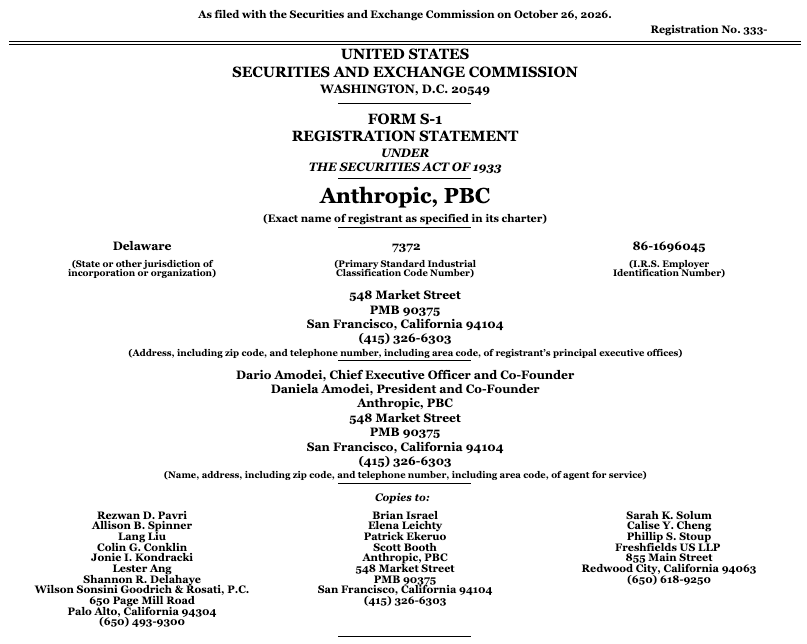
Anthropic, the developer of Claude, is about to complete its initial public offering. The price range of $70 to $78 per share corresponds to a base market valuation of roughly $1 trillion, and up to approximately $1.4 trillion on a fully diluted basis. It is expected to price on November 18, and list on Nasdaq the following day under the ticker ANT. This will be the first frontier AI lab to go public. According to Bloomberg, the public offering and private placement combined will raise up to $90.4 billion. The market had previously floated a valuation of $2 trillion.
But beyond the buzz, there is one detail that is easy to overlook:
Anthropic's offering price range is $70 to $78 per share. The public offering portion consists of 825 million shares, raising up to approximately $64.4 billion; another $26 billion will be sold to seven strategic investors through a private placement, bringing the two together to a maximum of about $90.4 billion.
The seven are AMD, Broadcom, Google, Micron, Microsoft, Nvidia, and TSMC; the price they pay is the same as the IPO offering price.
In Anthropic's IPO, Google and you pay the same price—but what it gets is stock plus a compute order, while what you get is only stock.
Ordinary investors pay the same price as these companies but receive fewer rights; and the circular financing structure of the AI industry may transfer part of the risk to investors in the public market. In this deal, those eager to jump into the IPO are the party with the weakest bargaining power and the least additional value. Will they lose money?
The $26 Billion "Special Seat"
This $26 billion is not an ordinary placement; its terms are more favorable to both Anthropic and the seven buyers.
All seven buyers are Anthropic's compute and chip suppliers. Based on the midpoint price, Google and Nvidia each account for roughly $10 billion, AMD about $2.5 billion, Broadcom, Micron, and Microsoft about $1 billion each, and TSMC about $500 million. What they bought is Class N common stock, at a price equal to the IPO offering price.
This deal has four characteristics:
- No underwriting fees: The prospectus explicitly states that underwriters will not receive discounts or commissions on the private placement. Based on a typical industry fee of about 1%, the $26 billion corresponds to roughly $260 million in saved fees.
- No voting rights: Class N shares carry zero votes per share, while the publicly offered Class A shares carry one vote per share.
- Resale restrictions: These shares are unregistered and are in practice difficult to sell on the exchange immediately. The specific lock-up period is subject to the prospectus, while Decrypt notes that these shares are not subject to the usual post-listing lock-up period.
- Price-insensitive: They have committed to buy at the final offering price, regardless of what the IPO price is.
Based on the maximum fundraising amount of $90.4 billion, this placement accounts for 28.8% of the entire round. In other words, nearly 30% of the funds come from a group of buyers who do not need to care about price.
Google's Dollar, and Your Dollar
For the same dollar, Google buys one more thing than you do: in addition to Anthropic stock, it also gets business revenue.
According to the original commentary article, Anthropic has agreed to pay Google approximately $250 billion in compute fees over the next seven years. Anthropic does not currently have that money, nor is it an investment-grade credit; but the more capital it holds, the more likely it will eventually be able to pay. So part of the money Google puts in will flow back to Google in the form of revenue.
This also means that a share of Anthropic stock is worth more to Google than to you. In theory, Google would be willing to pay a higher price, and Anthropic would be willing to give Google a lower price, because the two parties can share the additional value created. But in reality, Google and ordinary investors pay the same offering price.
Both strategic investors and ordinary IPO investors buy at the IPO offering price, though those who buy after the market opens pay a higher price. Strategic investors receive non-voting Class N shares, while ordinary investors receive Class A shares with one vote per share. The strategic investors' shares are in practice subject to resale restrictions, while ordinary investors can trade immediately after listing. Strategic investors have committed to buy at the offering price and are less price-sensitive; ordinary investors are highly price-sensitive and can choose not to buy.
The two sides are completely identical in terms of the stock itself; the difference lies "beyond the stock." The same price, but different things bundled in—this is "same price, different value."
This issue was raised back in 2024: VC Apoorv Agrawal asked, when Microsoft, Amazon, Alphabet, and Nvidia set the price of a financing round themselves, and pure financial investors enter at the same valuation, aren't they effectively overpaying? By the 2026 IPO, this question has shifted from VC institutions to ordinary investors.
What Price-Insensitive Buyers Are Propping Up
Strategic investors will not directly push up the offering price, but their presence changes the deal you face in three ways. The IPO price is determined by book-building demand in the public market. Companies like Google are price takers, not price setters, so "Google is willing to pay more, so you have to pay more" does not fully hold.
Source: Anthropic
The following three things are still unfavorable to public market buyers:
- Anthropic has more confidence in pricing, Nearly 30% of the fundraising amount already has committed buyers, so the issuer and underwriters face less pressure to price at the upper end of the range; the higher the valuation, the higher the bubble that IPO retail buyers face.
- Less tradable supply, The $26 billion in placement will not enter the public market immediately. The smaller the float, the easier it is to push up the opening price once demand is strong. So from this angle, retail investors may end up buying at a higher price.
- Limited opportunity to buy at the offering price, According to CNBC, about 20% of the allocation is for retail investors. Those who cannot get an allocation can only buy in the secondary market after listing, which is already a price that includes the first-day gain.
Institutions find it easier to get the offering price, while ordinary investors often have to enter after the market opens. This is the first layer of "same financing round, different actual cost."
The AI Industry's "Circular Financing"
Anthropic is not an isolated case; the structure in which suppliers invest in customers and customers then spend the money back on suppliers has appeared repeatedly in the AI industry.
- Microsoft, Nvidia, and Anthropic: According to Business Insider, Anthropic plans to spend $30 billion on compute fees on Microsoft Azure, with Nvidia investing up to $10 billion and Microsoft up to $5 billion.
- Amazon and Anthropic: According to a Penchan roundup, Amazon has invested about $8 billion and will invest another $5 billion in 2026, while Anthropic has committed to spending more than $100 billion on AWS over ten years.
- AMD and OpenAI: AMD granted OpenAI warrants for up to 160 million shares, unlocked in tranches as OpenAI deploys 6GW of AMD chips—essentially "stock for orders."
- Nvidia and OpenAI: According to Global Finance, the original plan was for Nvidia to invest $100 billion over ten years while OpenAI procures 10GW of infrastructure; Nvidia has already put $30 billion into OpenAI's latest funding round.
The common feature of such structures is that the investor is both shareholder and supplier, forming a closed loop of capital. Risk also propagates along the loop: in early 2026, reports said Nvidia's $100 billion investment plan for OpenAI had stalled, and Oracle's stock fluctuated as a result, because once Nvidia's funding wavered, OpenAI's ability to pay Oracle would also be affected.
In the past, these loops were largely completed at the private level. As the first frontier lab to go public, Anthropic for the first time gives ordinary investors a chance to directly hold a link in this chain.
In Circular Financing, Who Bears the Tail Risk
Circular financing makes the distribution of risk asymmetric: the benefiting party is both shareholder and supplier, while public market investors bear the residual risk.
The chain roughly goes like this: suppliers spend money buying Anthropic stock, Anthropic uses the money to purchase compute, and the compute payments flow back into these suppliers' revenue. Public market investors' money enters the same pool.
Three layers of risk will fall on you:
Common shareholders' rights rank behind all of the company's contractual obligations. If the roughly $250 billion commitment to Google ultimately exceeds Anthropic's ability to pay, shareholders are affected first, including retail investors, not suppliers.
At the same time, if the roughly $64.4 billion raised in the public offering is also mainly used for compute procurement, then a considerable portion of it ultimately flows to exactly those suppliers who also hold Anthropic stock, returning to the point we discussed above: "retail investors are overpaying."
On conflicts of interest, strategic investors receive zero-voting Class N shares precisely to isolate the divergence between their commercial interests and the interests of all shareholders. But what is isolated is only voting rights; the terms of the compute contracts are negotiated between the company and the suppliers, and public market investors are not at the negotiating table.
Once the offering price is set, what is more worth asking about is what lies beyond the price. Ordinary investors pay the same price as Google but receive fewer rights; if they buy only after the market opens, they pay an extra layer for the first-day gain; and in the circular financing chain, their position is the furthest back. If Anthropic can grow revenue and profit, today's price may well prove reasonable, and the strategic investors' extra returns will not be taken directly out of public market investors' pockets. But before Thursday, we can only wait and see.