


Shares surge 8% after earnings—can CoreWeave escape Musk's doomsday prophecy?


- Core Viewpoint: CoreWeave's Q3 earnings rebut the "idle compute" narrative with strong figures—revenue up 168% and backlog reaching $132.5 billion—but $46.8 billion in debt and $846 million in quarterly interest expense still pose a severe test, with risks of the high-leverage model unresolved.
- Key Elements:
- Q3 revenue of $3.661 billion, up 168% year-over-year; adjusted EBITDA margin of 62%; operating margin rose to 10%, hitting the double-digit target one quarter early.
- Revenue backlog reached a record $132.5 billion, up more than $28 billion quarter-over-quarter; available capacity through 2028 is sold out, and product prices have been raised cumulatively by about 35% this year.
- Total debt soared to $46.873 billion, with broad debt including lease liabilities at approximately $66.2 billion; Q3 free cash flow was negative $7.466 billion.
- Quarterly net interest expense of $846 million far exceeded operating profit, resulting in a GAAP net loss of $709 million; Q4 interest expense is expected to rise to $1.05–1.15 billion.
- Response strategies include: customer prepayments (projected $9 billion), asset-level secured loans (DDTL at 7%–7.5% interest), and the expiration of roughly 300,000 "zero-debt" older GPU contracts in 2027–2028 that will release incremental revenue.
- Analysts estimate 2027 capital expenditure at $66 billion, with a financing gap of at least $25 billion remaining; active power capacity is 1.7 GW but the activation ratio is only 37%.
Original | Odaily (@OdailyChina)
Author | Azuma (@azuma_eth)

Half a month ago, Elon Musk and Silicon Valley venture capitalist Chamath Palihapitiya joined forces on X to hand down a "death sentence" to more than 200 emerging compute cloud providers (Neoclouds) worldwide — from predicting that a large number of GPUs would become "Stranded Compute" in unfinished construction sites, to disclosing that "the door to the debt market has been completely shut," asserting that the neocloud sector is about to witness a "mass extinction and consolidation."
- Odaily note: For details, please refer to "Badmouthing Neoclouds: Musk's Master Plan."
While Musk was launching his fierce offensive, CoreWeave (NASDAQ: CRWV), the AI neocloud leader at the very center of the storm, was also experiencing a brutal "dual sell-off in stocks and bonds" — its share price plunged over 40% in the past month, the yield on its 9.75% coupon bonds maturing in 2031 once spiked to 16.7%, a level signaling a junk bond crisis, and its five-year credit default swap (CDS) spread also once exceeded 1,200 basis points.
The entire Wall Street is holding its breath, waiting to see whether the high-leverage flywheel of neoclouds "borrowing money to buy chips" is truly about to stop turning.
After the market close on November 10, US Eastern Time (early morning Beijing time on the 11th), CoreWeave delivered its Q3 2026 financial report, which could be described as a "life-or-death exam" for the entire neocloud sector. Once the results landed, the market gave a highly dramatic response — CoreWeave's after-hours share price surged 7.9% to $52.58.
Facing the siege from short sellers, what kind of report card did CoreWeave deliver? And how is it attempting to defuse its current debt pressure?
A Direct Counterattack Against the "Idle Compute" Narrative
Before the earnings release, one of the short sellers' core narratives was that — with infrastructure delays and cautious spending by big tech — GPUs bought at sky-high prices would gather dust in warehouses or be relegated to low-margin grunt work. But CoreWeave's Q3 report directly responded to doubts about "slowing demand" with a set of explosive growth figures.
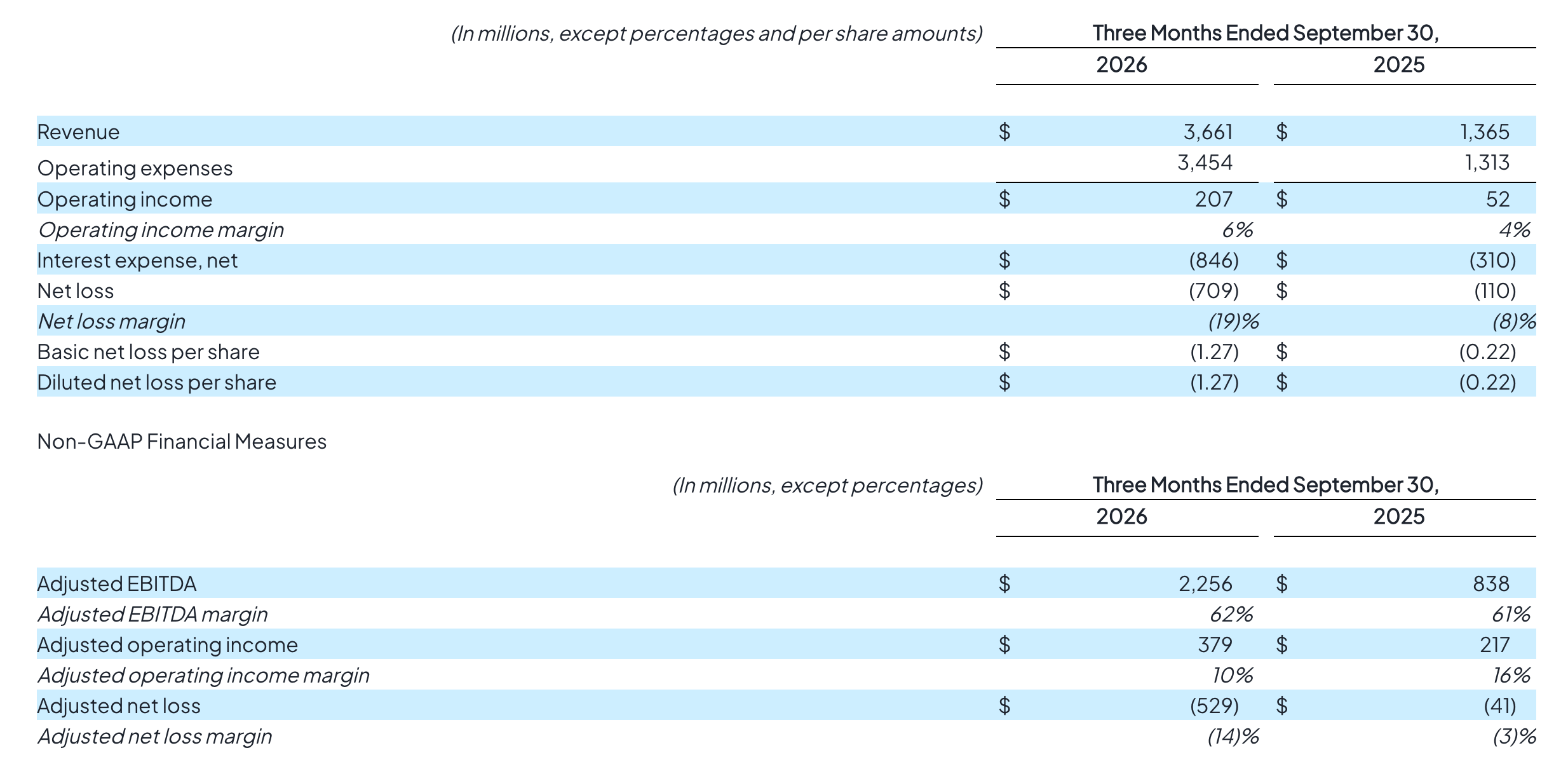
In Q3, CoreWeave beat market expectations on both revenue and profit margin — total revenue was $3.661 billion, up a staggering 168% year-over-year and 42% quarter-over-quarter, with quarterly net new revenue exceeding $1 billion for the first time. This not only surpassed the Wall Street consensus of $3.55–3.56 billion, but also exceeded the upper end of the company's own guidance ($3.6 billion); non-GAAP adjusted EBITDA reached $2.256 billion, with a margin as high as 62%, above the market expectation of 57.6%; adjusted operating income reached $379 million, far exceeding the prior guidance of $200–260 million; and the adjusted operating margin jumped from 1% in Q1 and 5% in Q2 to 10%, achieving the double-digit margin target a quarter early.
On the backlog front, as of September 30, CoreWeave's Revenue Backlog from unfulfilled contracts reached a record $132.5 billion, surging more than $28 billion in a single quarter from $104.2 billion at the end of Q2, and up 138% year-over-year. About 36% of this is expected to convert into actual revenue within the next 24 months.
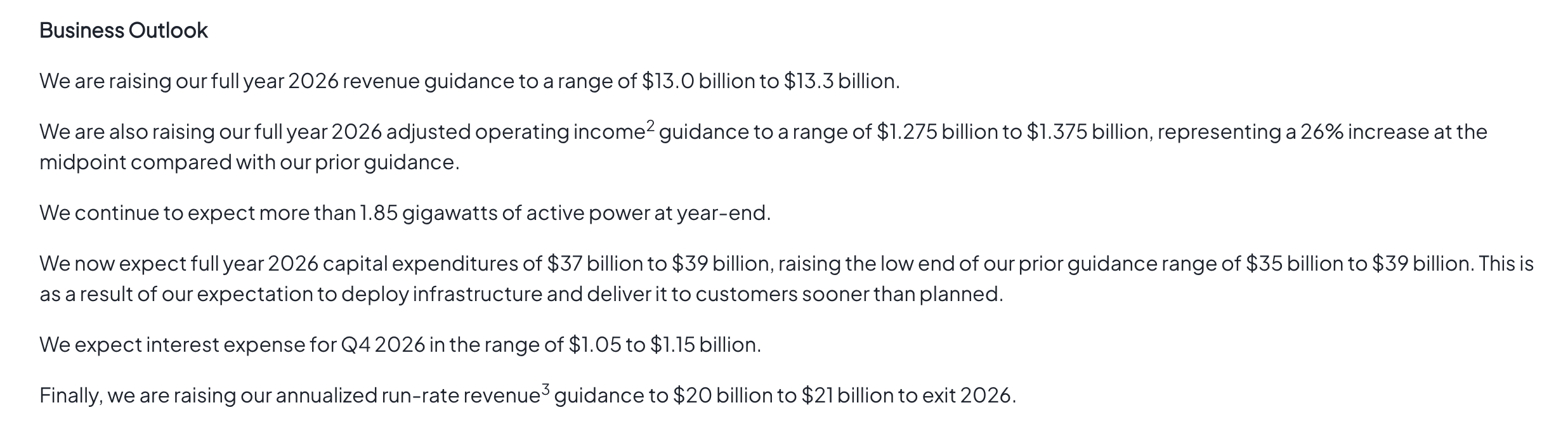
In the earnings report, CoreWeave raised its full-year 2026 revenue guidance from $12.4–13.2 billion to $13.0–13.3 billion; raised its full-year adjusted operating income guidance to $1.275–1.375 billion (a 26% increase at the midpoint from before); and raised its end-of-2026 annualized revenue run-rate (ARR) target to $20–21 billion.
Beyond the explosive financial figures, management also demonstrated a hardline seller's-market stance on the earnings call. CoreWeave CEO Michael Intrator said on the call: "Our available capacity for 2028 is sold out. Although we haven't brought all of our 2028 capacity to market yet, every bit that we have brought to market has been snapped up."
The supply-demand structure has also given CoreWeave the confidence to raise prices against the tide — in July this year, CoreWeave raised prices across all product SKUs by about 25%, then added another 10% increase at the end of Q3, with prices still climbing in Q4. CoreWeave CFO Nitin Agrawal disclosed that pricing for 4–5 year long-term contracts has now risen to $20–25 million per megawatt, while short-term contract prices are as high as over $40 million per megawatt per year.
As for the "old GPU depreciation" issue that short sellers had attacked, there has also been a reversal. Intrator disclosed that due to the compute shortage, renewal prices for previous-generation Hopper architecture chips also rose 30% to 50% quarter-over-quarter in Q3, even higher than their initial launch prices when contracts were first signed.
Debt Pressure Remains Enormous
Despite the business side's rapid advance, if one opens the unvarnished balance sheet and cash flow statement, it becomes clear that the short sellers' sniping was not groundless — in the face of the asset-heavy black hole of "borrowing money to buy chips," the debt pressure facing CoreWeave remains suffocating.
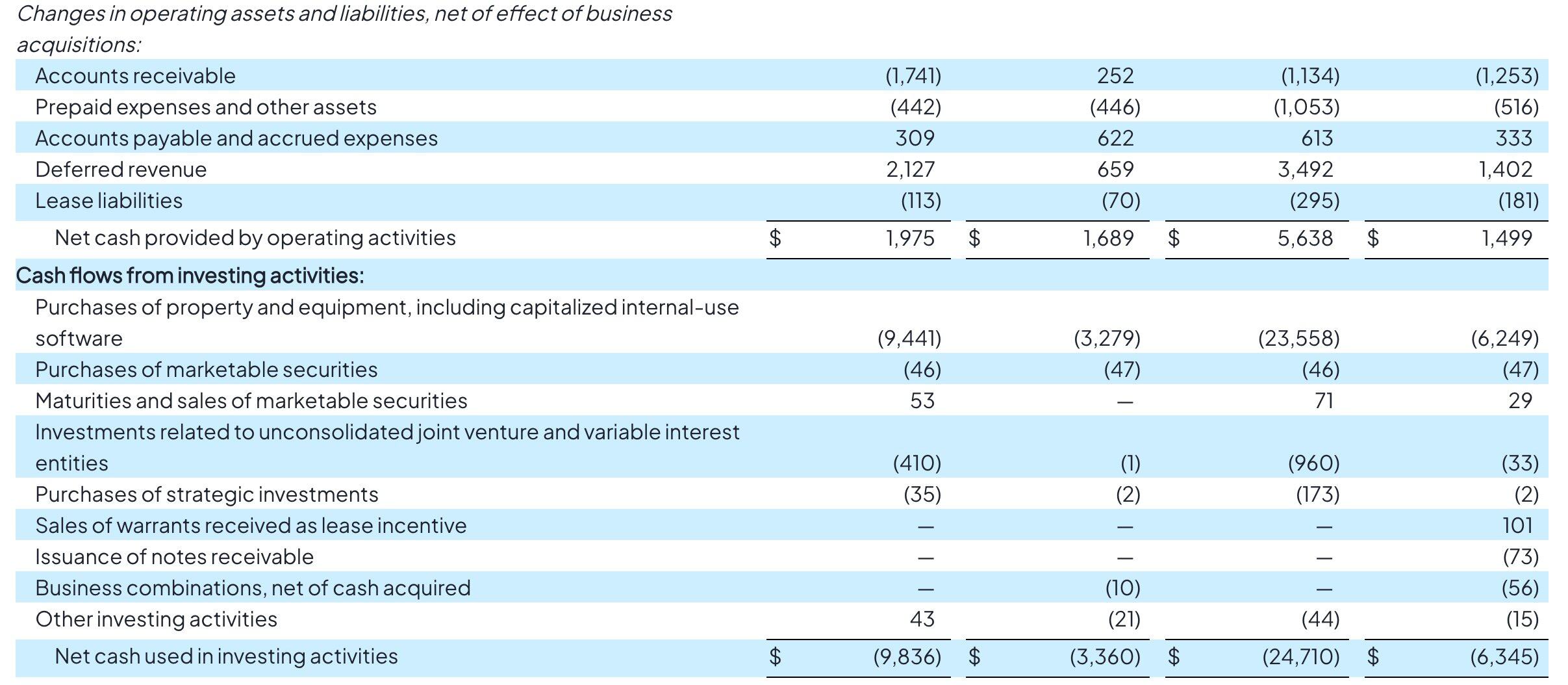
First, the staggering debt growth and cash burn. In Q3, CoreWeave's capital expenditure under the company's disclosed methodology reached $14.5 billion. Meanwhile, the cash flow statement shows that the company's actual cash spending on property and equipment during the quarter was $9.441 billion. After deducting this cash outflow, Q3 free cash flow was a net outflow of $7.466 billion, and the cumulative net outflow for the first three quarters reached $17.92 billion.
To fill the funding gap, as of September 30, CoreWeave's total debt on the books had soared to $46.873 billion. If further including $18.697 billion in operating lease liabilities and $649 million in finance lease liabilities, its total debt and lease liabilities reached approximately $66.22 billion.
The worsening trend of "profit and interest inverted" is equally worth vigilance. In Q3, CoreWeave's adjusted operating income was $379 million (GAAP operating income was only $207 million), but quarterly net interest expense was as high as $846 million, directly dragging the company into a GAAP net loss of $709 million. More grimly, management expects Q4 interest expense to climb further to $1.05–1.15 billion (annualized interest expense as high as $4.4 billion). Even though the company has already raised its adjusted operating margin to 10%, there remains a huge gap between its profitability and financing costs.
D.A. Davidson analyst Gil Luria commented: "Interest expense is far higher than operating profit, indicating that the business returns currently generated by the data centers are still insufficient to repay the accumulating debt."
Facing enormous debt pressure, CoreWeave has rolled out three moves to try to break the deadlock and buy itself a breathing window.
- Refusing to issue high-interest unsecured debt, relying on customer prepayments for "blood transfusions": CFO Agrawal explicitly stated that, given current market yield levels, CoreWeave has no plans to issue new parent-level unsecured debt before the end of 2027. The alternative is to ask downstream customers for money — within the next three months, the company expects to receive about $9 billion in customer prepayments and deposits (currently 70% of deals come with prepayments), and management says most of its funding needs in 2027 will be covered by customer prepayments and financing from hardware partners.
- Pivoting to asset-level secured loans (DDTL): Bypassing parent company credit and directly using investment-grade major customer contracts as collateral. Currently, the company's overall weighted average cost of debt is 7.9%, and a new investment-grade DDTL tranche will be launched in the coming weeks at an expected rate of 7%–7.5%, which can cover more than 90% of the capital expenditure for relevant projects.
- Counting on "old chips" to generate cash once loans are repaid: Since the chip purchase loan cycle is tied to the first customer contract, the expiration of the first contract means the loan is repaid. Intrator revealed that in 2027 and 2028, contracts for more than 130,000 and approximately 170,000 GPUs will expire, respectively. At current rising prices for older chips, these 300,000 "debt-free" devices can generate nearly $4 billion and nearly $10 billion in incremental annualized revenue in 2027 and 2028 respectively, without additional capital expenditure.
But market doubts have not been dispelled. Wells Fargo analyst Michael Turrin estimates that even under an optimistic scenario, CoreWeave's 2027 capital expenditure will be as high as $66 billion, and there will still be at least a $25 billion new debt financing gap; at the same time, if part of the $9 billion in prepayments comes from downstream AI startups that are also burning cash through financing, the quality of their risk resilience still needs to be questioned.
The Alarm Is Paused, But the Big Test Is Still Ahead
Beyond the tens of billions in on-book debt, delivery frictions in the physical world and policy headwinds are also squeezing the margin for error.
The earnings report shows that although CoreWeave's active power doubled to 1.7GW, the activation rate is only 37% (total contracted power has exceeded 4.6GW). Considering that after the US midterm elections, many regions have tightened their stance on energy-intensive data centers, CoreWeave will be forced to accelerate the dispersion of more than 1.3GW of contracted capacity to overseas markets such as India, Indonesia, and Spain.
Ultimately, this better-than-expected Q3 report and the nearly 8% after-hours rebound only prove that downstream AI compute demand is still red-hot, and that leading players still have chips to pass funding pressure on to customers. It has temporarily extinguished the imminent liquidity panic, but has far from rewritten the perilous underlying reality of high-leverage sprinting.
Under the weight of $65.6 billion in broad debt and more than $1 billion in quarterly interest, Musk's "mass extinction prophecy" still hangs overhead. CoreWeave has won a breather tonight, but the real cash flow test that will determine its life or death has only just begun.





