US Stocks Daily | Nvidia Falls Another 5.5%, Dragging Down AI Sector; S&P and Nasdaq Close Lower, Financials and Energy Buck the Trend (November 11)


- Key Takeaways: October CPI and core CPI both beat expectations on a MoM basis, making a December rate hike the base case, with surging long-end rates weighing on high-valuation assets; crypto DAT leader Strategy's position has swung to an unrealized loss, with mNAV dropping to 0.82x, as the industry shifts from "leveraging up to buy coins" to "repairing balance sheets."
- Key Elements:
- October CPI rose +0.4% MoM and core +0.3%, both above expectations; the 10-year Treasury yield climbed to 4.983%, breaching 5% intraday; Waller said at least a 25bp hike in December, with 50bp on the table if necessary.
- Nvidia fell 5.47% in a single day amid CEO scandal and a class-action lawsuit, down nearly 30% over five weeks; the 11/17 earnings report becomes a key validation point for the AI sector.
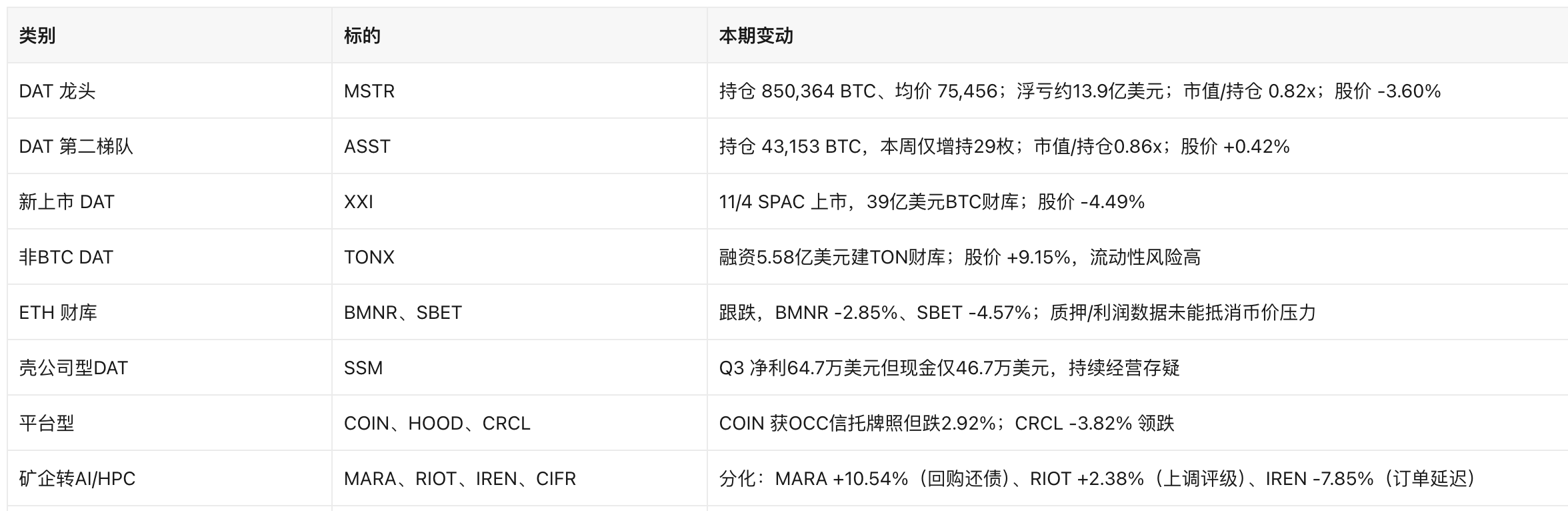
- BTC traded at $73,800, falling below Strategy's average position cost of $75,456, with an unrealized loss of approximately $1.39 billion; MSTR's market cap/position ratio dropped to 0.82x, and 66.3% of this period's fundraising was used to repurchase preferred stock rather than buy coins.
- US spot Bitcoin ETFs saw three consecutive days of net outflows, with IBIT logging $1.66 billion in cumulative outflows over 7 days; Ethereum ETFs saw six consecutive weeks of net outflows, as ETFs shifted from marginal buyers to marginal sellers.
- Coinbase obtained a final trust bank charter from the OCC, bringing its custody business under the federal framework; however, COIN still fell 2.92% with the broader market, as regulatory tailwinds failed to offset rate and coin-price beta.
- The MSCI November index review may remove companies with high digital asset exposure, posing the biggest non-fundamental risk to the DAT sector; if the removal is confirmed, rebalancing will take effect at the end of November.
- Sector rotation reflected a "reflation + rate hike" trade: XLK -1.15%, while XLF +0.52%, XLE +0.44%, and XLV +0.29%; VIX pulled back, indicating the market has not yet entered a systemic risk-off phase.
1. Top Stories
- October CPI rose 0.4% MoM and core 0.3%, both above expectations, and the market is now treating a December rate hike as the base case. Headline CPI rose +0.4% MoM (expected +0.3%, prior +0.6%), core +0.3% (expected +0.2%); due to the data gap caused by the October 2025 government shutdown, BLS did not publish YoY readings this period. The 10-year Treasury yield rose to 4.983% (+11.9bp), briefly breaking above 5% intraday.
- Fed officials signaled that "50bp could be considered." Waller said he would support at least a 25bp hike in December and would consider 50bp if inflation stays elevated; Logan also leaned hawkish. A Reuters survey showed most economists expect one more hike in December, while Goldman Sachs pushed its third-hike forecast to March next year.
- Nvidia fell another 5.47%, becoming the biggest drag on the index. After CEO Jensen Huang's relationship with a "suspected Chinese spy" was exposed, the company and Huang himself faced a shareholder class action, and multiple institutions cut their price targets; the stock has fallen nearly 30% over five weeks (24/7 Wall St), with earnings due after the close on 11/17 (EPS expected at $2.49). It rebounded 0.94% after hours.
- Crypto-related US stocks came under broad pressure, but internal divergence was clear. BTC traded at $73,800, already below Strategy's average holding cost of $75,456; MSTR fell 3.60%, with market cap/holdings down to 0.82x; MARA rose 10.54% against the trend after authorizing a $500 million buyback and repaying a $750 million bitcoin-collateralized loan, while IREN fell 7.85% after being downgraded on delays to its Microsoft project.
- Geopolitics: expectations of a "war's end" in Iran coexisted with attacks in Hormuz, and oil first fell then rebounded. Trump said military action against Iran would "end soon," and Brent briefly fell below $90 intraday before closing at $91.49 (-1.17%); however, shipping in Hormuz was attacked again during the Asian session on 11/11, and Brent rebounded to $92.05 (+0.61%).
- Three key after-hours variables turned positive. Costco announced a $30 per share special dividend ($13.3 billion in total) and restarted a $4 billion buyback, rising 1.88% after hours; CoreWeave beat revenue expectations in Q3 and raised guidance, rising 7.9% after hours; Nvidia edged higher after hours. This provided a buffer for the 11/11 open.
2. US Stock Market and Macro
2.1 Index Closes (US Eastern 2026-11-10 16:00 EST)
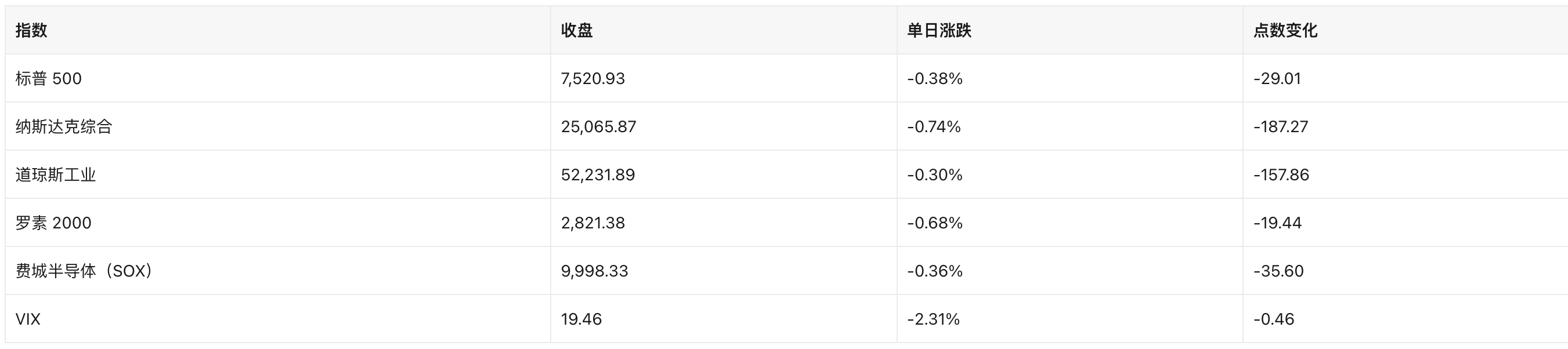
Core drivers:
① October CPI headline and core both beat expectations, long-end rates jumped, pressuring high-valuation growth stocks;
② Nvidia's idiosyncratic risk (CEO scandal + class action) overlapped, causing sharp divergence within semiconductors;
③ Capital rotated from tech into financials, energy, and healthcare — XLK -1.15%, while XLF +0.52%, XLE +0.44%, XLV +0.29%, XLC +0.37%.
Key point: this was a narrow decline driven by "rate shock + single-stock risk," while VIX actually fell, indicating the market has not yet entered systemic de-risking.
The S&P is 3.81% below its 10/6 high of 7,818.93; the Nasdaq is 9.18% below its 10/6 high of 27,599.79; the Nasdaq has fallen for four consecutive weeks.
2.2 Macro Data and the Fed
- October CPI (11/10 08:30 ET): headline MoM +0.4% (expected +0.3%, prior +0.6%); core MoM +0.3% (expected +0.2%, prior +0.3%); CPI index (NSA) 337.511, real hourly earnings 0.0% MoM (prior -0.4%). Due to the data gap caused by the October 2025 shutdown, YoY and core YoY were not published this period, marking the third consecutive month of "elevated MoM, missing YoY."
- Fed commentary: Waller explicitly said "at least 25bp in December, and 50bp would be considered if inflation readings run hot"; Logan also supports further tightening. Reuters survey: most economists expect one more hike in December; after CPI, Goldman Sachs pushed its third-hike forecast to March next year and its rate-cut forecast to the end of next year.
- Rates and the dollar (11/10): 10-year Treasury yield 4.983% (+11.9bp), breaking 5% intraday; 30-year 5.350% (+9.4bp); the 11/10 10-year auction cleared at 5.020%. The dollar index closed at 102.23 (+0.57%), and at 102.31 (+0.08%) during the Asian session on 11/11.
- Commodities (11/10 settlement): COMEX gold $4,030.20/oz (-2.05%), rebounding to $4,072.50 (+1.05%) during the Asian session on 11/11; Brent $91.49/bbl (-1.17%, briefly below $90 intraday); WTI $86.04/bbl (-0.93%).
3. Hot Stocks and Sectors
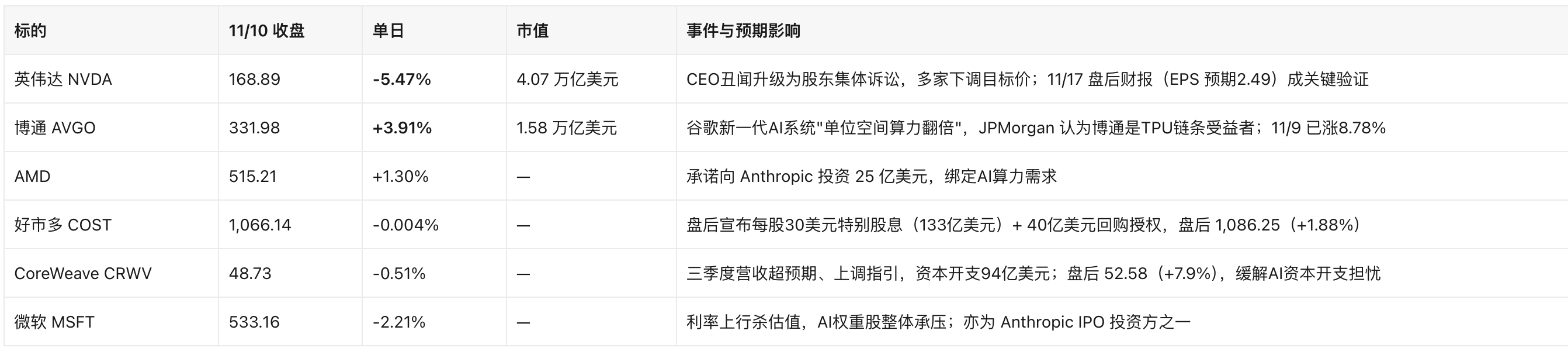
Sectors and narratives
- Rate sensitivity was clearly ordered: tech (XLK -1.15%) and real estate (XLRE -0.13%) came under pressure, while financials (XLF +0.52%, benefiting from curve steepening), energy (XLE +0.44%), and healthcare (XLV +0.29%) saw inflows. This is a classic "reflation + rate hike" trade, not a recession trade.
- Within AI, the focus shifted from "narrative" to "validation": Nvidia's decline reflected corporate governance risk, while Broadcom/AMD's gains reflected order and equity-binding logic; CoreWeave's after-hours guidance raise showed that compute demand has not deteriorated. Together, these indicate that the AI trade has not collapsed as a whole, but pricing has shifted from "P/E expansion" to "cash flow and order visibility."
- Midterm election fallout persists: after Democrats swept both chambers of Congress, the market worries about tougher AI regulation and antitrust enforcement; on 11/5 the Nasdaq plunged in a single day, wiping out $2.5 trillion in market value. This policy discount has not been fully repaired and is a background variable behind the current weak rebound in tech stocks.
- Note: Nvidia will report earnings after the close on 11/17, the only event in the coming week capable of repricing the AI sector; Costco's special dividend has a record date of 11/24 and a payment date of 12/4 ($13.3 billion in total).
4. Crypto-Related US Stocks
4.1 DAT Leader: Strategy (MSTR)
Latest disclosure (SEC 8-K, 2026-11-09, covering 11/2–11/8)
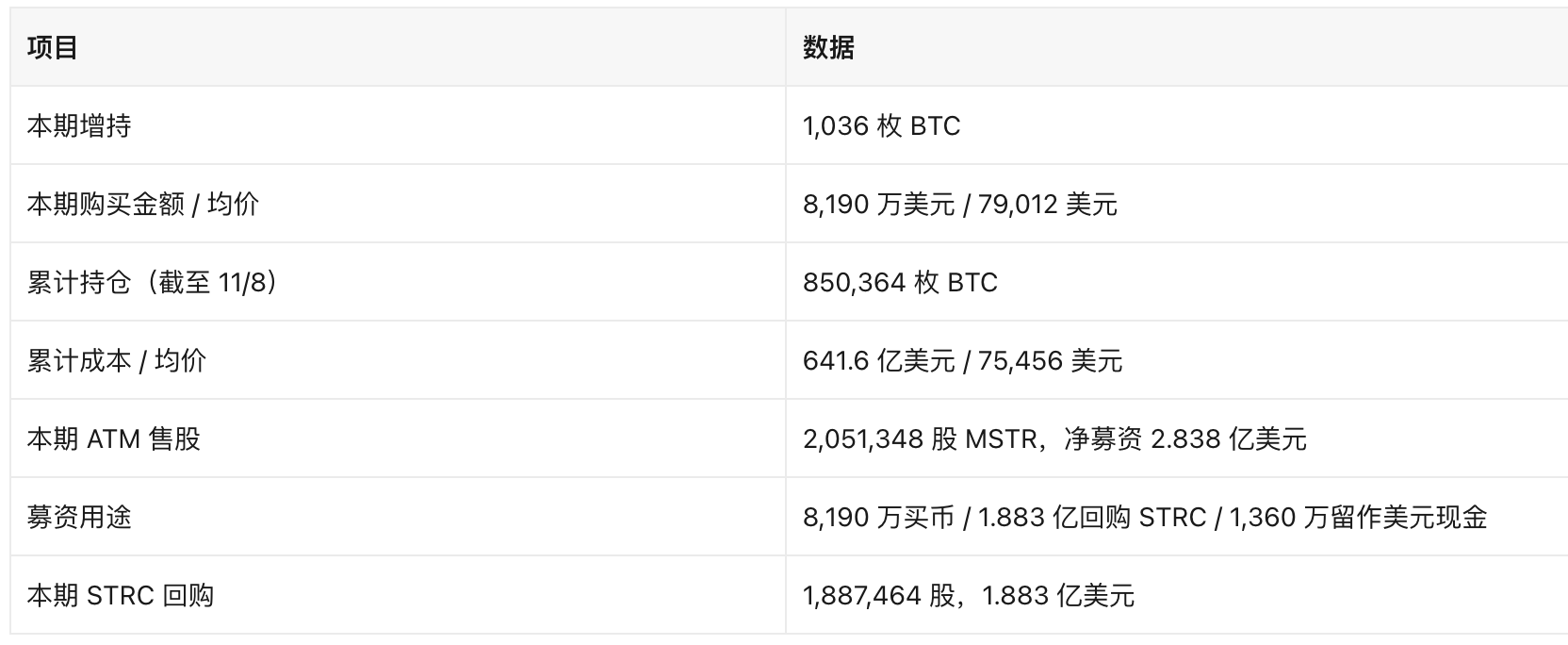
- Signal one: holdings officially turned to unrealized losses. Based on BTC at $73,819.91 as of 11/11 07:29 UTC, the holdings are worth about $62.77 billion, below the $64.16 billion cost basis, for an unrealized loss of about $1.39 billion (-2.2%); BTC's current price is 2.17% below its average cost.
- Signal two: fundraising prioritized balance sheet repair. Only 28.9% of net proceeds this period went to buying coins, while 66.3% went to repurchasing STRC preferred stock — continuing the sequence of "lower preferred cost first, buy coins later."
- Signal three: valuation discount widened. Closing market cap of $51.13 billion / holdings value of $62.77 billion = 0.82x (this measure excludes total liabilities and preferred stock and is not equivalent to full EV/NAV; prior period was 0.83x). The stock price was $121.07, down 3.60% on the day and 28.2% from its 9/21 high.
- Remaining issuance capacity: MSTR $18.34 billion, STRC $17.51 billion, STRF $1.62 billion, STRK $2.10 billion, STRD $4.01 billion — ample ammunition for issuance, but when mNAV<1, issuing shares means "selling stock at a discount to buy coins," raising dilution costs.
Other DATs
- Strive (ASST, $21.55, +0.42%, market cap $2.74 billion): added only 29 BTC during 11/2–11/8 ($2.2 million, average price $75,862), holding 43,153 coins; in October it bought 15,124 coins at an average price of $83,310. At current coin prices, holdings are worth about $3.19 billion, market cap/holdings 0.86x (rough calculation based on 11/11 BTC price). H.C. Wainwright reiterated it as "top pick."
- BitMine (BMNR, $18.08, -2.85%): ETH treasury leader, disclosed $121.4 million in ETH staking revenue for fiscal 2026, but weak coin prices weighed on valuation.
- SharpLink (SBET, $5.85, -4.57%): an ETH treasury name, Q3 profit +620% YoY (including non-cash fair value gains), but the stock still fell with ETH.
- Twenty One Capital (XXI, $5.32, -4.49%, market cap $2.98 billion): completed its SPAC listing on 11/4, carrying a $3.9 billion BTC treasury, and is the most important new DAT sample this quarter.
- TON Strategy (TONX, $3.22, +9.15%, market cap $177 million): completed $558 million in financing to build a TON treasury, the latest case of a "non-BTC DAT"; small cap, high volatility, liquidity risk needs separate assessment.
- Sono Group (SSM, $0.959, +3.94%): first full quarterly report after pivoting to a BTC treasury, Q3 net income of $647,000 (mainly from bitcoin-related and non-cash gains), but cash on hand was only $467,000, raising going-concern doubts — the most typical "small-cap shell company" risk sample in the DAT boom.
4.2 New Entrants and Transformations
Addition to the crypto US stock watchlist: this period (11/10–11/11) no US-listed company was found making a first-time announcement to buy BTC/ETH or to transform into a crypto DAT.
- The "blank" itself延续了上周的信号: with BTC below the DAT average cost and mNAV generally below 1, the arbitrage space of "issuing stock to buy coins" has disappeared, and new entries have naturally stalled.
- The most recent "new face" remains Twenty One Capital (XXI, listed 11/4), already added to the watchlist; this week we need to track its first post-listing disclosure and lock-up arrangements.
- The reverse trend continues: miners are shifting capex from mining to AI/HPC (RIOT's Corsicana data center, IREN's Microsoft project), and "compute companies" are being repriced as "power + facility companies."
4.3 Broad Crypto US Stocks and ETFs
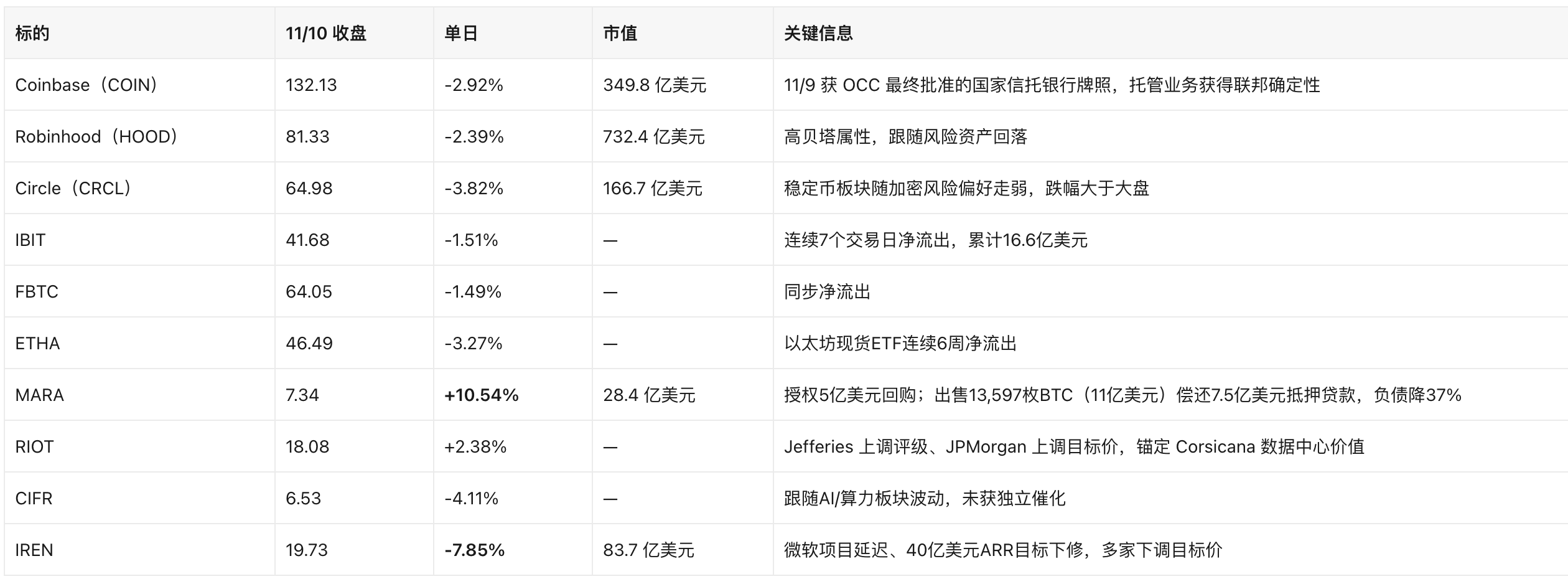
- ETF flows: US spot bitcoin ETFs saw net outflows of $201 million on 11/9, the third consecutive trading day of net outflows; IBIT saw 7 consecutive days of net outflows totaling $1.66 billion, the longest streak since January 2026. Spot ether ETFs saw net outflows of $365 million last week, the sixth consecutive week of net outflows. Single-day flow data for 11/10 has not yet been released (typically updated the next day US Eastern time) and was not obtained for this period.
- Miners' "decoupling" from coin prices is showing cracks: MARA's gain came from capital structure actions (buyback + debt repayment), not coin prices; RIOT's from analyst re-rating; and IREN's decline from AI order delays. Within the same "miner-turned-AI" sector, pricing has begun to diverge based on "whether orders are delivered," rather than moving in lockstep with BTC.
- Structural signal: MARA selling coins to repay debt, Strategy selling stock to buy back preferred, Strive's accumulation nearly stalling — the DAT group has moved from the "lever up to buy coins" phase into the "balance sheet repair" phase, the most important qualitative change of this cycle.
4.4 Regulatory and Accounting Drivers
- Coinbase obtained a final OCC trust bank charter (11/9): it now holds a federal trust charter alongside Circle and Ripple, moving custody from a "state-level patchwork" to a "federal framework," the most important structural positive for crypto US stocks this week; yet COIN still fell 2.92% with the broader market, showing that regulatory positives cannot offset rate and coin-price beta in the short term.
- SEC enforcement intensity fell to an 18-year low (FY2026): fines and case counts fell sharply, with the SEC bringing 348 enforcement actions for the year. This is a lenient environment for the industry, but after Democrats won both chambers of Congress, the regulatory direction could reverse in 2027, which is the source of the "policy discount" in current crypto asset and DAT valuations.
- MSCI index review (key non-fundamental risk): MSCI finalized on 10/15 the rule that "companies with excessive digital asset exposure need to have their index eligibility reassessed," and the November semi-annual review results are expected to be announced this week (reports point to Wednesday; the exact timing and list are subject to MSCI's official announcement and remain unconfirmed); if removed, rebalancing would take effect at the end of November. DAT leaders such as Strategy and Metaplanet are the main candidates for review.
- Legislative stalemate: former House Financial Services Committee Chairman McHenry said the industry "wasted the opportunity to pass the CLARITY Act"; the legislative path is more uncertain after the midterms. (Industry media, 11/9)
- Accounting treatment: ASU 2023-08 fair value measurement directly ties DAT income statements to coin prices. BTC falling below average cost means coins bought at highs this quarter will directly create paper losses, which in turn suppresses the willingness to continue issuing shares — exactly the financial backdrop for Strategy prioritizing fundraising for STRC buybacks.
4.5 Crypto US Stock Watchlist (Changes This Period)
5. Crypto Market Background
- BTC $73,819.91 (11/11 07:29 UTC), -1.23% over 24 hours, roughly flat versus the 11/10 US close; down 14.8% from its 9/21 high of $86,602.91, and 2.17% below Strategy's average cost. It fell below its 50-week moving average on 11/9, with over $1