US Stocks Daily | Chip Index Falls Another 3.43% in a Single Day, PPI at 6.5% Pushes 10-Year Treasury Yield to 5.15% (November 14)


- Key Takeaways: US October PPI rose 6.5% year-over-year, hitting a near four-year high, with December rate hike expectations rising to nearly 100%; long-end Treasury yields broke above 5.15%, and high discount rates are weighing on high-valuation assets such as AI and crypto; compounded by the leadership vacuum triggered by Nvidia CEO Jensen Huang's resignation, both the AI computing power chain and the crypto treasury model are under simultaneous pressure.
- Key Elements:
- October PPI rose 0.3% month-over-month and 6.5% year-over-year; the 10-year Treasury yield closed at 5.154%, and CME data shows an 88% probability of a December rate hike.
- Jensen Huang resigned on November 12 amid a board investigation, with the CFO temporarily taking over; NVDA fell 12.75% for the week, marking its longest weekly losing streak since 2012, with $1.7 trillion in market value wiped out.
- Bitcoin fell below $67,000 to a new low since August, down 11.55% this week; US spot Bitcoin ETFs saw net outflows for 7 consecutive trading days, with cumulative outflows of $2.35 billion over two weeks.
- Strategy holds 850,000 BTC with $7.21 billion in unrealized losses, and its stock trades at a 17% discount to net asset value; MSCI removed it from global indices, potentially triggering $2.8 billion in passive selling.
- MARA sold 13,597 BTC within six weeks, cashing out $1.1 billion; multiple treasury companies have reduced holdings or exited, and the "issue stock to buy Bitcoin" flywheel struggles to self-reinforce once the premium disappears.
- Nvidia's earnings on November 17 is the core event this week, simultaneously determining the AI narrative and index direction; the semiconductor sector pulled back on Friday but still gained 8.05% for the week.
1. Top Stories
- October PPI up 6.5% year-over-year, highest in nearly four years, rate expectations revised higher again. The U.S. October producer price index rose 0.3% month-over-month and 6.5% year-over-year; Reuters called it "a moderate increase but inflation is broadening." The 10-year Treasury yield closed at 5.154% and the 30-year at 5.481%, with markets pricing in a higher probability of a December rate hike.
- NVIDIA CEO Jensen Huang resigns, the core asset of the AI trade loses its leader. After the board announced on November 8 an investigation into his relationship with a "suspected Chinese spy," Huang resigned on November 12, with CFO Colette Kress serving as interim CEO. NVDA fell 2.01% to $162.85 on Friday and 12.75% for the week, its longest weekly losing streak since 2012; the board investigation is still ongoing.
- Chip stocks pulled back collectively on Friday, but the week was still strong overall. The Philadelphia Semiconductor Index (SOX) fell 3.43% to 10,146.32, with AMD down 8.75%, Broadcom down 4.76% (after a ratings downgrade), and Marvell down 4.68%; the S&P 500 information technology sector came under pressure, but the SOX still gained 8.05% for the week.
- Bitcoin falls below $70,000, crypto-linked U.S. stocks and ETFs bleed in tandem. BTC briefly fell below $67,000 on Friday, its lowest since August, and last traded at $66,971.49 (down 2.26% in 24 hours); U.S. spot bitcoin ETFs saw net outflows for a seventh consecutive trading day; MSTR fell 2.44% to $111.62 and 13.43% for the week.
- FAA grounds all flights nationwide for several hours, compounded by an Iranian strike on U.S. targets in Bahrain. The Federal Aviation Administration issued a rare nationwide ground stop due to an air traffic system failure, lifting it that evening, and airline stocks fell; Iran claimed it struck a U.S. military radar site in Bahrain, while the U.S. denied being hit and said it shot down 2 drones.
2. U.S. Stock Market and Macro
2.1 Index Closes (U.S. Eastern Time 2026-11-13 16:00)
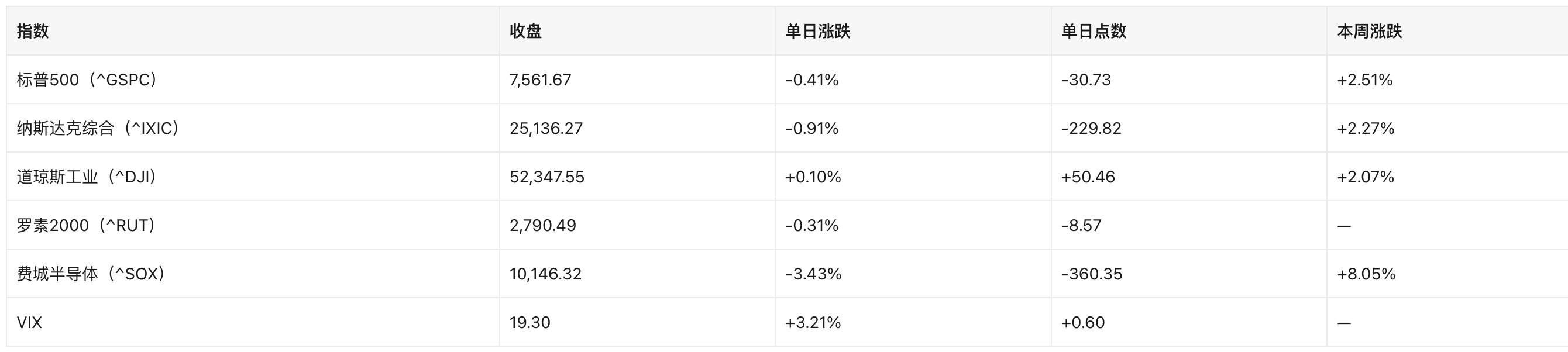
Driving logic: Friday was a day of digesting both "inflation data + NVIDIA leadership change." PPI pinned long-end rates above 5%, directly weighing on high-valuation growth stocks; the leadership vacuum at NVIDIA prompted capital to withdraw from the AI compute chain and rotate into defensives and value (the Dow closed up against the trend). But earlier in the week (November 9-11), CoreWeave's earnings beat and the trade that "NVIDIA's leadership change benefits competitors" pushed the three major indexes to their "best week since August."
2.2 Macro Data and the Fed
- October PPI: +0.3% month-over-month, +6.5% year-over-year, the highest year-over-year reading since 2022. Reuters emphasized that "goods and services prices rose simultaneously, and inflation is broadening."
- Rate hike expectations: After October CPI beat expectations, CME FedWatch showed the probability of a December hike rising to 88%; Seeking Alpha said on November 12 that "the probability of a hike is now close to 100%." Bloomberg on November 13: The Fed is on track to raise rates in December and may hike again in January.
- Treasury yields (November 13 close): 5-year 4.981%, 10-year 5.154% (prior day 5.103%), 30-year 5.481%. The curve is bear-steepening, reflecting the triple pressure of "rate hikes + sticky inflation + fiscal supply."
- Dollar and volatility: The dollar index (DXY) at 103.41, up 1.09% for the week; VIX at 19.30, up 3.21% on the day, still in a moderate range, indicating this is "orderly deleveraging" rather than panic.
- Commodities: WTI crude at $88.56 (-0.20%), Brent at $95.84 (+0.02%, down 2.52% for the week); COMEX gold at $3,886.30 (+0.03%, down 4.63% for the week, its worst week since June). Oil prices remain elevated but fell for a second consecutive week, with the IEA saying "global oil supply has returned to surplus for the first time since the Iran war broke out."
3. Hot Stocks and Sectors
3.1 NVIDIA (NVDA): -2.01% to $162.85, down 12.75% for the week
- Events: The board launched an investigation on November 8, Huang resigned on November 12, and CFO Colette Kress became interim CEO; Reuters reported exclusively on November 12 that "there is also a relationship with a second employee"; NBC said on November 13 that the board investigation did not end with the resignation, and Republicans in both chambers of Congress demanded that Huang and Commerce Secretary Lutnick testify before Congress.
- Market impact: Market cap of $4.01 trillion, and this losing streak has erased $1.7 trillion in market value. The real pricing event is the earnings report after the close on November 17: with the CEO position vacant and doubts about AI capital expenditure rising, this report will simultaneously determine both the "AI narrative" and the "index heavyweight" storylines.
- Watch points: Interim CEO Kress's stance toward major customers such as OpenAI is interpreted as "tougher than Huang," and if earnings guidance turns conservative, valuation pressure on the semiconductor chain will be released a second time.
3.2 Semiconductors: AMD -8.75%, Broadcom -4.76%, Marvell -4.68%
- After AMD rose 30% last week (still +18.93% for the week), it gave back 8.75% on Friday to $534.06, a case of profit-taking on the "leadership change trade" plus a BofA target price cut; Broadcom fell 4.76% to $347.01 after analysts downgraded its rating and target price (still +18.16% for the week).
- Transmission: Capital did not leave semiconductors but rotated among names within "the compute share vacated by NVIDIA" — AMD and AVGO surged during the week and pulled back together on Friday, indicating this is position rebalancing rather than a deterioration in fundamentals. The SOX being +8.05% for the week while down 3.43% on Friday is precisely a reflection of this high volatility.
3.3 Cisco (CSCO): -6.24% to $95.64
- In its November 12 after-hours earnings, revenue and EPS both beat expectations and AI data center orders grew, but the services business was flat and next-quarter revenue guidance was soft, sending the stock down 6.24% on Friday (Barron's: "the beat failed to dispel long-term concerns"). It was still +1.91% for the week.
- Implication: AI hardware "pick-and-shovel" companies are now being asked to prove how quickly orders convert into profits, which reinforces the cautious sentiment ahead of NVIDIA's earnings.
3.4 Modine (MOD): +27.86% to $135.66, +40.42% for the week
- Events: Media reported that Samsung is in talks to acquire this data center cooling equipment supplier. This was one of the largest single-day gainers of the day, showing that M&A premiums for AI infrastructure remain, and capital is willing to pay up for certain segments such as "data center cooling."
3.5 Airlines: DAL -0.35%, LUV -0.64%, AAL -1.05%
- Events: The FAA issued a nationwide ground stop due to an air traffic control system failure and lifted it several hours later, but cancellations and delays persisted for days. Barron's noted that "airline stocks fell while rental car stocks rose" — a classic operational disruption trade.
- Assessment: The ground stop is a one-off operational shock, a short-term sentiment and cost disturbance for airline stocks; the real risk is whether the "aging air traffic control technology stack" will be placed on the fiscal/infrastructure agenda.
3.6 Defensive and Value Rotation: WMT +1.51%, COST +1.28%, META +2.90%, JPM +0.98%
- In an environment of long-end rates above 5% and rising expectations for a December hike, consumer staples (WMT 128.09, COST 1,106.21) and banks (JPM 346.19) attracted capital; META rose 2.90% against the trend to $641.69 and +5.17% for the week, benefiting from the "internal redivision of labor within mega-cap tech" (advertising cash flow + capital expenditure discipline).
- The core of this rotation is not "betting against AI" but rather shifting positions toward assets with certain cash flows and lower valuations as the discount rate rises.
4. Crypto-Related U.S. Stocks
4.1 DAT Companies and Position Changes
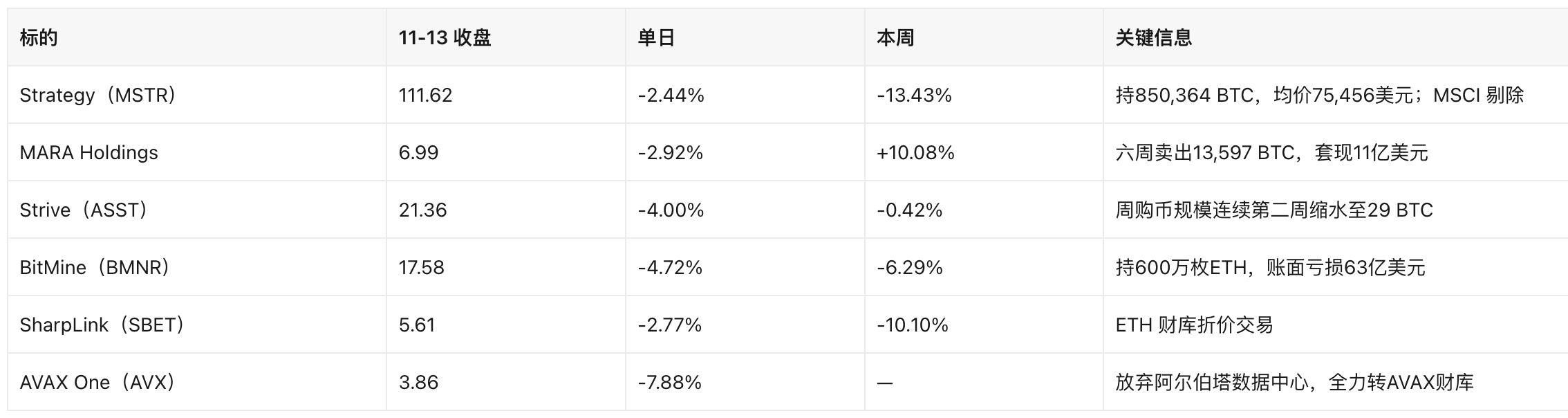
Strategy (MSTR) — the most important signal this period
- Holdings and cost: 850,364 BTC at an average cost of $75,456 (company disclosure, after adding 1,036 BTC on November 9). Based on the BTC quote of $66,971.49 at 02:44 on November 14, position value = 850,364 × 66,971.49 = $56.95 billion; cost = 850,364 × 75,456 = $64.17 billion; unrealized loss of $7.21 billion.
- Valuation: Nasdaq market cap of $47.14 billion ÷ position value of $56.95 billion = 0.83x, meaning the stock trades at a 17% discount to the value of the bitcoin it holds. This means the "issue shares to buy bitcoin" flywheel can no longer reinforce itself once the premium disappears.
- Index events: MSCI announced on November 11 that under new "non-operating company" rules it would remove Strategy from global indexes, and JPMorgan estimated this could trigger $2.8 billion in passive selling (November 11); MSCI also removed Metaplanet from the Japan small-cap index, effective at the end of November.
- Financing side: The company previously repurchased preferred stock at a price close to $100 and approved daily dividend payments on four preferred shares (approved by 99.3% of shareholders at the October 28 meeting), prioritizing "balance sheet repair" over continued accumulation when mNAV<1.
Reductions and exits (counter-evidence for the "treasury flywheel")
- MARA: Sold 13,597 BTC within six weeks, raising $1.1 billion, and said it would continue selling (CoinDesk, November 10); it also announced a $500 million buyback (November 10), and the stock rose 11%. Mining companies are switching from "holding coins" to "cash flow."
- BTCS: This Ethereum treasury company sold ETH at a discount to keep a $64 million Aave loan healthy, with a liquidation line of $1,717, while ETH last traded at $1,890.59.
- Nakamoto: Extended a $165 million Kraken loan by one year and extended another $60 million loan (November 13) — a typical move for highly leveraged treasuries when collateral shrinks.
- Hyperscale Data (GPUS): Sold its last batch of bitcoin, abandoned a $100 million BTC treasury plan, and shifted to a Michigan AI data center (November 10).
Crypto U.S. Stock Watchlist: No new faces announcing coin purchases for the first time this period
- Note: No U.S.-listed company announcements of first-time inclusion of BTC/ETH as reserve assets were found for November 13-14. Changes to the list were concentrated in "contraction of existing companies": AVX abandoned its data center and pivoted fully to an AVAX treasury (November 13), a structural adjustment of token treasuries rather than a new entry; Hyperscale was a clear exit case.
- Conclusion: At the current stage, the marginal buyers of DAT are decreasing while sellers are increasing, the opposite of the 2025 environment where "a new company announced coin purchases every week."
4.2 Broad Crypto U.S. Stocks: Platforms, Stablecoins, Miners
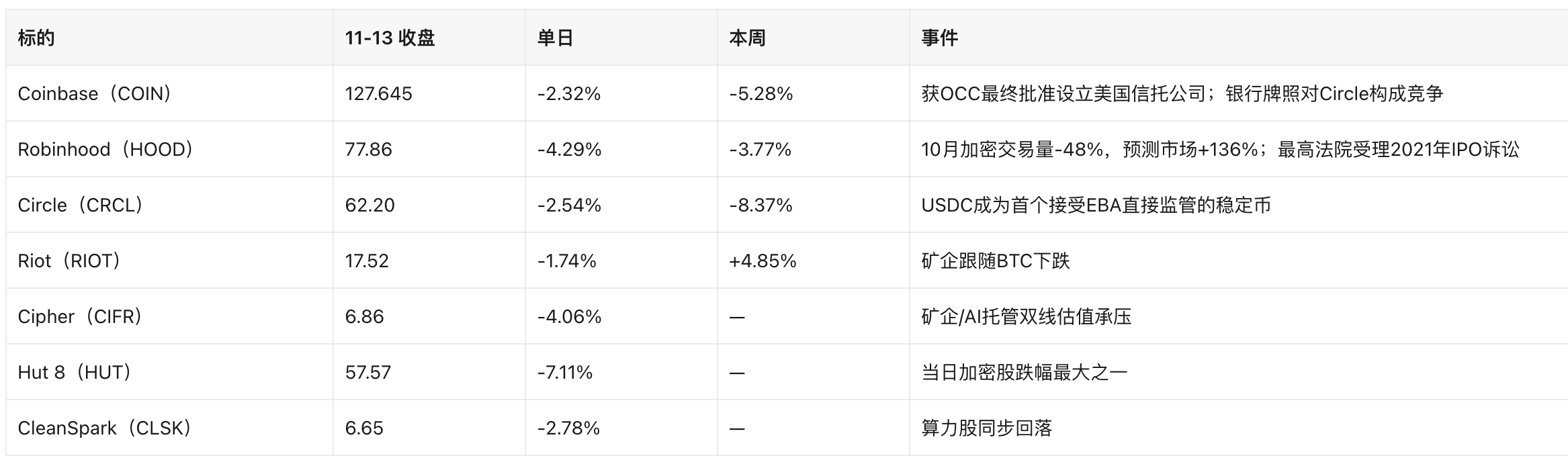
- Spot ETF fund flows: U.S. spot bitcoin ETFs saw net outflows of $185 million on November 13, the seventh consecutive trading day of net outflows; cumulative net outflows of $2.35 billion over the past two weeks, with BlackRock products bleeding for 11 consecutive trading days; year-to-date flows have turned to net outflows of more than $1.5 billion.
- ETF prices: IBIT 38.94 (-3.52%), FBTC 59.86 (-3.50%), BITB 37.34 (-3.54%), ETHA 44.02 (-3.34%); IBIT was -9.19% for the week, roughly in line with BTC's -11.55%, indicating that premiums/discounts provided no buffer.
- Stablecoins and payments: The OCC issued final GENIUS Act rules on October 21; Circle moved USDC reserves to EU regulation (November 12); Bottomline enabled enterprise-grade USDC payments (November 10). Stablecoin "compliance" is advancing, but in the short term it provides no floor for coin prices or valuations.
- Miner transformation: The AI/HPC narrative of MARA, RIOT, and CIFR provided no valuation protection during this selloff — CIFR's decline this week was significantly larger than BTC's, indicating the market doubts how quickly "replacing coin-holding income with compute contracts" can be delivered.
4.3 Regulatory and Accounting Drivers
- Personnel: The White House submitted 4 crypto-friendly SEC/CFTC commissioner nominees to the Senate on November 12-13 to fill the vacancy left by Hester Peirce's departure. After the Democrats' landslide in the midterm elections, the legislative process for the CLARITY Act actually stalled.
- Accounting: The FASB fair value accounting standard (the ASU 2023-08 framework) has companies mark crypto assets to market, which amplifies paper profits in a bull market and equally amplifies losses during drawdowns — Metaplanet's disclosure of a net loss of ¥2.7157 billion on November 13 is the latest example. The rule's appeal for "new company entrants" is being offset by the visibility of losses.
- Index rules: MSCI's new "non-operating company" rule is the most substantive rule change this period, removing "treasury companies" from the investable pool for passive funds and directly affecting the premium base of mNAV.
5. Crypto Market
- BTC: $66,971.49, down 2.26% in 24 hours, down 11.55% for the week; intraday low on Friday broke below $67,000, the lowest since August.
- ETH: $1,890.59, down 2.17% in 24 hours, down 15.41% for the week; ETH/BTC continued to weaken, and leverage pressure on Ethereum treasury companies (BTCS, BitMine) became explicit.
- Leverage: $1.6 billion in contract liquidations across the network on November 13, of which $870 million in long bets were liquidated; stablecoin exchange balances have continued to decline over the past two months, and marginal buying is shrinking.
- Reason: Coinbase Institutional explicitly stated that "what crushed bitcoin was Fed rate hike expectations, not the Binance hack" — that is, interest rates are the main variable in this crypto drawdown, which is the same source as the decline in U.S. growth stocks.
6. Geopolitical Impact
6.1 U.S.-Iran Conflict: Low Intensity, Prolonged
- On November 13, Iran claimed it struck a U.S. military early warning radar in