24H Trending Coins & News | Global Assets Lose Over $4 Trillion in 24 Hours, Nasdaq 100 Nears Bear Market; BTC Falls Below $58,000 Before Briefly Reclaiming $61,000 (November 26)


- Key Takeaways: Global risk assets sold off sharply in unison, with Bitcoin briefly falling below $58,000. The retreat from AI trades and rising inflation triggered a violent market correction, with crypto derivatives liquidations exceeding $510 million in 24 hours.
- Key Elements:
- Global assets lost over $4 trillion in the past 24 hours. The Nasdaq fell 3.91%, Bitcoin briefly touched $57,209, and long liquidations reached $423 million.
- The Nasdaq 100 is down 20% from its October high and nearing bear market territory. Six chip stocks including Nvidia contributed over 60% of the decline, as concerns over AI capital expenditure intensify.
- The U.S. October PCE annual rate rose to 3.8%, a near three-year high, with Wall Street widely expecting a Fed rate hike in December.
- Spot Bitcoin ETFs saw nearly $5 billion in net outflows this month, potentially the highest single-month figure on record. Bitcoin has fallen 25% in November.
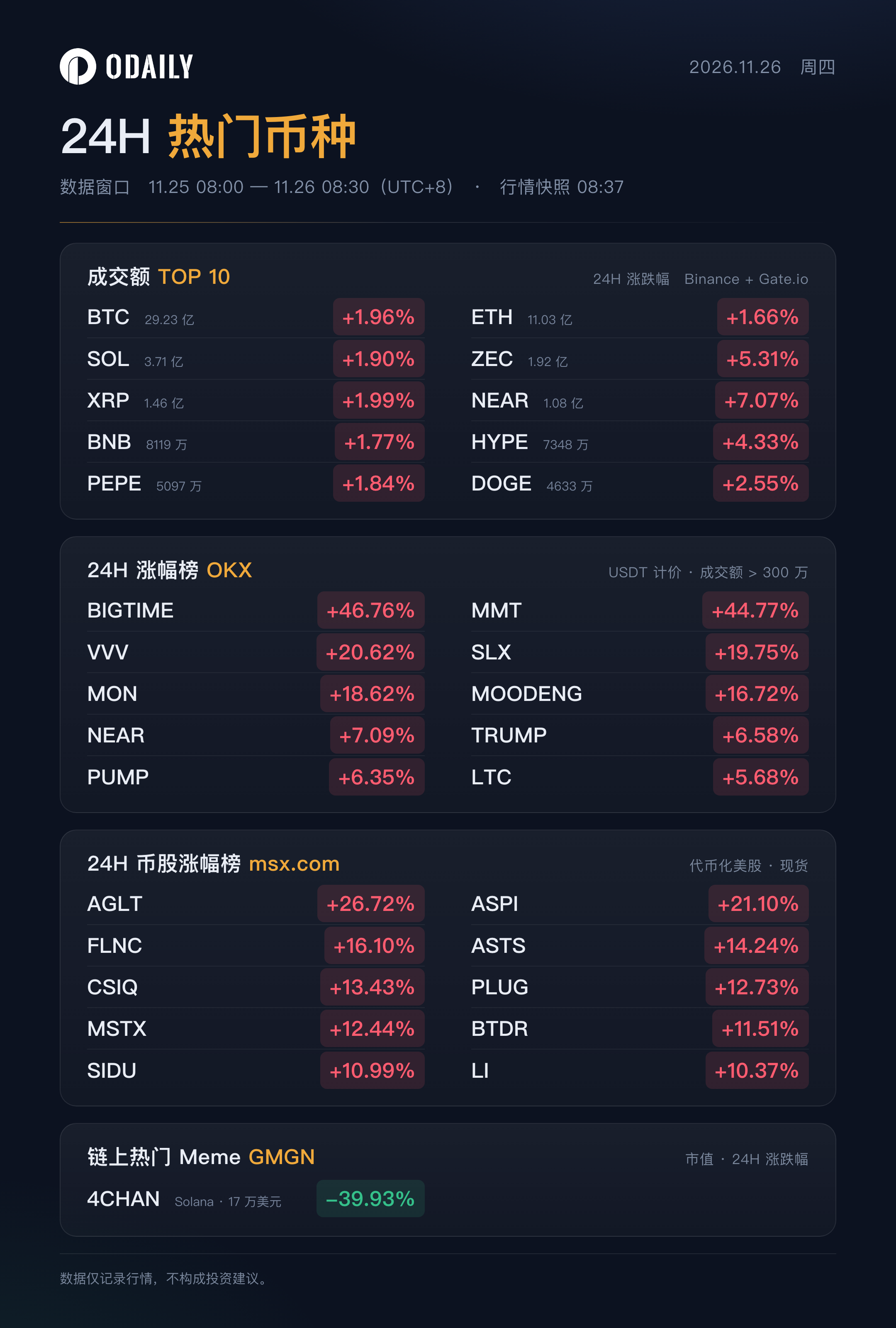
- On the CEX gainers list, BIGTIME rose 46.76% and MMT rose 44.77% to lead, while NEAR gained 7.07%. Meme coin 4CHAN dropped 39.93% in 24 hours.
- The Hong Kong Monetary Authority launched a DLT-based CMU digital asset platform, supporting end-to-end paperless bond tokenization and on-chain DvP settlement.

Trending Coins on CEX
Top 10 CEX Trading Volume and 24-Hour Price Change:
- BTC: +1.96%
- ETH: +1.66%
- SOL: +1.90%
- ZEC: +5.31%
- XRP: +1.99%
- NEAR: +7.07%
- BNB: +1.77%
- HYPE: +4.33%
- PEPE: +1.84%
- DOGE: +2.55%
24-Hour Gainers List (Source: OKX):
- BIGTIME: +46.76%
- MMT: +44.77%
- VVV: +20.62%
- SLX: +19.75%
- MON: +18.62%
- MOODENG: +16.72%
- NEAR: +7.09%
- TRUMP: +6.58%
- PUMP: +6.35%
- LTC: +5.68%
24-Hour Crypto Stock Gainers List (Source: msx.com):
- AGLT: +26.72%
- ASPI: +21.10%
- FLNC: +16.10%
- ASTS: +14.24%
- CSIQ: +13.43%
- PLUG: +12.73%
- MSTX: +12.44%
- BTDR: +11.51%
- SIDU: +10.99%
- LI: +10.37%
2. Top On-Chain Meme Top 1 (Source: GMGN):
- 4CHAN (Solana) — A meme coin on Solana tied to the image forum 4chan, originating from X user Bud41_'s proposal to add a platform coin for the continuous stream of 4chan memes, positioned as a base layer paired with various 4chan meme coins; snapshot market cap of $170,000, 24-hour decline of 39.93%.
Headlines
Global Assets Lost Over $4 Trillion in the Past 24 Hours; Bitcoin Briefly Dropped Below $58,000
Global financial markets continued to decline on Wednesday, with estimated global asset losses exceeding $4 trillion over the past 24 hours. The Nasdaq Composite fell 3.91%, the S&P 500 dropped 2.72%, the Dow Jones Industrial Average declined 1.74%, and spot gold fell 3.49%. Bitcoin on Wednesday briefly dropped to $57,209 on Bitstamp, then rebounded to $57,746 by 10:30 AM ET, and regained $58,000 by 11:00 AM. Coinglass data shows that crypto derivatives saw $510.96 million in 24-hour liquidations, involving 126,557 traders, with long liquidations at $422.73 million and short liquidations at $88.23 million.
Nasdaq 100 Nears Bear Market as AI Trade Unwinds Triggers Major Tech Selloff
Amid mounting concerns over AI investment prospects, the Nasdaq 100 plunged 4.7% on Wednesday, accumulating a 20% decline from its early October all-time high, with market cap evaporating over $8.5 trillion and year-to-date losses widening to 0.6%, facing the risk of entering a bear market for the first time in over a year. Chip stocks bore the brunt of the selloff. Nvidia, Marvell Technology, Intel, AMD, Lam Research, and Applied Materials collectively accounted for over 60% of the Nasdaq 100's decline from its peak, with Nvidia alone contributing approximately 23%. Market concerns continue to mount over massive AI infrastructure capital expenditures, corporate cash flow pressures, and regulatory risks surrounding data center construction.
PCE Inflation Accelerates, Fed Unable to Avoid Rate Hike Next Month
The Fed's preferred inflation gauge rose again in October, and at a faster pace, almost certainly meaning the Fed will raise rates next month. The U.S. October PCE price index rose 0.3% month-over-month, in line with Wall Street expectations. This pushed the annual PCE inflation rate from 3.7% to 3.8%, reaching a near three-year high. For over six years, U.S. inflation has remained above the Fed's 2% target, leaving a lasting impact on the U.S. economy and frustrating households and businesses. The Fed paused rate hikes in October to gain a clearer picture of price trends, but inflation actually worsened further. Wall Street almost unanimously expects the Fed to raise rates at its mid-December meeting and again in early next year. The October core PCE price index also rose 0.3% month-over-month, with the annual rate rising from 3.1% to 3.3%. (Jinshi)
Industry News
U.S. Proposes New Tariffs on 14 Trading Partners
After completing trade investigations, the Trump administration has proposed new tariffs on 14 major U.S. trading partners. The currently announced proposed tariff rates include: China: 20%, potentially rising to as high as 40%; Vietnam: up to 35%; India: up to 25%; Taiwan region of China: up to 25%; South Korea: up to 25%; Indonesia: up to 25%; Malaysia: up to 25%; Thailand: up to 25%; Cambodia: up to 25%; EU: up to 20%.
ETF analyst Nate Geraci posted on X that spot Bitcoin ETFs have seen nearly $5 billion in net outflows this month, potentially setting a record monthly high. Additionally, Bitcoin's price has fallen 25% in November.
According to unfolded. monitoring, Binance BTC perpetual futures volume reached 8x spot volume in October, the highest monthly ratio since the contract launched in 2019. Year-to-date in 2026, this ratio stands at 6.5x, compared to 3.9x in 2025. During the same period, Binance BTC spot daily volume dropped to approximately 30,000 BTC, while perpetual futures daily volume remained at approximately 196,000 BTC.
Project News
Polymarket has announced the launch of a compute power prediction market, initially covering Nvidia H100, B200, and B300 GPUs, with contract terms extending to 2028 and plans to add more chip models and trading terms in the future. The market aims to establish a compute pricing market similar to a yield curve, displaying predicted hourly rental prices and price trends for different GPUs across various expiration dates. Polymarket stated that previously there was a lack of public forward pricing mechanisms for compute power, while a large number of AI compute procurement, financing, and GPU loans involve judgments about future rental prices.
SpaceX Reportedly Cuts Nvidia Blackwell Chip Rental Prices by Up to 35%
Semiconductor research firm SemiAnalysis disclosed two developments in a report sent to institutional clients this week: first, SpaceX has lowered rental prices for small-scale Nvidia Blackwell GPU clusters; second, AI large model company Anthropic has decided not to renew its lease on a batch of H200s from SpaceX. SemiAnalysis stated in the report that SpaceX has reduced rental prices for small-scale Blackwell clusters from approximately $15 to $15.5 per GPU per hour to $10 to $12, a reduction of 20% to 35%, roughly in line with the bulk pricing it offers major clients like Anthropic and Google.
Hong Kong Monetary Authority Launches CMU Digital Asset Platform
The Hong Kong Monetary Authority announced the official launch of the CMU Digital Asset Platform, built on distributed ledger technology (DLT), supporting paperless end-to-end operations for bond issuance, secondary market trading and settlement, coupon payments, and maturity redemption, as well as tokenization of traditional bonds. The platform adopts on-chain atomic Delivery versus Payment (DvP) settlement, can connect to real-time payment settlement systems and central bank digital currencies, and supports 24-hour multi-currency settlement through cash tokens. Future plans include expanding the platform's coverage to funds and real-world assets, and exploring connections with other distributed ledger platforms, tokenized deposits, and regulated stablecoins.
Funding & Investment
Sequent Completes $2.2 Million Pre-Seed Round, Led by Metaplanet and Others
Sequent, a formal verification startup associated with Vyper, has completed a $2.2 million pre-seed funding round, co-led by Frachtis and Jaan Tallinn's investment firm Metaplanet. Jaan Tallinn previously led Anthropic's Series A round in 2021. Sequent stated that Curve has become its first paying customer, and the company is currently developing support for Solidity and Solana for its AI-assisted verification software. (The Block)
OpenVault Completes $2 Million Seed Round, Led by HorizonArc Ventures
OpenVault announced the completion of a $2 million seed funding round, led by HorizonArc Ventures, at a post-money valuation of $20 million. The funds will primarily be used for AI technology development, product portfolio expansion, compliance infrastructure construction, and global market expansion. OpenVault integrates stablecoin yields, quantitative investment strategies, and diversified asset allocation through a standardized Vault architecture, providing digital asset yield management, RWA, and structured products. Its AI engine supports intelligent recommendations and automated subscriptions, stable yield product suites, Bitcoin FCN and other structured products, and end-to-end AI-assisted management.
Stablecoin issuer Tether announced on November 25 an investment in Argentine fintech company Lemon, with the specific amount undisclosed. The investment will support Lemon in developing digital asset-based financial products to reduce transaction costs and simplify user access to alternative financial services. Lemon plans to launch lower-cost financial products by 2027 to expand the use of USDT and XAUT. Argentina's crypto activity scale reached $88.5 billion, up 15.3% year-over-year, ranking second in Latin America. (Bitcoin.com News)
Regulatory Developments
The Hong Kong government published the "2026 Virtual Asset Service Legislation (Amendment) Bill" on November 20, proposing to expand the regulatory scope to virtual asset custody, trading, advisory, and management services. According to the bill, banks regulated by the HKMA and licensed stored value payment instrument institutions must register with the Hong Kong Securities and Futures Commission (SFC) before providing relevant services, while independent service providers typically must obtain SFC licenses. The bill is expected to be submitted to the Legislative Council for first reading on December 2, and applicants must undergo fit-and-proper person reviews and meet other regulatory requirements. Regulators plan not to automatically grant transitional authorization to existing service providers, but will provide expedited approval arrangements for certain banks, bank subsidiaries, and entities associated with licensed virtual asset trading platforms.
U.S. Senators Urge SEC to Withdraw Proposed Crypto Rules
Senators Chris Van Hollen and Elizabeth Warren sent two letters urging SEC Chairman Paul Atkins to withdraw proposed rules concerning crypto project financing and tokenized securities trading. The two stated on Wednesday that the letters express concerns about the SEC setting special treatment for crypto assets and tokenized securities, saying this would come at the expense of investor protection and market integrity.
The U.S. Strategic Bitcoin Reserve bill has been advanced from the House Financial Services Committee and can now be sent to the full House for a vote. The bill proposes prohibiting the sale of BTC in the reserve for at least 20 years.
Utah Plans to Drop 14 Criminal Charges Against Kalshi; Platform Has Suspended Local Operations
The office of Utah Attorney General Derek Brown issued a statement saying it has filed a motion seeking to dismiss 14 criminal charges against prediction market platform Kalshi, while reserving the right to refile charges in the future. Kalshi has currently suspended operations in Utah, and the state's civil lawsuit against Kalshi is still ongoing. Kalshi General Counsel Yaakov Roth stated that good-faith jurisdictional disagreements should not be criminalized, and the company is willing to cooperate with state attorneys general on reasonable interim measures until courts clarify regulatory authority over prediction markets. Currently, the U.S. Commodity Futures Trading Commission (CFTC) asserts exclusive jurisdiction over prediction markets under the Commodity Exchange Act, while multiple states seek to enforce their own anti-gambling laws.
Voices
Arthur Hayes stated on The Defiant podcast that his earlier prediction of Bitcoin reaching $250,000 this year fell short, primarily due to lower-than-expected money supply expansion. Arthur Hayes believes that if lenders begin to question AI companies' compute procurement commitments, the market may begin to crash in the second half of 2027, and subsequent bailout measures will spawn the next bull market.
Michael Burry: Has Sold All Nasdaq 100 Put Options; Portfolio Now Almost Entirely Long
"The Big Short" Michael Burry stated that despite recent increased market volatility, his portfolio currently has higher long exposure than it has had for some time, with short exposure significantly reduced. Apart from put options on Palantir and MetLife, he is currently almost entirely holding long positions and continues to look for shorting opportunities; taking advantage of weakening tech stocks, he sold the remaining half of his Nasdaq 100 Index (NDX) put options. His portfolio currently holds approximately 25% in cash, mainly from previously profitable put options and additional injected funds.