The Democrats' Counterattack: A Detailed Breakdown of the Reversibility of 36 Trump-Era Crypto Policies


- Core Viewpoint: Whether the 36 crypto policies from the Trump era can be overturned by the Democrats and future administrations depends on their legal form rather than the order in which they were introduced. Executive orders and staff statements are the most fragile, while statutes, pardons, and final judgments are nearly irreversible, and established facts such as ETFs and licenses will significantly raise the cost of revocation.
- Key Elements:
- The 36 measures are divided into four tiers by reversibility: 13 are highly reversible (executive orders and staff statements), 3 are legally easy to revoke but face practical obstacles, 8 are moderately reversible, and 8 are low-reversibility or irreversible; another 4 bills have not yet been passed.
- Most fragile points: SEC/CFTC staff statements and no-action letters can be withdrawn overnight; Executive Orders 14178, 14233, 14330, 14331, and 14405 can be revoked on the new president's first day in office.
- Most solid victories: The GENIUS Act passed the Senate 68:30 and the House 308:122, requiring a 60-vote threshold to amend; H.J.Res.25 repealed the IRS DeFi broker rule via the CRA, and agencies may no longer issue substantially similar rules.
- Irreversible matters: The pardons of Ross Ulbricht, the BitMEX founders, and CZ; the dismissal with substantive effect of lawsuits against Coinbase, Kraken, Binance, and others; the final ruling in the Ripple case; and the Justin Sun settlement.
- In 2027–2028, Democrats control both chambers but Trump holds veto power, so they can only investigate, shelve the CLARITY Act, and reject personnel appointments—they cannot repeal measures already in effect.
- After full governing power in 2029: executive orders and agency leadership would be revoked on day one, staff statements and interpretive letters within months, and formal rules dismantled through a one-to-two-year rulemaking process; however, repealing GENIUS, reversing pardons, and forcing ETFs to delist would still be nearly impossible.
Original | Odaily (@OdailyChina)
Author | jk

Introduction: How Many of the 36 Policies Can Be Overturned?
Since Trump returned to the White House in January 2025, US crypto regulation has taken a clear turn. Congress passed the first federal stablecoin law, the White House signed multiple executive orders related to digital assets in succession, the US Securities and Exchange Commission (SEC) and the Commodity Futures Trading Commission (CFTC) dropped a large number of lawsuits and rolled out exemptions, interpretations, and rule proposals one after another, while banking regulators withdrew their previous restrictive guidance on crypto business.
But in the November 2026 midterm elections, the Democrats won both the House and the Senate. The new Congress will begin its term on January 3, 2027. However, Trump's presidency lasts until January 2029, and he holds the veto power, while the Democrats still fall considerably short of the two-thirds majority needed to override a veto (67 votes in the Senate, 290 in the House). This means that from 2027 to 2028, the Democrats can block new crypto bills, launch investigations, and refuse to confirm personnel appointments, but they cannot repeal any measures already in effect. Yet as soon as a Democratic president takes office in 2028, they can begin overturning various decisions.
A popular judgment circulating is that once the Democrats take over, everything enacted after the GENIUS Act could be overturned. This judgment is only partly valid: whether a policy can be overturned does not depend on when it was enacted, but on its legal form. Over the past two years, there have been statutes passed by Congress, executive orders that a president can revoke with a single pen, and staff statements from within regulatory agencies—the fragility of these three is worlds apart.
A measure being legally easy to revoke does not mean it is easy to revoke in reality. ETFs already listed and trading, federal licenses already granted, and the businesses banks have built around new rules all create established facts that impose high political and market costs on later comers.
This article sorts through the 36 major measures of this period one by one. For each, it will explain what kind of bill it is, who issued it, what stage it has reached, and how difficult it would be to overturn if the Democrats return to power.
This article divides reversibility into four tiers:
- "High" means a new administration or new agency head can revoke it within a relatively short period, typically executive orders and agency guidance.
- "Medium" means the full rulemaking process must be redone, usually taking one to two years, and may face court challenges.
- "Low" means Congress must pass new legislation to change it, which is nearly impossible under the Senate's 60-vote threshold.
- "Irreversible" refers to matters such as pardons and concluded litigation, which basically cannot be reversed at the legal level.
The main text is arranged in tiers from high to low reversibility.
I. High Reversibility: The New Administration and Congress Can Revoke in a Short Time (13 items)
This tier contains 13 items, including executive orders, presidential working group reports, staff statements, interpretive letters, withdrawal of guidance, rules still in the proposal stage, and internal Department of Justice memoranda. Their common feature is a thin legal foundation: a new administration or new agency head does not need congressional consent to revoke, shelve, or rewrite them.
1. SEC Staff Statements and Guidance
Between 2025 and 2026, SEC staff issued a series of "staff statements" expressing views on whether certain types of transactions or activities constitute securities. Topics covered include meme coins, proof-of-work (PoW) mining, certain stablecoins, protocol staking, and liquid staking, as well as the December 2025 broker custody statement, the January 2026 tokenized securities taxonomy, and the April 2026 position on self-custodial interfaces. Such statements are not subject to a Commission vote and are not legally binding, but in practice the market treats them as a kind of "safe harbor," and the industry adjusts its business accordingly.
These statements are roughly as follows in chronological order:
- February 27, 2025, on meme coins: holding that their value is mainly driven by market demand and speculation, and that their offering does not need to be registered with the SEC, i.e., they are not deemed securities.
- March 20, 2025, on proof-of-work (PoW) mining: stating that mining on a PoW network does not constitute the offer and sale of securities, including methods such as solo mining.
- April 2025, on "Covered Stablecoins": similarly holding that such stablecoins are not securities.
- May 29, 2025, on protocol staking: determining that staking on a proof-of-stake network, whether self-staking or through a third-party service, does not constitute a securities offering. At the time, liquid staking and restaking were not covered; the Division of Corporation Finance later issued a separate statement determining that liquid staking and staking receipt tokens meeting the described criteria also do not involve a securities offering.
- December 17, 2025, on broker-dealer custody: explaining how broker-dealers can satisfy the "physical possession" requirement of Rule 15c3-3 for crypto asset securities, in practice by controlling the corresponding private keys and retaining the ability to transfer on-chain.
- January 28, 2026, tokenized securities statement: reiterating that tokenized securities are still securities, and dividing them into securities tokenized by the issuer itself and securities tokenized by third parties, with the latter further distinguished into custodial and synthetic types.
- April 13, 2026, on "Covered User Interface": as long as websites, browser extensions, or applications do not custody user assets, do not recommend specific transactions, and meet other conditions, staff will not recommend enforcement action on the grounds that they are not registered as broker-dealers. This statement will automatically be withdrawn after five years unless the Commission acts otherwise.
Reversibility is "high." Non-binding means it can be withdrawn overnight. This is also what law firms repeatedly remind clients: building a business on staff statements carries considerable uncertainty.
2. SEC's Proposed "Regulation Crypto Assets"
This is the SEC's most important crypto rule proposal to date, published on August 18, 2026. It designs a dedicated financing and disclosure regime for crypto project teams, including a $5 million startup-stage exemption, a two-tier fundraising exemption (Tier 1 capped at $20 million, Tier 2 capped at $75 million), a safe harbor, and preemption of state law. It allows a crypto project to legally issue tokens and raise funds under specific limits and conditions without fully registering under traditional securities offering standards. The comment period ended on October 20, 2026, and it has not yet been formally adopted.
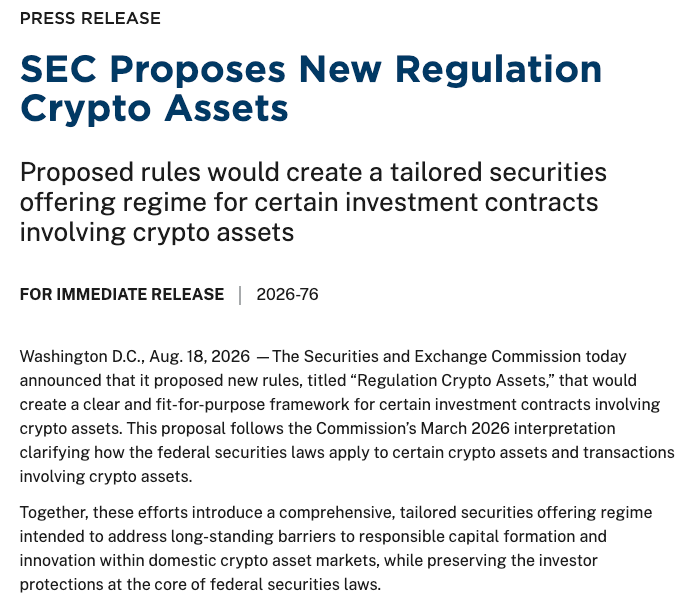
SEC's official statement, source: SEC website
For a detailed interpretation, see this article: "Interpretation of the SEC's New Crypto Regulation: No Registration Needed for Token Fundraising Under $5 Million—Is Altcoin Season Coming Back?"
Reversibility is currently "high," because at this moment it is only a proposal and can be declared void or rewritten. Once finalized in 2027–2028, it becomes "medium," requiring the rulemaking process to be redone. If it is pushed to the final stage of Trump's term, i.e., finalized around the end of 2028, it could also fall into the CRA's lookback window and be directly repealed by the new Congress.
3. CFTC's Crypto Asset Market Rules
The Commodity Futures Trading Commission (CFTC) is the agency that regulates futures, options, and other derivatives markets. Its current situation is very unusual: Chairman Michael Selig was confirmed by the Senate on December 18, 2025, by a vote of 53 to 43, and former Acting Chairman Caroline Pham subsequently left and joined MoonPay. In terms of legal authority, the CFTC has jurisdiction over crypto commodity transactions with leverage, margin, or retail financing; for fully paid spot transactions, it can only address fraud and manipulation. This "statutory ceiling" applies equally to a crypto-friendly commission and to a future more stringent commission.
Against this backdrop, on September 17, 2026, the CFTC sent a preliminary rule document titled "Crypto Asset Transactions and Crypto Asset Markets Rules" (RIN 3038-AF80) to the White House Office of Information and Regulatory Affairs (OIRA) for review. The text is now public in the form of an advance notice of proposed rulemaking (ANPRM), with a 60-day comment period after publication in the Federal Register, which has now ended.
The main content of this document defines the scope of crypto asset regulation: it only targets retail commodity transactions under Section 2(c)(2)(D) of the Commodity Exchange Act, i.e., retail crypto asset transactions with leverage, margin, or financing (Crypto Asset Transactions, or CTX). Such transactions must be conducted on a designated contract market (DCM) unless an exception applies. The document's definition of "crypto asset" excludes payment stablecoins issued by permitted issuers under the GENIUS Act, and it provides preliminary interpretations of what constitutes an "offer" and what constitutes "actual delivery."
Reversibility is "high." Measures at the pre-proposal stage are easily shelved when policy shifts.
4. CFTC Staff Guidance and "No-Action Letters"
CFTC staff issued crypto asset FAQs on March 20 and September 24, 2026, covering tokenized collateral and margin, among other things. In addition, Staff Letter No. 26-25 gave a "no-action" commitment for "passive software," i.e., staff indicated that under specific conditions they would not take enforcement action against providers of such software.
The specific contents of these documents are as follows:
- The December 2025 staff letter allows tokenized US Treasuries, money market fund shares, and other real-world assets to be used as collateral; 26-05 is a "no-action" position allowing futures commission merchants (FCMs) to accept non-security digital assets such as Bitcoin, Ethereum, and payment stablecoins as customer margin.
- March 20, 2026, added operational details to the above letters, providing that: crypto assets (including payment stablecoins) cannot be used as eligible margin for non-cleared swaps, but tokenized eligible collateral may be used as long as it confers the same legal and economic rights; clearinghouses may accept crypto assets, including payment stablecoins, as initial margin, provided that credit, market, and liquidity risk requirements are met.
- The March 17, 2026 staff letter granted a "no-action" position to wallet software developer Phantom Technologies, exempting it from registering as an introducing broker. The September 17 letter extended the same conditions to all "passive software providers," i.e., wallets or applications that only provide a front end and route users to regulated futures commission merchants, introducing brokers, and designated contract markets.
Reversibility is "high." Staff guidance and no-action letters can be withdrawn by staff or a new Commission.
5. Specific Implementing Rules of GENIUS (from Treasury, FDIC, NCUA, FinCEN)
Implementation of the GENIUS Act relies on a great many government agencies: the Office of the Comptroller of the Currency (OCC), the Treasury Department, the Federal Deposit Insurance Corporation (FDIC), the National Credit Union Administration (NCUA), and the Financial Crimes Enforcement Network (FinCEN) each handle a portion of the detailed rules, covering deposit insurance, credit union issuance of stablecoins, anti-money laundering obligations, and more. As of November 2026, about 13 rules remain in the proposal stage. Among them, Treasury's interim final rule on the state-level regulatory regime certification process took effect on September 30, 2026; Treasury's April 2026 "substantially similar" state-level regulatory principles have not yet been finalized. "Substantially similar" means that if a state's stablecoin regulatory regime is substantially similar to federal standards, its issuers can take the state-level path.
Reversibility in terms of "content" is "high." Rules at the proposal stage can be rewritten by new leadership or finalized in a different direction. But the statutory legislative authorization will not disappear, and the new administration must complete the rules within the legal framework rather than leave them hanging.
6. Executive Order 14178: "Strengthening American Leadership in Digital Financial Technology" (CBDC Ban)
This was the first major crypto executive order signed after Trump returned to the White House, dated January 23, 2025. It has three layers of effect: declaring federal government support for the development of the digital asset industry, prohibiting federal agencies from advancing central bank digital currencies (CBDCs), and establishing the "President's Working Group on Digital Asset Markets" (PWG), which is responsible for proposing regulatory framework recommendations.
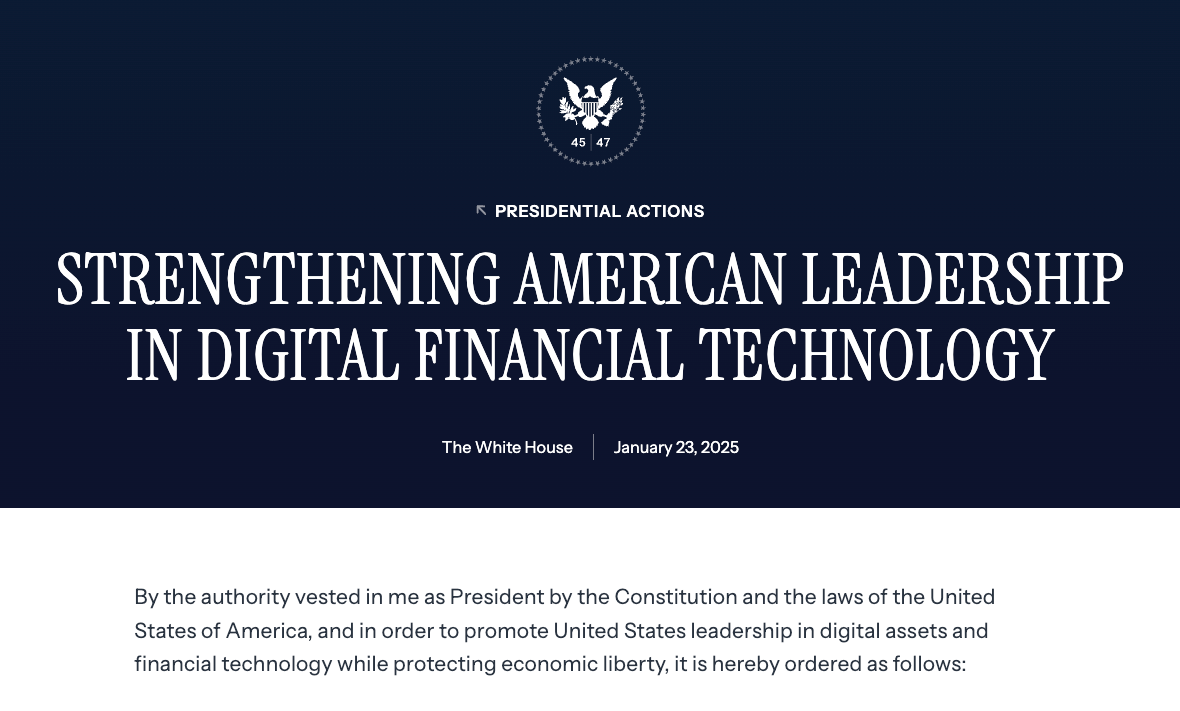
Original text of the order, source: White House website
The CBDC ban mentioned in item 34 currently relies solely on this order at the federal level.
Reversibility is "high." The next president can revoke it on day one. The CBDC ban will only become solid after Congress passes separate legislation.
7. Executive Order 14331: "Ensuring Fair Access to Banking Services for All Americans" (Anti-"Debanking")
"Debanking" refers to banks refusing to provide account services to specific individuals or businesses for non-financial-risk reasons such as political stance or industry reputation. During the Biden administration, the crypto industry long complained that it was the main victim. This order, signed on August 7, 2025, requires federal banking regulators to clean up related practices. The order itself does not create any rights that can be asserted in court; what actually creates binding effect are the final rules subsequently issued by the OCC and FDIC (see item 23).
The crypto industry's claim is that during the Biden era there was an operation targeting the crypto industry (Operation Choke Point 2.0). The name was coined by crypto venture capitalist Nic Carter, after three crypto-friendly US banks collapsed in succession; he believes this was a "conspiracy" aimed at preventing crypto companies from accessing banking services. The allegation itself remains controversial, but it became a core narrative of the Trump camp: at the March 2025 White House Crypto Summit, Trump announced the end of this operation; this executive order requires a retrospective review of past complaints and bank supervisory records. The order's text does not name "crypto"; it prohibits "politicized or unlawful debanking" of any lawful business, and the scope of protection is not limited to the crypto industry.
As for the order itself, reversibility is "high."
8. Executive Order 14405: "Integrating Financial Technology Innovation into the Regulatory Framework"
This order, issued on May 19, 2026, requires financial regulators to review their rules within 90-day and 180-day deadlines, removing obstacles to fintech and crypto business, and requires the Federal Reserve to submit a report on fintech firms' access to payment accounts. It is a continuation of the aforementioned executive orders, pushing the goal from "statements of position" to "cleaning up rules agency by agency."
Reversibility is "high"; the next president can revoke it on day one.
9. OCC Interpretive Letters
"Interpretive letters" are formal responses from the OCC on what banks "can do." Several letters issued in 2025 clarified that banks can provide crypto asset custody, participate in stablecoin business, operate blockchain nodes, and hold crypto assets to pay network fees.
The specific contents of the three letters are as follows:
- Letter 1183 confirmed that participating in distributed ledger activities such as independent node verification networks is permissible. It also withdrew Letter 1179, which had required banks to obtain a regulatory "no objection" before engaging in these activities;
- Letter 1184 allows banks to buy and sell assets held in custody at customer direction, and to outsource permitted custody-related services to third parties.
- Letter 1186 confirmed that national banks may pay blockchain network fees (i.e., gas fees) in order to conduct already-permitted business, and may hold crypto assets to test already-permitted crypto platforms.
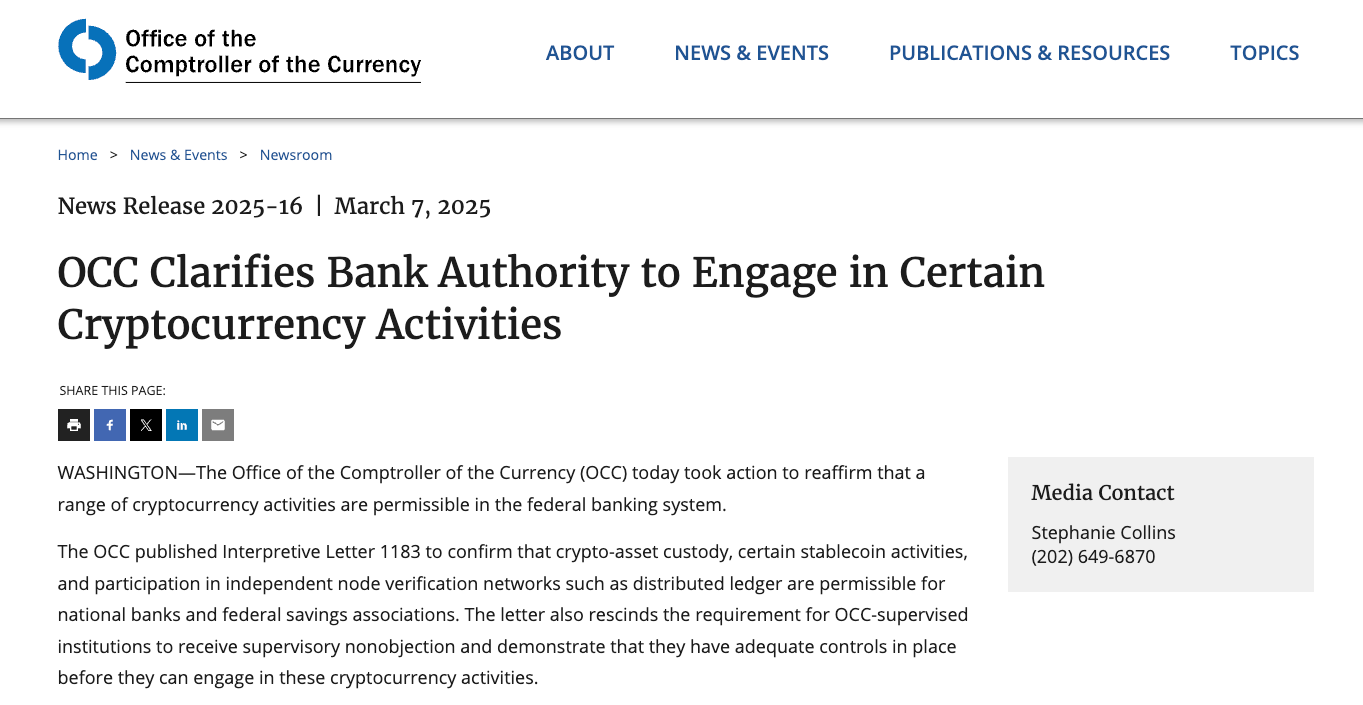
Original text of the interpretive letter, source: OCC website
Reversibility is "high." A new OCC head can directly withdraw these letters; such withdrawals have happened before, for example, Interpretive Letter 1179 issued in 2021