


How much revenue does every $1 spent on compute generate for Anthropic?


- Core View: Anthropic has updated its prospectus with an IPO valuation of approximately $1.33 trillion. The core tension lies in whether revenue per dollar of compute—which has fallen from a peak of $2.08 to $1.72—can be covered by new model iterations and usage growth against massive long-term compute contracts, determining both its profitability and valuation reasonableness.
- Key Elements:
- Q3 revenue was $17 billion, with quarter-over-quarter growth slowing from 144% to 47%, and revenue increments declining from $6.8 billion to $5.4 billion; of the $9.9 billion in compute spending, approximately $5 billion was high-cost short-term compute.
- Revenue per dollar of compute rose from $0.40 in Q1 2025 to $2.08 in Q2 2026, then fell back to $1.72 in Q3, with adjusted operating margin dropping from 19% to 15%.
- About 80% of revenue is usage-based; Claude Code drove growth, with annualized revenue run rate increasing from $500 million to over $2.5 billion; price cuts reduced Q3 revenue by approximately $600 million.
- Models released in the past six months contributed over 80% of revenue, with the technology premium dependent on continuous iteration; open-weight models already account for about 70% of token usage on some gateways.
- Contractual obligations total approximately $900.9 billion, almost entirely related to compute infrastructure; annual minimum payments from 2027 to 2030 are approximately $77 billion to $82 billion, and idle compute still incurs costs when demand is insufficient.
- The IPO price range is $70 to $78, with $74 corresponding to 8.4x 2027 revenue; Chiltern's sum-of-the-parts valuation is $69 and discounted cash flow valuation is $98, with a recovery in the compute revenue ratio above 1.8x set as a condition for adding to positions.
TL;DR
Revenue generated per $1 of compute and infrastructure cost rose from $0.40 in Q1 2025 to $2.08 in Q2 2026, before falling back to $1.72 in Q3. Of the roughly $9.9 billion in compute spending for the quarter, about $5 billion came from more expensive short-term compute.
Quarterly revenue grew roughly 45x over six quarters, reaching $17 billion in Q3, but quarter-over-quarter growth slowed from 144% to 47%, and the quarterly revenue increment also fell from $6.8 billion to $5.4 billion.
About 80% of revenue is usage-based. Claude Code allows the same pool of enterprise employees to hand more tasks to the model, and customers can also route some calls to cheaper models.
Models released in the past six months contributed more than 80% of Q3 revenue. Anthropic must sustain its premium through new versions while recovering training investment before older versions are displaced.
The revised prospectus discloses about $900.9 billion in contractual obligations, almost all related to compute and infrastructure. Chiltern estimates that annual minimum payments on compute contracts from 2027 to 2030 will be roughly $77 billion to $82 billion.
Anthropic's IPO price range is $70 to $78 per share, with $74 implying a fully diluted equity valuation of about $1.33 trillion. Chiltern's sum-of-the-parts valuation is $69 per share, its base-case DCF valuation is $98, and it lists a recovery in the compute revenue ratio to above 1.8x as one of its conditions for adding to the position.
Editor's note: On November 10, Claude developer Anthropic updated its prospectus and plans to list on Nasdaq at $70 to $78 per share. At $74, Chiltern Capital's fully diluted equity valuation is about $1.33 trillion. Meanwhile, Google and Nvidia each plan to subscribe $10 billion, with seven strategic investors subscribing a combined $26 billion. The companies funding Anthropic are also selling it chips, compute, and cloud services.
Behind this valuation lies a concrete question. For every $1 Anthropic invests in compute, how much revenue can it generate? Q3 revenue grew 47% quarter-over-quarter to $17 billion, yet revenue per dollar of compute fell from $2.08 to $1.72, and the adjusted operating margin declined accordingly. Most customers pay for actual usage, while Anthropic has signed compute and leasing contracts years in advance. Whether paid usage can keep pace with new capacity deliveries will determine whether the next batch of compute boosts profit or drives up costs.
Chiltern is a heavy paying customer of Claude and also uses Claude to help read prospectuses, build valuation models, and draft research. The firm is willing to build half a position within the price range and lists a recovery in revenue per dollar of compute to above $1.80 as one of its conditions for adding to the position.
The following is the original text:
For every $1 invested in compute, how much revenue can it generate?
Chiltern divides quarterly revenue by compute and infrastructure costs for the same period, with the denominator including both training and inference spending. In Q3 2026, $17 billion in revenue divided by about $9.9 billion in compute costs equals roughly $1.72. The company must also pay channel fees, personnel, and other operating expenses out of that revenue.
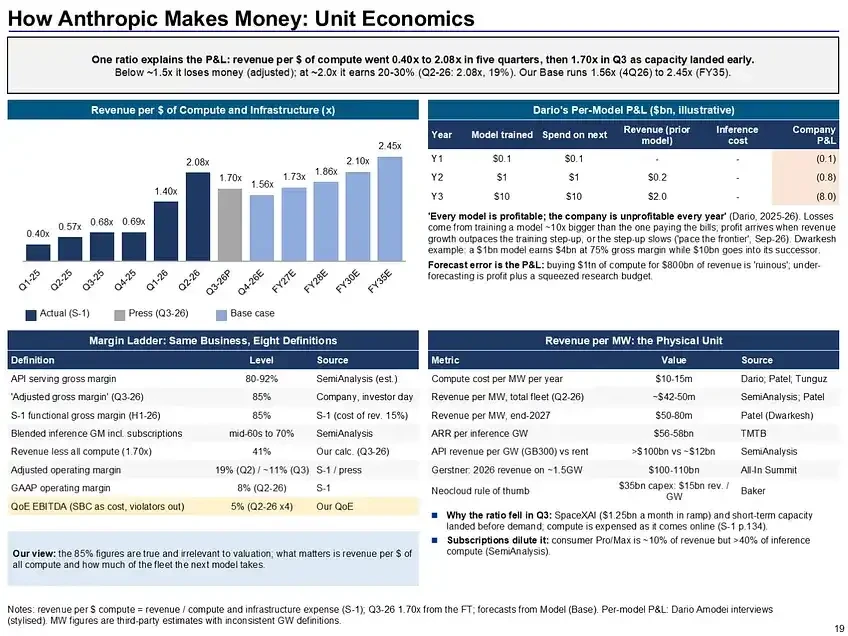
In Q1 2025, every $1 Anthropic spent on compute generated only $0.40 in revenue. By Q2 2026, that figure had risen to $2.08. The effects of scaling are also reflected in cost ratios. Compute and infrastructure costs fell from 160% of full-year 2025 revenue to 57% of revenue in the first nine months of 2026.
In Q3, this ratio fell back to 1.72x, and the company's adjusted operating margin declined from 19% to 15%. Of the roughly $9.9 billion in compute spending for the quarter, about $5 billion came from more expensive short-term compute. At the same time, the quarterly revenue increment fell from $6.8 billion to $5.4 billion. Whether subsequent long-term compute deliveries can lower unit costs, and whether new capacity can be fully utilized by paid demand, will determine whether the ratio can recover.
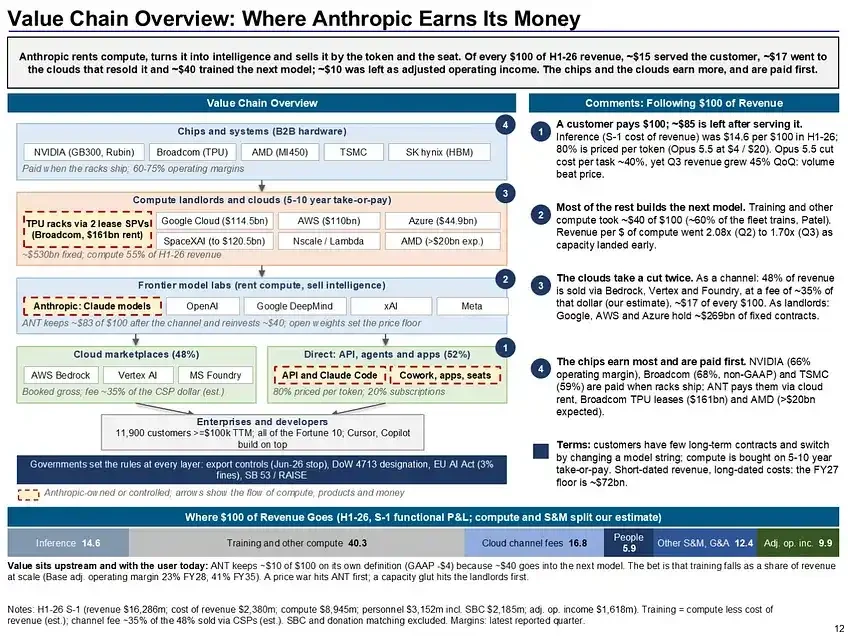
According to Chiltern's breakdown of the cost structure, of every $100 in revenue, about $15 goes to inference—running models and handling customer requests—and about $40 to training and research compute. The more expensive and faster-iterating next-generation models become, the more the company needs to recover training investment in a shorter time. Of the roughly $104 billion net loss in the first three quarters, about $94 billion came from non-cash fair value changes on convertible bonds and other financing instruments, while operating cash flow for the same period was about positive $6.6 billion. Measuring profitability from day-to-day operations also requires looking at training expenses, channel fees, and stock-based compensation.
Claude Code drives more usage, while price cuts lower revenue per call
Anthropic's revenue was $41 million in 2023, rose to $4.6 billion in 2025, and reached $33.2 billion in the first nine months of 2026. Claude Code is a key driver of this growth. It can execute multi-step tasks within a codebase. Once enterprises connect permissions, project context, and engineering workflows, the same pool of employees can hand more work to the model. According to company disclosures, Claude Code's annualized revenue run rate rose from about $500 million in September 2025 to more than $2.5 billion in February 2026. Run rate is an annualized level extrapolated from recent revenue.
About 80% of Anthropic's revenue is charged by usage, with enterprises and developers paying based on the tokens the model reads and generates (the unit of processing for text and other content), while the remaining roughly 20% mainly comes from subscriptions. Even if seat counts change little, more tasks and longer tasks can generate more revenue. This structure also makes revenue sensitive to model pricing and customer procurement decisions. As of the end of September, remaining performance obligations were $13.8 billion, of which about three-quarters are expected to be recognized within one year. Revenue concentration from the top five customers fell from 36% in Q1 to 21% in Q3, though migration by top customers can still affect quarterly performance.
Opus 4.5, launched in November 2025, is about 67% cheaper than its predecessor, and revenue growth in the following two quarters reached 132% and 144% quarter-over-quarter, respectively. Chiltern sees this as evidence that price cuts are unlocking demand. By Q3 2026, the company estimates that price cuts reduced quarterly revenue by about $600 million. New usage must be sufficient to offset the decline in unit price and cover the added inference costs for those requests in order to improve revenue output per dollar of compute.
Channels also change the revenue basis for this ratio. In the first nine months of 2026, about 44% of revenue was sold through the cloud marketplaces of AWS, Google, and Microsoft. Anthropic recognizes the related revenue on a gross basis, with channel fees accounted for separately. Chiltern estimates that on a net basis, revenue for the past 12 months would be about 15% lower, with EBITDA unchanged. When comparing model companies using revenue multiples, channel accounting also affects the results.
New models contribute 80% of revenue, and the technology premium depends on continuous iteration
The prospectus shows that more than 80% of Q3 2026 revenue came from model versions released in the past six months. According to benchmarks compiled by Chiltern, Opus 5.5 leads on the composite capability metrics of Artificial Analysis and Epoch. In Artificial Analysis testing, Opus 5.5 costs about $5.98 per task, while GPT-6.1 Sol costs about $0.72, a difference of 6 scoring points. How many tasks enterprises are willing to pay that price gap for will determine whether Anthropic can recover its next round of training investment.
Open-weight models already account for about 70% of token usage on OpenRouter and the Vercel gateway, while closed-source models still account for 73% and 77% of spending on the two gateways, respectively. Anthropic's share of spending on Vercel fell from 64% in August to 44% in September. Vercel's customers skew toward startups, so single-month data is of limited representativeness. If cheaper models continue to narrow the capability gap, Claude will need to sustain its premium through higher-value tasks.
Security reviews, export restrictions, and corporate governance will also affect the pace of new model releases. The prospectus discloses that the Long-Term Benefit Trust can appoint four of seven directors, and the founder entity holds a fixed 50.1% voting power. Chiltern believes that delaying releases or restricting the scope of openness could alter the revenue growth trajectory. The firm views Cowork, industry tools, and international markets as potential growth sources, with the base case supported mainly by businesses that already have sales.

Long-term contracts lock in payments, and demand determines whether capacity can be fully utilized
The revised prospectus discloses total contractual obligations of about $900.9 billion, almost all related to compute and infrastructure, including about $112.3 billion in commitments signed after the end of September. Within 12 months from the end of September, about $70.7 billion is expected to be paid. Chiltern estimates that about $452 billion will mature cumulatively by the end of 2030. The prospectus discloses that about $186.2 billion of commitments are conditional or may be terminated before commencement.
After excluding cancellable portions, Chiltern estimates that annual minimum payments from 2027 to 2030 will be roughly $77 billion to $82 billion. When demand fails to keep up, idle compute still generates contractual expenses. In Chiltern's model, if revenue per dollar of compute remains below about $1.50, Anthropic would be loss-making on an adjusted basis. The firm's base case expects that as compute deliveries concentrate, the ratio may first fall to 1.51x in Q4 before recovering to 1.87x in 2028.
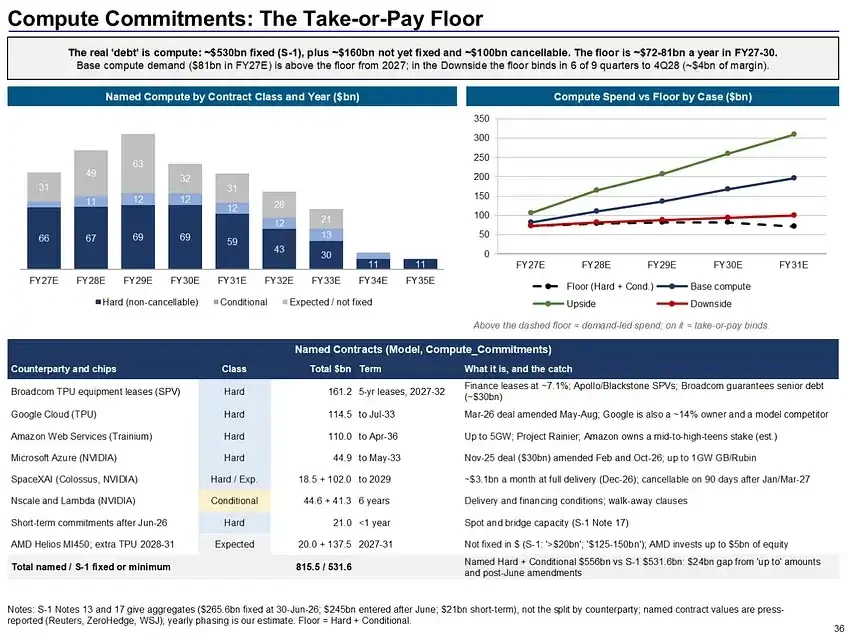
Funding and compute often come from the same group of companies. Google participates in funding while also leasing TPU compute to Anthropic. Amazon is both an investor and a supplier of Trainium compute. Broadcom has also agreed to provide up to $42 billion in note financing, with the funds restricted to paying related rent. Chiltern expects Anthropic to have about $216 billion in cash at year-end after the IPO. Its stress test assumes revenue stalls at a Q4-annualized $86 billion, and the results show about $147 billion in liquidity remaining at the end of 2031. Under this set of assumptions, a growth stall would first weigh on profit and valuation.
Buying at $74 requires a recovery in compute efficiency
At $74, Chiltern estimates Anthropic's enterprise value at about 8.4x its forecast 2027 revenue, versus a median of 6.6x for 16 comparable listed companies. Comparing the usage-based business with AI compute companies and the subscription business with high-growth software companies yields a sum-of-the-parts valuation of about $69 per share. The base-case DCF valuation is $98. Backing out from base-case margins, $74 corresponds to about $406 billion in revenue in 2035, implying a compound annual growth rate of about 25% from 2026 to 2035.
Chiltern's base case expects revenue of $133 billion in 2027 and $194 billion in 2028, with adjusted operating margin rising to 25%. Using an exit at the end of 2028, the base case is about $120 per share, the bull case about $279, the price-war case about $34, and the severe stress case of losing technological leadership about $18. The firm assigns weights of 45%, 20%, 25%, and 10% to the four scenarios, respectively, yielding a probability-weighted exit price of about $120 and a 35% probability of loss.
Chiltern is willing to build half its planned position at $70 to $78 per share, equivalent to about 0.8% of net portfolio value. Its Q4 revenue base expectation is $21.5 billion. Revenue above $22.5 billion, revenue per dollar of compute recovering above $1.80, or the stock falling below about $66 could all support adding to the position. If it rises to about $92 on the first day, its model's expected annualized return falls to 13%, below its 15% threshold. What the first post-IPO earnings report must test is whether, after long-term compute gradually replaces expensive short-term capacity, Claude's usage can bring revenue per dollar of compute back to nearly two dollars.





