


2028 — A Pit Dig by the US Midterm Elections for the AI Upstream Supply Chain


- Core View: After the US midterm elections, new governors in Texas and Ohio plan to pause data center approvals. Morgan Stanley estimates roughly 5GW of capacity will be delayed from 2028 to 2029, creating a tech supply chain "air pocket" in 2028. However, the overall logic of AI capital expenditure remains intact—this is merely a timing mismatch.
- Key Elements:
- Democrats win the governorships of Texas and Ohio. The two states' combined 2028 data center capacity exposure is approximately 4.9GW, and new approval policies push projects back.
- US data center net new capacity falls 4% year-over-year in 2028 and rebounds 38% in 2029; globally, capacity grows 9% in 2028 and 20% in 2029.
- Cloud semiconductors are hit first: Aspeed's price target is cut by roughly 40%, Montage by roughly 52%, and the legacy memory sector is downgraded ahead of schedule on expectations that pricing power has peaked.
- Hyperscaler capex forecasts remain unchanged (e.g., Google's 2027/2028 combined $375 billion/$400 billion), with the impact being delays rather than cancellations; some projects may shift to Tennessee, Louisiana, and overseas.
- ERCOT interconnection applications reach approximately 474GW, more than 5x historical peak electricity demand; data centers account for roughly 90% of new power requests, making power—not chips—the new bottleneck in the AI race.
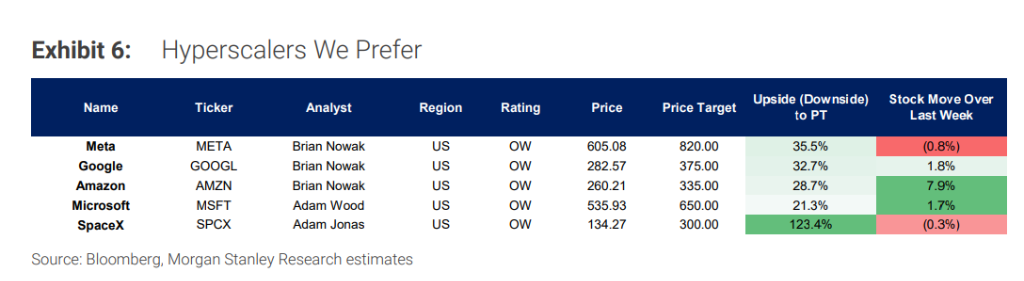
- Morgan Stanley recommends focusing on large cloud providers, select data center supply chain names, software enablers, and AI application adopters, believing the market has overreacted.
Original author: Long Yue
Original source: Wallstreetcn
One election has forced Wall Street to reassess the pace of AI buildout.
In November 2026, the results of the US midterm elections came in. The Democratic Party not only won both chambers of Congress but also secured governorships in Texas and Ohio—two states that happen to be home to the densest concentration of US data center construction.
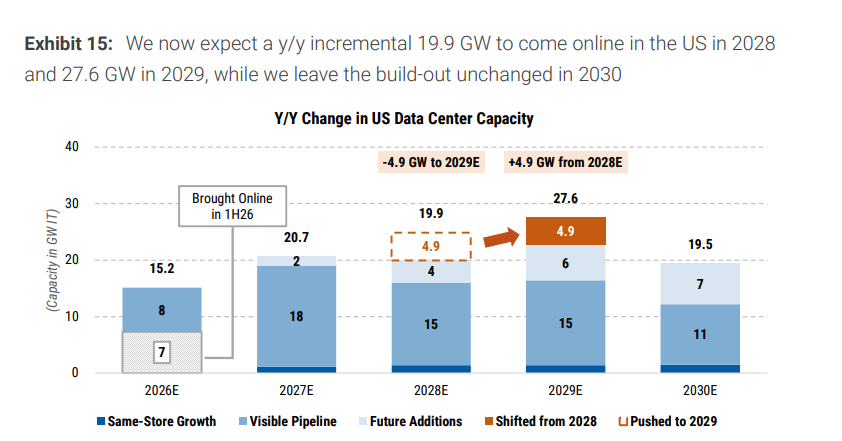
Morgan Stanley's latest research report "Buy the Drop: AI Investment Opportunities Post the US Midterms" concludes that after the blue wave in the US, roughly 5GW of US data center capacity will be delayed from 2028 to 2029, equivalent to 20% of that year's US incremental capacity and 10% of global incremental capacity.
The direct result of this delay: US data center GW incremental capacity will decline 4% year-over-year in 2028 and rebound 38% in 2029; at the global level, it will grow 9% year-over-year in 2028 and 20% year-over-year in 2029.
The US midterms also seem to have "dug a pit" for the AI upstream supply chain—and its name is 2028. Morgan Stanley worries that the large number of delayed data centers "could create an 'air pocket' in the tech supply chain in 2028, leading to weakened pricing power or inventory buildup. There could even be order slowdowns, margin normalization, and earnings downgrades, even if AI demand itself remains intact."

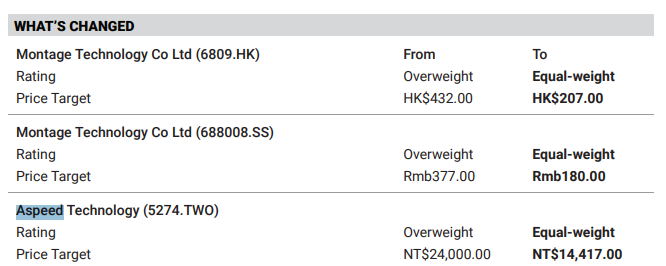
As for the impact of the 2028 "air pocket," upstream cloud semiconductors are the first to be hit. Analysts promptly slashed price targets for Asian cloud semiconductor suppliers such as Aspeed, citing the risk of US project delays over the next 2-4 quarters; the old memory sector was also downgraded, on expectations that pricing power has "peaked" earlier than anticipated.
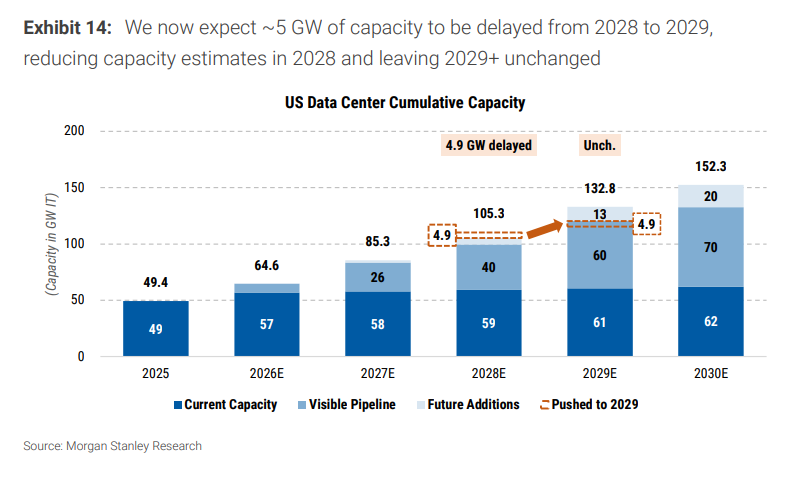
US data center cumulative capacity trajectory: 2028 revised down from 110GW to 105GW
Why 2028? How the Election Dug the Pit
The direct trigger for the data center delays comes from the US midterm elections.
The Democratic Party won governorships in multiple states, including Texas and Ohio. Texas Governor-elect Gina Hinojosa's campaign platform included: pausing approvals for new data centers until the Texas legislature enacts stronger protections. Ohio Governor-elect Amy Acton proposed a conditional pause on new data centers and new permits, requiring projects to pay 100% of natural gas, water, and electricity costs and to use union labor.
Analysts' assessment: projects already under construction in 2027 are largely unaffected, because "newly elected governors are unlikely to disrupt projects already in progress." The delay risk is concentrated in 2028 projects that have not yet broken ground.
The report notes that Texas and Ohio previously had a combined data center capacity exposure of approximately 4.9GW (IT basis) in 2028. These projects face deferral due to new approval processes.
At the same time, ERCOT (the Texas grid) has received interconnection applications totaling approximately 474GW, more than 5 times its historical peak electricity demand, with data centers accounting for about 90% of new power requests. Power bottlenecks have long existed; the election results merely layered policy uncertainty on top.
The "Pit" in the Upstream Supply Chain: Cloud Semiconductors Hit First
What does the 2028 air pocket mean for the AI upstream supply chain?
Morgan Stanley's Asia semiconductor team quickly followed up with a report "Cloud Semis: Peak Growth, Less Upside," pointing out that cloud semiconductors face "Peak Growth, Less Upside."
Aspeed is a core supplier of server baseboard management controllers (BMC), directly benefiting from the data center buildout cycle. Data center semiconductor company Montage's core product is the memory interconnect chip for server DRAM.
Both companies' price targets were sharply cut:
- Aspeed: price target cut from NT$24,000 to NT$14,417, a decline of about 40%
- Montage: price target cut from HK$432 to HK$207, a decline of about 52%
Analysts explained that the core logic behind the downgrades is: "The US team expects about 20% of 2028 US data center incremental capacity could shift to 2029, potentially affecting cloud semiconductor suppliers' 2028 earnings."
"Peak Pricing Power" for Old Memory: Earlier Than Expected
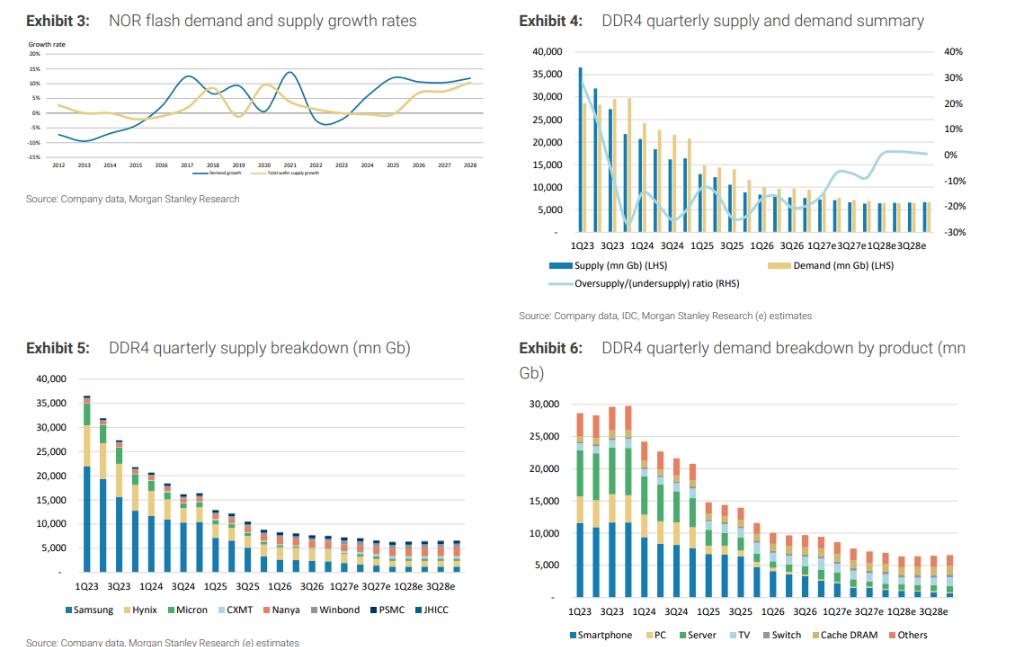
Meanwhile, Morgan Stanley's old memory research team published a report "Old Memory: Peak Pricing Power? Reduce exposure," downgrading Winbond, GigaDevice, Powerchip, and Macronix all from Overweight to Equal-weight, with Phison cut further to Underweight.
The report explicitly states that the scope of analysis is limited to DDR3/4, SLC/MLC NAND, and NOR, and does not cover the mainstream DDR5 or TLC/QLC NAND markets.
The core judgment is: "The pricing advantage of old memory is no longer sufficient."
The report lists three pressures:
- Deteriorating visibility of cloud spending
- Weak consumer demand
- Supply and demand normalizing by 2028
The most direct trigger is precisely the deferral of US data center construction timelines. "An air pocket could emerge in the 2028 tech supply chain, potentially leading to declining pricing power and inventory buildup."
The report particularly emphasizes that these companies' 2026 EPS is actually still being revised upward; the core of the downgrades is "cycle inflection management" rather than an earnings collapse.
Stocks can begin to reprice before the recent tightness necessarily disappears: narrowing shortages alone are enough to erode incremental pricing power before earnings peak.
Hyperscalers: Capex Unchanged, but Timing Misaligned
Despite project delays, Morgan Stanley maintains its capex forecasts for hyperscale cloud providers: Google/Alphabet $375 billion/$400 billion combined for 2027/2028, Meta $225 billion/$250 billion, Amazon $355 billion/$365 billion, Microsoft $238 billion/$298 billion—all unchanged.
The report believes these companies will still "build as much capacity as possible," because new products powered by large language models serve billions of users and still offer returns on capital exceeding 30%.
But "how much to spend" and "when it gets built" are two different things.
The report notes that the impact of delays is more about "deferral rather than cancellation." Some projects may shift from Texas and Ohio to more friendly states such as Tennessee and Louisiana. Overseas, Morgan Stanley predicts potentially 20GW of spillover demand flowing to Asia and the Europe-Middle East-Africa region.
Meta says it aims to achieve a 10x improvement in compute efficiency by 2027; Google's TPU 8t and 8i deliver up to 2.7x higher training performance and 80% better inference price-performance versus the previous generation, respectively.
These efficiency gains are viewed as buffer tools to cope with capacity constraints.
Silicon Valley's Confidence vs. Wall Street's Caution
On this 2028 "air pocket," the market does not speak with one voice.
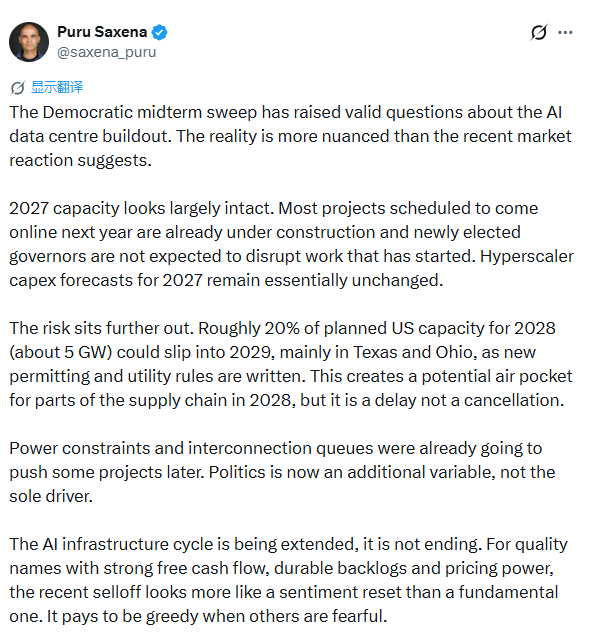
Investor Puru Saxena (founder of AlphaTarget) posted on social media with a view broadly consistent with Morgan Stanley but more concise: "The Democratic midterm landslide does raise legitimate questions about AI data center construction, but the reality is more complex than the recent market reaction suggests."
He pointed out that 2027 capacity is "largely intact" because most projects coming online next year are already under construction, and newly elected governors are not expected to interrupt projects already underway.
"The AI infrastructure cycle is being stretched out, not ended," he wrote, citing the investing maxim: "It pays to be greedy when others are fearful."
This aligns with Morgan Stanley's core stance—but Wall Street's analysis is more granular: companies at different points in the supply chain, in different geographic locations, and with different capital structures face vastly different risks.
The scarcity of already-built data center assets with secured power will increase; financing quality divergence will deepen; neoclouds and new-build projects will face stricter scrutiny, while large cloud providers will further consolidate their advantages through scale and capital strength. Morgan Stanley says:
Financing remains available, but the midterms should deepen the quality divide.
Who Fills the 2028 Pit?
Morgan Stanley's entire analytical framework points to one core conclusion: AI demand has not disappeared, but the misalignment in buildout timing will create a real supply chain pressure window in 2028.
This "pit" was not dug by technological failure, but by a set of state-level elections, a batch of new permitting requirements, and 474GW of backlogged ERCOT interconnection applications.
Power—not chips—is becoming the new bottleneck in this AI race.
The report ultimately recommends investors watch three categories of opportunity: large cloud providers, select data center supply chain names, and software enablers and AI application adopters.
We believe the market reaction is overdone—deferring some projects from 2028 to 2029 rather than undermining the overall capex thesis.





