SEC Crypto Regulation New Rule Explained: Issuance and Fundraising Under $5 Million Exempt from Registration—Is the Altcoin Season Coming Back?


- Core Takeaway: On August 18, 2026, the SEC released a new rulemaking proposal, "Regulation Crypto Assets," establishing a tailored exemption framework for crypto asset issuances. This move advances regulation proactively amid the stalled CLARITY Act in Congress, providing a legal pathway for altcoin issuance and clarifying the conditions under which tokens shed their securities status.
- Key Elements:
- The startup exemption allows cumulative fundraising of up to $5 million over four years, requiring only narrative disclosure with no audit requirement, simplifying the process.
- The fundraising exemption, modeled after Regulation A+, permits raising up to $75 million every 12 months, accompanied by audited financial statements and ongoing reporting obligations. Both exemption tiers retain applicability of anti-fraud provisions.
- The investment contract safe harbor stipulates that tokens can shed their securities status once the project team completes or permanently ceases the promised "essential managerial efforts," thereby no longer falling under SEC oversight or state law restrictions.
- The new rule originates from the President's Working Group report and joint SEC-CFTC guidance, categorizing crypto assets into five major classes to provide a direct theoretical foundation.
- The CLARITY Act has faced legislative gridlock, with Polymarket prediction probabilities dropping from 82% to 21%, prompting the SEC to leverage its rulemaking authority to act first.
- The rule is expected to take months or longer to become effective, with a 60-day public comment period. Hester Peirce plans to step down in November 2026, which may affect forward momentum.
Original: Odaily Planet Daily (@OdailyChina)
By jk
The U.S. Securities and Exchange Commission (SEC) officially released a new rule proposal titled "Regulation Crypto Assets" on August 18, North American local time, establishing a "tailored" issuance framework for investment contracts involving crypto assets. This marks the most significant substantive move in crypto regulation since SEC Chairman Paul Atkins took office, and it is also a key signal that the regulator is proactively forging its own path amid the continued stagnation of the CLARITY Act in Congress.
What the New Rules Are: Two Exemptions, Altcoins Can Start Moving Forward
According to the SEC's official release, the core of "Regulation Crypto Assets" includes two registration exemptions under Section 5 of the Securities Act of 1933, as well as a conditional safe harbor rule.
1. Startup Exemption
This allows early-stage projects to raise cumulative funds of no more than $5 million over a maximum period of four years without completing the full registration process. Issuers only need to provide principle-based narrative disclosures, with a relatively streamlined process closer to a notice filing.
2. Fundraising Exemption
This allows issuers to raise no more than $75 million within any 12-month period. This exemption mechanism largely mirrors the existing Regulation A+ framework, with two tiers. In addition to narrative disclosures, issuers must also submit audited financial statements and assume ongoing reporting obligations. Issuers under both exemptions are not exempt from the anti-fraud and anti-manipulation provisions of federal securities laws.
In other words, if an issuer needs to raise funds by issuing tokens, they can choose to utilize one of the two exemptions depending on the scale of fundraising, without having to go through the traditional, time-consuming, and costly full SEC registration process:
- For smaller-scale early-stage fundraising (no more than $5 million total over 4 years): For example, a newly launched project looking to sell tokens on a small scale to bootstrap development can use the Startup Exemption, which only requires plainly written narrative disclosures about the project. No audited financial statements are needed, and the process is simple — closer to a filing than an approval.
- For larger fundraising rounds (up to $75 million annually): For example, a project with some existing foundation looking to raise funds from a broader public audience would use the Fundraising Exemption. In addition to narrative disclosures, issuers must also provide audited financial statements and continue to report to the SEC after raising the funds (similar to periodic disclosure obligations for listed companies).
Under these registration rules, issuing altcoins in the United States would be completely legal.
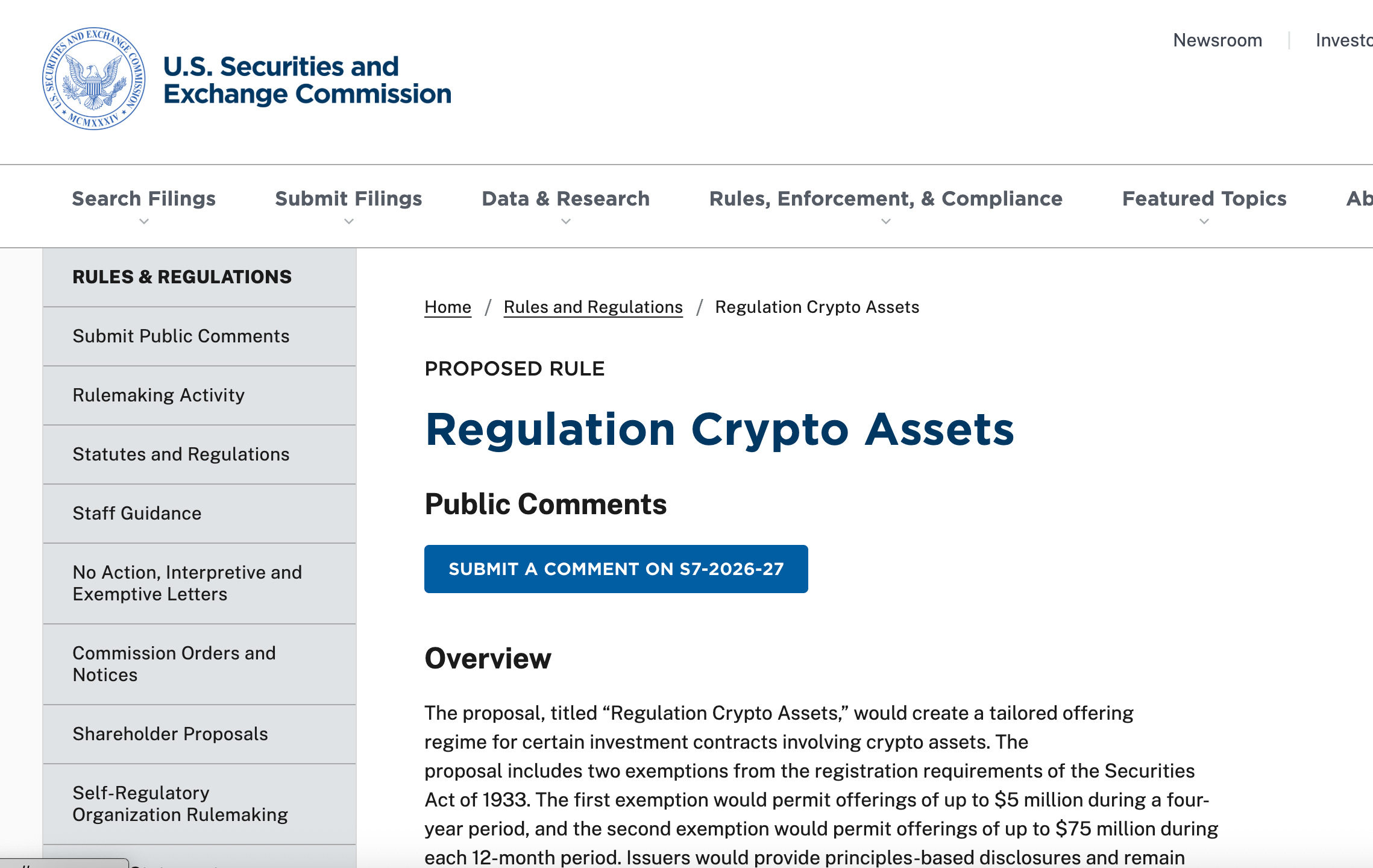
Original text on SEC website. Source: SEC
3. Investment Contract Safe Harbor
Under this safe harbor provision, once an issuer has completed or permanently ceased the "essential managerial efforts" it previously promised investors it would undertake, the relevant crypto asset will be deemed no longer subject to "investment contract" classification — meaning the asset can "detach" from its securities status.
Additionally, the proposal includes a redefinition of "qualified purchaser," which means securities issued under the "Regulation Crypto Assets" exemptions, as well as related secondary market transactions, will be exempt from state securities law registration and qualification requirements (i.e., federal preemption of state law).
In other words, if a token was originally sold as an "investment contract" (e.g., the project team promised "we will work hard to develop, maintain, and operate this network, and the token will have value in the future"), as time goes on, as long as specific conditions are met, that token can no longer be regulated as a security:
The trigger condition is that the project team has done everything it committed to, or has stopped doing it entirely. Either the project team has completed the "essential managerial efforts" it originally promised (e.g., the network has been built and is sufficiently decentralized, no longer relying on a specific team to maintain it); or the project team has permanently ceased fulfilling those commitments (e.g., the team disbanded, or development was abandoned). In short, as long as investors can no longer reasonably expect the project team to continue "working" for the token, the token can detach from the investment contract framework and no longer constitute a security.
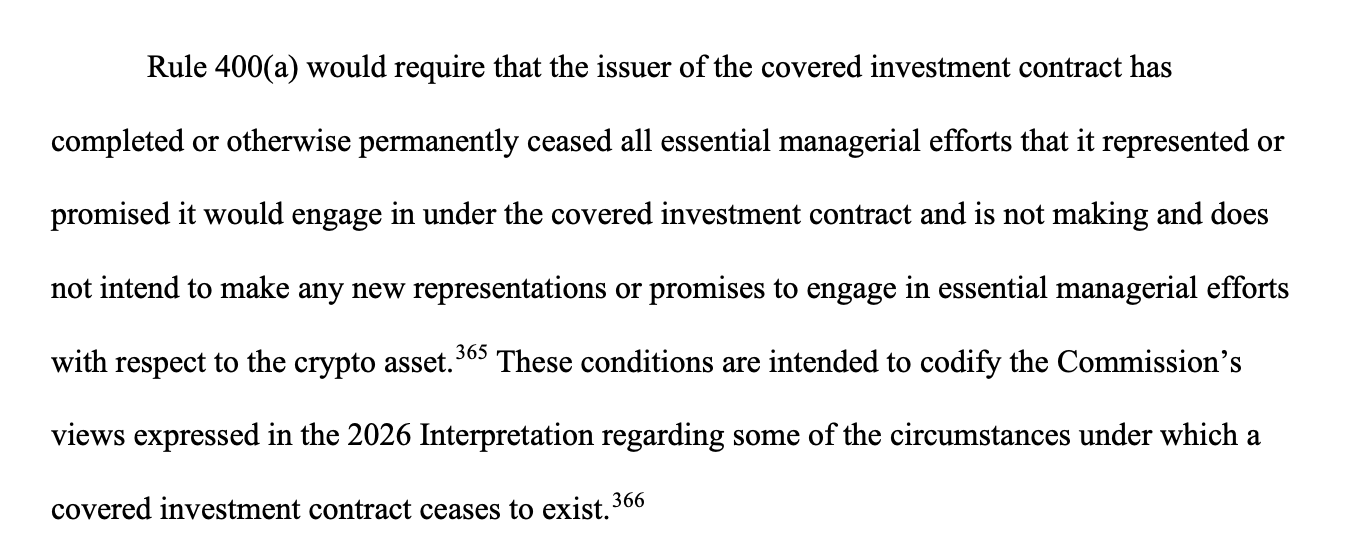
Original text on official website. Source: SEC
Once the conditions are met, buying, selling, and transferring the token is no longer treated as a securities transaction. It no longer requires securities registration, is not subject to lock-up rules, and exchanges can list and trade it more freely.
When a token is first issued, it is treated as a security because the project team promises "I will work to make it valuable." But once the team fulfills its promises (or completely gives up), the token can become an ordinary asset not subject to securities laws.
In other words, all tokens whose teams have abandoned them would no longer be considered securities, would not be subject to SEC oversight, and large trades would not require reporting — clearing all regulatory hurdles.
Notably, the SEC's proposal specifically defines a new term, "covered investment contract," limiting it to:
(1) Involving a crypto asset;
(2) Where the crypto asset itself is not a security;
(3) Where the investment contract does not involve any other asset besides that crypto asset (whether security or non-security).
This strict scope definition means the two exemptions and the safe harbor apply only to narrowly defined crypto asset issuance scenarios, and do not apply to offerings involving "security-type" or "tokenized securities."
The Reason Behind This Proposal: The CLARITY Act Is Faltering
"Regulation Crypto Assets" represents the continuation and implementation of a series of SEC policy actions over the past year and a half:
- January 2025: President Trump signed an executive order on "Strengthening American Leadership in Digital Financial Technology," establishing the "President's Working Group on Digital Asset Markets."
- Early 2025: The SEC established the Crypto Task Force, led by Commissioner Hester Peirce, soliciting public input and receiving more than 300 comment letters.
- July 2025: The President's Working Group released a report explicitly recommending that the SEC use its rulemaking and exemption authority to establish tailored registration exemptions, time-limited safe harbors, and an exemption arrangement for airdrops for securities offerings involving digital assets. Atkins subsequently announced the launch of the "Project Crypto" initiative.
- March 17, 2026: The SEC and CFTC jointly released the "2026 Interpretive Guidance," which for the first time systematically classified crypto assets into five major categories — digital commodities, digital collectibles, digital instruments, stablecoins, and digital securities — and clarified the criteria under which non-security crypto assets fall into or out of investment contract classification. This guidance serves as the direct theoretical foundation for the current "Regulation Crypto Assets" proposal.
- August 18, 2026: "Regulation Crypto Assets" was officially published as a rule proposal, entering a 60-day public comment period.
The SEC acknowledged in the proposal that its past approach to regulating crypto assets relied primarily on the Howey Test established by the Supreme Court in 1946. This "forcing a square peg into a round hole" approach has two major flaws: first, the Howey Test itself is difficult to apply to crypto assets, a new type of asset whose rights attributes evolve over time; second, the disclosure requirements of existing rules (such as Regulation S-K and Form 1-A) often diverge from the information crypto asset investors genuinely care about (such as tokenomics, network governance mechanisms, and source code security). This is why Rule 103's "principle-based disclosure requirements" were specifically designed in this proposal.
More critically, the SEC's decision to act proactively at this juncture is directly linked to the severe obstruction of the legislative process in Congress. The CLARITY Act, originally viewed as the "ultimate solution" for the crypto industry, has faced repeated setbacks in the Senate since the beginning of this year — from disagreements between the crypto industry and the banking sector over stablecoin reward provisions, to ethical controversies surrounding Trump's personal crypto asset interests. The bill has consistently failed to secure enough votes in the Senate.
On Polymarket, the contract pricing for "CLARITY Act to be signed into law by end of 2026" has declined from a February peak of nearly 82% to the 18%-21% range by mid-August. Although the Senate Majority Leader filed a motion for cloture on August 8 and scheduled a procedural vote for September 15, the vote requires 60 votes in favor. Based on current Republican seat counts, this would still require roughly 10 Democratic senators to defect — no small feat.
It is against this backdrop of stalled legislation and sustained pressure from markets and the industry that White House crypto policy advisor Patrick Witt stated at the SALT conference that the administration is "giving the Senate and Congress ample opportunity" but "won't wait forever." He indicated that if the September legislative window fails, regulators will proceed with their own rulemaking. "Regulation Crypto Assets" is the concrete implementation of this stance. With congressional legislation hanging in the balance, the SEC has chosen to leverage its existing rulemaking and exemption authority to provide the crypto industry with an interim regulatory framework first, rather than waiting idly for a bill that could die at any moment.
Timeline: When Will It Become Official Rules?
"Regulation Crypto Assets" is currently still in the proposal stage and has not yet taken effect. Key milestones ahead are as follows:
- August 18, 2026: SEC officially releases the proposal, docket number S7-2026-27.
- Within 60 days of release: Public comment period opens. Anyone can submit comments via the SEC website or email. The deadline will be determined after the proposal is formally published in the Federal Register.
- After the comment period closes: The SEC must review and respond to all substantive comments before deciding whether — and in what modified form — to formally adopt the final rules ("adopting release"). There is no statutory deadline for this process. Historically, similar rules have taken anywhere from several months to more than a year from proposal to final adoption.
- November 2026: Hester Peirce plans to depart the SEC, which could impact the internal momentum for advancing this framework.
Overall, for "Regulation Crypto Assets" to ultimately take effect, it still needs to go through the full comment, revision, and formal adoption process, which is not expected to be completed in the short term (within a few months). Meanwhile, the parallel legislative process for the CLARITY Act remains highly uncertain. For the crypto industry, this means that for the foreseeable future, the regulatory environment for crypto asset issuance in the United States will remain in a transitional state — a race between rulemaking and legislation with the outcome still undecided.