What happens if the CLARITY Act ultimately fails to pass?


- Core Viewpoint: The US CLARITY Act is stalled in the Senate due to conflict of interest ethical review clauses. Its probability of passing this year has dropped from 82% in February to 35%. If it ultimately fails, the market impact will be limited, but the political landscape will undergo significant changes.
- Key Elements:
- Reasons for Legislative Stalemate: The primary controversy lies in the ethical review clause concerning high-ranking government officials' conflicts of interest with crypto assets. Democrats see it as a check on presidential power and have linked it to the political agenda opposing Trump.
- Market Expectations: Polymarket data shows only a 35% probability of the bill being signed within the year. The market has already priced in this pessimism. The downward pressure on Bitcoin's price is primarily influenced by macro liquidity factors.
- Impact on Coinbase: Analysts predict that if the bill fails, the stock price could drop to the $140-$160 range. However, long-term growth remains supported by the trend of institutional allocation. The expected earnings per share for the July 30 earnings report is $0.19 (a sequential improvement).
- Complex Effect on Circle: Some analysts believe that the failure of the bill might not necessarily be bearish for Circle; it could even reduce competitors in the stablecoin space. However, if the clause limiting stablecoin yield is implemented, it would weaken its distribution revenue.
- Alternative Regulatory Pathways: If the bill fails, the industry will continue to rely on the already enacted GENIUS Act (for payment stablecoins), as well as the respective regulatory agendas of the SEC and CFTC, meaning there will be no regulatory vacuum.
- Political Time Window: Having missed the final deadline of August 7, the bill's advancement could be delayed until 2027. After the midterm elections, the political reshuffling will lower the chances of bipartisan consensus.
Original by Odaily (@OdailyChina)
Author: jk

The Digital Asset Market Clarity Act (CLARITY Act), which passed the House of Representatives on July 17, 2025, by a vote of 294 to 134, has been stalled in the Senate for over a year. The Senate Banking Committee voted 15-9 on May 14, 2026, to advance the bill to the legislative calendar, but as of now, it has not received a full Senate vote nor been signed by the President.
So, where is the bottleneck? Odaily has conducted a detailed analysis on this matter. Interested readers can refer to "One Step Away: What's Actually Holding Up the CLARITY Act?"
The core of this bill is to classify and define crypto assets: clarifying whether tokens are securities or commodities, thereby dividing regulatory authority between the SEC and the CFTC, while also covering provisions on user self-custody of private keys, stablecoin yield mechanisms, and registration of foreign exchanges. The primary dispute currently hindering a Senate vote concerns ethics review provisions aimed at conflicts of interest related to senior government officials' crypto asset holdings.
On July 27, Senate Majority Leader John Thune confirmed that the Senate will prioritize the sanctions bill against Russia and personnel nominations in the near term. The voting window for the CLARITY Act may consequently be delayed until September. Industry and Congressional negotiating parties had generally viewed August 7 as the last realistic window for the bill to pass in 2026. If missed, most analysts believe the likelihood of the bill becoming law this year would significantly diminish.
Currently, Polymarket data shows that the probability of the CLARITY Act being signed into law this year is only 35%. In February, this number was 82%.
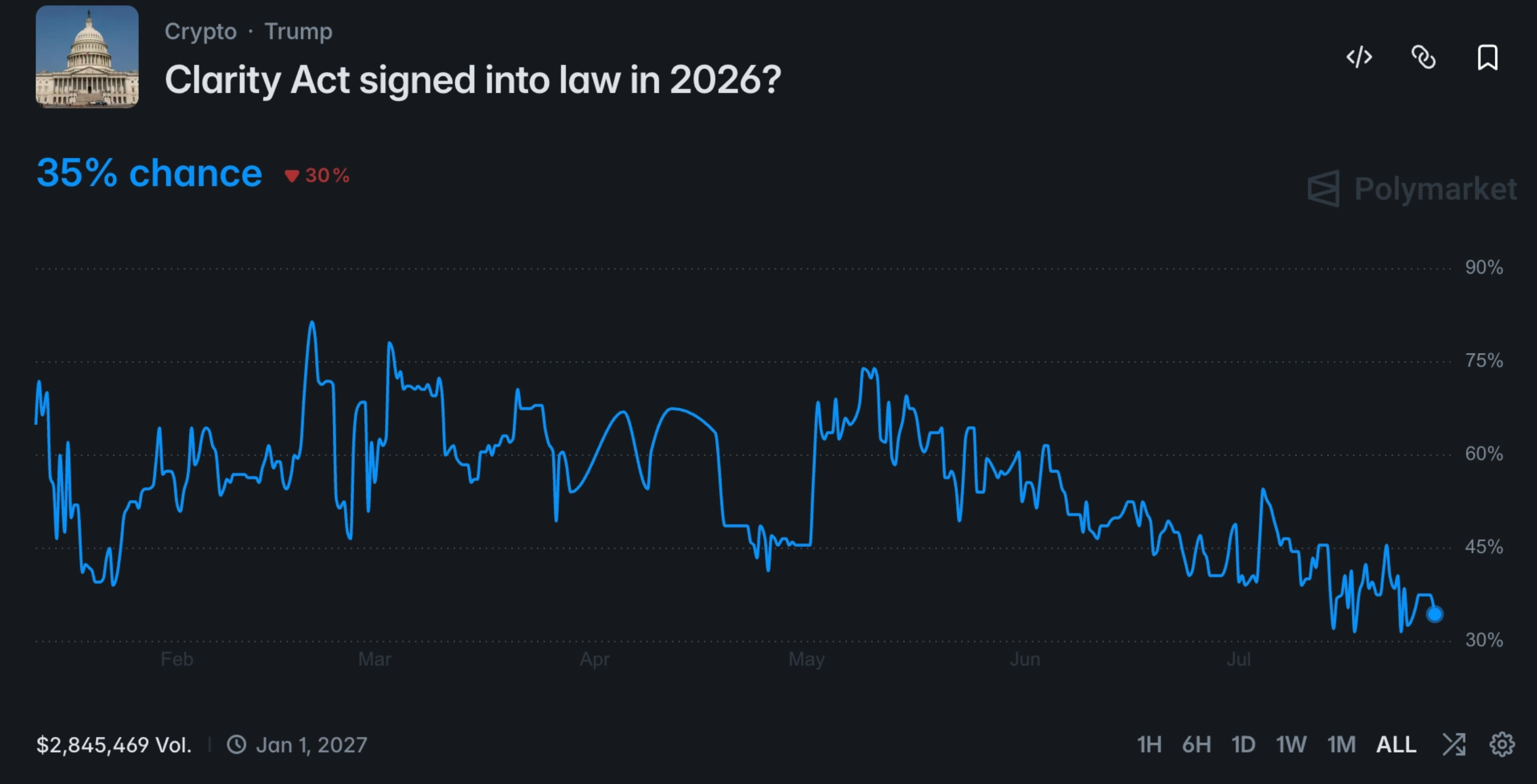
The probability of Clarity passing this year has been steadily declining. Source: Polymarket
So, if the Clarity Act truly fails to pass, how will the crypto market react? What will happen to Bitcoin? How will related US stock market targets be impacted? What political changes will occur in Washington? Odaily will explore the potential scenarios for the industry if the CLARITY Act ultimately fails to pass the Senate, from these three perspectives.
1. Crypto Market: Analysts Generally Believe the Impact is Limited and the Market Has Already Priced It In
Based on current price action, the market's pessimism regarding the CLARITY Act is gradually being reflected. The most obvious sign is the decline in Polymarket odds from 82% to the current 35%. Looking at the trend, this probability rose above 70% multiple times between February and May but has consistently declined since June, indicating a clear weakening of confidence. The cumulative trading volume has now reached $2.845 million.
Bitcoin's price itself has faced recent pressure, dipping back to the $65,000 to $66,000 range in late July. Market interpretations generally link this to macro liquidity factors rather than the bill itself.
On the institutional side, most analysts are skeptical of the view that "bill failure equals industry crisis." Ed Engel, an analyst at Compass Point Research & Trading, maintains a Sell rating on Coinbase. However, he also points out that even if the CLARITY Act fails, there are enough industry events in the second half of the year to sustain market attention, and the blockchain industry still has two to three years to prove its practical application value.
It's important to note that the specific provisions of the bill themselves contain significant points of contention, and their direction impacts different sub-sectors differently. Take the stablecoin yield provision, for example. A draft of the CLARITY Act in March proposed prohibiting any stablecoin holding yield arrangement "substantially equivalent to interest." This news caused Circle's stock price to plummet 20% in a single day, while Coinbase stock fell nearly 10% on the same day. This means the market impact of the bill's failure largely depends on the final details of the provisions, rather than the passage of the bill itself.
2. US Stock Market: Will Coinbase and Circle Crash?
Coinbase

Coinbase's performance over the past week. Source: Google
Coinbase's stock price has recently been under pressure as the probability of the bill's passage declines. On July 28, COIN closed at $165, down 3.8% over the past five days, with the decline attributed to selling pressure from the weakening prospects of the bill. During the week of July 24, COIN fell from a price level of around $169. Raymond James set a price target of $158, about 6.5% lower than the stock price at the time; Oppenheimer previously lowered its price target to $209. Baird lowered its target from $160 to $142, maintaining a Neutral rating.
In other words, institutions believe that if CLARITY fails, we will likely see Coinbase trading in the $140 - $160 range.
At the same time, most analysts do not directly link Coinbase's long-term investment thesis to the success or failure of the CLARITY Act. Analysis cited by TipRanks suggests that even if the bill fails to pass before August, the Wall Street trend towards institutional allocation of crypto assets will still support Coinbase's long-term growth. Coinbase is set to release its Q2 earnings on July 30, with the market expecting earnings per share of $0.19, a significant improvement from the Q1 loss per share of $1.49. In the long run, if CLARITY doesn't pass, long-term growth could offset this failure.
Circle
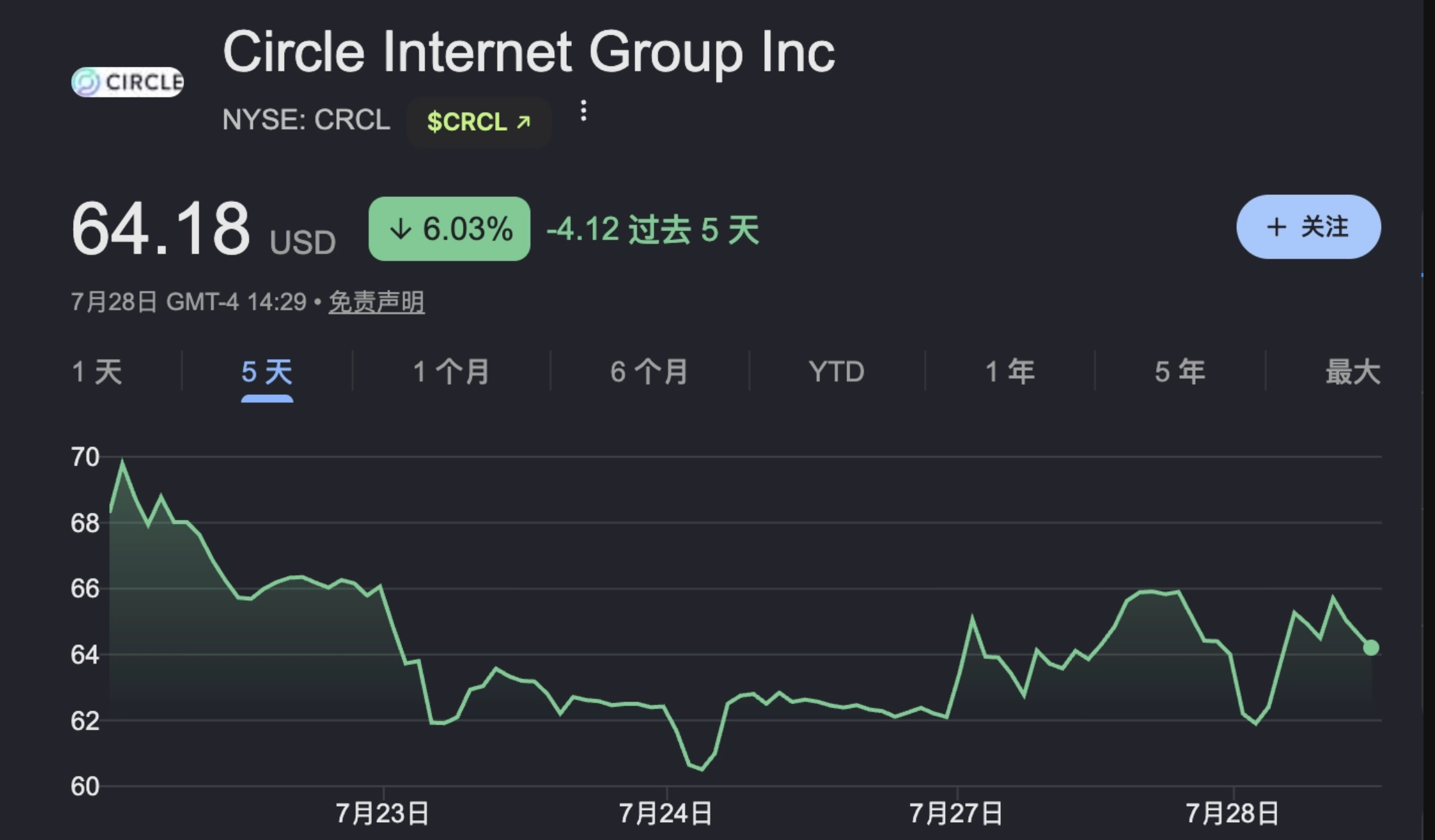
Circle's performance over the past week. Source: Google
Circle's situation is relatively more complex. Some analysts believe that the failure of the bill may not necessarily be bad for Circle. Mizuho Securities analysts point out that if the CLARITY Act passes smoothly and brings a clearer regulatory framework, it might actually attract more competitors into the stablecoin space, accelerating commoditized competition in the stablecoin business and eroding Circle's revenue in the long term. This year, the Open USD project, supported by over 140 institutions including Visa, Mastercard, Stripe, and BlackRock, has emerged, posing direct competition to Circle's USDC. Mizuho had previously downgraded Circle's rating due to this project.
On the other hand, if the stablecoin yield restriction provisions in the CLARITY Act are ultimately implemented, they would weaken the high-margin revenue Coinbase earns through its USDC distribution agreement. This could tilt bargaining power towards Circle during the renegotiation of their commercial agreement scheduled for August 2026. Morgan Stanley analyst Thielen believes that a stricter federal regulatory framework generally benefits licensed issuers with compliance capabilities, asset scale, and credit backing, positioning Circle relatively well in this landscape. Bitwise CIO Matt Hougan argues that the sell-off in Circle's stock triggered by the draft bill was "overblown" and that the bill itself doesn't change Circle's long-term investment thesis.
In other words, if CLARITY truly fails to pass, it might be good for Circle's long-term price. In the short term, if sentiment continues to weaken, several repeatedly mentioned support levels are around $61.70, and in more extreme scenarios, the market has mentioned a potential drop back to this year's February low of $49.
Crypto Treasury Companies
Companies holding crypto assets on their balance sheets, such as Strategy (formerly MicroStrategy, ticker MSTR), have stock prices far more correlated with Bitcoin's price than directly with the CLARITY Act itself, effectively acting as leveraged plays on Bitcoin.
As of July 1, affected by Bitcoin's price falling below $59,000, MSTR's stock price slipped to the $85-$86 range, marking its eleventh consecutive monthly decline and representing a drop of approximately 84% from its all-time high of around $540 in November 2024. Citigroup analysts linked their base case of Bitcoin reaching $100,000 to the expectation of the CLARITY Act passing, suggesting that if the bill is successfully enacted, pushing Bitcoin to $100,000, the value of Strategy's Bitcoin holdings would correspondingly rise to approximately $84 billion.
Strategy recently disclosed that its model calculates a lower bound for Bitcoin's annualized return at -11.34%. If actual returns fall below this level, the company may need to consider restructuring its debt. Furthermore, two listed companies sold a combined 511 Bitcoins within 24 hours to repay approximately $31.7 million in debt. These financial pressures are relatively independent of the CLARITY Act's legislative progress but could be amplified in an environment where the bill languishes and market sentiment is weak.Strategy is scheduled to release its Q2 earnings during the week of July 30-31, with the market expecting increased stock price volatility during this period.
3. Washington Political Landscape: Future Legislation Will Be Much Harder
Looking at the Senate voting structure, whether the bill can pass depends on securing support from 7 to 9 Democratic Senators to surpass the 60-vote threshold. On the Republican side, Senators Josh Hawley and Rand Paul are expected to vote against it based on substantive positions, meaning that even if all 53 Republican Senators are present, they would still be insufficient to pass the bill on their own. On the Democratic side, Senator Ruben Gallego of Arizona is seen as a relatively reliable source of support.
Notably, the opposition within the Democratic Party is not purely about the crypto regulatory framework itself, but is significantly linked to President Trump's disclosure of over $1 billion in crypto-related investments. Several Democratic Senators view the ethics clause as a check on potential conflicts of interest for the President. Senator Angela Alsobrooks previously dismissed a compromise proposal from the White House as an "unserious proposal." This has, to some extent, tied the legislative process of the CLARITY Act to the broader goal of opposing Trump, moving beyond a purely technical debate on industry regulation.
If the bill ultimately fails to pass in 2026, most analysts believe it won't create a regulatory vacuum. Instead, it means the crypto industry will continue to rely in the short term on two existing paths: first, the GENIUS Act, which took effect in July 2025, specifically regulating payment stablecoins and their issuers; and second, the respective regulatory agendas of the SEC and the CFTC. The SEC's Regulation Crypto proposal is expected to formally enter the rulemaking process in the second half of 2026.
From a timeline perspective, the November 2026 midterm elections are a key variable affecting the bill's subsequent progress. Most analysts believe that if the window before the August recess is missed, the possibility of resuming consideration in the fall is significantly reduced due to appropriations bill disputes and the approaching election cycle. Substantive progress would likely be pushed back to 2027. However, 2027 itself falls within a period of political realignment post-midterms, which would significantly lower the chances of the bill maintaining the previous bipartisan consensus. An alternative path proposed by some industry lobbyists is to incorporate the core provisions of the CLARITY Act into the must-pass omnibus legislation at the end of the year. However, as of now, no Senator has publicly confirmed that this strategy is being seriously considered.