EIP-8363: Why Is the Ethereum Community Up in Arms?


- Key Takeaway: EIP-8363 proposes that as Ethereum’s staking ratio approaches 50%, newly issued validator rewards be gradually burned until they reach zero, aiming to curb centralization and inflation. The proposal has sparked fierce opposition in the community due to significant cuts to staking yields, and could disrupt the business models of ETH treasury-listed companies that depend on staking income.
- Key Elements:
- Mechanism Design: The proposal sets up a burn mechanism that activates as supply approaches 60.25 million ETH (approximately 50% of total supply), affecting only issuance rewards while leaving fee and MEV income untouched.
- Supporters' Rationale: Backers argue that network security exhibits diminishing marginal utility, and that limiting staking can reduce inflation, strengthen ETH's scarcity narrative, and protect independent stakers who incur no additional costs.
- Opponents' Concerns: Aave's founder estimates total returns would drop from approximately 2.86% to 1.48%, arguing that high-cost institutions (such as exchanges and ETFs) would remain while ordinary stakers get filtered out, accelerating centralization risk.
- Market Reaction: Following the news, Lido and Ether.fi tokens both fell more than 10%, though ETH spot prices and treasury company stock prices have yet to show direct correlation.
- Impact on Treasury Companies: BitMine's staking income could halve to approximately $120-130 million; SharpLink, which relies on staking for about 97% of its revenue, faces a decline risk exceeding 35%; Bit Digital has relatively lower dependency due to a proactively reduced staking ratio and holdings in other assets.
- Proposal Progress: Still in draft stage, not included in the Hegotá upgrade list, with core developer meetings recommending withdrawal. Community consensus remains deeply divided, making near-term approval unlikely.
Original: Odaily Planet Daily (@OdailyChina)
Author: jk
In early August, the Ethereum community was stirred up by a proposal numbered EIP-8363, named "Tapered Issuance Burn."
The proposal argues that as the proportion of staked ETH approaches half of the total supply, the newly issued rewards available to validators should be gradually burned until they reach zero. In other words, the returns from staking ETH would dwindle over time, effectively threatening the business models of treasury companies and staking pools.
The debate ignited by EIP-8363 among Ethereum researchers, DeFi protocol founders, and publicly listed ETH treasury companies has been described by Aave founder Stani Kulechov as one of the most fiercely opposed proposals in Ethereum's history. The core developers call (ACDC #184) on August 6 dedicated a full half-hour to discussing it.
What problem does this proposal actually aim to solve? Where do supporters and opponents diverge? And if implemented, what impact would it have on publicly listed companies betting on ETH staking yields? Odaily Planet Daily will provide a detailed analysis in this article.
What Exactly is EIP-8363?
Let's set aside the technical jargon and understand what EIP-8363 does in plain terms.
Ethereum's current issuance mechanism can be compared to a money printer that pays out per head: the more people stake ETH, the larger the total issuance, but because it's spread across more participants, the individual yield (APR) decreases. This design has one key characteristic: regardless of how many people stake, the printer never completely stops. Even if 100% of all ETH were staked, validators would still receive a floor yield of around 1.5%.
The authors of EIP-8363 believe this never-stopping design harbors risks. As long as staking yields remain higher than what other crypto assets can offer, rational capital will continue flowing into staking, causing the staking ratio to keep climbing. An excessively high staking ratio often means more and more ETH is held by centralized entities like exchanges, custodians, and ETF issuers, rather than by individuals genuinely interested in participating in network security.
To address this, the proposal introduces a gradual shutdown mechanism. As the network-wide staked amount approaches 60.25 million ETH (roughly half of the current supply), the system would directly burn an increasing proportion of the issuance rewards validators would otherwise receive—giving them to no one and destroying them entirely. When staked amounts truly reach that threshold, validators' net issuance-based rewards drop to zero.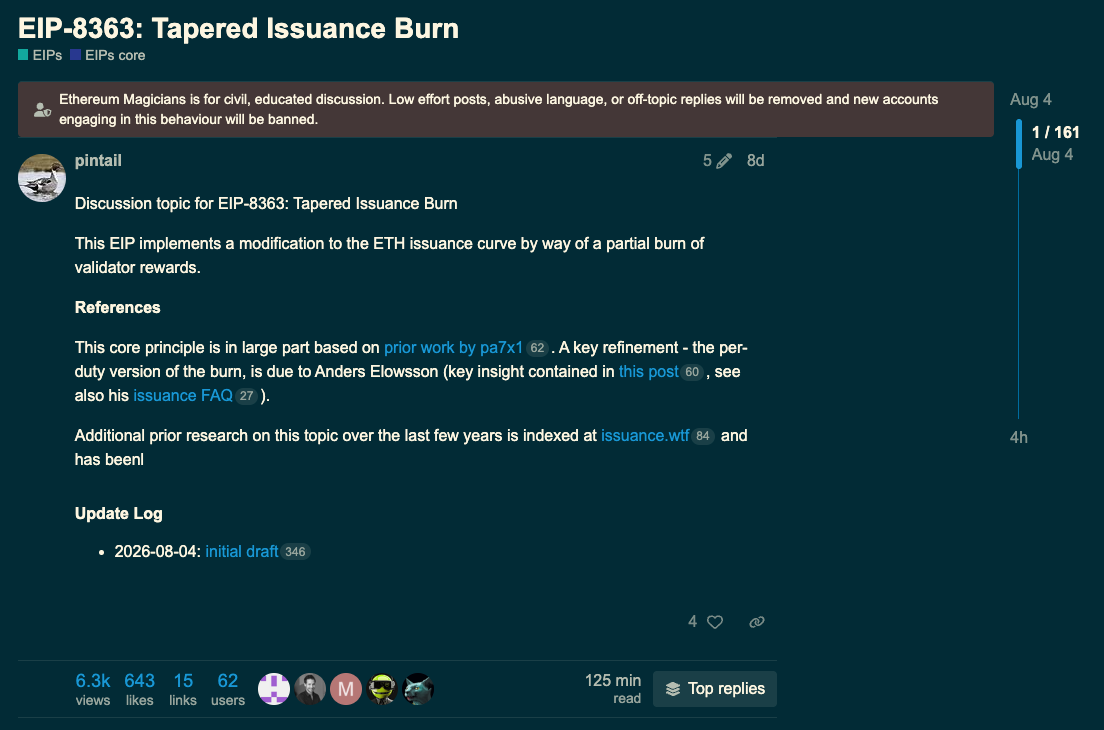
Original forum post for EIP-8363. Source: Ethereum Magicians forum
This mechanism has two caveats. First, it only burns issuance rewards and does not touch execution-layer income—namely, the transaction fees and MEV (Miner Extractable Value) validators earn from including transactions. This portion remains entirely unaffected. So even if issuance rewards drop to zero, validators won't truly earn nothing. Second, penalty mechanisms—such as slashing for downtime or malicious behavior—remain fully intact. Validators who underperform will still lose funds, though recouping those losses will take longer.
The proposal is co-authored by six individuals, including Ethereum Foundation researcher Justin Drake and EthCC co-founder Jérôme de Tychey. It's still in its earliest Draft stage, with a long way to go before being included in any hard fork upgrade—but it has already ignited fierce debate within the community.
Why Propose This Solution?
Supporters: Enough rewards suffice; more becomes a burden
A long-standing view within Ethereum research circles holds that network security does not scale linearly with the amount of staked ETH, but rather has a tipping point of diminishing marginal utility. Beyond that point, additional staked ETH does little to meaningfully raise the cost of attacking the chain, while instead accelerating the concentration of wealth and power among a few large institutions. Those who hold this view argue that rather than letting the staking ratio climb unchecked, it's better to proactively set a cap.
Supporters argue that if the issuance curve remains unchanged, Ethereum's net supply growth could drift toward 1% annually—an implicit inflation tax on all ordinary holders who don't stake. Closing this loophole would theoretically strengthen ETH's long-term scarcity narrative. Grayscale's research team reached a similar conclusion in a report earlier this year, arguing that controlling inflation and reinforcing ETH's positioning as a store of value would be positive for the price over the long term.
Another perspective holds that this mechanism actually protects independent stakers. Institutional stakers typically charge management fees and bear compliance costs, while ordinary individuals running nodes at home have almost none of these additional burdens. When overall yields are compressed and market-based returns approach near-zero risk premiums, independent stakers operating with a lean cost structure are better positioned to survive, while intermediaries reliant on high yields to cover operating costs would be the ones eliminated.
Opponents: The centralization risk the proposal aims to prevent would actually be accelerated by this mechanism
Aave's Stani Kulechov calculated that based on current staking ratios, counting both issuance rewards and MEV income, validators' all-in returns would drop from approximately 2.86% to 1.48%—a reduction of nearly half. He argues that once yields approach zero, the only entities willing to remain staking would be those doing so for structural, compliance, or product reasons—namely exchanges, custodians, and institutional ETFs, which are precisely the actors the proposal aims to drive away. What would actually be filtered out are ordinary individuals and small independent operators who stake purely for economic returns.
Additionally, the proposal designs a transition period during which the nominal rewards validators receive would first be temporarily increased, then gradually compressed while roughly half is simultaneously burned. This means that in countries with accrual-based tax rules—such as the United States—independent stakers' taxable income could ostensibly double on paper, dealing a significant blow to ordinary stakers' cash flow.
Opponents also worry this could disrupt an implicit benchmark interest rate in DeFi. ETH staking yields have long served as a reference anchor for on-chain lending and derivatives pricing. If it approaches zero, strategies like borrowing ETH to short ETH would become economically irrational, potentially destabilizing lending protocols and the business models of liquid staking tokens (LSTs). The ether.fi founder stated bluntly that the proposal is disappointing on every level, while the Lido team pointed out that issuance rewards don't just buy slashable staked amounts—they also purchase node operator diversity and the network's censorship resistance. These qualities would become far harder to maintain once rewards hit zero.
To be fair, it's worth noting that the loudest opposing voices—Aave, Lido, ether.fi—are themselves protocol entities whose businesses depend on staking and DeFi yields. Ethereum co-founder Vitalik Buterin has not publicly commented on the proposal so far, and Justin Drake, one of the co-authors and an Ethereum Foundation researcher, has also been silent on the matter for some time.
What Happens to Yields? And What About ETH Treasury Companies?
Based on the formula proposed in EIP-8363, at the current staking ratio of approximately 34%, validators' net issuance-based rewards would drop from roughly 2.6% today to around 1.2%. If the staking ratio further climbs to 50%, this portion would be entirely eliminated. It's important to note that this only covers issuance rewards; fees and MEV income remain completely unaffected. So the actual total return reduction would be somewhat less than a theoretical halving—roughly around 40%.
Following the news, Lido and Ether.fi both experienced declines of over 10%.
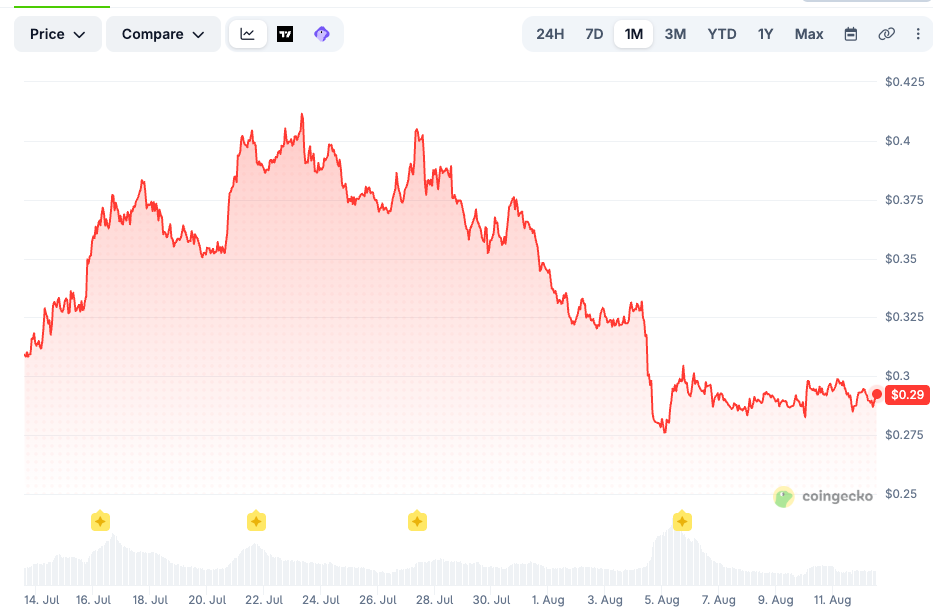
Lido saw a noticeable decline in early August. Source: Coingecko
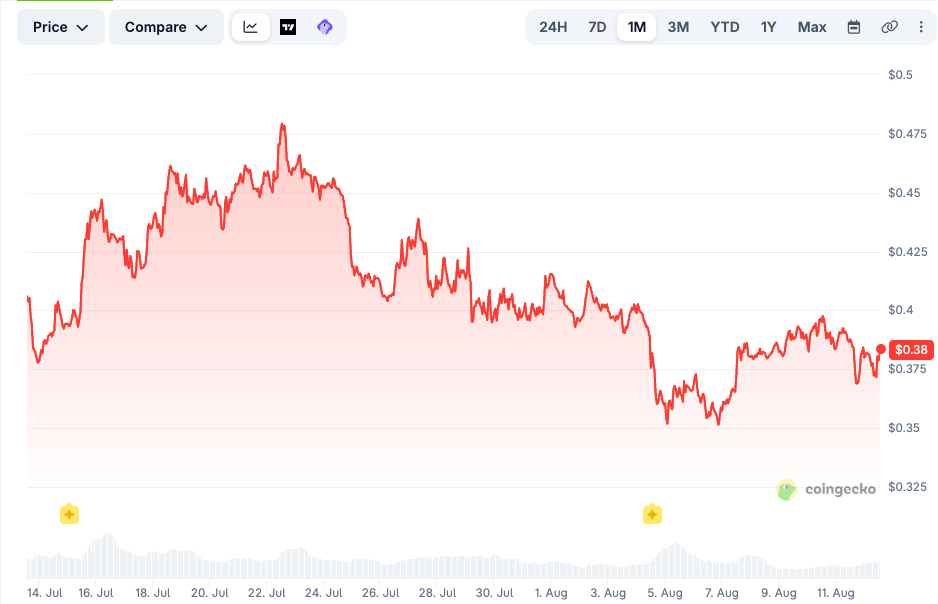
Ether.fi price trend. Source: Coingecko
How would publicly listed companies betting on ETH staking yields be affected? Would their stock prices cliff-dive?
Over the past year or so, a wave of ETH treasury companies has listed on US stock exchanges with a relatively straightforward business model: raise capital, buy large amounts of ETH, stake that ETH to earn interest, support financial reports with stable staking income, and pitch shareholders a story of continuously appreciating per-share ETH holdings. Industry data shows that among the several treasury companies that separately disclose staking revenue, staking income averages about 60% of disclosed revenue—and for many of these companies, it is essentially their entire source of income.
However, these companies have different levels of exposure.
- BitMine (BMNR) is currently the largest ETH treasury by holdings, with approximately 5.8 million ETH, of which about 87% is staked. Its current annualized staking income is in the range of over $200 million. If net consensus returns roughly halve, its annualized staking income would drop from approximately $257 million to the $120–130 million range;
- SharpLink (SBET) is the second-largest ETH treasury, backed by Consensys/Ethereum co-founder Joe Lubin. Nearly all of its holdings are staked, and staking income accounts for as much as 97% of its quarterly total revenue—meaning the company faces a potential revenue decline of over 35%. Its CEO, Joseph Chalom, former head of digital assets at BlackRock, has publicly opposed the proposal. He argues that native staking yield is ETH's greatest differentiator versus Bitcoin, and if weakened, the cost of holding for institutional capital would rise, potentially driving some funds elsewhere over the long term.
- Bit Digital (BTBT) is relatively unique. It transitioned into an ETH staking/treasury company in June 2025, but its staking dependence is comparatively lower and actively decreasing: as of May 31, only approximately 74,163 ETH (about 46%) was staked (down from roughly 89% previously), with the company explicitly stating it reduced its staking ratio to "preserve flexibility and pursue higher-yield opportunities." It also holds approximately 27 million shares of WhiteFiber (WYFI) stock (worth about $755.6 million in May), making it significantly less dependent on staking than BitMine/SharpLink/Ether Machine.
It's worth noting that the market's actual reaction so far has primarily manifested in liquid staking protocol tokens like Lido (LDO) and ether.fi (ETHFI)—both fell over 10% within a day or two of the proposal's announcement. As for ETH spot prices and the share prices of these treasury companies, no obvious movement directly tied to the proposal has emerged so far; they remain dominated by ETH's own price fluctuations. This storm has not yet truly transmitted to treasury company stock prices.
Where Does It Stand Now? Could It Pass?
Currently, the proposal is still very far from actual implementation.
It remains in the initial draft stage and has not entered the formal process of being confirmed for inclusion in any specific upgrade. At the core developers meeting on August 6, the team dedicated half an hour to discussion, but meeting records show that participants broadly raised concerns about small validators and centralization. The post-meeting recommendation was to consider withdrawing the proposal from the currently progressing Hegotá upgrade. Moreover, in the list of proposals formally confirmed for inclusion in that upgrade after the meeting, EIP-8363 does not appear.
Can we predict whether it will eventually pass? Community consensus is currently severely fractured, with significant voices on both sides. In the short term, it's unlikely either side will persuade the other.
A more pragmatic assessment is that even if this proposal doesn't ultimately land in its current form, the underlying question of whether Ethereum should impose a cap on its staking ratio will likely not simply disappear. It may resurface later in a revised version or as a completely different proposal—perhaps incorporating a minimum yield floor, extending the transition period, or redesigning the trigger threshold to address the most concentrated criticisms currently raised.