






Apple: The Other Side of the AI Boom—Why a Perfect Earnings Report Triggered a Nearly 10% Plunge?


- Key Takeaway: Apple delivered strong Q3 FY2026 earnings but saw its stock plunge nearly 10%, mainly due to management's guidance for future revenue and gross margin coming in below expectations, along with warnings that AI-driven constraints on memory and advanced process capacity are shifting from data centers to consumer electronics. This has prompted the market to reprice concerns over growth sustainability and cost pressures.
- Key Elements:
- Earnings Data: Q3 revenue reached $109.42 billion (up 16% YoY), EPS of $2.02 (beat expectations), and a record gross margin of 50.1%. However, roughly 2 percentage points came from government tariff refunds; excluding this one-time factor, the actual gross margin was approximately 48.1%.
- Guidance: The company projects September-quarter revenue growth of 9%-11%, below the market consensus of around 12%. Gross margin guidance is set to decline to 47%-48%, which directly triggered the sharp stock selloff.
- Supply Constraints: Cook cited "unprecedented" supply limitations. AI-related memory (HBM, server DRAM) is consuming about 20% of global equivalent DRAM wafer capacity (per TrendForce estimates), squeezing supply of consumer memory like LPDDR. In addition, advanced process capacity is also limiting A/M-series chip production.
- Mitigation Measures: Apple's inventory surged from $5.72 billion to $11.09 billion (component inventory rose from $2.12 billion to $7.65 billion) to secure supply in advance. However, analyst Ming-Chi Kuo estimates A20 chip shipments could come in 10%-20% lower than original targets. Apple is evaluating new suppliers such as CXMT, though these can hardly replace Samsung, SK Hynix, and Micron in the near term.
- Supply Chain Divergence: Memory makers (Micron's revenue up 350% YoY) benefit doubly from AI demand and supply contraction. TSMC, spanning both consumer electronics and AI chip demand, posted Q2 2026 revenue of $40.2 billion (up 33.7% YoY) with a 67.7% gross margin, making it the biggest beneficiary of resource repricing.
- AI Monetization Unproven: Services revenue of $30.74 billion (up 12.1% YoY) missed expectations. Apple Intelligence has yet to fully launch in key markets such as China and the EU. Siri's early AI capabilities rely on Google Gemini. While the asset-light approach (capex under 6% of operating cash flow) is an advantage, core model capabilities remain dependent on external partners.
A nearly flawless earnings report triggered a 10% stock price plunge.
On July 30, Apple reported third-quarter revenue of $109.42 billion for fiscal 2026, up 16% year-over-year, marking its strongest June quarter ever. Diluted earnings per share reached $2.02, up 29% year-over-year and significantly beating the market's expected $1.89. Overall gross margin hit 50.1%, an all-time high.
From revenue and profit to core product sales, nearly every key metric exceeded Wall Street expectations. Considering this was Tim Cook's final earnings call before stepping down as CEO, it should have been a fittingly graceful farewell.
But the capital markets reacted in the exact opposite way.
Following the earnings release, Apple's stock initially fell about 5.5% in after-hours trading, then dropped nearly 10% during the next trading session, erasing close to $500 billion in market value. The problem wasn't the quarter that just ended—it was Apple's outlook for the future. Management guided for September-quarter revenue growth of 9% to 11% year-over-year, below Wall Street's consensus of approximately 12%. Gross margin guidance also fell back to 47% to 48%.
Cook further stated that the company is facing very significant supply constraints, and that the supply chain has little remaining flexibility to maneuver. This also exposed the fact that the global competition for semiconductor resources driven by AI is now transmitting from data centers to consumer electronics, and even Apple—with the world's strongest supply chain management capabilities—cannot stay on the sidelines.
Understanding this thread is the starting point for understanding Apple's next-phase cost, product, and valuation challenges.
1. AI Becomes a "Memory Black Hole," and Apple Gets Drawn into the Resource Battle
Over the past two years, the market has grown accustomed to understanding AI infrastructure through GPUs, optical modules, networking equipment, and power systems—while relatively overlooking another rapidly unfolding shift: AI data centers not only consume computing power, but are also rapidly consuming the world's best memory production capacity.
Large AI accelerators require substantial amounts of HBM, and training and inference servers also need server DRAM, enterprise-grade SSDs, and even larger-scale data storage. Because HBM uses higher stacking layers and more complex manufacturing processes, it consumes significantly more wafer and manufacturing resources per unit than conventional memory.
This doesn't mean HBM shares the exact same final packaging line as the LPDDR used in smartphones, but upstream memory manufacturers will reallocate wafer capacity, capital expenditures, and engineering resources based on profitability and customer certainty.
As a result, when more resources flow to HBM, server DRAM, and enterprise storage, the supply of traditional DRAM and LPDDR left for phones, PCs, and other consumer electronics naturally gets squeezed. According to TrendForce's industry estimates, on an equivalent wafer consumption basis, AI-related memory could absorb close to 20% of global DRAM capacity in 2026.
So when people say "AI took away iPhone's memory," it doesn't mean Nvidia directly snatched a batch of LPDDR that Apple had already ordered. Rather, AI customers—with their higher margins, longer procurement cycles, and stronger prepayment capabilities—have changed how the entire memory industry allocates its resources.
And in this resource repricing, different segments of the supply chain face vastly different outcomes.
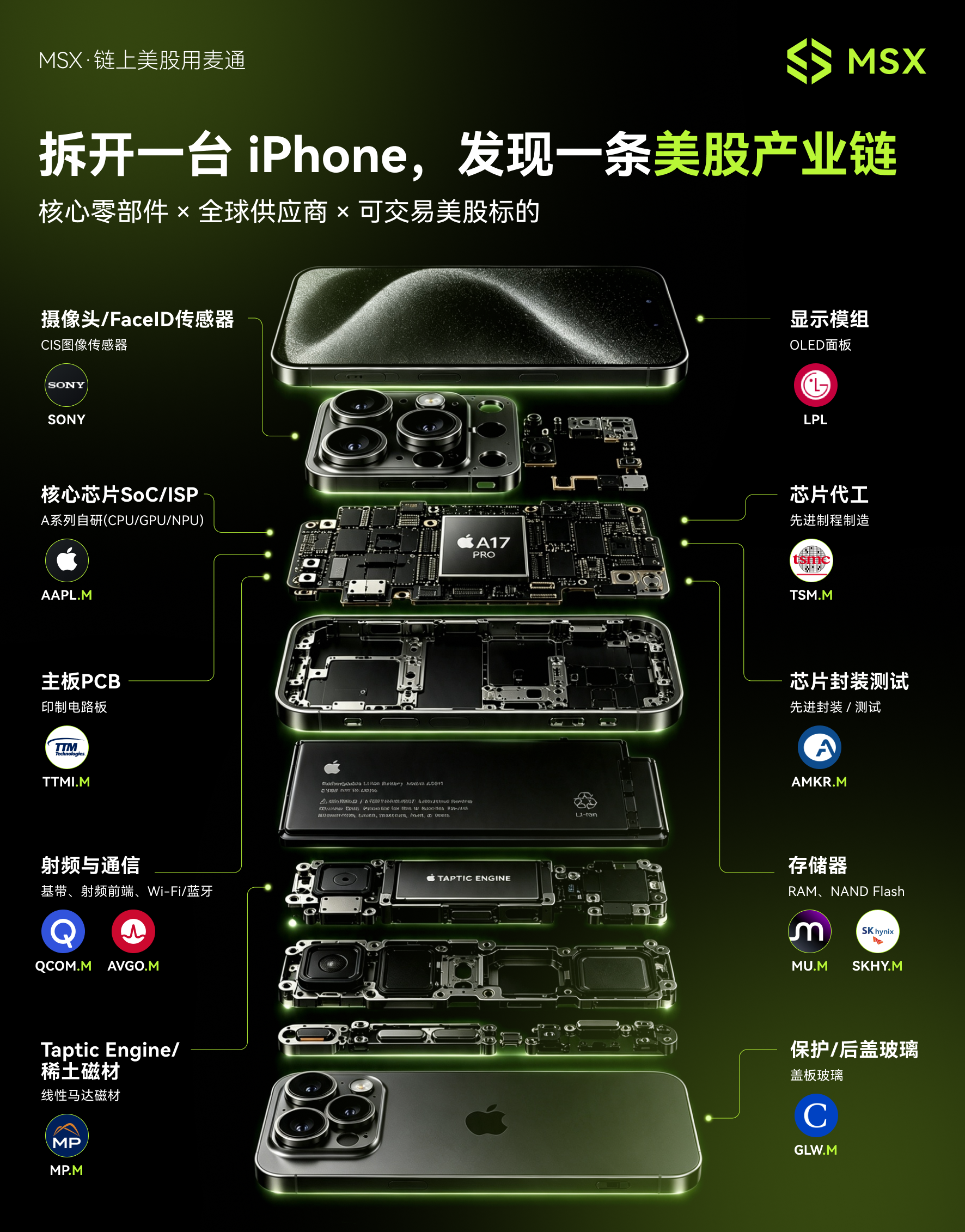
1. Memory Manufacturers: From Cyclical Price Increases to Resource Scarcity
The most direct beneficiaries are DRAM makers like SK Hynix, Samsung Electronics, and Micron.
AI customers provide higher unit prices, longer order visibility, and stronger prepayment capabilities for HBM. At the same time, as memory makers shift more capacity and investment toward AI products, they further tighten the supply of traditional DRAM and LPDDR.
Micron's most recent fiscal quarter generated revenue of approximately $41.46 billion, up nearly 350% year-over-year—more than four times the same period last year. Its growth came simultaneously from HBM, DRAM, and NAND product lines.
Memory makers are thus enjoying a double dividend: on one end, high-value products like HBM and server DRAM are ramping rapidly; on the other end, tightening consumer electronics memory supply is driving up prices for traditional products.
Micron's most recent fiscal quarter generated revenue of approximately $41.46 billion, up nearly 350% year-over-year—more than four times the same period last year. Its growth came simultaneously from HBM, DRAM, and NAND product lines.
This is what makes the current memory cycle so unique. Past memory bull markets typically depended on recovering demand from traditional end-markets like phones and PCs. This rally, however, is being driven by both AI demand expansion and traditional capacity contraction simultaneously.
Data centers keep increasing memory content per server, while consumer electronics makers must pay higher prices for the limited remaining capacity. Demand expansion and supply contraction happening at the same time gives memory makers far greater profit elasticity than a typical cyclical recovery.
Of course, distinctions still need to be made among individual memory companies. Micron, SK Hynix, and Samsung are direct participants in the DRAM, LPDDR, and HBM logic. NAND-focused companies like SanDisk benefit more from enterprise SSD demand, data storage needs, and NAND price increases.
They all belong to the memory theme, but they don't share the same business logic, nor should they simply be viewed as direct beneficiaries of Apple's LPDDR shortage.
2. Apple and Downstream Suppliers: Who Ultimately Bears the Cost Pressure?
For Apple, the memory shortage means three possible responses: raise prices, compress margins, or adjust the shipment mix across products and configurations.
Theoretically, when component costs keep rising, Apple is more likely to prioritize high-margin, high-priced products, tilting limited supply toward the Pro lineup and higher-capacity variants.
But it's important to emphasize that there is currently insufficient official information to prove that Apple has massively cut production of a particular base model by one-third due to the memory shortage. Some supply chain reports mention order adjustments for the standard iPhone 17, but these could also include normal product lifecycle factors, demand changes, and pre-launch inventory clearing ahead of new releases.
Therefore, a more prudent way to assess the situation is to look at where a supplier sits in the value chain:
- Assembly, PCB, connector, and general component makers that rely on overall shipment volume and low value-added orders are more sensitive to Apple cutting production;
- Suppliers with scarce technologies—such as image sensors, premium displays, advanced packaging, and core chips—possess relatively stronger bargaining power;
However, stronger bargaining power doesn't mean complete immunity.
If Apple's overall shipments decline, nearly every part of the supply chain will feel the impact. The difference lies only in the magnitude of order declines and whether higher per-device value can offset lower shipment volumes.
Ming-Chi Kuo estimates that due to LPDDR supply tightness, Apple's actual pull-in volume of A20 chips from the second half of 2026 through Q1 2027 could be 10% to 20% lower than originally targeted. But part of that variance may also stem from Apple's earlier overbooking to secure capacity.
Apple is also evaluating additional memory supply sources, which has brought CXMT into the market's spotlight. However, this path remains subject to product qualification, supply scale, and US regulatory policy considerations, making it difficult to fully replace Samsung, SK Hynix, and Micron in the near term.
3. TSMC: The True "Toll Booth" Spanning Both Demand Streams
TSMC occupies the most unique position in this resource repricing.
Apple needs TSMC to produce its A-series and M-series chips. Nvidia, AMD, and cloud providers' custom AI chips also depend on TSMC's advanced process nodes and packaging capabilities. Therefore, whether capital flows to consumer electronics or AI data centers, TSMC benefits either way.
But Apple and Nvidia aren't simply competing for the exact same production lines.
Apple's main constraints center more on advanced wafer processes like N3 and N2. AI accelerators, beyond needing advanced wafer processes, also heavily rely on CoWoS advanced packaging capacity and HBM integration.
The two bottleneck areas overlap but are not fully identical.
What really matters is that simultaneous strength in both AI and consumer electronics demand keeps TSMC's advanced processes, packaging capabilities, and customer scheduling value at elevated levels. TSMC's Q2 2026 revenue reached $40.2 billion, up 33.7% year-over-year, with gross margin at 67.7%. Its 2-nanometer process already contributed approximately 3% of wafer revenue.
When Apple's product cycle is strong, TSMC benefits. When AI chip demand continues expanding, TSMC benefits equally.
When both happen at the same time, TSMC doesn't just gain higher capacity utilization—it gains the opportunity to reprice the scarcity of advanced manufacturing.
2. The Strongest June Quarter Exposed the Biggest Concern
Understanding how industrial resources are being reallocated makes it easier to understand why Apple's stronger-than-expected earnings report actually made the market more worried.
On the surface, Apple's Q3 profitability looks almost abnormally strong.
Overall gross margin reached 50.1%, continuing to improve from the prior quarter. But roughly two percentage points of that came from tariff refunds paid by the US government. The tariff refund also contributed about $0.11 to earnings per share. Excluding this one-time factor, Apple's actual gross margin was approximately 48.1%.
That number is still solid, but nowhere near as impressive as the headline 50.1%.
In other words, the high gross margin in this report doesn't fully represent a structural improvement in Apple's product mix and pricing power. Part of the profit was merely a phased return of previously paid tariff costs, while the pressure from rising memory, chip, and other key component prices continues to accumulate.
Apple has already passed some costs onto consumers by raising prices on certain Mac and iPad products. But as its highest-volume and most competitive core product, iPhone pricing adjustments are far more sensitive.
This also explains why stronger iPhone sales this quarter made investors more worried about the next quarter.
Against the backdrop of persistently tight memory and advanced chip supply, some consumers may have pulled forward purchases of existing products before prices rise. Q3's robust demand could therefore simultaneously include normal replacement demand, product cycle tailwinds, and advance purchases driven by expectations of price increases.
If Apple raises prices on new products, it needs to verify whether consumers will maintain the same upgrade cadence. If it doesn't raise prices, it must absorb higher component costs itself, or protect margins by adjusting product mix, configurations, and shipment volumes.
Either way, Apple faces a situation that hasn't commonly occurred in the past: the pace of supply chain cost increases is approaching the limit of what Apple's traditional pricing, inventory, and product mix tools can absorb.
What's more noteworthy is that the "supply constraints" mentioned in the earnings report don't come from memory alone.
Cook stated that one of the main bottlenecks in the quarter just ended was insufficient advanced process capacity for producing Apple Silicon, which particularly impacted supply of products like the Mac. At the same time, Apple expects memory costs to continue rising next quarter.
So Apple is currently facing two different types of shortages happening simultaneously: on one end, DRAM and LPDDR memory prices are rising, directly pushing up device bill-of-materials costs; on the other end, advanced process capacity is tight, limiting how many A-series and M-series chips Apple can produce.
Cook described the current memory market as a "once-in-a-century flood" the likes of which he has never seen in his career. Apple's response has been to build inventory in advance. As of the end of June 2026, Apple's inventory stood at $11.09 billion, nearly doubling from $5.72 billion at the end of fiscal 2025. Component inventory rose from approximately $2.12 billion to $7.65 billion, showing Apple is locking in key components as early as possible.
But inventory can only smooth costs—it cannot create new capacity.
Especially for a company whose valuation is already at historic highs, this state of "able to sell, but not necessarily able to produce; able to produce, but not necessarily at the original margins" is enough to trigger a market repricing.
3. The AI Narrative Is Shifting—Where Does Apple Go From Here?
It's worth noting that just before the earnings-driven selloff, Apple had completed a highly symbolic market cap overtaking.
On July 28, Apple's market value briefly broke through $5 trillion for the first time, becoming only the second company globally to reach that milestone after Nvidia. As of that day, Apple was up about 25% year-to-date and had briefly regained its position as the world's most valuable company.
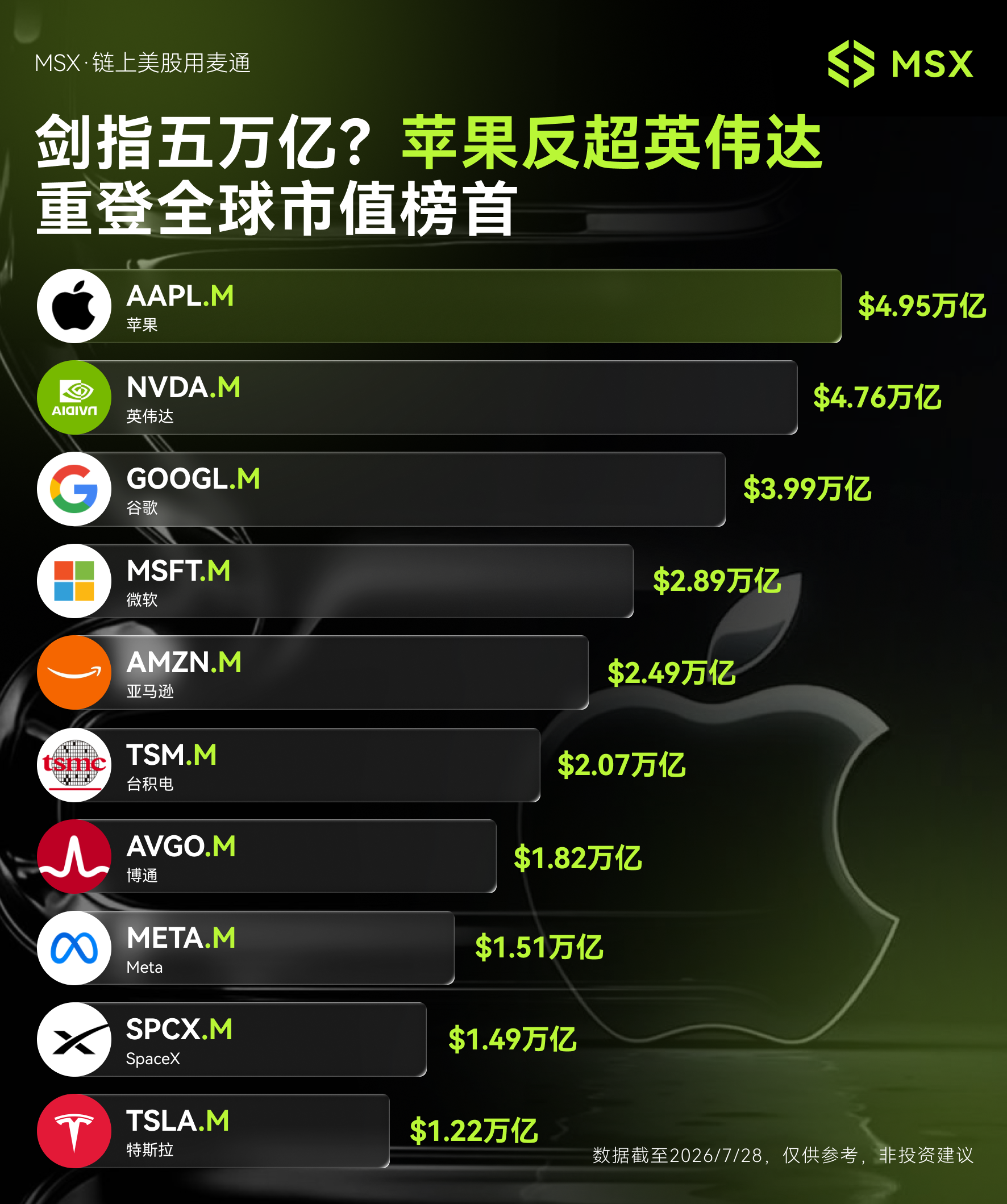
Apple's rise doesn't mean the market believes it now has the most powerful large language models.
Quite the opposite—Apple has been widely considered behind OpenAI, Google, and Anthropic in foundation model capabilities, cloud compute reserves, and AI product velocity.
The market's repricing of Apple reflects a shift in the AI narrative.
In the first phase of AI investment, the market rewarded model capability and technological breakthroughs. In the second phase, the market rewarded infrastructure providers like GPU, networking, memory, and data centers. As capital expenditures balloon, the third phase's question becomes: how much revenue, profit, and free cash flow can all this compute ultimately generate?
In this phase, Apple's advantage isn't training the model with the most parameters—it's owning one of the world's largest entry points for high-value consumer devices.
As of early 2026, Apple's active installed base exceeded 2.5 billion devices. Meanwhile, paid subscriptions across Apple's services business surpassed 1.5 billion. Apple can embed AI capabilities into phones, computers, headphones, watches, and operating systems, then monetize through hardware upgrades, iCloud+ subscriptions, and the broader services ecosystem.
It doesn't need to first prove that hundreds of billions of dollars in data center investment can generate sufficient capital returns, the way cloud giants do. It only needs to prove that AI can increase upgrade intent, services attachment rates, and user stickiness.
This "device distribution + subscription services" path is exactly why Apple has been repriced higher amid rising controversy over AI capital expenditures. In the first nine months of fiscal 2026, Apple generated $116.996 billion in operating cash flow, while capital expenditures for fixed assets were approximately $6.799 billion. Apple maintains its vast device and services ecosystem with less than 6% of operating cash flow going to fixed asset investment.
Compared to tech giants building massive AI data centers, this business model is significantly more asset-light.
But "asset-light" doesn't mean there's no cost. Apple is currently pursuing a hybrid AI approach: on-device models and Private Cloud Compute run Apple's own models, while some of the more complex Siri capabilities rely on Google's Gemini technology.
This approach reduces early infrastructure investment, but it also means Apple depends on external partners for core model capabilities, inference costs, and product cadence.
If Siri AI usage grows rapidly in the future, Apple could face higher cloud inference costs and be forced to increase its own compute investment. Apple may have skipped the most aggressive phase-one capital expenditure race, but it hasn't permanently escaped AI infrastructure costs.
The more immediate problem is that Apple's AI commercialization has yet to be proven by financial data.
Services revenue grew 12.1% year-over-year to $30.74 billion this quarter, but missed the market's expected $31.22 billion. App Store gaming revenue is also being affected by regulatory changes and the opening of external payment channels. Apple Intelligence in China is still awaiting regulatory approval. In the EU, the new Siri AI won't be fully rolled out across iPhone, iPad, and Apple Watch in its early stages.
This means Apple has a massive device entry point but currently cannot unleash AI capabilities simultaneously across all key markets.
The analyst divergence after earnings stems precisely from this.
Bulls argue that Apple possesses user entry points, a hardware ecosystem, and cash flow capabilities that other AI companies can't easily replicate, and that the next iPhone cycle will mark the starting point of AI commercialization. Bears argue that Apple's current valuation has already priced in AI-driven upgrade and subscription growth that hasn't actually materialized yet.
Following the earnings release, at least four institutions cut their Apple price targets while three raised theirs, with the consensus target adjusting to approximately $330.
What Apple needs to answer going forward is no longer just "how many next-gen iPhones can be sold," but two deeper questions:
- First, with memory and advanced process costs continuing to rise, can Apple still simultaneously defend sales volume, pricing, and profit margins?
- Second, can Apple Intelligence and Siri AI genuinely convert from product features into upgrade demand, subscription revenue, and higher customer lifetime value?
In Closing: AI's Boom Has Another Balance Sheet
Over the past two years, the mainstream AI supply chain story has been Nvidia selling more GPUs, cloud providers building more data centers, and memory makers getting higher prices.
Apple's earnings report shows the other side of this boom.
As AI infrastructure absorbs more memory, advanced process capacity, and engineering resources, consumer electronics companies must pay higher costs, suppliers must reallocate orders, and consumers may face higher prices.
Apple stands at both the pressure end and the opportunity end


