






当市场开始质疑AI资本开支:五家科技巨头Q2财报全解析


- 核心观点:2026年7月美股科技巨头财报季显示,AI基础设施投入持续加速,但市场关注重心已从需求增长转向自由现金流回报。五家公司营收利润普遍超预期,但股价反应分化,资本开支指引成为左右股价的核心变量。
- 关键要素:
- Alphabet Q2营收1197.96亿美元同比增24%,云业务同比大增82%,但资本开支上调至1950-2050亿美元致上市以来首次负自由现金流,股价跌超7%。
- 英特尔营收同比增25%创十五年来最强增速,但因资本开支上调至200亿美元引发市场担忧,盘后一度暴涨13%后转跌,多空博弈胶着。
- 微软Azure年化收入首破千亿美元,主动下调资本开支预期至1750亿美元并承诺正向自由现金流,股价创18年来最佳单日表现。
- Meta营收超预期但资本开支达310.8亿美元致自由现金流仅剩7.84亿美元,同比萎缩逾90%,连续两个季度因上调开支指引遭抛售,股价累计跌近10%。
- 苹果营收利润均创同期新高,但下调Q4指引(同比增9%-11%低于预期)并警告芯片短缺影响扩大,市值单日蒸发超3000亿美元。
Original by Odaily Planet Daily (@OdailyChina)
Author|jk

In late July 2026, the U.S. tech sector entered its most密集 earnings week of the year. Google parent Alphabet kicked things off, followed by Intel, Microsoft, Meta, and Apple.
The main storyline across all five earnings reports was nearly identical: AI infrastructure spending continues to accelerate, but the market's patience for when these massive investments will translate into tangible returns is rapidly wearing thin. Revenue and profits largely beat expectations, yet investor reactions were sharply divided—some companies saw their stock surge on better-than-expected guidance, while others faced sell-offs due to capital expenditure or forward guidance falling short.
Below, Odaily Planet Daily provides an analysis of this round of tech giant earnings and the related U.S. stock performance.
Google: Revenue Sets Record with Double-Digit Growth for 12 Straight Quarters, but Stock Falls 7%
After the market close on July 22 ET, Google parent Alphabet reported its Q2 2026 earnings. Total revenue reached $119.796 billion, up 24% year-over-year, marking the twelfth consecutive quarter of double-digit growth. Operating income came in at $40.77 billion, beating the $40.55 billion market estimate, while net income attributable to shareholders reached $112.1 billion, including approximately $99 billion in unrealized gains on equity securities. Cloud was the biggest highlight of the quarter, with Google Cloud revenue hitting $24.8 billion, up a massive 82% year-over-year, accelerating from the 63% growth in the previous quarter and far exceeding the $22.3 billion market expectation. Enterprise AI solutions became the core growth engine for Google Cloud for the first time, with Gemini Enterprise paid monthly active users growing 40% quarter-over-quarter and cloud backlog orders doubling sequentially to $460 billion.
In short, Google's revenue picture in this report was very strong.
However, what made the market nervous was Google's capital expenditure: in Q2, Alphabet's capex reached $44.92 billion, doubling year-over-year, with roughly 60% going to servers and 40% to data centers and network equipment. The company also significantly raised its full-year 2026 capex guidance from $180-190 billion previously to $195-205 billion, and explicitly stated that spending would increase further in 2027. The massive investment directly eroded current cash reserves, resulting in Alphabet recording its first quarterly negative free cash flow since going public, at approximately negative $5.855 billion to $5.9 billion.

Google's stock price took a dive after hours on the 22nd. Source: TradingView
Following the earnings release, Google's stock fell more than 4% in after-hours trading. The next day (July 23), all three major U.S. indices plunged, with Google's stock dropping over 7% during the session, attributed by reports to Middle East tensions pushing up oil prices. But at the same time, this factor was compounded by investor concerns over expanding AI capital expenditures and cash flow prospects.
Intel: Strongest Revenue Growth in 15 Years, but Stock Witnesses a "Rollercoaster" Reversal
Intel reported earnings after the close on July 23 ET (July 24 Beijing time), delivering the most dramatic contrast of the earnings season. Q2 revenue grew 25% year-over-year to $16.128 billion, marking the strongest growth in over fifteen years, well above the $14.42 billion market expectation—an upside surprise of nearly 12%. The core growth driver was the data center and AI business, which generated $6.3 billion in revenue, up 59% year-over-year, far exceeding analysts' $5.6 billion estimate. Driven by this, the company turned profitable on a non-GAAP basis, with net income of $2.2 billion and EPS of $0.42. Due to fair value changes in U.S. government-owned shares, the company still recorded a net loss on a GAAP basis, but operating cash flow reached $7 billion, showing strong performance. The company also raised its Q3 revenue guidance to a midpoint of approximately $16.3 billion, corresponding to over 15% year-over-year growth, also above market expectations.
However, alongside the results, Intel announced it was raising its full-year 2026 capex guidance from $18 billion previously to over $20 billion, and预告 that 2027 capex would be significantly higher than 2026 levels. The company cited extremely strong customer demand signals, saying data center CPU demand has exceeded the company's continuously expanding supply capacity. Management used the word "takeoff" to describe the current demand environment. Goldman Sachs noted in its post-earnings report that the significant increase in capex implies rising near-term free cash flow pressure, estimating Intel's net debt-to-EBITDA ratio would rise from 0.8x to 1.2x in 2026, with wafer front-end equipment spending also increasing about 40%, reflecting the company's transition from the fab construction phase to the equipment filling phase. Goldman therefore maintained a "Neutral" rating with a price target of $150, declining to upgrade the rating despite the earnings beat.
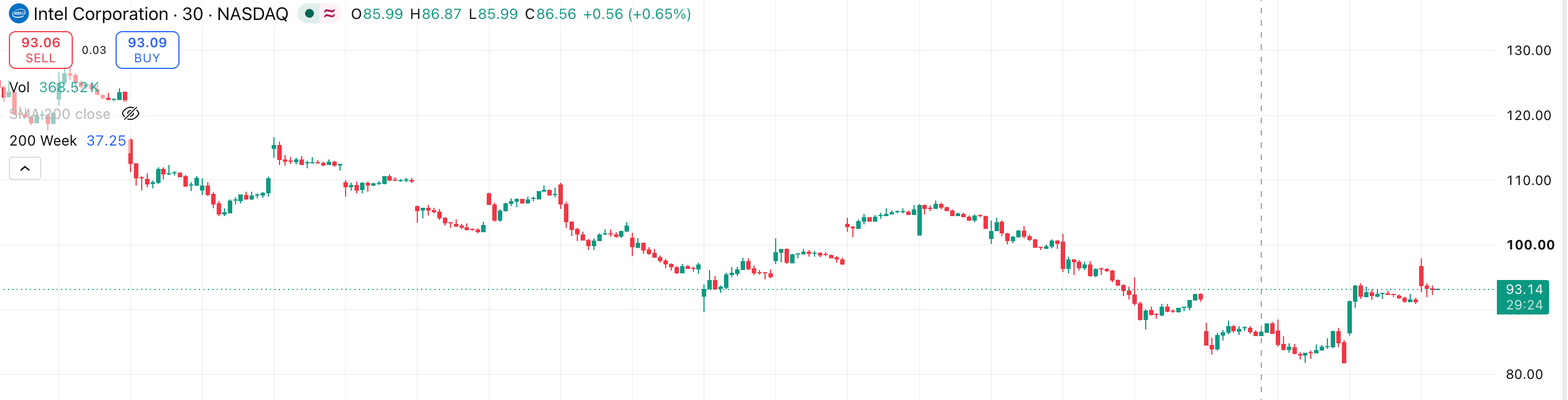
Intel's stock turned from gains to losses. Source: TradingView
Before the earnings release, Intel's stock closed down over 2% in regular trading on the day, reflecting lingering market doubts about its fundamentals. After the release, the stock quickly surged in after-hours trading, at one point jumping over 13%. However, this rally didn't fully hold. As the market shifted focus to the capex increase issue, Intel's gains narrowed significantly, and the stock at one point turned down over 7%. The gains quickly shrank to just around 4%. This pattern of a big surge on earnings night followed by a pullback also reflects lingering disagreement in the market over Intel's transformation—the bull-bear battle over the earnings information remains highly contested.
Microsoft: Azure Surpasses $100 Billion Annual Run Rate for First Time, Capex Lowered, Stock Posts Best Single-Day Performance in 18 Years
Microsoft reported earnings after the close on July 29 for its fiscal Q4 2026 (corresponding to the natural year's Q2, ending June 30), recording the most positive stock reaction among the five companies. Quarterly revenue reached $90 billion, up 18% year-over-year, above the $87.7 billion market expectation; GAAP net income was $35.766 billion to $35.8 billion, up 31% year-over-year, with diluted EPS of $4.81, also beating the $4.24 market estimate. Net income growth was partly aided by a $3.2 billion gain from its investment in Anthropic, as well as voluntary severance costs coming in below prior guidance. The Intelligent Cloud segment generated $39.3 billion in revenue, up 32% year-over-year, with Azure cloud revenue growing 43% year-over-year, pushing Azure's annual revenue past the $100 billion milestone for the first time in fiscal 2026. Commercial remaining performance obligations—a measure of future contracted revenue—reached $678 billion, up 84% year-over-year, significantly above market expectations. Q4 capex reached $41 billion, up 69% year-over-year, bringing full fiscal year 2026 capex to $145.3 billion.
Given Alphabet's stock slump from raising its capex guidance, the market was highly anxious about whether Microsoft would similarly "double down." Instead, Microsoft signaled a reduction in spending: the company lowered its calendar 2026 capex expectation from $190 billion previously to $175 billion during the earnings call, while management projected positive free cash flow for fiscal 2027. Management emphasized that actual investment plans had not changed; the lower spending figure primarily resulted from an accounting adjustment to data center asset useful lives—extending the depreciation period for office buildings and data center structures from 15 years to 25 years.
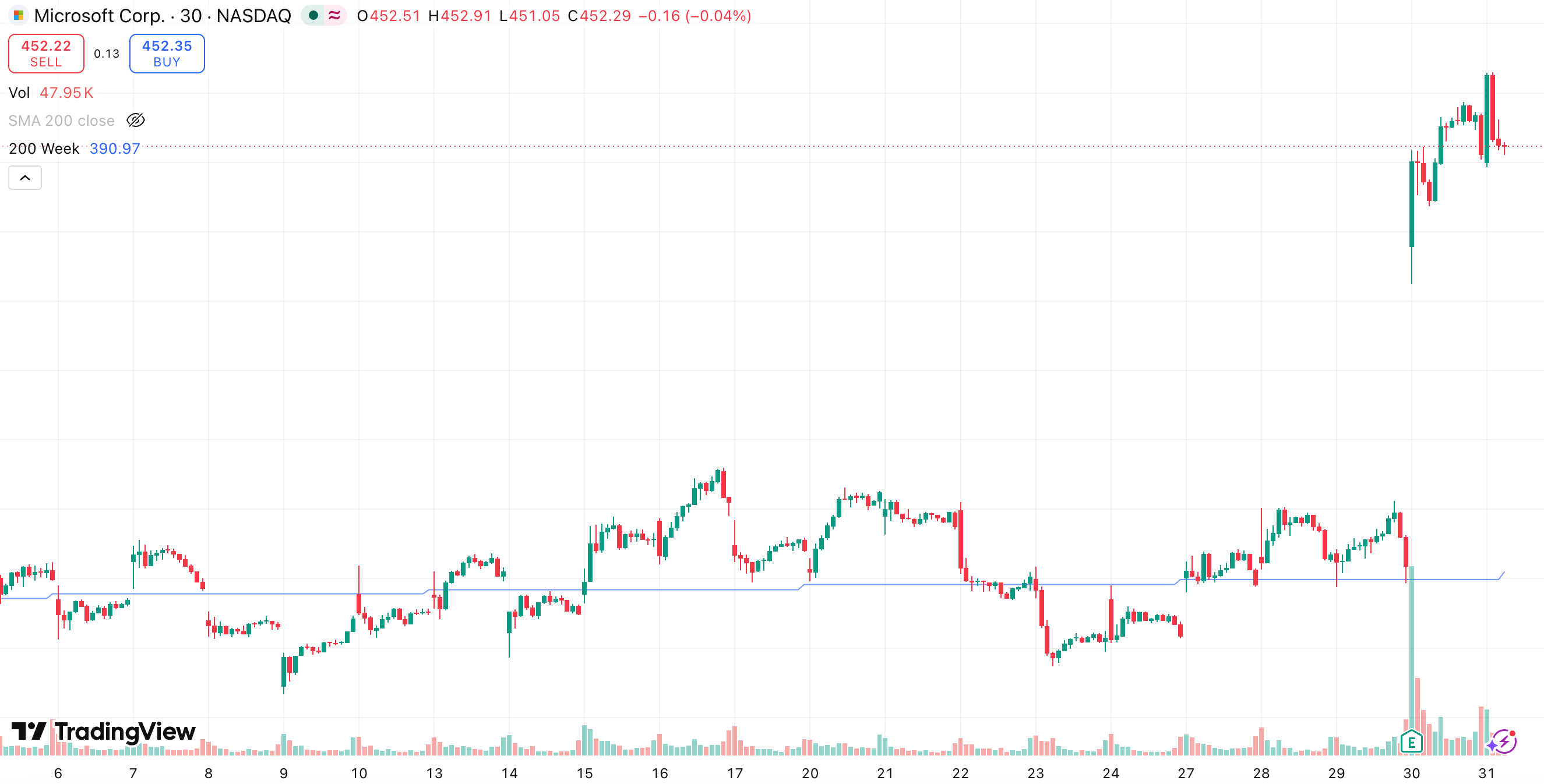
Microsoft's stock soared after the earnings release. Source: TradingView
Boosted by the dual positives of strong results and guidance, Microsoft's stock surged over 8% in after-hours trading, and on the next trading day after the release (July 30), Microsoft shares posted their best single-day performance in eighteen years.
Meta: Revenue Beats but Profit Declines, Runaway Capex Triggers the Most Violent Sell-Off
Meta reported earnings after the close on July 29, recording the most negative stock reaction of the earnings season. Core advertising remained strong, with Q2 revenue of $60.801 billion, up 28% year-over-year, slightly above the $60.17 billion market expectation. Ad revenue was $59.363 billion, up 27% year-over-year, with ad impressions up 14% and average price per ad up 12% year-over-year. Ad click-through rates and conversions improved following AI ranking model upgrades. Revenue from other Family of Apps businesses exceeded $1 billion in a single quarter for the first time, surging 73% year-over-year, primarily driven by WhatsApp paid messaging and subscription revenue.
The cost side was the first reason for the quarterly profit decline. Total costs and expenses reached $42 billion in Q2, up 55% year-over-year. Dragged down by this, operating income was $18.775 billion, down 8% year-over-year, with operating margin falling to 31% from 43% in the prior-year period. GAAP net income was $15.848 billion, down 14% year-over-year, with EPS of $6.18, below the $7.14 reported in the same period last year.
What truly triggered the stock sell-off was capital expenditure and free cash flow. In Q2, Meta's capex reached $31.08 billion, while operating cash flow was $31.86 billion, leaving only $784 million in free cash flow after offsetting—a sharp contraction of over 90% compared to $8.54 billion in the prior-year period. The company also raised the lower bound of its full-year 2026 capex guidance from $125 billion to $130 billion, and lifted its tax rate expectation for the remainder of 2026 from 13%-16% to 15%-17%. CEO Mark Zuckerberg emphasized that selling compute capacity for short-term profit would be "dumb," and that continuously increasing compute investment is not a gamble but a necessity—meaning the company may keep raising spending.
Evercore ISI analyst Mark Mahaney noted that the lack of forward guidance on 2027 capex and insufficient disclosure of details on frontier AI model R&D progress were both significant factors weighing on the stock.
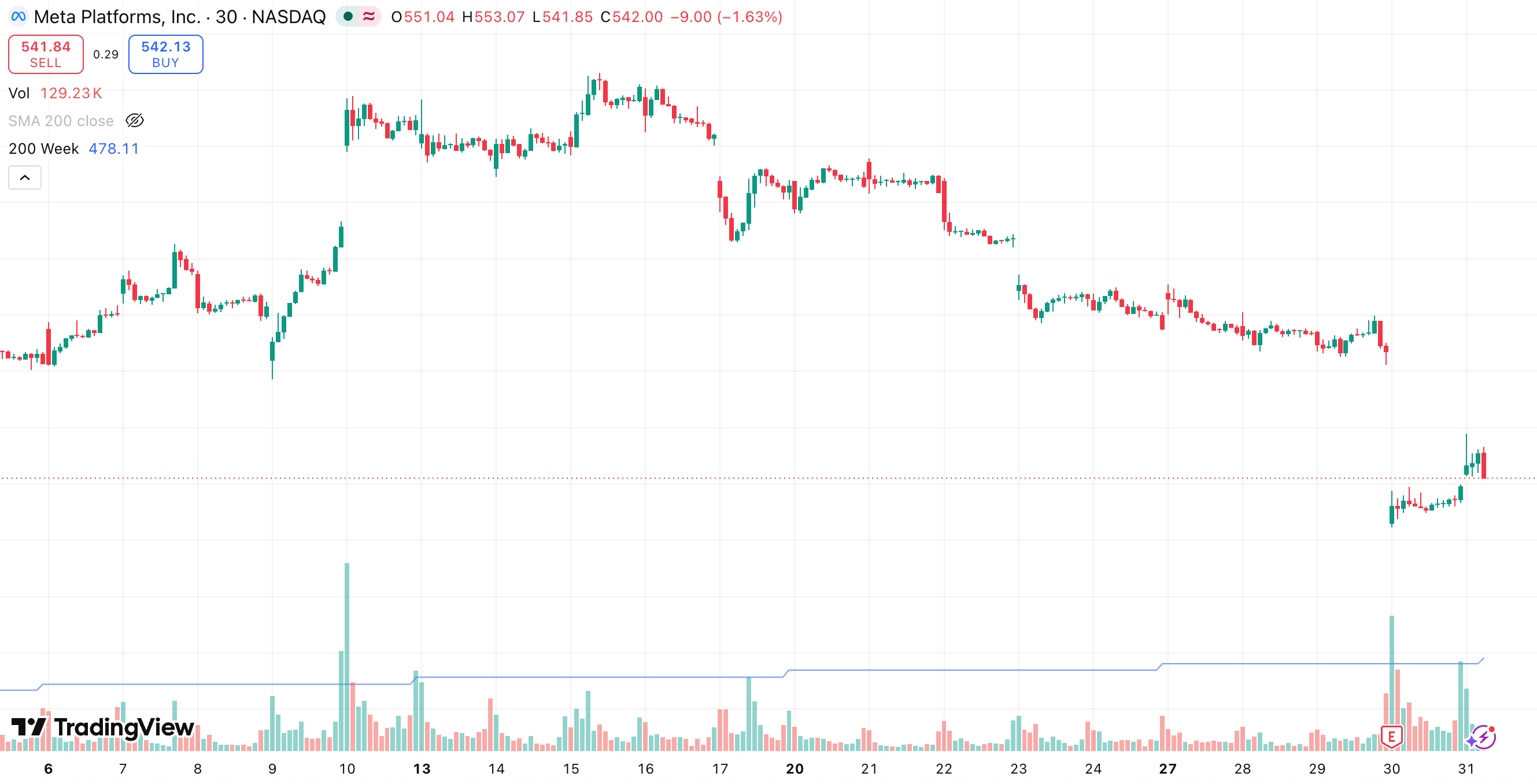
Meta's stock plunged. Source: TradingView
On the night of the earnings release, Meta's stock fell over 7% in after-hours trading, with losses widening further before the next day's open. By July 31, the decline still hadn't stopped, with the stock at one point dropping nearly 10% during the session—the longest correction and largest cumulative loss among the five companies this round. Notably, this isn't the first time Meta has suffered a major stock slump over capex issues. In its Q1 earnings released on April 29 this year, the company similarly plunged over 8% on earnings night after raising its full-year capex guidance, wiping out over $100 billion in market value in a single day. "Raise capex, get sold off" has become Meta's established market reaction pattern over the past two earnings cycles.
Apple: Revenue and Profit Both Hit Record Highs for the Quarter, but Market Cap Erases $300 Billion in a Single Day
Apple's earnings best illustrate the "earnings-beat but stock-decline" theme of this earnings season. On July 30 local time, Apple reported its fiscal Q3 2026 (ending June 27, corresponding to the natural year's Q2) results, with total revenue of $109.42 billion, up 16% year-over-year, beating the $108.65 billion market expectation, and net income of $29.789 billion, up 27% year-over-year. Blended gross margin reached 50.1%, with tariff rebates contributing an additional ~2 percentage points. iPhone revenue was $54.25 billion, up approximately 22% year-over-year, and Mac revenue was $10.35 billion, up approximately 29% year-over-year—both beating market expectations. CEO Tim Cook said in the release that this was Apple's best June quarter ever, with iPhone, Mac, services, and every major geographic segment achieving double-digit growth.
So what dragged the stock down? The company guided Q4 fiscal (ending September) revenue growth of 9% to 11% year-over-year, with the top end of the range clearly below Wall Street's consensus of 12.1%. Q4 gross margin guidance also declined to 47%-48% from the current quarter's 50.1%. The earnings call highlighted two major headwinds: first, foreign exchange volatility is expected to drag overall revenue growth by approximately 2.5 percentage points; second, the negative impact of chip and memory supply shortages is expected to expand significantly quarter-over-quarter, constraining production capacity across all three core product lines—iPhone, Mac, and iPad. Delivery wait times for key computer products like the Mac mini and Mac Studio have already been extended, directly tied to the industry backdrop of sharply rising DRAM and NAND contract prices and persistent shortages in memory chips and PC processors this year. The message from this guidance is that the negative impact of supply chain bottlenecks could be more severe and longer-lasting than the market previously expected.
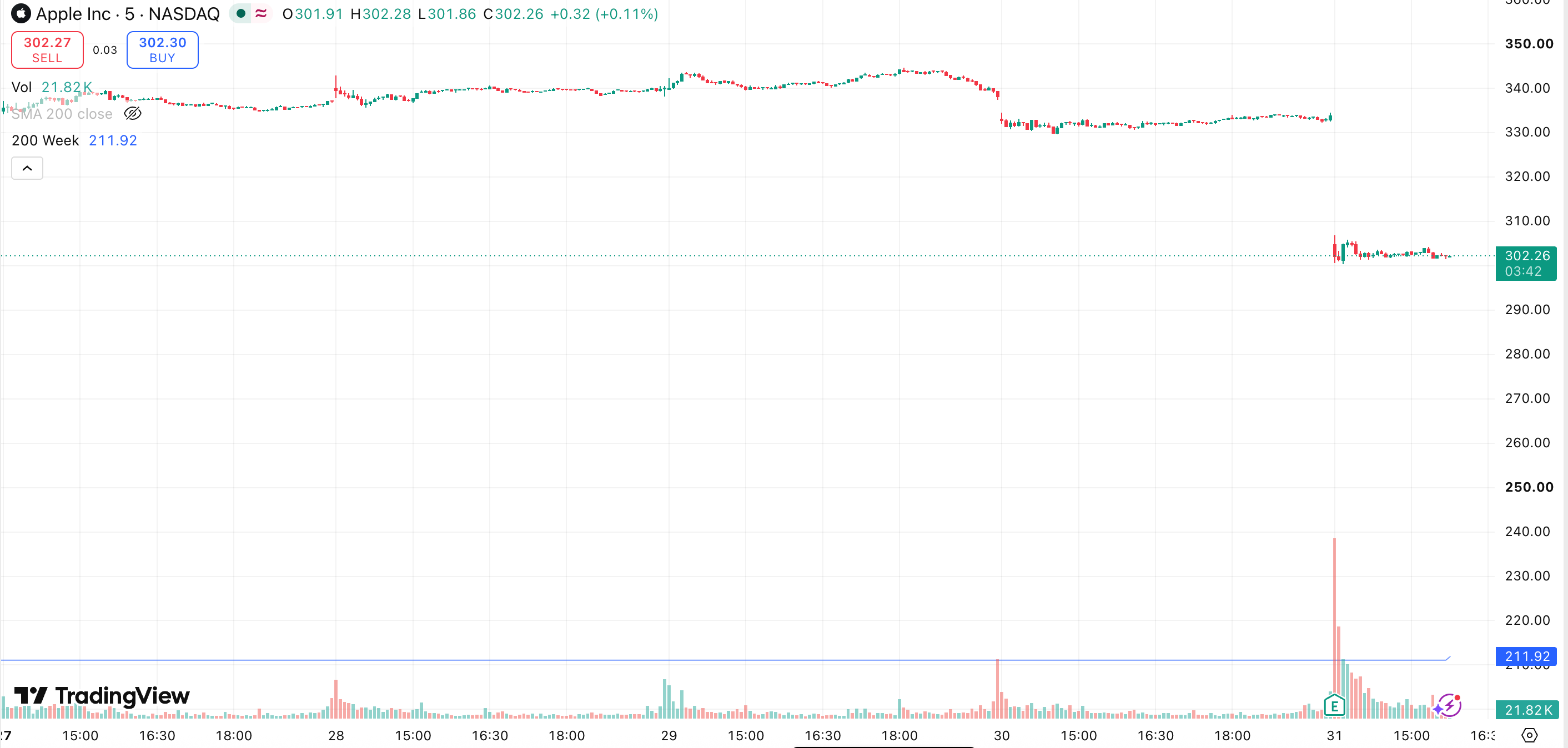
Apple's stock plunged. Source: TradingView
Due to multiple factors, Apple's stock fell as much as 8.37% in after-hours trading, marking its worst single-day drop since April 2025, with the closing price at one point falling to the $301-$312 range, erasing over $300 billion in market value in a single day.
Overall, all five companies beat market expectations on both revenue and profit. AI-related businesses—whether cloud computing, data center chips, or enterprise AI tools—all grew at significantly higher rates than their parent companies, indicating that strong AI demand shows no signs of slowing.
But the divergence in stock performance makes it clear that the market's focus has shifted from whether demand exists to free cash flow returns. Google and Meta were sold off for seeing cash flow turn negative after raising capex guidance, while Microsoft successfully convinced the market to pay up by lowering capex guidance and committing to positive free cash flow. This also signals that in the next earnings season, how each company explains the pace and return path of its capital expenditures will matter more to stock performance than revenue and profit figures themselves.
Other Earnings Coverage This Week
Why SK Hynix's Most Profitable Quarter Ever Was Still "Below Expectations"
13 Business Lines Hit $100M+ Annual Revenue Run Rate, Robinhood Moves Toward "Super Finance App"
First Earnings Report After STRC's Major Depeg: How Is Strategy Repairing Its Capital Flywheel?
Cyclical Stock or Growth Stock? Coinbase's Q2 Report Reveals the "Valuation Divide"


