Deep Dive into Storage Long-Term Agreements: The Bottom of This Cycle Has Been Lifted Above Historical Peaks


- Key Insight: The storage industry is experiencing a systemic shift in pricing power. Through longer-duration, higher-coverage, more favorably priced, and more binding long-term supply agreements, manufacturers including Samsung, SK Hynix, Micron, and SanDisk have lifted the cyclical bottom above historical peaks, with pricing power shifting from buyers to sellers.
- Key Elements:
- SanDisk has signed eight long-term agreements, with minimum total revenue of $93.9 billion calculated at floor prices—roughly $20 billion annually—locking in nearly half of current revenue for over four years, with shipment coverage expected to rise to approximately two-thirds in fiscal 2028.
- Contract durations have shifted from annual renegotiation to a minimum of five years. Samsung uses a five-year base with annual rolling renewal mechanisms, Hynix's contracts mostly span five years, and Micron's strategic customer agreements are predominantly five-year terms, systematically compressing buyer flexibility.
- Long-term agreement coverage has jumped: Samsung expects multi-year orders to account for 60%-70% of planned capacity, with over 90% of advanced HBM capacity locked in; Hynix's LTA share stands at approximately 50%-60%; Micron targets LTA revenue contribution exceeding 50%.
- Pricing features one-way protection: Samsung caps quarterly price declines at 5% with no ceiling on increases; SK Hynix has directly removed price caps and linked pricing to spot rates; Micron's gross margins at floor prices remain higher than historical cyclical peaks.
- Binding force has significantly strengthened: Micron expects to receive approximately $22 billion in prepayments, SanDisk holds financial guarantees exceeding $11 billion, and Samsung has already received roughly a quarter of contract prepayments, making breach costs prohibitively high.
- Goldman Sachs data shows that as of the end of Q2 2026, both Samsung and Hynix maintain inventory levels of 2-4 weeks—below the normal 4-5 week range and far below the 10+ weeks seen before previous downturns—underscoring that supply-demand tightness underpins these favorable terms.
The pricing power in the storage industry is undergoing a systemic restructuring.
On August 5, SanDisk released its FY2026 full-year earnings. The results were strong, but the stock fell 8% after hours. The market's disappointment was simple: guidance didn't beat expectations. But buried in the earnings call was another number, far more significant than the quarterly results.
SanDisk disclosed that its eight signed long-term supply agreements represent minimum total revenue of $93.9 billion based on floor prices. The weighted average term of these contracts is over four years, translating to roughly $20 billion annually—while SanDisk's current annualized revenue is around $42 billion. In other words, even in the worst-case scenario, SanDisk has already locked in nearly half of its revenue for over four years at prices far below current market rates.
This isn't just a SanDisk story.
On August 4, Goldman Sachs' Giuni Lee team published a research report featuring a cross-comparison of long-term agreement (LTA) terms across four memory manufacturers: Samsung Electronics, SK Hynix, Micron, and SanDisk. The report's core thesis: LTA terms are shifting in favor of suppliers across four dimensions—longer durations, broader coverage, more favorable pricing structures, and stronger enforceability. Every single dimension points in the same direction: pricing power in the storage industry is shifting from buyers to sellers.
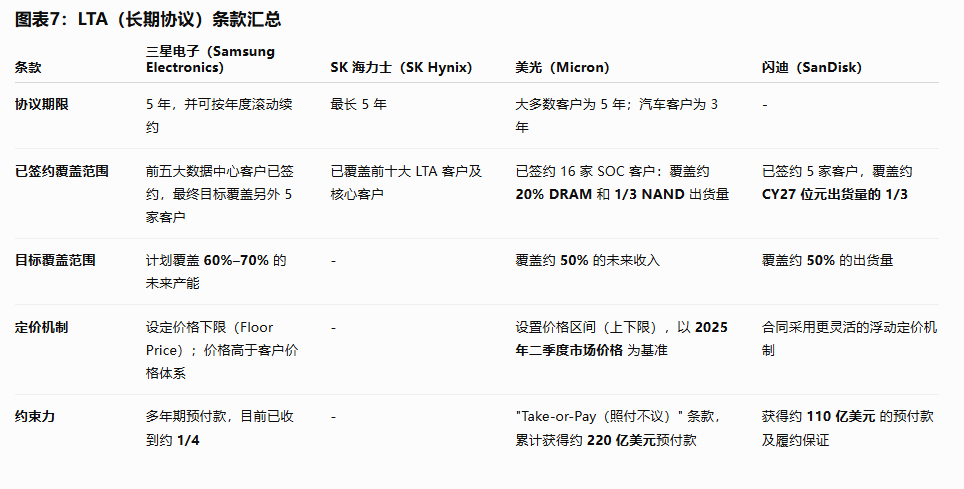
(Translated from Goldman Sachs' chart)
This shift means the definition of the "cyclical bottom" in the storage industry has been rewritten—the floor of this cycle has been lifted above the ceiling of past cycles.
Duration: From "Yearly Negotiations" to "Five Years Minimum, Possibly Longer"
The standard contract cycle in the storage industry used to be one year. Buyers and sellers would sit down annually to negotiate prices and volumes based on supply and demand. Buyers held the leverage—locking in prices with long-term contracts when the market was strong, and pressuring prices down or reducing volumes when the market weakened.
According to Goldman Sachs' comparison chart: most suppliers indicate contracts are primarily five-year terms, with some customers at three years. That means even the "shortest" contracts are three times longer than the historical standard.
Samsung explicitly stated in its latest earnings call that its LTAs are based on five-year terms with annual rollover mechanisms. Each year, one year is added—the contract never expires. Samsung co-CEO Jun Young-hyun put it more bluntly earlier: "Given the supply-demand uncertainty from expanding AI investment, we are shifting from traditional short-term agreements to multi-year contracts of three to five years." SK Hynix CEO Kwak Noh-Jung echoed this sentiment, noting that customer demand for LTAs is increasing.
SK Hynix has already covered its top ten LTA customers and core clients, with most terms at five years; Micron has signed 16 strategic customer agreements, with most contracts at five-year terms and automotive customers at three years; SanDisk's eight long-term customers have a weighted average term exceeding four years, with a maximum of five years.
All four manufacturers are simultaneously extending contract durations, systematically compressing buyers' flexibility—once signed, procurement strategies cannot be adjusted based on market changes for five years.
Coverage: From 20% to Over 60%
Longer contracts are one thing; how much capacity they cover is another. If only 10% of volume were locked in, even the longest terms wouldn't matter much. But that's not where the numbers stand.
From 2023 to 2025, the industry's typical LTA coverage ranged from 20% to 30%. By 2026, that number has jumped dramatically.
Samsung has signed contracts with the world's top five data center customers and is in final negotiations with five more major clients. Management expects that once all contracts are finalized, multi-year orders will reach 60% to 70% of planned capacity. HBM advanced capacity is locked in even more aggressively—over 90% is already covered.
SK Hynix has completed negotiations on roughly ten long-term agreements, with LTA coverage at approximately 50% to 60%. Micron has signed 16 strategic customer agreements covering about 20% of DRAM shipments and one-third of NAND shipments, but management has explicitly stated the end goal is for LTA revenue to exceed 50%.
SanDisk's numbers are even more striking. Signed agreements already cover over 50% of FY2027 shipments, and that figure will rise to approximately two-thirds by FY2028. Just three months ago, FY2028 coverage was only one-third.
When 60% to 70% of a company's capacity is locked in by multi-year contracts, its pricing logic fundamentally changes. The remaining 30% to 40% of capacity can capture excess returns in the spot market, but the foundation is anchored by contracts. Buyers have lost their old leverage—"cut your price or I'll go elsewhere"—because everyone else is locked into similar contracts.
Buyers have done the math. Signing a long-term agreement means accepting terms that disadvantage them, but only because the alternative is worse: without an LTA, they can't secure enough memory chips for the AI computing arms race. When supply tightness is structural, being "taken advantage of" is far less costly than having "no product at all." That's precisely why suppliers have the confidence to push terms to their limits.
Pricing: From Fixed Prices to "Protected Price Ranges"
This is the most critical change across all four dimensions.
Past LTAs were primarily fixed-price. One price for one or two years, with both sides sharing the risk equally—if prices rose, buyers benefited; if prices fell, sellers took the hit.
The new contract structure is fundamentally different.
Samsung's terms are the most aggressive. BofA Securities' August 1 research report revealed: Samsung's contract terms feature explicitly asymmetric pricing—quarterly price declines are capped at 5%, but upside is uncapped, ranging from 10% to 20% or even higher. Samsung's memory business head Jaejune Kim stated on the earnings call that the company uses different pricing models for different customer segments and product categories, with floor prices set for commodity products.
Translation: when the market declines, Samsung's downside is capped at 5% per quarter. When the market rises, upside is unlimited. Buyers bear nearly all the downside risk, while sellers retain nearly all the upside optionality.
Micron's contract structure differs, but the direction is the same. Its largest contracts include price ceilings and floors, benchmarked to Q2 2026 market prices. The key is the floor—management emphasized repeatedly on the earnings call that even at floor prices, gross margins remain far above the peak of any historical cycle. Micron's historical gross margin peak was just over 60%.
SK Hynix has taken an even more aggressive path. According to TrendForce citing Korean media, Hynix has directly eliminated the industry-standard price ceiling in its latest contracts. Even if customers sign long-term agreements, once spot prices are driven up by supply shortages, contract prices will fully adjust upward in line with market conditions. Goldman Sachs noted in its report that compared to peers who have locked in price ceilings, Hynix has greater exposure to general DRAM price elasticity—meaning more significant upside if prices exceed expectations.
SanDisk's pricing mechanism sits between fixed and floating prices, employing a customized hybrid model. CFO Luis Visoso revealed on the earnings call that the agreements combine "fixed and floating pricing mechanisms," tailored to each customer's actual demand.
Four players, four structures, but all pointing to the same thing: price protection is one-way—favoring the seller.
Enforceability: From Verbal Commitments to Real Money
Past LTAs had limited enforceability. After signing, buyers could reduce volumes, delay shipments, or even breach without significant consequences.
The biggest difference this cycle is the prepayment mechanism.
Micron expects to receive approximately $22 billion in cash deposits and related financial commitments. SanDisk has disclosed financial guarantees exceeding $11 billion, with customer default protection of $16.5 billion. Samsung has stated its contracts include substantial prepayments, with roughly one-quarter of total contract prepayments already received.
This isn't a deposit. This is the price buyers pay to lock in supply ahead of time. For a cloud provider to secure sufficient HBM and DRAM by 2028, they must place billions of dollars on the manufacturer's books upfront. This money locks in not just supply, but also the buyer—the cost of default becomes unacceptably high.
Goldman Sachs called the prepayment mechanism "the most significant differentiator of this cycle's LTAs compared to previous cycles."
The Meaning of Floor Prices: The Bottom Surpasses Historical Peaks
Looking at all four dimensions together leads to one conclusion: the storage industry is redefining the "cyclical bottom" through contracts.
Micron management revealed that even if prices fall to contract floors, gross margins would remain far above the peak of any historical cycle. Micron's historical gross margin peak was just over 60%.
SanDisk's $93.9 billion floor price tells the same story—while the margin rate at floor prices wasn't explicitly disclosed, approximately $20 billion in annual minimum revenue is now contractually locked, and SanDisk's current gross margins are at historical highs. Putting Micron and SanDisk together yields a directional conclusion: the floor of this cycle has likely been lifted above the ceiling of past cycles.
The trade-offs differ. Micron's contracts set explicit price ceilings and floors—the floor protects downside, but the ceiling caps upside, with excess returns capped by contract terms. Samsung's terms are asymmetric—downside has a floor, upside has no ceiling. SK Hynix took another path: eliminating price ceilings to retain maximum upside elasticity on general DRAM—Goldman Sachs specifically noted in its report that compared to peers who have locked in ceilings, Hynix has more significant upside. The trade-off is that LTA coverage stands at only 50% to 60%, roughly 10 percentage points less revenue certainty than Samsung.
The inventory data in Goldman Sachs' report offers another perspective. As of the end of Q2 2026, Samsung and SK Hynix's DRAM and NAND inventories were both at 2 to 4 weeks, below the normal level of approximately 4 to 5 weeks, and far below the 10+ weeks seen before previous downturns. With no inventory buildup, manufacturers have no incentive to cut prices. The contract terms favored suppliers because the supply-demand tightness is real.
But contracts lock in prices, not capacity. Total NAND capacity is currently around 2.01 million wafers per month. With existing fabs, additional equipment, and process upgrades, that can rise to approximately 2.15 million by year-end. The real incremental capacity will come from new fabs and cleanrooms—a cycle of 18 to 24 months. Industry sources indicate new capacity will begin coming online after mid-next year, at a scale of roughly 17% to 19% of total capacity.
The timing of capacity release is the real test for LTA terms. When supply catches up, will those buyers who signed five-year contracts and prepaid billions find themselves locked into a price that's already outdated? The answer depends on the details of the contract terms—and those details are entirely under the suppliers' control.