借贷市场消失之后,这些公链还剩下什么?


- 核心观点:Aave 关闭六条低营收公链的借贷市场,揭示出缺乏真实经济活动的公链无法维系信贷基础设施,资源正加速向头部公链集中,过去靠补贴流动性的模式不可持续。
- 关键要素:
- Aave 关闭的六条链季度收入均不足5000美元,而其在以太坊年收入达1.42亿美元,V4存款突破3亿美元,凸显头部集中效应。
- Harmony 和 Fantom 案例显示,跨链桥攻击或借贷协议退出后,预言机、稳定币、清算机制等基础设施集体失灵,重建成本远超收益,导致链上信贷市场永久消亡。
- Sonic 通过1.9亿美元空投和做市补贴制造虚假信贷需求,激励退坡后 TVL 暴跌98%,代币跌至不足1美分,证明补贴无法维持真实借贷市场。
- Aave 设定新链部署年营收200万美元门槛,这一成本相当于维护预言机、风险监控和清算基础设施的最低费用,而中小公链融资2.5亿美元仍无法覆盖。
- 类比传统金融,全球代理银行关系2011-2022年减少30%,世界银行需6900万美元补贴才保住太平洋岛国清算通道,但加密行业缺乏类似兜底机制。
- DeFi 借贷整体高速增长,Morpho TVL 一年内从1.05亿增至80亿美元,但以太坊及前三大二层网络占据90% TVL,资源集中于少数头部生态。
Original Author: Vaidik Mandloi
Original Translation: Chopper, Foresight News
Last week, Aave announced it would shut down its lending markets on six blockchains. Each of these chains generated less than $5,000 in quarterly revenue. Based on Aave's standard fee structure of taking roughly 13 cents for every dollar of interest earned, its earnings on Mentis and Aptos would barely cover the cost of a single dinner. By contrast, Aave's deployment on Ethereum generated $142 million in revenue last year; meanwhile, its expansion to new chains like Linea saw V4 deposits surpass $300 million.
This article takes a deep dive into what happens to these public chains once Aave exits, whether any projects will step in to replace it, and how these chains may permanently lose their credit functions if no successor emerges.
The Cascading Collapse
What exactly happens when a top lending protocol exits a public chain? Let's first review past cases.
The first case is Harmony Protocol. In June 2022, its core cross-chain bridge Horizon was attacked, resulting in losses of approximately $100 million. As the largest lending protocol on the chain, Aave froze all on-chain reserve assets. Later that year, the community proposed a bailout plan, but it was rejected by 99% of Aave token holders. Today, this public chain is effectively dead, with the root cause being the complete loss of lending liquidity.
You might wonder: why not simply fork Aave and redeploy it on Harmony? After all, the code is open source, and deploying a lending protocol takes less than a day. That logic is sound, but what's easily overlooked is that a lending market also requires continuous maintenance, oracles backed by capital providers to price collateral assets, and sufficient DEX liquidity to ensure that when borrowers are liquidated, collateral can be automatically sold without causing more than 40% price slippage.
Stablecoin issuers also need to recognize the chain and support native redemptions. This means issuers like Circle and Tether can natively issue tokens on the chain, allowing users to directly convert USDC into fiat without cross-chain bridges. After Harmony's cross-chain bridge collapsed, all stablecoins on the chain de-pegged, oracle price feeds failed, and the liquidation mechanism became completely inoperable. The entire stack supporting the lending market failed collectively. Since then, no party has had the commercial incentive to rebuild this system. On a chain with no lending demand, who would be willing to pay to maintain oracle price feeds?
Another typical case is Fantom, which also suffered a cross-chain bridge hack in 2023. Before the attack, 78% of the chain's market cap depended on that bridge. After the attack, the bridged USDC on Fantom plummeted to around $0.22, causing a large amount of collateral to lose value and fall into insolvency.
The most thought-provoking point is this: Fantom was once the third-largest DeFi public chain in the crypto industry, with real users and genuine lending demand. Even with these fundamentals, it still failed to rebuild its credit market. For a chain that is losing users, the cost of rebuilding oracles, stablecoins, and the entire underlying infrastructure will always exceed the revenue it can generate—the core user base has long since left.
Fantom later attempted a rebranding and relaunch as Sonic, trying to turn things around with pure capital. The project conducted a $190 million token airdrop, with Aave, Silo, and Euler all deployed on day one, and Wintermute providing market-making support. But things didn't go as planned—the project was hit by Sybil attacks. Depositors and borrowers were largely the same set of users: depositing assets to farm airdrop points, then using the same assets as collateral to borrow, maximizing point yields. The TVL was inflated, with the same capital being repeatedly counted through leverage loops.
Lending demand came entirely from airdrop incentives rather than genuine on-chain economic activity requiring working capital or leverage. For example, Ethereum users borrow to loop-stake stETH or to source capital for trading strategies—the demand exists regardless of whether protocols issue rewards. But on Sonic, once you remove the incentives, there's no real lending demand at all. This directly led to TVL crashing 98% after Wintermute's partnership expired, the token price falling below $0.01, and both founders resigning from the board. Subsidies and market-making partnerships can create the illusion of a credit market, but they cannot sustain its long-term operation.

Data source: DeFiLlama
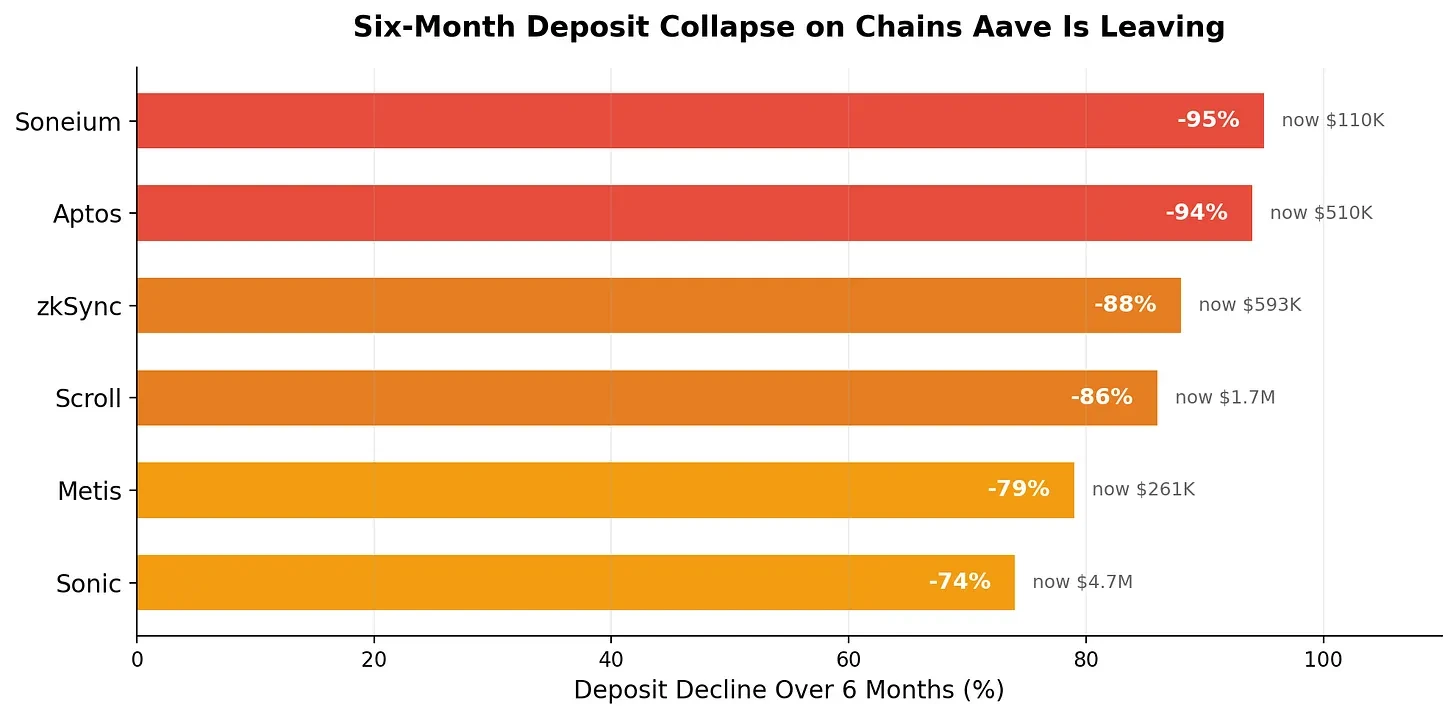
Now consider the chains Aave is about to exit—Soneium, Aptos, Zksync, Scroll, and others. Their situation is even worse than Harmony and Fantom. On-chain deposits have already plummeted 95%, and lending business generates less than $5,000 in quarterly revenue.
Harmony and Fantom, at least before being hacked, had native lending demand generated by real users. These six chains, however, never developed native business demand from the start. These chains raised an average of $250 million each and deployed the most cost-efficient lending protocol in DeFi, yet still failed to generate real demand.
Data source: Aave Governance Page
Aave's exit will also trigger a chain reaction. Many people don't realize that Aave is the core pillar of these chains' financial infrastructure. Nearly all Chainlink oracle price feeds on these chains have their maintenance costs borne by Aave, since Aave is the largest consumer. After Aave leaves, all oracle service providers will reassess whether to continue maintaining price feeds for a chain with no active lending market. Market makers will likewise stop deploying capital into DEXs on these chains for the same reason. Even stablecoin issuers won't provide native issuance support for chains generating less than $1,000 in monthly revenue. One service provider's exit accelerates the next one's departure—the commercial viability of every service provider depends on other supporting services continuing to function.
Resources will increasingly concentrate toward public chains that are operating well, have sufficient liquidity, and where lending markets function properly. As infrastructure exits each niche chain, it further reinforces the agglomeration effect around top chains, which in turn makes the business case for remaining niche chains to maintain their own lending infrastructure even weaker.
This centralization is self-reinforcing. Lending is the foundation of an entire chain's financial system. Without lending, most yield strategies cannot operate—most strategies require borrowing one asset against another as collateral; efficient liquidity market-making also becomes impossible, as concentrated liquidity positions often depend on borrowed capital. Once lending disappears, all financial applications built on top of it lose their foundation. Developers then leave one by one, on-chain activity declines further, and even fewer infrastructure providers are willing to stay.
This is precisely why Aave has set a threshold for new chain deployments: minimum annual revenue of $2 million. This amount essentially covers the cost of maintaining oracle price feeds, risk monitoring, and liquidation infrastructure for a single chain. This also fully demonstrates that the old model of raising hundreds of millions and fast-tracking launches through liquidity subsidies is no longer viable or sustainable.
A Dilemma Not Unique to Crypto
Public chains losing credit infrastructure is not a phenomenon unique to the crypto space. Any industry with high fixed costs but small market size faces the same kind of problem.
After 2008, major global banks began cutting correspondent banking relationships with certain small countries. The logic is highly similar to Aave's: anti-money laundering monitoring, regulatory reporting—every partnership incurs fixed costs, and the revenue from small cross-border transactions cannot cover those costs. Between 2011 and 2022, effective correspondent banking relationships worldwide decreased by 30%. Dollar clearing corridors for Pacific island nations shrank by more than 60%, with some countries left with only a single correspondent bank. The situation became so severe that the World Bank had to provide $69 million in subsidies to keep the remaining clearing service providers in eight Pacific countries operational.
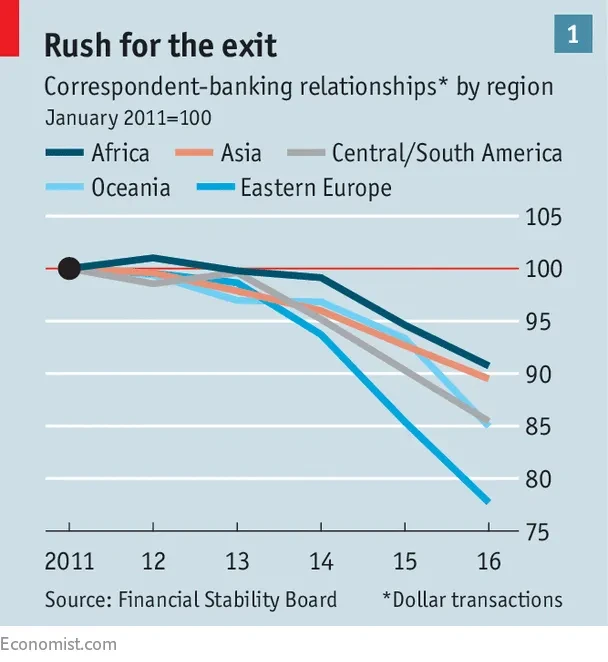
However, there is a key difference between the crypto industry and traditional cases. In the traditional correspondent banking system, the World Bank can step in as a backstop, with central banks and development institutions providing subsidies to keep operations going. But the crypto industry has almost no such backstop mechanism—and this is exactly the reality these chains are experiencing. A mid-sized bank spends $15-40 million annually on compliance costs alone, and the World Bank's $68 million only preserved the last dollar clearing channel for eight countries. By contrast, Aave's total risk monitoring contract costs across all chains are only $5-8 million, and these six chains cannot even afford their share of that cost.
Of course, this doesn't mean DeFi lending is shrinking overall—quite the opposite: the industry is growing rapidly while becoming highly concentrated. Morpho's TVL grew from $105 million to over $8 billion in one year; Euler expanded from $6 million to $300 million within just a few months. Aave's V4 surpassed $300 million in deposits within months of launch, and Société Générale became the first traditional bank to integrate with a DeFi lending protocol. The credit market is thriving, but resources are concentrating on Ethereum and two to three Layer 2 networks like Base and Arbitrum—not spreading across dozens of public chains.
Many public chains were created in the past based on the assumption that since deploying infrastructure costs very little, every chain could build its own financial system. That assumption was only half right. Launching a chain is indeed cheap, but running a credit infrastructure on top of it is extremely expensive. Looking at the current Layer 2 landscape, Ethereum and the top three chains account for 90% of all TVL. The remaining chains are left fighting over scraps—revenue that doesn't even cover the cost of a single Chainlink price feed. For these chains, the future may bring a flawed fork of Aave with defective oracles, or quite possibly, nothing at all.