Arc Chain Mainnet Goes Live for 5 Days, Launchpads Fall Silent Collectively with Revenue Under $1


- Core Viewpoint: Less than a week after Arc Chain's mainnet launch, hype has rapidly cooled, Meme Launchpad revenue is dismal, ecosystem growth is sluggish, and a turnaround depends on the ARC token airdrop and institutional adoption.
- Key Elements:
- Multiple Meme Launchpads generated less than $200 in protocol revenue over the past 24 hours, with some below $1 or even zero.
- On-chain DEX trading volume fell from a peak of $131 million to approximately $41 million, a decline of nearly 70%.
- The mainnet launch was initially mired in controversy: an online meeting sparked "Indian team" rumors, and a small incentive program of only $10,000 was questioned by the market.
- The ARC token completed its genesis minting of 10 billion tokens, with 60% allocated to the ecosystem, but airdrop expectations are primarily aimed at payment, forex, and other partners rather than Degen traders.
- The first batch of validators includes institutions such as BlackRock, Visa, and Mastercard. BlackRock plans to deploy its BUIDL fund to Arc, and institutional adoption is seen as a key growth path.
Original author|Odaily (@OdailyChina)
Author|Wenser (@wenser 2010)
Less than a week after its mainnet launch on September 16, the Arc chain's hype has already cooled rapidly, and the various launchpads that were once highly anticipated before launch have found themselves in an awkward business position.
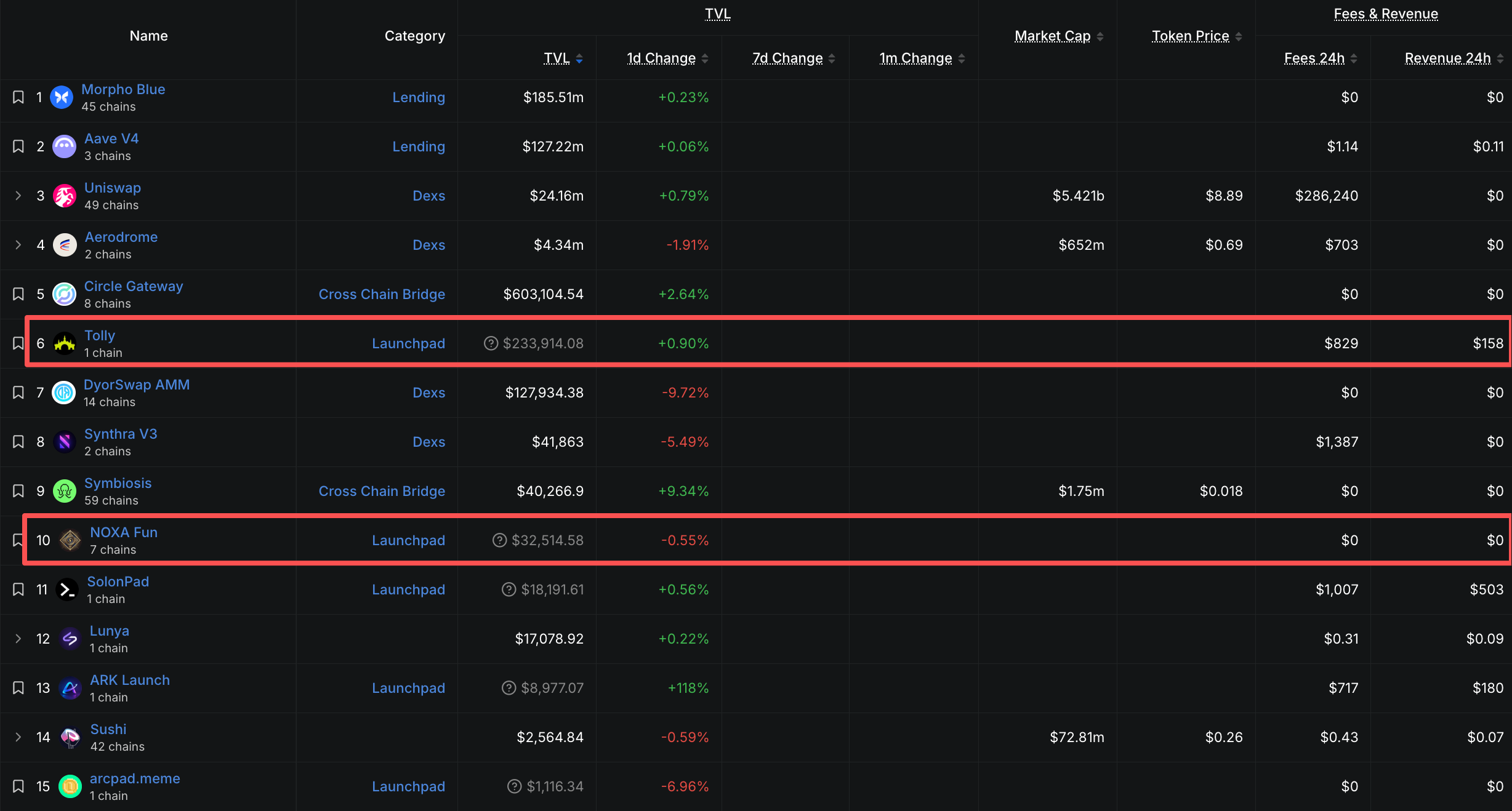
According to DefiLlama data, the 24-hour protocol revenue of multiple Meme launchpads on the Arc chain came in at less than $200: Solon generated just $503, while ARK Launch and Tolly brought in $180 and $171 respectively, and Wonk Fun and AKA made $69.6 and $66.87 respectively; UBI.fun, Sashimi.fun, and CircleWarp all earned less than $1, with several other launchpads yet to generate any revenue at all.
In its attempt to forcibly replicate the development path of Robinhood Chain, the Arc chain has met its moment of setback. And looking back at the recent Arc chain's rapid rise followed by its equally swift cooldown, one could say all the warning signs were there from the start.
Arc Chain's One Week: The "Indian Team" Controversy, the "$10,000 Micro-Grant," and the "AI Agent Payment" Positioning
For the Arc chain, which is backed by Circle, the stablecoin issuance giant, the past week cannot be described as particularly smooth.
Although in the run-up to the mainnet launch, the Arc chain drew a "collective pilgrimage" from many crypto-native projects, most came with the mindset of grabbing a piece of the pie and capturing market share and users for themselves, rather than wanting to inject their existing user base and liquidity into the Arc ecosystem. This is evident from the fact that many partners talked profusely about "providing support" and "integration and access" while avoiding any mention of corresponding incentives or concrete actions. (Recommended reading: "On Arc's Launch Day, Crypto Infrastructure Projects Celebrated Collectively—Is the Next Robinhood Chain Here?")
Specifically, the problems the Arc chain encountered were not merely early-stage incentive issues, but rather a series of market controversies and marketing missteps.
First, the "Indian team" controversy surrounding an Arc chain online meeting.
On launch day, a screenshot of an online meeting's participant thumbnails circulated widely in the crypto community. The presence of multiple members who appeared to be of Indian and African descent on screen led many to mistakenly believe it was an Arc chain team meeting, with some even spreading the absurd claim that "the Arc chain is actually an Indian project." As a result, Meme coins on the Arc chain saw a broad decline, and crypto KOL Him even remarked: "The Arc chain livestream looks scarier than the Fed's FOMC meeting."

However, the reality is that the meeting screenshot was simply an online appearance by Arc chain ecosystem developers, most of whom are not official Arc chain team members—including the Indian guy who went viral, who is the founder of the Arc chain project @Xylonet_. One can only say that rumors spread faster than the truth, and in a crypto world that values "white backgrounds," this rumor quickly dealt a heavy blow to the carefully crafted technical image of the Arc chain. (Recommended reading: "Team Livestream Scarier Than a Rate Hike—Did ARC's Meme Launch Collapse in Just One Day?")

Second, the controversy over the Arc chain's official "$10,000 micro-grant."
On September 17, the second day after the mainnet launch, Arc officially announced a micro-grant program. It stated: "This program will distribute 20 grants of 500 USDC each—totaling 10,000 USDC—to qualifying early developers who launch functional Mini Apps on the Arc mainnet, covering early-stage projects, prototypes, and proof-of-concept applications." Yes, you read that correctly—it's not $100,000, nor $1 million, but $10,000. Looking at this number alone, it's hard to imagine that this is an incentive program launched by an L1 public chain that has been heavily backed by Wall Street institutions and has raised hundreds of millions in funding.

Although the Arc team had previously published an announcement for a "up to $1 million ecosystem builder incentive" program, by comparison, this $10,000 micro-grant still left the market stunned—it's hard to imagine why the Arc chain's official team would pull such a move at the very time when "generous rewards bring forth brave warriors" is most needed in the early days of launch.
Third, the "AI Agent payment positioning" controversy.
On September 16, the day of the mainnet launch, Circle co-founder and CEO Jeremy Allaire stated that Circle's founding vision was to build a new open economic layer for the internet, enabling money, contracts, and machines to operate on a new distributed computing engine. The Arc chain was thus born.
On September 19, the Arc chain officially announced that it had launched agent payments, providing x402 developers with a custodial access pathway.
Clearly, Arc, which started as a stablecoin network, has inherent advantages and broad application scenarios in AI Agent payments, but this clearly does not match the currently hot Meme coin market. Previously, crypto researcher Ignas wrote that his Arc chain trading had "no FOMO," arguing that Arc focuses more on forex, payments, and tokenization scenarios, and that the team's support for Crypto Native culture is relatively limited.
Well-known Meme coin trader Bonkguy also spoke out multiple times, stating that "Arc is essentially a stablecoin public chain and may find suitable application scenarios such as stablecoins in the future. Although he has already bought Meme coins on the Arc chain, he plans to hold them for a few days at most, and emphasized that if participating in Meme coin trading on Arc, it should be treated as a short-term opportunity." He evenonce warned "don't get stuck in Arc."
The recent rapid quieting of the Arc chain ecosystem has also validated the market's judgment.
How Can the Arc Chain Stage a Comeback? It Can Only Pin Its Hopes on Token Airdrops and Institutional Adoption
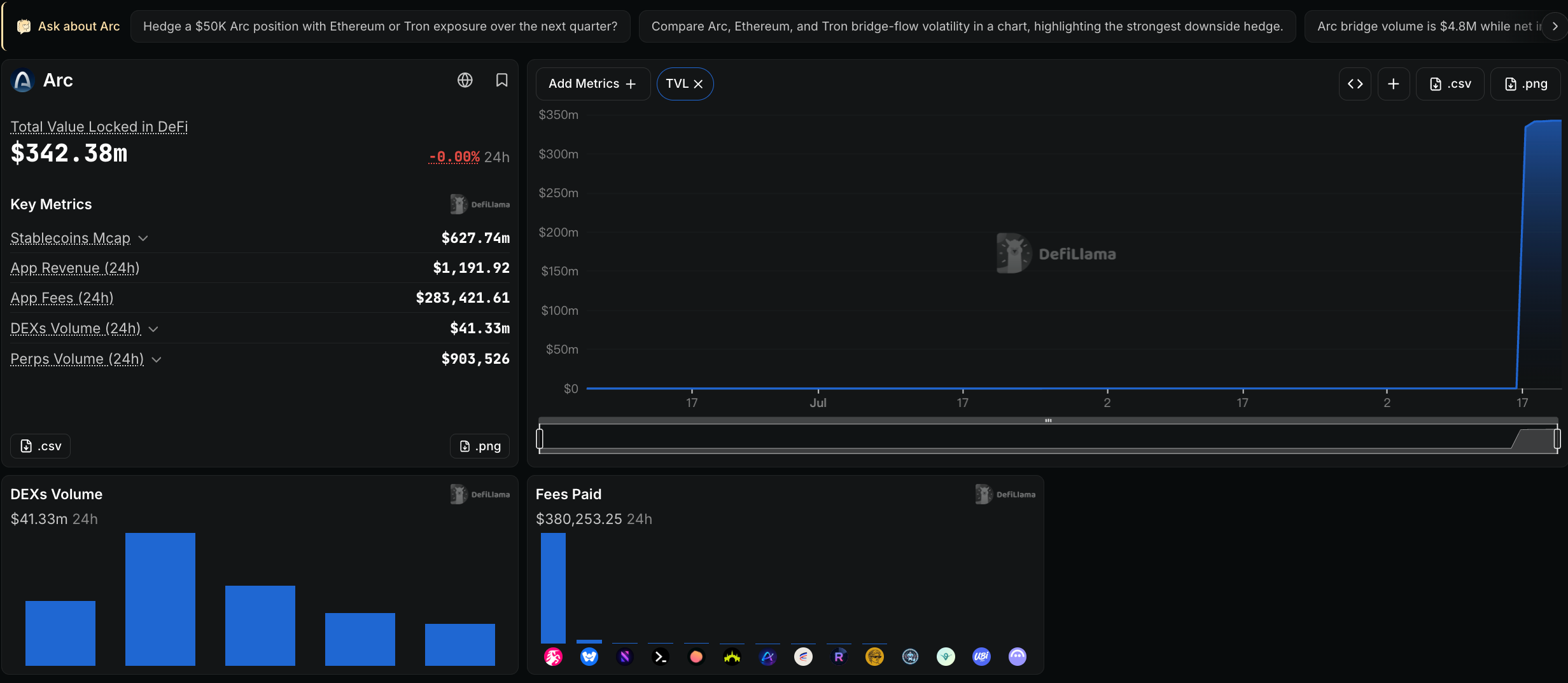
DefiLlama data shows that the 24-hour net revenue of apps on the Arc chain is only around $1,191; its DEX trading volume peaked at $131 million on September 17 and has been declining daily since, dropping to around $41 million by September 20—a decline of nearly 70%.
At present, the scale of AI Agent payments is still insufficient to support the operation of the Arc chain ecosystem. To stage a successful comeback, it can only pin its hopes on the ARC token airdrop and large-scale institutional adoption.
On September 16, Circle stated that it had completed the genesis minting of 10 billion ARC tokens, but emphasized that this was merely a technical milestone and did not represent a commitment to a public offering; the company is exploring a transition of its consensus mechanism from Proof of Authority to Proof of Stake by 2027. According to Bubblemaps monitoring, Circle subsequently distributed all ARC tokens to 11 addresses via empty addresses, which can be tracked on-chain in real time.
According to the previous token whitepaper, the ARC token distribution plan is as follows:
- 60% allocated to the ecosystem (token sales, developer grants, network growth);
- 25% allocated to Circle (protocol development, staking, and governance);
- 15% allocated to long-term reserves (strategic flexibility and economic stability).
Whether the 6 billion ARC tokens can subsequently feed back into ecosystem building and drive ecosystem development will depend on how the Arc chain team plans the corresponding use and distribution methods. On this point, the aforementioned crypto researcher Ignas also mentioned: one of Arc's potential attractions may come from the ARC token airdrop. He noted that Arc has 60% of its tokens planned for the "ecosystem," but expects the related tokens may be more likely used to incentivize ecosystem partners in payments, forex, and tokenization rather than Degen traders.
The other direction is institutional adoption.
Previously, Robinhood announced on the first day of the Arc chain mainnet launch that it would soon support Arc, the L1 network built by Circle, allowing users to deposit and withdraw USDC directly within supported networks. Although Robinhood Chain and the Arc chain compete to some extent in the user market and Meme coin market, as a payment network L1, Arc remains an unavoidable part for many institutions, trading platforms, and payment networks.
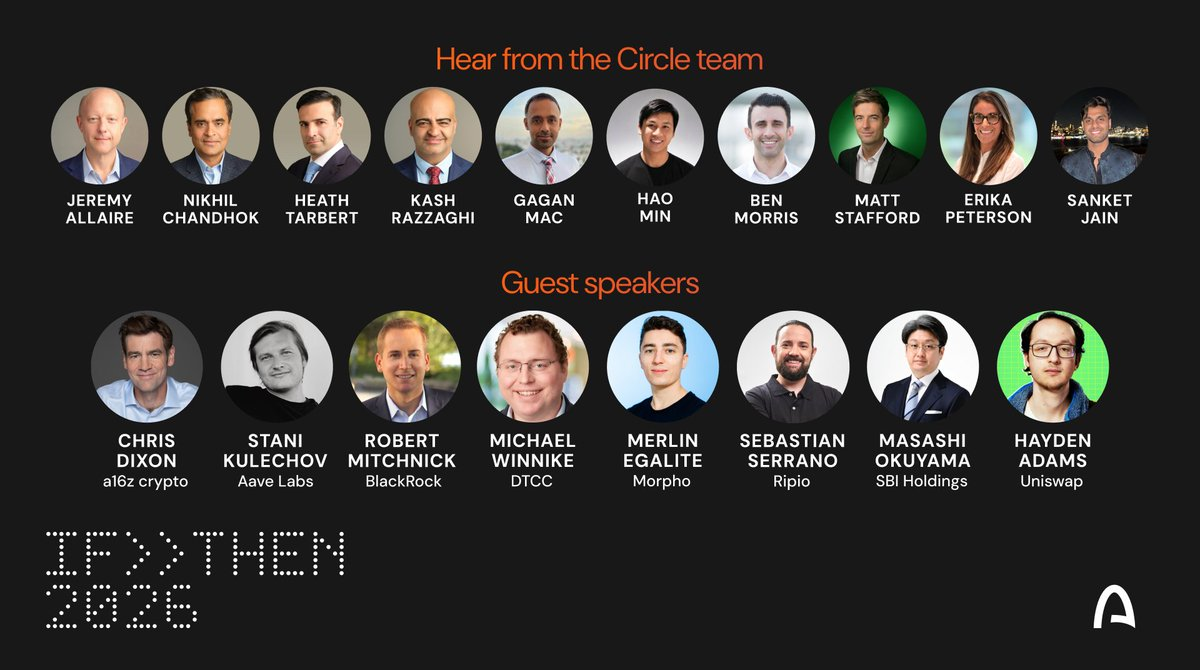
Earlier, on its launch day, the Arc chain invited a host of big names from Wall Street and the crypto world to attend its launch event, and its first batch of 11 founding validators included BlackRock, Visa, Mastercard, and the Depository Trust & Clearing Corporation. BlackRock had also planned to deploy its BUIDL fund to Arc to support on-chain subscription and redemption. In summary, the subsequent benefits of the GENIUS Act will further drive Arc chain adoption by more institutions, making it an important node in the global stablecoin payment network.
Of course, returning to the topic from the beginning, the launchpads on the Arc chain still face a precarious survival situation, and the fee revenue of DeFi projects is also quite ugly, with many projects' 24-hour revenue directly at 0. Although the number of on-chain addresses appears to be in the hundreds of thousands, the Arc chain still has a long way to go in terms of growth.