






USDC's "White Terror": Can the full-stack of the DeFi protocol save the decentralized narrative?


Original author:Jack (0x137),BlockBeats
Original author:After the Tornado Cash sanctions incident, the encryption circle can be said to have turned pale when talking about USDC, and people's fear and concern about centralized stablecoins have reached an unprecedented level. We found that the economic foundation of the decentralized world has now become the ultimate weapon of regulation against Crypto.(BlockBeats note, "A turning point in the history of encrypted finance: USDCs are backlashing DeFi
In the past year, the stablecoin market has grown several times, of which USDC and USDT alone accounted for nearly 80%. The tentacles of centralized stablecoins such as USDC are all over every corner of DeFi. Decentralization seems to be a deadly proposition for Web3. Despite this, we still see many public chains and DeFi protocols launching their own stablecoin projects. Against this background, can DeFi get rid of the shadow of USDC? Can decentralized narratives be saved?
first level title
Looking at the current USDC, we can't help but remind us of the former "Blue Giant" IBM. In the 1970s and 1980s, IBM had absolute dominance in the computer field. From the military to aerospace to finance, and even Kubrick's Hollywood blockbusters, the three letters of IBM are everywhere. The bright blue logo on the screen, the burly and cold appearance, and the invincible industry influence make IBM a symbol of monopoly, centralization and ruling class. And Apple under the leadership of Jobs set off a new wave of personal computers with the narrative of "anti-IBM dictatorship", that is, everyone should have a personal computer that belongs to them and can be used at will.

image description
Apple's 1984 Macintosh personal computer ad, the theme hints at confrontation with "Blue Giant" IBM
Today's DeFi and stablecoin markets are similar to the computer industry in the past. In addition to its absolute dominance on centralized trading platforms, USDC’s tentacles have also extended to the liquidity pools and vaults of every DeFi protocol. Currently, the two largest decentralized stablecoins DAI and FRAX, more than half of the collateral is USDC. As long as USDC sneezes, a major earthquake will occur in the entire encryption ecosystem.
Of course, this scale effect and monopolistic market position are based on sacrificing Crypto's sovereignty and censorship resistance. In order to attract huge amounts of liquidity while maintaining a strong anchor, it is impossible for centralized stablecoins to rely on encrypted assets for endorsement, because they not only fluctuate greatly, but also have a relatively small market value. In contrast, fiat currency, especially US dollar fiat currency, not only has strong liquidity, but also has various abilities to generate income in the real world. The only downside is that it inevitably tightly binds the encryption industry and regulation.
In November last year, the Biden administration's Financial Market Working Group, the Federal Deposit Insurance Corporation, and the Office of the Comptroller of the Currency issued reports calling for legislation to restrict the issuance of stablecoins and strengthen strict supervision of stablecoins to prevent them from affecting the economy and the economy. The financial system poses "systemic risk". While the stablecoin’s market capitalization pales in comparison to Wall Street’s risky derivatives market, the report nonetheless demonstrates Congress’ determination to defend the U.S. dollar’s fiat currency. Anyone who thinks that Authority will not supervise the stablecoin track is absolutely wishful thinking.
In response to the new law’s requirements for the disclosure of reserves for stablecoin issuers, all major mainstream centralized stablecoins have disclosed their own assets.
Paxos and TrueUSD are also following Circle's pace, holding high the banner of security compliance. Paxos Trust disclosed its Binance USD (BUSD)-backed assets in June, and the report even detailed the identification numbers of every treasury bill and bond held in its reserves, as well as the names of its deposit banks.
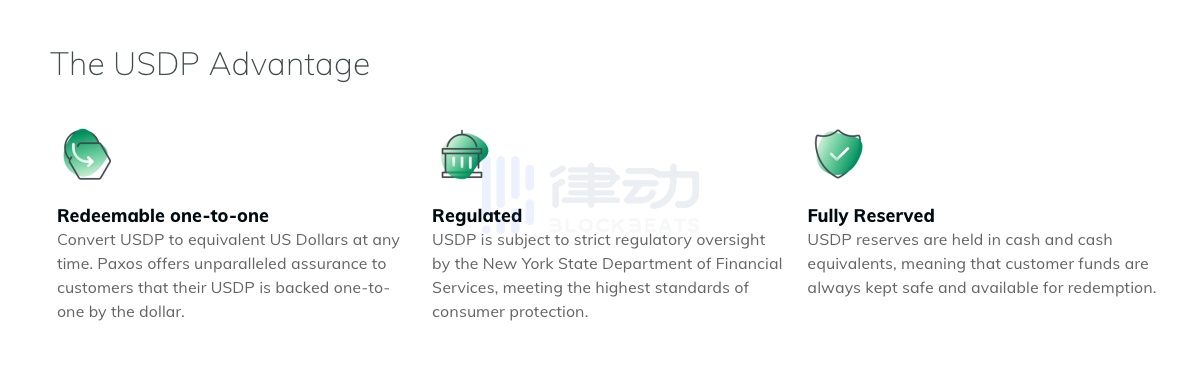
image description
On the contrary, USDT, which has been criticized, is very tough on this issue. Although Tether finally released the details of its reserves in March last year, the company has always opposed the disclosure of USDT's reserve composition, and even asked the New York Supreme Court to prevent the state attorney general from responding to CoinDesk's Freedom of Information Act (FOIL) request filed against Tether. Even so, USDT cannot escape the iron fist of regulation. According to the data on its official website, 40% of USDT’s endorsed assets are U.S. Treasury bonds, forming a profound interest bond with the U.S. Authority.
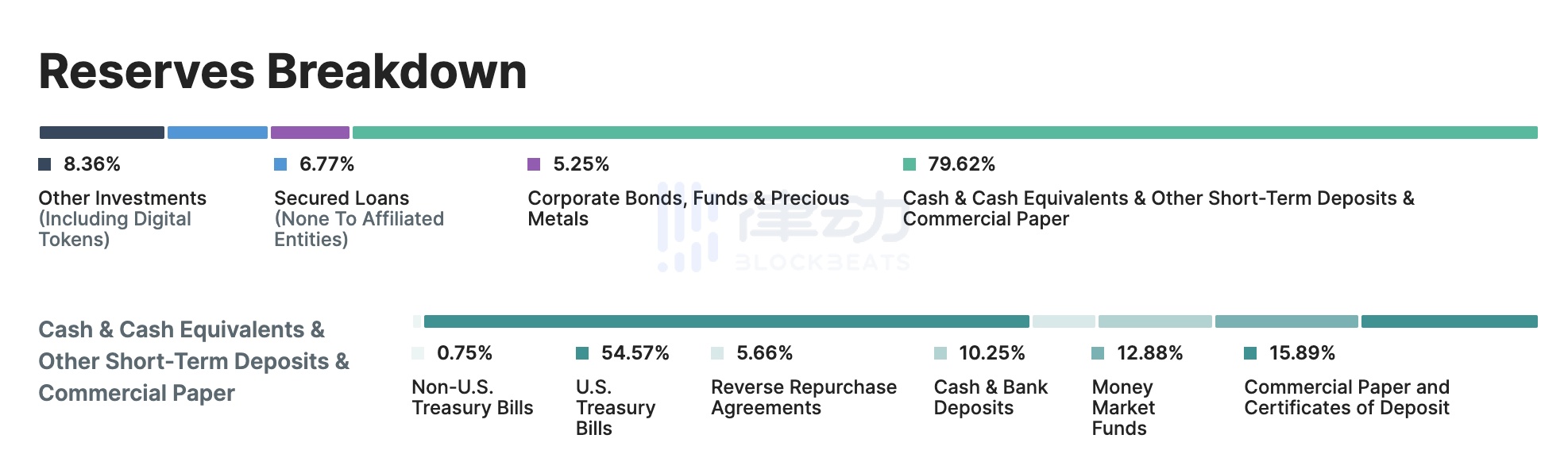
image description
USDT reserve composition
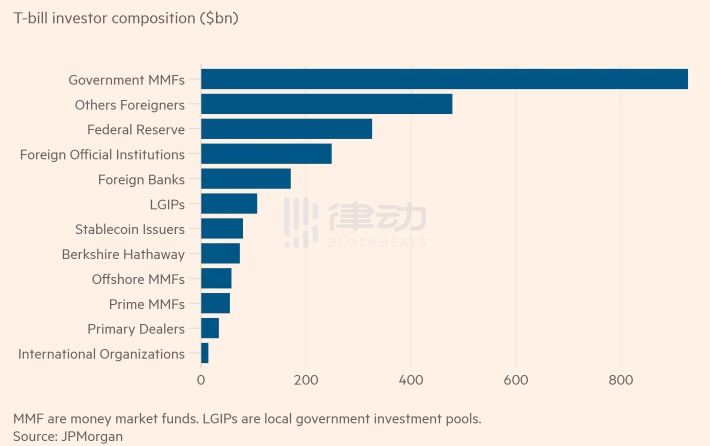
In fact, this "interest binding" between centralized stablecoins and Authority has become an irreversible trend. According to the latest report released by JPMorgan Chase, the value of U.S. Treasury bonds held by stablecoin issuers such as Tethe and Circle has reached 80 billion U.S. dollars, accounting for 2% of the entire national debt market, surpassing Buffett's Berkshire Hathaway. So to be precise, the real Big Blue is not USDC, but the pair of regulatory hands that operate USDC behind it. The strong willingness to recruit security and the deep-seated interest binding have made the regulation of stablecoins an inevitable foregone conclusion.
In the situation where the Web3 ecology is flourishing, we have forgotten the sword of Damocles hanging over the heads of every encrypted user. However, in the past few months, the turmoil in the encryption market has brought great changes to the industry, and the collapse of UST in May has added momentum to Authority's promotion of stablecoin regulation. In the end, the sword of sanctions fell on Tornado Cash, followed by USDC freezing accounts, and the dream of a decentralized revolution was awakened.
If you want to be big but not fail, you have to make sacrifices. For a stablecoin project to achieve scale, it must currently adopt real-world assets. Relying entirely on encrypted assets will be like DAI in the future, rolling back part of the mortgage system (that is, the deposit reserve system), and even facing the risk of floating. So in the face of the "white terror" of USDC and supervision, is it possible for Crypto to achieve decentralization? DeFi full-stack may be able to give a reliable answer.
first level title
Full stack of DeFi protocols: Assuming you are not alone
Thinking about it carefully, the reason why we need to face the above-mentioned risks is because we assume that DAI needs to bear the liquidity of the entire stable currency and even the encryption industry, and we assume that DAI is still pursuing economies of scale. What if DAI is not a person? A completely decentralized stablecoin project cannot scale, but if there are dozens or hundreds of decentralized stablecoins that cannot be scaled, the decentralized stablecoin as a whole may achieve Scale. Now, that vision appears to be coming true.
Now, when we talk about the financial ecology in the encryption field, the first thing that comes to mind is the "three-piece set" of transactions, lending and stable coins. This combination matrix can be said to be the holy grail of today's encryption world. Whether it is for CeFi trading platforms and asset management institutions, or for DeFi protocols and new husband chains, it is a strategic high ground that must be contested. This kind of competition has penetrated into every level of the encryption field. Unknowingly, DeFi seems to usher in the era of full-stack.
secondary title
Public chain: Self-made liquidity, seeking ecological independenceSince UST became famous, examples of public chain stablecoins have appeared one after another in our field of vision, first USN of Near, USDD of Tron, and NOTE of Canto now. In fact, regarding the end of the public chain as a stable currency, BlockBeats previously discussed in "The Lord of the Rings Dream of Algorithmic Stablecoins: After LUNA, there will be no next UST
"There has also been an analysis. At that time, LUNA and UST had not yet collapsed. For a public chain, the biggest attraction of using a dual-currency mechanism to construct a native algorithm stable currency is undoubtedly the positive price of its native Token. However, when the momentum of “the stability of the public chain” was about to take off, UST experienced a stampede and collapse, and the stability of the algorithm was basically falsified. It became a taboo topic that no one dared to touch in the stablecoin track.
The New Public Chain Canto Ecology: Using Stablecoins for High Annualized Liquidity MiningThe New Public Chain Canto Ecology: Using Stablecoins for High Annualized Liquidity Mining》)
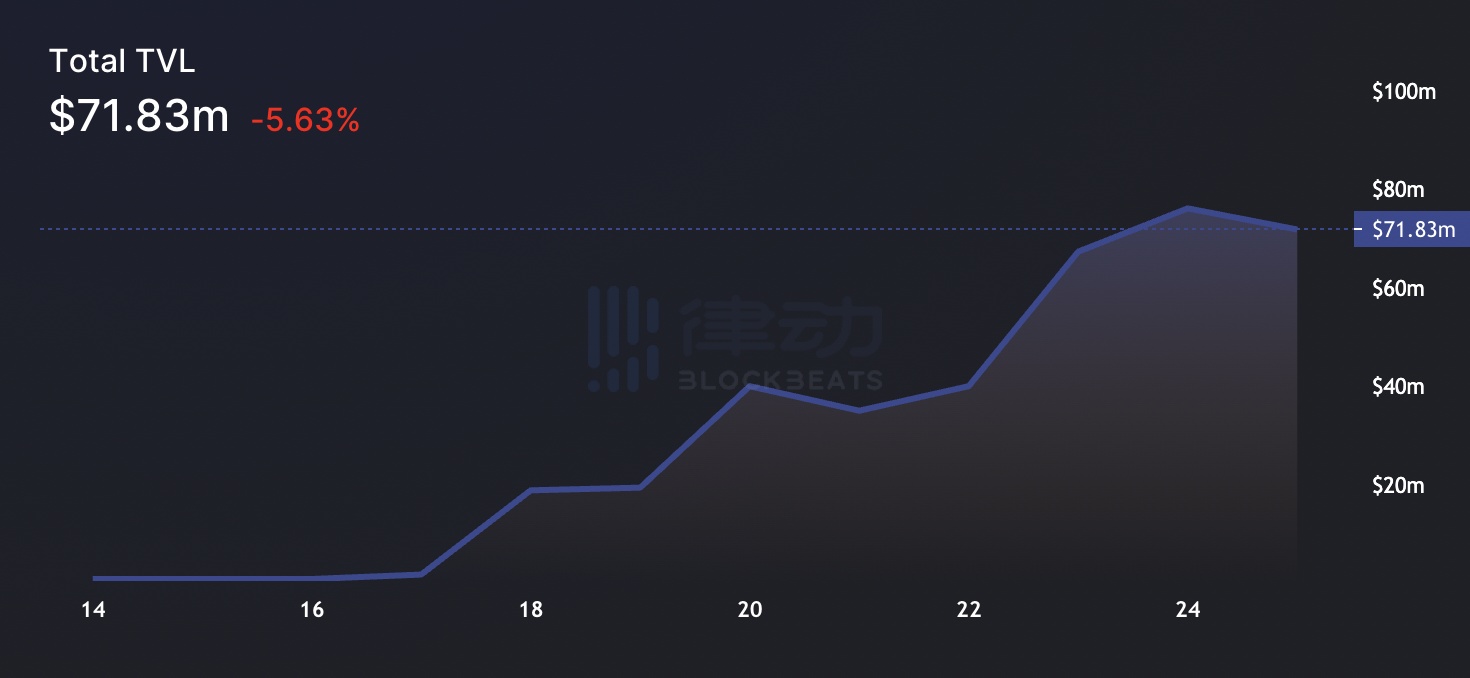
image description
Canto relies on NOTE stablecoin mining incentives, and TVL climbs rapidly
The second is to get rid of dependence on external liquidity. As the source of life of the public chain ecology, stablecoins basically support all protocols and applications in the public chain ecology. However, for now, most of the stablecoins of the L1 public chain are cross-chain from USDC on Ethereum, which makes these L1 public chains double dependent on USDC and Ethereum users, and it is difficult to cultivate their own ecosystem. native users. To get rid of this dependence, or to cultivate native users, the most critical step is to let them use their own stable currency. It is also for this reason that Avalanche chose to cooperate with UST, and Near and Tron chose to launch USN and USDD.
Of course, public-chain stablecoins also face many challenges.
The first to bear the brunt is the interference with ecological development. Taking Canto as an example, in order to stabilize and promote NOTE, the team must build its own liquidity platform, namely AMM and lending agreement, which severely discourages the enthusiasm of other DeFi agreements that want to develop on Canto. Although the Canto team uses the excuse of "creating a new DeFi public chain", it is difficult to hide this fact. We can recall that in the Luna ecosystem, besides Anchor, are there other mainstream lending platforms?Analysis of Near’s native stablecoin USN: it is fundamentally different from UST"and""and"》)
What's more dangerous is that after the public chain launches the native stablecoin, even if the entire ecology is tied to a piece of wood, once the stablecoin has a problem, it will face the risk of annihilation of the entire army. The most typical case, in addition to UST, is the recent aUSD theft incident on Acala. Similar to Canto, Acala hopes to use DeFi as an entry point to become the financial center of the Polkadot ecosystem, so it naturally issued its own stable currency aUSD. However, on the 14th of this month, the iBTC-aUSD pool on its chain was hacked, resulting in the improper issuance of 1.29 billion aUSD, and the decoupling of stablecoins, which has not yet returned to anchoring. This is undoubtedly a devastating blow to protocols built on Acala that rely on aUSD liquidity, and they are likely to face a similar fate as the Luna ecological protocol.
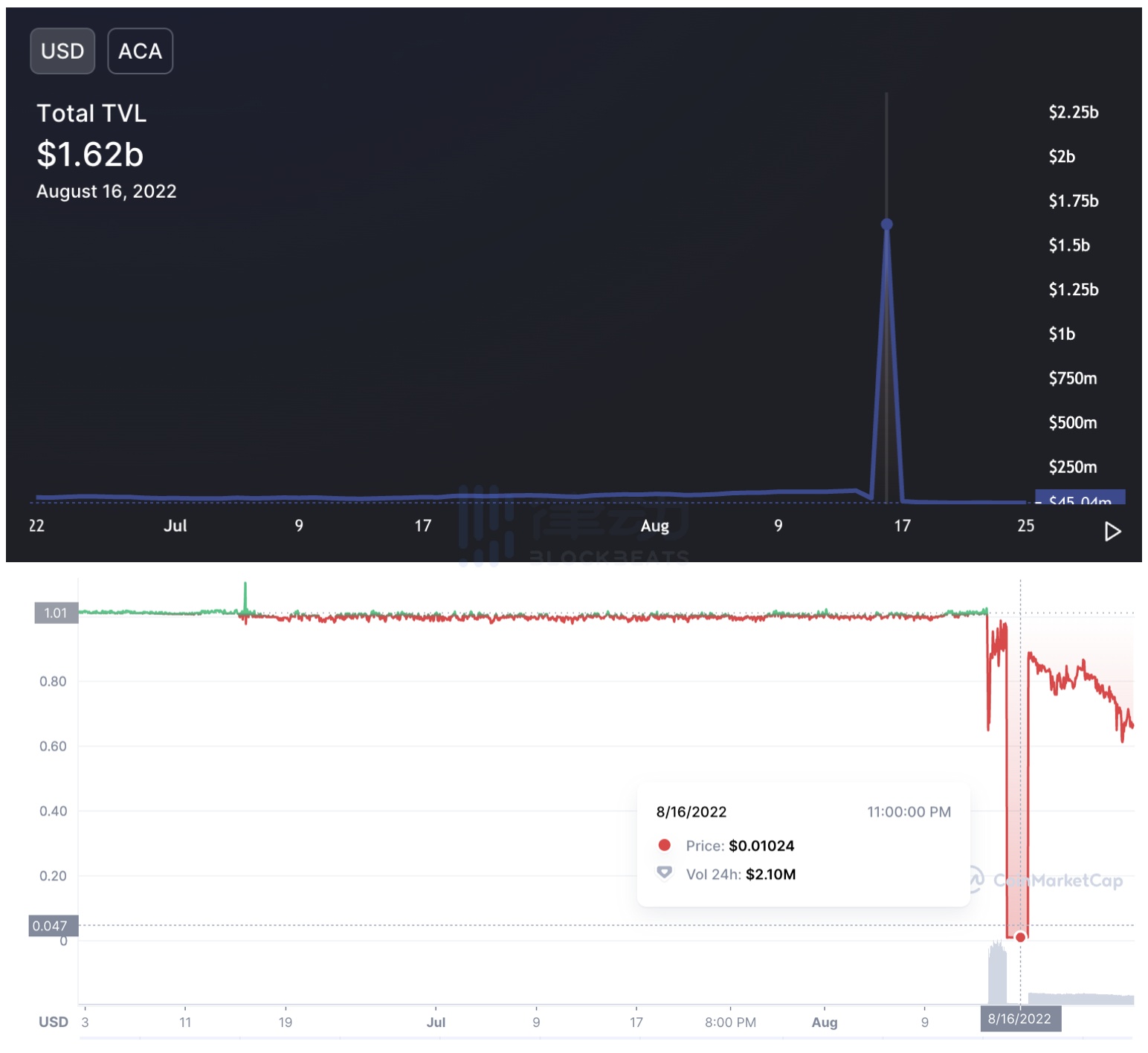
Due to the abnormal issuance of aUSD, Acala TVL fluctuated dramatically, and aUSD was seriously de-anchored
secondary title
Lending, AMM agreement: Digging a liquidity moat, so that the rich water does not flow to outsiders
Compared with the public chain, it seems more reasonable for the DeFi protocol to issue its own stable currency. On the one hand, the trading and lending platform itself is the liquidity center of each public chain, supporting most of the TVL of the ecology; loan assets. Therefore, it is indeed a waste of the inherent advantages of the protocol to hand over the considerable income-generating opportunities to other stablecoin minters.
Secondly, many OG DeFi protocols have long been burdened with the infamy of "fat protocols, thin tokens". Combining their own governance tokens with stable currency mechanisms may also be a good solution. With the two largest lending and AMM platforms, Aave and Curve, announcing the issuance of their own stablecoins, the DeFi protocols have also launched their own "liquidity defense battles."
Let's first look at how Aave combines its lending business with stablecoins.
The primary task of almost all lending protocols at the beginning of their creation is to attract as much stable currency liquidity as possible, because it undoubtedly has the greatest demand for lending among all assets, and Aave, the leading lending protocol, is no exception. Although Aave has extremely high TVL and liquidity, it is much better to have its own stable currency than to rely on the USDC of giant whales. What's more, most of the income generated by stablecoin lending flows into their pockets.
Since July 7, the Aave team has initiated the proposal of the native stablecoin GHO, and has continued to improve and supplement its mechanism description. As a decentralized stablecoin based on the Ethereum mainnet, GHO, similar to DAI, is minted by protocol users or borrowers. Users provide various aToken interest-earning assets pledged on Aave according to a specific mortgage ratio (BlockBeats live, aToken is an asset pledge certificate on the Aave platform, the price is linked to the original asset and can be traded freely), and then mint GHO. Conversely, when the user returns the loan or is liquidated, the minted GHO needs to be destroyed.
The Isolation Mode allows users to generate GHO using various assets currently supported by Aave, maintaining sufficient collateral while reducing risks. When the market is down, the demand for GHO may increase as the collateral price falls, because users will start to use a non-volatile asset such as USDC as collateral to borrow more GHO to repay the previous loan position. At this time, Aave will use E-Mode to help these stablecoin holders obtain GHO at a ratio close to 1:1 with zero slippage, so as to stabilize the lending market and prevent the decoupling of GHO.
In order to accelerate the market adoption of GHO, Aave introduced the mechanism of "Facilitators". Once approved by Governance, the designated protocol or entity will have the right to mint/burn GHO without permission, so that users can mint/burn GHO on other protocols or public chains. Each "Pusher" has a specific "Currency Basket Quota" (Bucket), which is used to stipulate the minting limit of its GHO. Aave itself will be the first "enabler" of GHO.
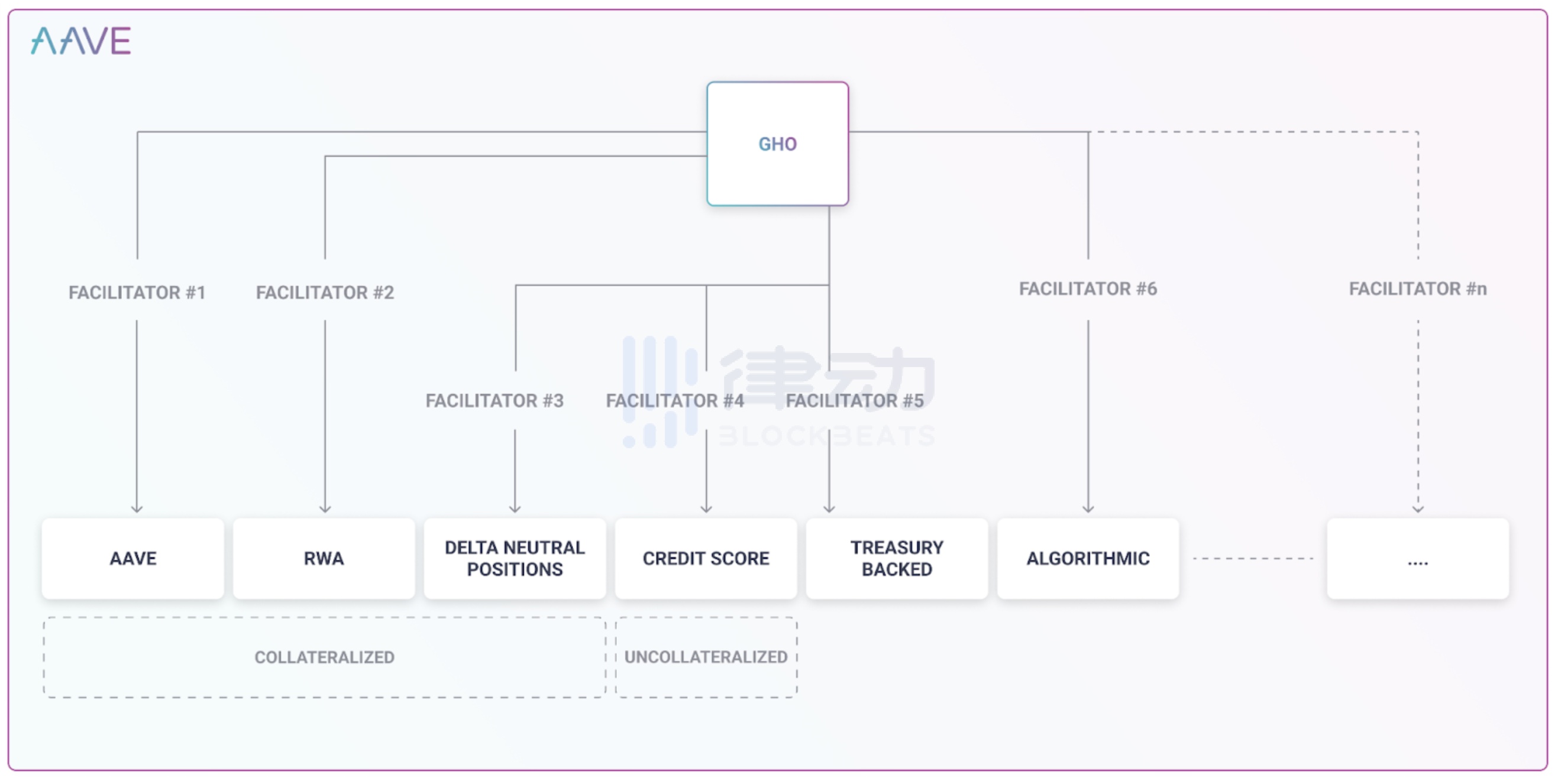
To some extent, it can be understood as a combination of DAI and MIM, but for the Aave protocol, GHO has a very important difference from them. Since GHO is minted directly by users through the agreement, all fees and interest generated by minting will not flow to LP whales, but will be directly charged in full by AaveDAO treasury. As the number and frequency of GHO minting/burning increase, Aave will earn considerable income.
In addition, unlike DAI, GHO's lending rate is adjusted by AaveDAO according to market conditions, in order to pursue higher stability while ensuring the flexibility of the interest rate model. Of course, GHO will also implement the interest rate strategy that the Aave community deems appropriate in the future. GHO also comes with a set of discount mechanism, holders of stkAAVE can pay lower interest rates, mint GHO at a discount rate of 0% to 100%, incentivize more AAVE to be pledged into the security module of the protocol, and further create Market demand. It is not difficult to see that the embedding of native stablecoins can kill two birds with one stone for lending protocols like Aave.

As the leading AMM on the stablecoin track, Curve is not far behind. On August 19, Curve founder Michael Egorov’s Telegram chat records were leaked on Twitter, from which we learned that Curve’s native stablecoin crvUSD will be launched as early as the end of this year. Although the team has not announced the details of crvUSD, we can make a reasonable guess based on Curve's unique mechanism. Next, let's take a look at the benefits of native stablecoins for AMMs like Curve.
Unlike GHO, the mortgage mechanism of crvUSD can be played in many different ways.
First of all, Curve is an AMM specially designed for stablecoins, and its existence is related to the life and death of most small stablecoins. Its 3Crv liquidity pool, which consists of the three major stablecoins USDT, USDC and DAI, is one of the largest stablecoin pools in the encryption market. At its peak, the TVL exceeded $4 billion. Emerging stablecoin projects only need to combine their own stablecoins with 3Crv pool hook, can rely on Curve's liquidity to survive. Therefore, in the case that the 3Crv pool is not replaced, crvUSD can be anchored with LP Token as collateral and linked to other stable coins, so that Curve can earn minting fees from its own 3Crv liquidity Share more income.Another way to play is to nest crvUSD into the "Curve Flywheel". Here we have to mention Curve War. (BlockBeats note, ""The Curve War mechanism is described in detail) For a long time, the struggle for control of CRV has been a strategic task of each DeFi protocol. By holding more CRV Tokens, the protocol can obtain higher voting rights to guide more CRV incentives into its own liquidity pool. In this way, on the one hand, the agreement can attract more liquidity, and on the other hand, CRV Token also has greater market demand. However, affected by market conditions in the past few months, the Curve flywheel has been sluggish, and the price of CRV has also dropped to around $1. After the team announced the launch of the stablecoin, there was also various jibes from the community.
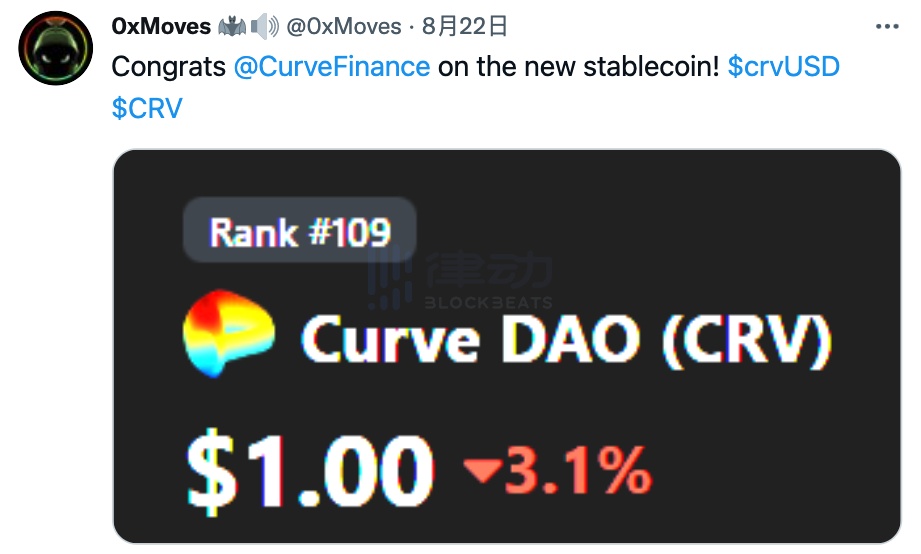
image description
Therefore, crvUSD can also use CRV for over-collateralization, and the Curve incentive changes from CRV to crvUSD. First of all, using stablecoins as liquidity incentives is more attractive than tokens with large price fluctuations. Secondly, in order to attract more liquidity, other DeFi protocols must hold more CRV to mint crvUSD, which not only reduces CRV emissions , also provides new upward momentum to the Curve flywheel. Of course, this is only the first attempt of two mainstream DeFi protocols. It will be more interesting when Uniswap also starts to launch its own stable currency.
secondary title
Protocol Stablecoin: Self-expanding application scenarios and expanding sphere of influence
Although the stable currency is the fat that everyone pays close attention to, it is only one part of the DeFi three-piece suit. It is absolutely impossible to build an ecology without transactions and loans. In the current stablecoin track, apart from DAI, which has first-mover advantages and network effects, there is no other decentralized stablecoin that can pose a threat to the status of USDC/USDT.
So how does a protocol stablecoin project expand its market share? The answer is simple, is to make your own transaction and lending components, such as Frax. After the end of the stable narrative, Frax has become one of the few stablecoin projects in the track that is still related to "algorithms". However, compared with protocol stablecoins such as FEI and USDN, FRAX has always been very strong.
In addition, the Frax team has always valued its position in the stablecoin ecosystem. During the Curve War, in order to compete for Curve voting rights, a lot of CRV and CVX were accumulated. After Luna gained momentum, it joined forces with UST to build a 4Crv pool, trying to squeeze out the position of 3Crv pool and DAI. After the collapse of UST, not only was FRAX not affected, but it became a powerful force that cannot be ignored in Curve War, controlling the distribution of CRV incentives. Recently, the Frax team has launched a new Base Pool, which is composed of FRAX and USDC in half, and allows other stablecoins to be pegged, declaring war on the 3Crv pool again. If you still can't feel the momentum of FRAX, you can feel its oppression in the picture below.
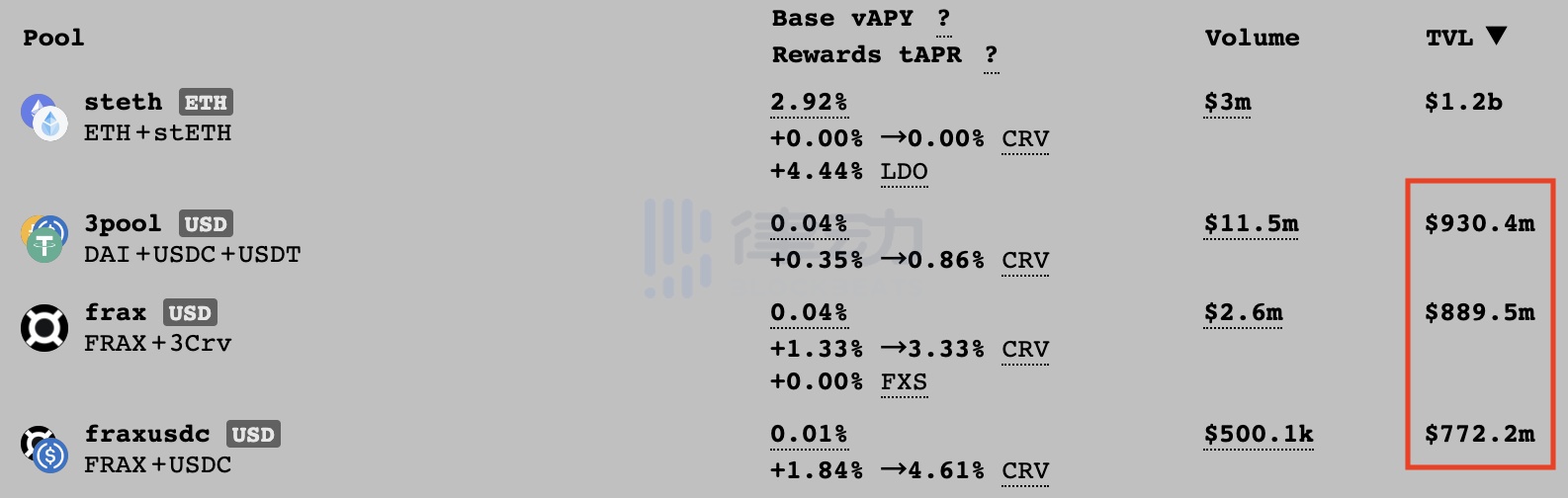
image description
Among the top four liquidity pools of Curve, two are related to FRAX, and the gap with 3Crv is very small
Fraxswap
However, although FRAX has extremely high liquidity on Curve, its trading volume cannot match 3Crv at all. The reason is actually very simple. The application scenarios and market adoption of FRAX are not as extensive as USDC, USDT and DAI. Therefore, after accumulating sufficient liquidity, the next step for Frax is to transform from a single stablecoin protocol to a DeFi ecological matrix. Of course, the first two operations are still trading and lending.
The Frax team refers to Fraxswap as the Time-Weighted Average Market Maker (Time-Weighted Average Market Maker, TWAMM), which is a license-free automated product based on the Uniswap V2 version. The main goal of Fraxswap is to help protocols and traders efficiently execute bulk order transactions to increase the transaction volume and velocity of FRAX and strengthen its anchoring. Fraxswap's operating profits will be returned to FXS holders.
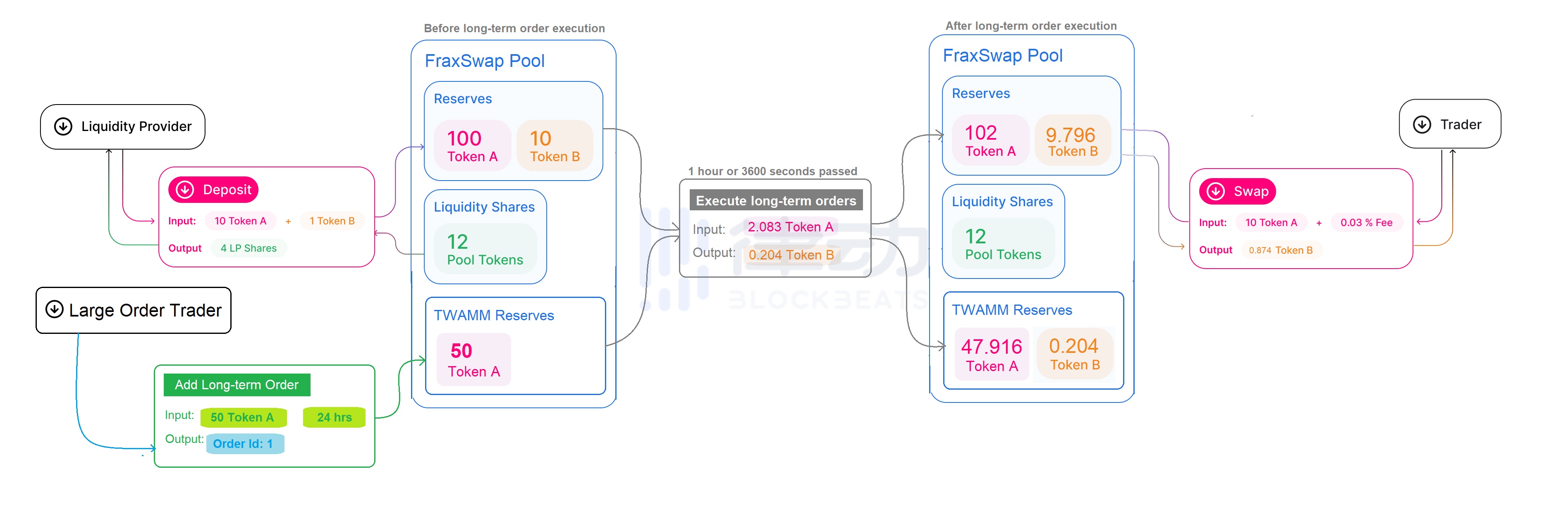
The core function of Fraxswap is to optimize and complete FRAX's "long-term orders" through an embedded TWAMM. The long-term order here can also be understood as a bulk order, and Fraxswap includes its process as Order Pooling and Aligning Order expiries in units of hours. Standing orders will always be executed before any other interaction on Fraxswap, and once per block.
When an individual user or agreement submits a large order to Fraxswap, that is, a long-term order, Fraxswap will decompose these large orders into countless infinitely small sub-orders, and then digest them at a uniform rate through the embedded TWAMM . For example, gradually sell 100 ETH in the next 1,000 blocks. It is worth noting that if these individual sub-orders are processed through the ordinary AMM mechanism, it will cost a lot of Gas cost, but Fraxswap's embedded model effectively avoids this defect.
Fraxlend
As time goes by, the execution of a long-term order will cause the corresponding asset price on TWAMM to gradually move away from its price on other AMMs or CEXs. When this happens, Fraxswap will allow arbitrageurs to trade with TWAMM in order to bring the price back to normal, ensuring good execution of long orders. For example, when long-term orders for ETH on Fraxswap are cheaper than on Uniswap, arbitrageurs can buy ETH from TWAMM and then sell it on Uniswap for profit. Of course, to achieve this kind of arbitrage, it must be done by holding and trading FRAX stablecoins.
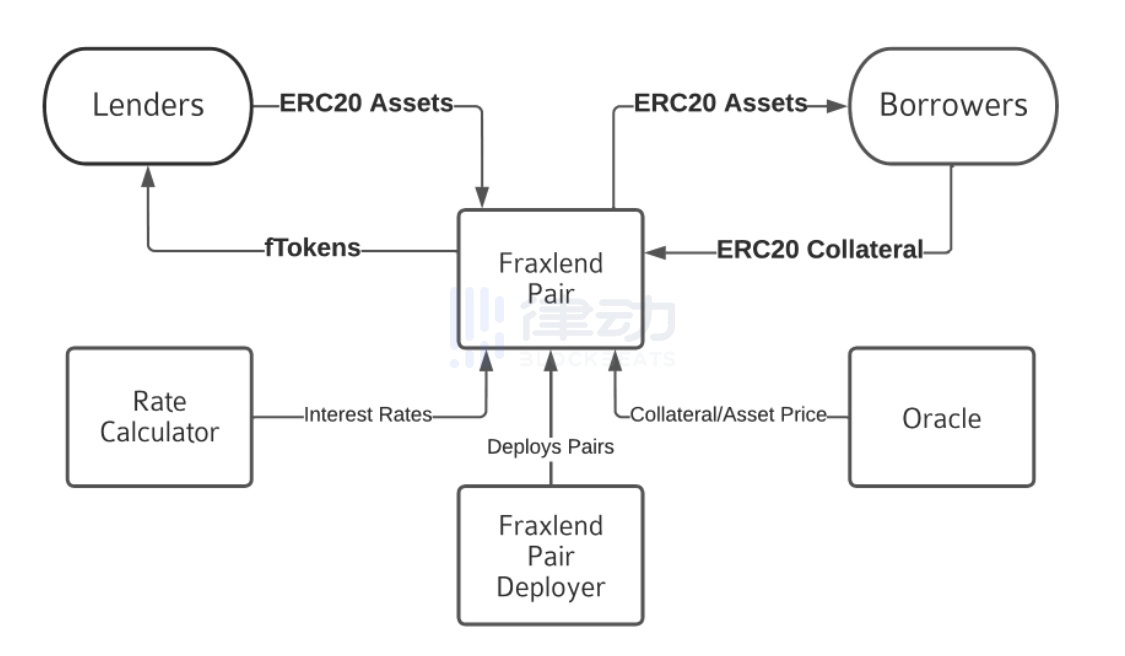
Fraxlend is an open lending platform of the Frax protocol, allowing anyone to create a lending market between any pair of ERC20 Tokens, as long as the Token is supported by Chainlink data. Each Token pair is an independent, permissionless lending market where anyone can use these assets for mortgage lending.
Through Fraxlend Pair, the lender deposits its own ERC20 assets into the loan Token pair and receives the corresponding interest-earning fToken certificate. fToken will accumulate interest over time, and the longer the time, the more underlying assets can be redeemed. The borrower provides mortgage assets to the Token pair and lends the underlying assets. The interest rate of the loan will be converted into underlying capital and paid to the lender when fToken is redeemed.
What is more interesting is that each Token pair on Fraxlend can be deployed with different rate calculators (Rate Calculator). The contract will calculate the interest rate based on the depth of funds that can be borrowed. The deeper the loan funds or the lower the demand, the lower the interest rate, and vice versa. In addition, Fraxlend also allows users to create custom term sheets for OTC debt structures, such as maturity dates, restricted borrowers and lenders, partial mortgages, and limited liquidation.
In fact, Frax is not the first project to expand the application scenarios and market adoption of its own stablecoin by creating ecological effects. In this regard, UST is the best case. Of course, this is talking about its mechanism aside. LUNA/UST existed before the rise of the public chain narrative. At that time, Terra was looking for offline e-commerce retail for the narrative of UST. As a result, the market did not buy it. Its real rise came after Anchor, and the team built it around DeFi. application ecology.
Multi-Stablecoin Future
first level title
The challenge for decentralized stablecoins today is that they cannot gain liquidity and scale without the support of other DeFi protocols. However, after Aave and Curve launched their own stable coins, and FRAX moved towards the DeFi matrix, the full-stack of the DeFi protocol is gradually solving this problem. New, fragmented decentralized stablecoin projects can gradually break down the regulatory risks facing DAI and reduce USDC's influence in the DeFi world.
Of course, you may say that this strategy has been tried in the market, and the risk of scattered small calculations is very high, and most projects will not survive in the end. First of all, it needs to be emphasized that many stablecoin projects in the past emphasized the word "stable", and in the end, most of them failed to survive. Therefore, this is more of a mechanism problem.
Second, this does not mean that every stablecoin project must achieve complete decentralization. The purpose of developing multiple decentralized stablecoins at the same time is not to completely get rid of USDC. After all, the market value of encrypted assets is still small, and it is impossible to achieve this. But we can reduce the influence of USDC in each stablecoin project. For example, if we make 100 stablecoins at the same time, the USDC endorsement of each project can be greatly reduced. Even if part of the mortgage is rolled back, there will be no serious systemic risk. .
In addition, the distributed liquidity of stablecoins has another advantage, that is, it can restrain the influence of giant whales on the market to a certain extent, just like the connected and independent compartments on a freighter, which can slow down or even prevent the occurrence of disasters. The continuous influx of sea water. Of course, this also depends on the complementarity and support between various stablecoin projects, but I personally think that the future decentralized stablecoin must take the road of partial mortgage, and regard USDC as a real-world risk asset that may be frozen at any time.


