






The Fed's "change of leadership" countdown: 5 candidates revealed, who will be the ultimate winner?


- 核心观点:美联储主席人选将影响加密监管与货币政策。
- 关键要素:
- 热门候选人哈塞特加密友好,主张降息。
- 候选人中多位对加密货币持开放态度。
- 预测市场显示哈塞特获提名概率达74%。
- 市场影响:或推动加密市场更宽松的监管环境。
- 时效性标注:中期影响。
Original article by Odaily Planet Daily ( @OdailyChina )
Author/ Wenser ( @wenser2010 )
As 2025 draws to a close, it means that the time for current Federal Reserve Chairman Jerome Powell to "step down" is getting closer, and market speculation about the candidate for the new Fed chairman continues.
According to previous reports from US Treasury Secretary Scott Bessent, the candidates have been narrowed down to five, including Kevin Hassett, a member of the Trump faction, and Kevin Warsh, a hawk. The winner among these five candidates will take charge of the Federal Reserve, the "heart of the US economy and finance," for the next few years.
Although Hassett currently leads with a 74% probability in the "Trump nominee for Fed Chair" poll on Polymarket , the final choice of the new Fed Chair remains uncertain due to Trump's erratic past behavior. Odaily will briefly introduce the five current nominees for Fed Chair in this article for readers' reference.
The elimination round for the new Federal Reserve Chair candidate: from an 11-person shortlist to a 5-person shortlist, and then from 5 to 1.
In August of this year , when the Trump administration was assessing candidates for the new Federal Reserve chairman, the list still contained the names of 11 candidates.
At the time, Treasury Secretary Scott Bessent stated that the review process would begin in September, and that all candidates were "extremely strong contenders." Among them, Jefferies Chief Market Strategist David Zervos, BlackRock Global Chief Fixed Income Investment Officer Rick Rieder, and Federal Reserve officials Christoper Waller and Michelle Bowman were all open to cryptocurrencies.
By the end of October , the shortlist had narrowed down to five people. Among the four "crypto openness" candidates mentioned earlier, BlackRock executive Rick Rieder, Federal Reserve officials Christopher Waller, and Michelle Bowman were all on the list. This demonstrates that Trump administration officials still adhered to the "crypto-friendly" standard in selecting candidates for Federal Reserve Chair. As for former Federal Reserve Governor Kevin Warsh, his hawkish stance garnered attention, perhaps he was simply included as a "sidekick" to maintain fairness.
On December 1st, Trump stated confidently , "I know who I'm going to choose as the Federal Reserve Chair, and I will announce it very soon." Combined with previous announcements from Treasury Secretary Scott Bessent , Trump's choice is expected to be revealed before Christmas. Below is a basic introduction to the five current candidates for Federal Reserve Chair, compiled and edited by Odaily Planet Daily for readers' reference.
"Favorite to win": Kevin Hassett, Director of the National Economic Council, a figure in the Trump faction; Crypto friendliness: High
In late November, sources familiar with the matter revealed that as the selection process for the new Federal Reserve chairman entered its final weeks, Kevin Hassett, director of the National Economic Council, had become the leading candidate to take over the Fed, according to White House advisors and Trump's allies.
The reason is simple: based on the available information, if Hassett is nominated, he will become a "dovish nail" that Trump has planted in the Federal Reserve, an independent central bank, bringing Trump's interest rate cut philosophy into the Fed from the top-level planning level. This is also one of the points that Trump has criticized the current Fed Chairman Powell.
As the most direct way for the US president to influence central bank decisions, the selection of the Federal Reserve Chairman and Governors has always been regarded as one of the "greatest powers in the president's hands." During Trump's first term, Powell was nominated by him, and when the latter failed to advance interest rate cuts at the expected pace, Trump deeply regretted his decision.
In the realm of economic policy, Hassett is undoubtedly a staunch supporter of Trump and a vocal advocate for interest rate cuts. He previously declared that if he were to lead the Federal Reserve, he would "immediately implement interest rate cuts" because "the data supports this decision." He also stated , "If I were to lead the Federal Reserve, hiring world-class forecasting experts who truly build non-linear time series models would be a wise investment. I believe that a leader with this understanding will help the Federal Reserve achieve better development."
Furthermore, his friendly stance towards the crypto market, viewing Bitcoin as a hedge against inflation, could potentially drive regulatory easing in the crypto market. According to a Bloomberg report in June , Hassett, as an advisor to the US cryptocurrency exchange Coinbase, holds Coinbase stock worth at least $1 million, and possibly as much as $5 million.
"Hawkish Player": Kevin Warsh, former Federal Reserve Governor, Crypto Friendliness: Low
Kevin Warsh, a former government official who served as a Federal Reserve governor from 2006 to 2011, has experience handling the 2008 financial crisis. He also served as a fellow at the Hoover Institution. His personal policy stance leans towards hawkishness, favoring tighter interest rates and prioritizing inflation control, as well as advocating for reducing the central bank's balance sheet. Undoubtedly, he is not a proponent of interest rate cuts; therefore, although he is a key figure within the Republican Party's economic circle, his economic policy positions do not largely overlap with Trump's.
Regarding its attitude towards cryptocurrencies, its public statements are somewhat contradictory.
In an interview with CNBC in early 2021, he stated, "In an economic climate with a weakening dollar, Bitcoin makes sense as part of an investment portfolio." In 2022, he also invested in Bitwise, the main asset management firm for BTC and ETH ETFs. Logically, he could be considered a "crypto-friendly" individual, but unlike Trump, he doesn't openly oppose a CBDC (Central Bank Digital Dollar); instead, he strongly supports it.
It is worth mentioning that he also served as VP/ED of the M&A department at Morgan Stanley on Wall Street. During the 2008 financial crisis, Kevin Warsh served as a bridge between the Federal Reserve and Wall Street, mediating between government agencies and financial giants.
Last November , Trump considered Kevin Warsh as Treasury Secretary, with the option of him later becoming Federal Reserve Chairman. However, Scott Bessent ultimately emerged as the best choice.
"Neutral Person": Christopher Waller, current Federal Reserve Governor, Crypto Friendliness: Medium
As a current Federal Reserve Governor, Christopher Waller's policy stance leans towards a conservative dovish position. He supports gradual interest rate cuts and has publicly stated that digital assets can serve as a supplement to payment tools, opposing CBDCs. He believes that stablecoins can enhance the dollar's status if properly regulated.
Waller's conservative approach may limit the possibility of a significant easing of monetary policy, and relatively speaking, the large rate cuts that Trump is hoping for or the continued tightening policies maintained by hawks are unlikely to occur.
However, in comparison, Waller lacks experience working at large investment banks or large investment funds, and his activities are mainly concentrated in academia and the Federal Reserve. Regarding monetary policy stances after the pandemic, he is primarily perceived by Wall Street as a neutral to hawkish Federal Reserve governor, with little connection to Wall Street and a degree of independence.
Furthermore, it's worth mentioning that Hassett's overwhelming popularity had previously sparked strong opposition from Wall Street and the American business community, leading to a collective effort to prevent Trump from nominating Hassett as the new Federal Reserve Chair in order to safeguard the Fed's independence. Waller was therefore considered a potentially suitable candidate, and his current position as a Federal Reserve governor meant that if nominated by Trump, he would only need one round of voting to be elected.
"Financial Giant": Rick Rieder, current executive at BlackRock, crypto-friendly: high
As BlackRock's Global Chief Fixed Income Officer, Rick Rieder directly controls trillions of dollars in asset allocation. He has no background in politics, no experience as a Federal Reserve governor, and no government involvement. Previously, he was considered one of the "bond kings" due to his donations to the Republican Party. His monetary policy stance is somewhat dovish. He emphasizes that the Federal Reserve should remain cautious and flexible after reaching the neutral interest rate.
Of course, as a current executive at BlackRock, his crypto-friendly attitude is beyond doubt. He previously stated that "Bitcoin is the gold of the 21st century," believing that cryptocurrencies have unique safe-haven and hedging value in an environment where traditional assets are converging in correlation.
However, given his Wall Street background, it's difficult for him to garner sufficient political support in the current political climate. After all, to some extent, the Federal Reserve needs to maintain its independent central bank political and economic status, which inherently conflicts with Wall Street capital. It's unrealistic to expect the Federal Reserve to be at the mercy of Wall Street. Therefore, his chances of taking office are relatively low.
"Transparent Accompaniment": Michelle Bowman, current Federal Reserve Governor, Crypto Friendliness: Medium
As a current Federal Reserve governor, Michelle Bowman was labeled a hawk by Democrats in her early years for "speaking for big banks," but now she mostly adopts a neutral to dovish stance on monetary policy.
In August of this year, she stated publicly that "given concerns about the vitality of the job market and the overall U.S. economy, interest rates should be cut three times this year." She worried that further delays in interest rate cuts could "lead to a deterioration in the job market and a further slowdown in economic growth."
In October of this year, it made a high-profile statement : "We continue to expect two more interest rate cuts before the end of this year."
In addition, his family owns a small bank, and he himself has served as the head of the banking bureau. He has also criticized regulators for being too cautious in regulating cryptocurrencies and advocated for "loosening the reins" on banks and the regulatory system.
Nevertheless, given his personal banking background and past statements, he will most likely be a runner-up in the nomination for Federal Reserve Chair.
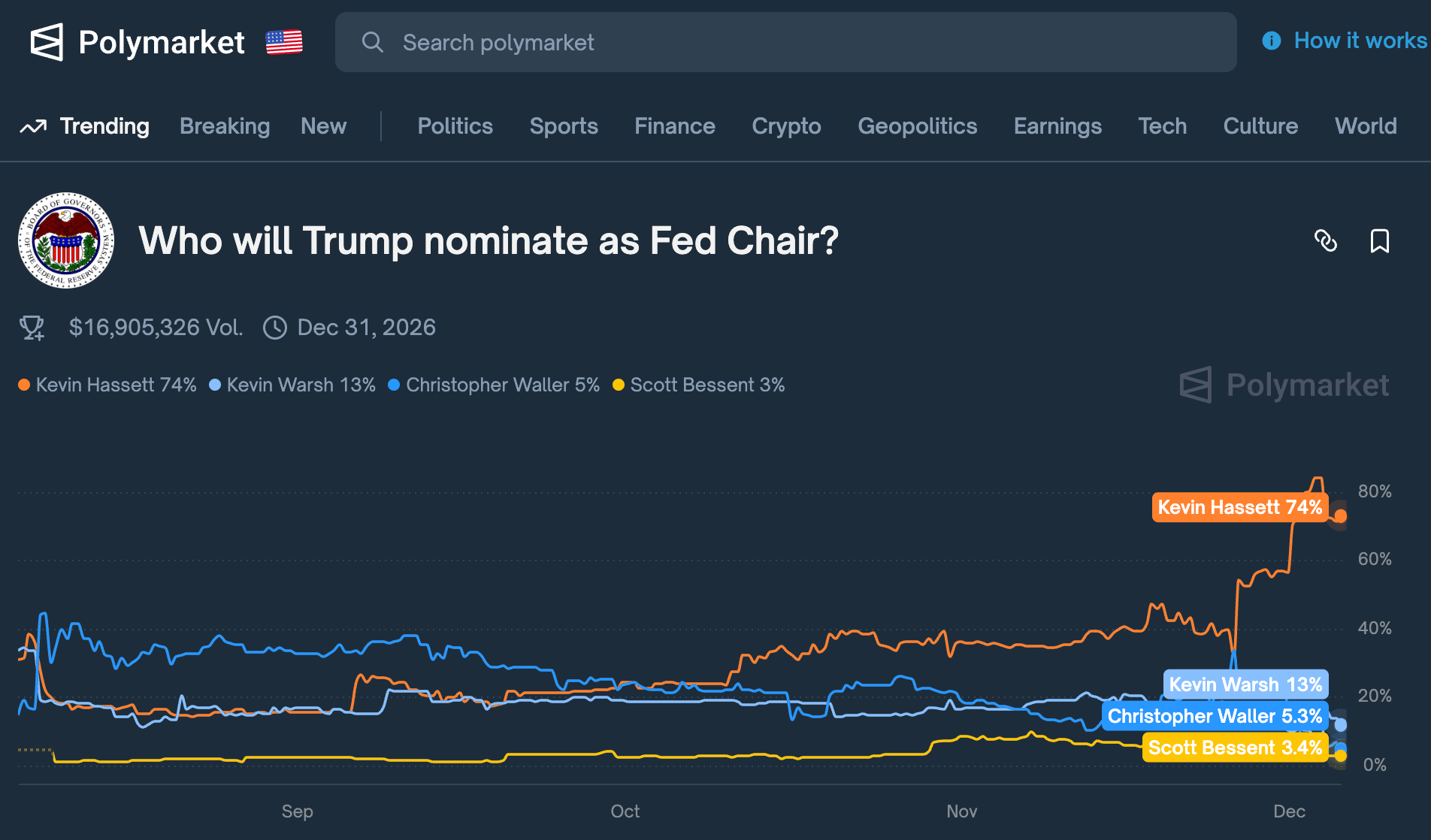
As of the time of writing, in the Polymarket news article "Trump nominates Federal Reserve Chair , "
- Hassett's probability is currently reported at 74%;
- Kevin Warsh's odds are currently estimated at 13%.
- Christopher Waller's probability is currently estimated at 5.3%;
- Scott Bessent's probability is currently estimated at 3.4%;
- Rick Rieder's probability is currently estimated at 2.9%;
- Michelle Bowman's probability is currently estimated at 1.6%.
Whether Polymarket can successfully predict this year's Federal Reserve Chair nominee, just as it did last year in predicting Trump's victory in the US presidential election, remains to be seen.


