Crypto 美股觀察:CRCL、HOOD、COIN 與 MSTR,最近在交易什麼?


- 核心觀點:近期美股與加密貨幣交叉領域的三大關鍵公司(Circle、Robinhood、Strategy)股價驅動因素顯著分化,商業模式與競爭格局正發生結構性調整,市場開始為它們交易不同的核心變數。
- 關鍵要素:
- Circle (CRCL.M) 的股價錨點重新回歸 USDC 流通量,其盈利高度依賴「平均 USDC 流通量 × 儲備收益率」,當前 USDC 流通量較3月高點已減少約7.4%至737億美元。
- Robinhood (HOOD.M) 上線 Robinhood Chain,從傳統券商反向滲透鏈上金融,威脅 Coinbase 的估值稀缺性。但 Base 仍占全球經調整穩定幣交易量的62%,網路效應顯著。
- Strategy (MSTR.M) 打破「只買不賣」的認知,近期出售3588枚比特幣(約2.16億美元)用於支付優先股股息,標誌著其從單向融資飛輪轉向主動資本管理。
- Circle 的股價轉折點需觀察三組共振訊號:DeFi 活躍度恢復、USDC 連續淨增發、以及盈利預期不被降息和分銷成本抵銷。
- Robinhood 與 Coinbase 的競爭本質是「跨資產金融入口」之爭,前者掌握傳統投資者和證券資產,後者擁有加密原生用戶和穩定幣分發優勢。
Over the past few weeks, three noteworthy trends have emerged at the intersection of U.S. equities and Crypto.
Circle (CRCL.M) is still digesting the pressures from declining USDC circulation and a cooling DeFi ecosystem on-chain; Robinhood (HOOD.M) has regained market favor by building its own public chain, further transferring competitive pressure to Coinbase (COIN.M); Strategy (MSTR.M) has begun substantively selling Bitcoin, breaking the market's long-held perception of its "buy-only, never-sell" approach.
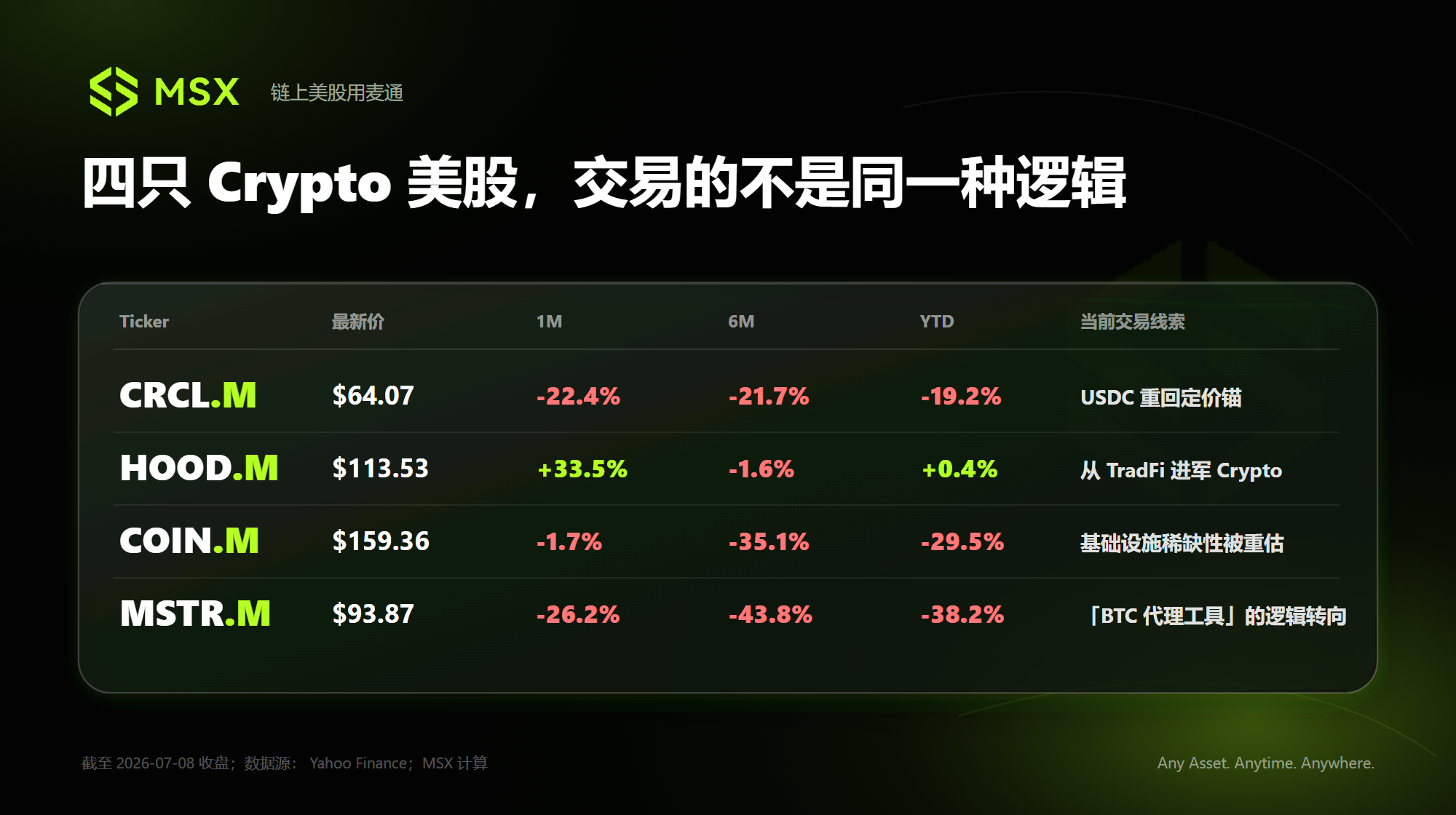
As of the close on July 8, CRCL.M, HOOD.M, COIN.M, and MSTR.M stood at $64.07, $113.53, $159.36, and $93.87 respectively. On the surface, they all occupy the intersection of U.S. stocks and Crypto, but the core variables influencing their stock prices have recently shown clear divergence:
- Circle's focus is returning to USDC circulation and DeFi sentiment;
- The competition between Robinhood and Coinbase has extended from trading platforms to asset issuance, user onboarding, and on-chain settlement;
- Strategy is no longer solely facing Bitcoin price fluctuations, but the balance between mNAV, financing costs, and cash expenditures;
In other words, the market is pricing different aspects for each of them.
1. Circle: Bubble Clears, USDC Regains its Pricing Anchor for CRCL
The most notable change for Circle currently is that the relationship between the CRCL.M stock price and USDC circulation is gradually shifting from the initial decoupling post-IPO to a fundamental resonance.
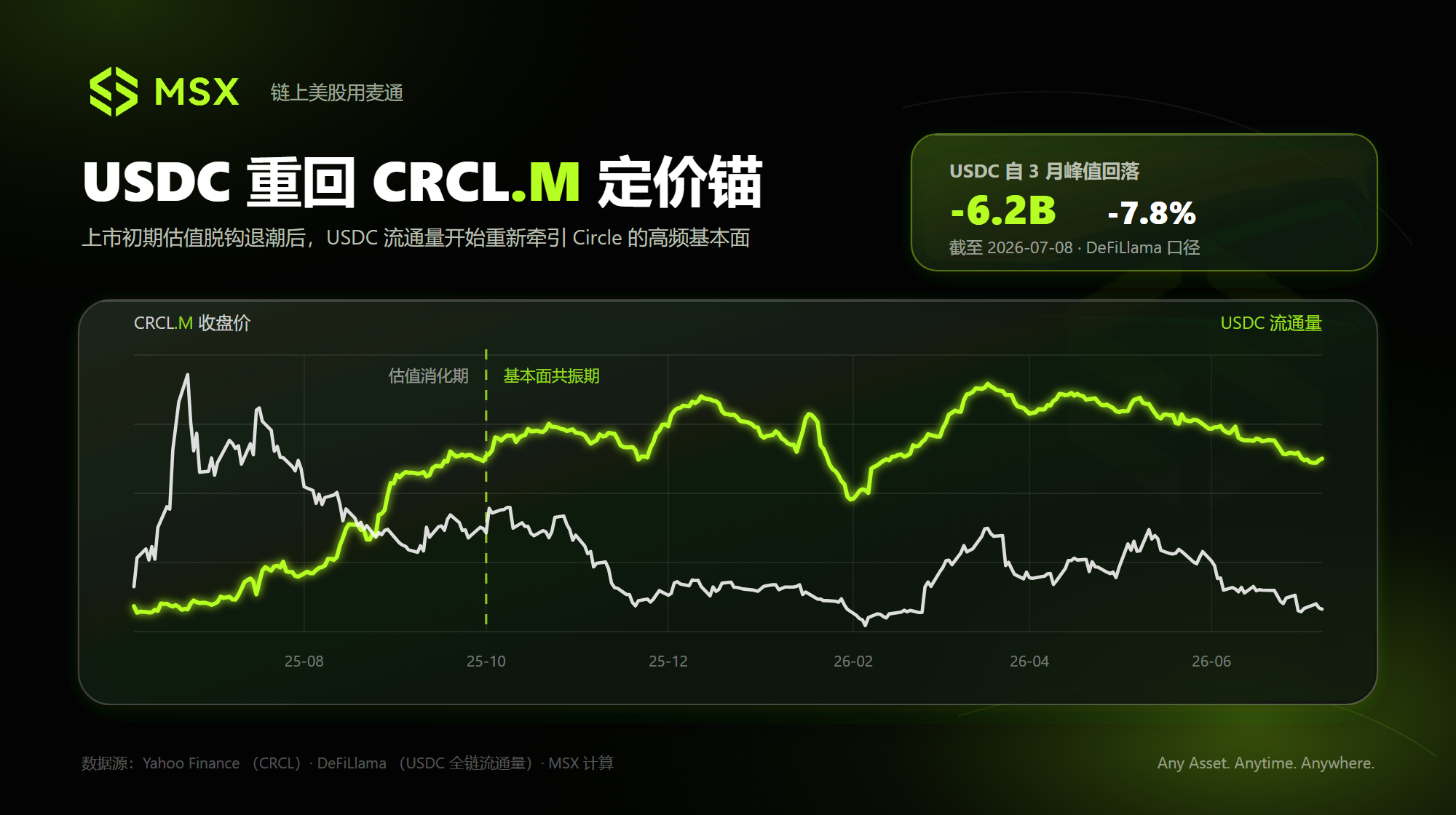
MSX Maitong has charted the comparison curve between CRCL.M's stock price and USDC circulation since Circle's listing, clearly showing two distinct pricing phases.
The first phase was the valuation digestion period post-Circle's IPO, roughly from June 2025 to the end of the year.
At that time, CRCL.M, as the first major stablecoin issuer listed on U.S. stocks, saw its price surge to an all-time closing high of $263.45, driven by scarcity, low float, and IPO euphoria, far exceeding the changes in USDC fundamentals.
Subsequently, as the low float premium and listing sentiment faded, a sustained valuation regression began. During the same period, USDC circulation continued to grow, causing the two curves to move in opposite directions and significantly lowering the full-cycle correlation coefficient.
The second phase began around the end of 2025 to early 2026. The initial post-IPO valuation bubble gradually cleared. The marginal pricing of CRCL started to realign with USDC circulation and Circle's operational data. The directional resonance between the two curves significantly strengthened:
- From late January to early February, USDC circulation rapidly declined, and CRCL correspondingly dropped to a phase low;
- From February to mid-March, USDC resumed expansion, rising to a phase peak of approximately $79.6 billion, while CRCL also saw a significant rebound;
- After late March, USDC growth stalled and gradually turned into net contraction, with CRCL subsequently re-entering a downward channel;
- By July 6, USDC circulation had fallen to about $73.7 billion, a decrease of roughly $5.9 billion or about 7.4% from the March high.
The fundamental reason behind this is that USDC is the core balance sheet variable in Circle's current revenue model. For instance, in Q1 2026, its reserve revenue reached $653 million, accounting for approximately 94% of total and reserve revenue, a 17% year-over-year increase.
This growth primarily came from a 39% year-over-year increase in average USDC circulation, partially offsetting a 66 basis point decline in reserve yield.
After all, Circle's other revenue during the same period was only about $42 million...
This also means that Circle's current profit logic can still be roughly simplified to "average USDC circulation × reserve asset yield - distribution costs - operating expenses."
Of course, reserve revenue is not equivalent to shareholder profit. Circle must also pay substantial fees to Coinbase, exchanges, and other distribution channels, but this sufficiently illustrates the sensitivity of business outcomes to USDC scale.
Continuing to track this reveals that USDC circulation itself is closely tied to the risk appetite and capital demand of the Crypto market, especially DeFi. This is precisely why a DeFi downturn directly impacts USDC—because the vast majority of USDC demand originates from on-chain lending protocols, perpetual contracts, liquidity pools, and institutional on-chain settlements.
A common feature of these scenarios is that capital doesn't just briefly pass through USDC; it needs to remain in protocols or accounts in USDC form for extended periods.
Therefore, when DeFi activity rises, capital flows into lending, trading, and liquidity protocols, often leading to a simultaneous increase in USDC demand; conversely, when DeFi confidence is shaken, investors redeem funds, deleverage, and exit on-chain yield strategies, potentially leading to USDC being transferred back to exchanges, swapped for other stablecoins, or directly redeemed for USD.
The KelpDAO/rsETH incident in April this year was a classic stress test. In this attack, insufficiently backed rsETH was used as collateral for borrowing in protocols like Aave, rapidly spreading risk across collateral pools, lending pools, and yield strategies.
Within 48 hours of the incident, the total DeFi TVL dropped from approximately $99.497 billion to $86.286 billion, a decrease of about $13.21 billion, or roughly 13.3%.
Among this, Aave's TVL fell from about $26.4 billion to $17.9 billion, as a large number of users tried to withdraw stablecoins, creating sustained net outflow pressure on on-chain capital. From a timing perspective, this corresponds to the node where USDC began to contract after reaching its phase peak of approximately $79.6 billion, and CRCL also weakened again after its March rebound.
Theoretically, however, the CRCL stock price is also influenced by factors like interest rate expectations, market risk appetite, earnings guidance, and valuation levels. USDC cannot explain all volatility, but after the IPO scarcity premium fades, it increasingly becomes Circle's most important high-frequency fundamental indicator.
So, how should we subsequently judge the turning point for CRCL's stock price?
From a trading perspective, simply observing a weekly USDC issuance increase is insufficient to confirm a CRCL reversal, as short-term issuance might be due to a single institution's portfolio adjustment, an exchange replenishing liquidity, or temporary settlement needs. What merits more attention is whether three sets of signals resonate consecutively:
- Is DeFi activity recovering? Focus on whether the TVL, lending demand, stablecoin deposits, and protocol revenue of core protocols like Aave/Sky, Morpho, Pendle, and Lido are rebounding simultaneously. Sustainable USDC demand requires capital re-entering protocols to generate real collateral, trading, and yield needs;
- Is USDC shifting from weekly issuance to consecutive net issuance? Circle publishes weekly USDC issuance, redemption, and circulation changes. Consecutive net issuance over two to four weeks is more meaningful, reducing noise from short-term capital deployment;
- Are Circle's earnings expectations no longer offset by rate cuts and distribution costs? Even if USDC resumes growth, if the Fed cuts rates rapidly, or if Circle cedes more reserve yield to compete for channels like Hyperliquid, exchanges, and others, the contribution of USDC growth to shareholder profits may be lower than expected. It's necessary to observe whether the reserve yield, distribution costs, and profit margin after distribution costs stabilize;
In a nutshell, when DeFi TVL, stablecoin lending demand, and protocol revenue begin to recover synchronously, accompanied by several consecutive weeks of USDC net issuance, a potentially tradable upward inflection point for CRCL.M's fundamentals may emerge.
Beyond this, Circle is also promoting USDC as the core quotation and settlement asset for on-chain trading platforms like Hyperliquid, while expanding its CPN cross-border payment network, the Arc public chain, and AI Agent payment infrastructure.
These initiatives will determine whether Circle can gradually break free from the singular valuation framework of "relying on U.S. Treasury reserves for interest spread and depending on Coinbase/Base for distribution."
But at least in the short term, the resonance between DeFi activity and weekly USDC net issuance remains the most direct signal for judging a fundamental turning point for CRCL.
2. Robinhood Chain: Squeezing Coinbase, More Than Just Another L2
On July 1, Robinhood officially launched the Robinhood Chain mainnet.
This is an Ethereum L2 built on Arbitrum technology, but Robinhood's goal is clearly not just to create another general-purpose public chain. Instead, it aims to gradually connect its brokerage services, stock tokens, wallet, lending, perpetual contracts, and AI trading capabilities into an on-chain issuance and settlement system it controls.
Currently, the new generation of Robinhood stock tokens can be traded 24/7 on Robinhood Chain, utilized in lending pools, or used as collateral for other DeFi transactions. Its wallet is integrated with on-chain trading platforms like Uniswap and Lighter, and Robinhood Earn offers stablecoin lending services via Morpho.
The capital market responded swiftly, with Robinhood's stock price rising 8.35% on July 1, closing at $113.53 on July 8, an increase of about 13% from June 30.
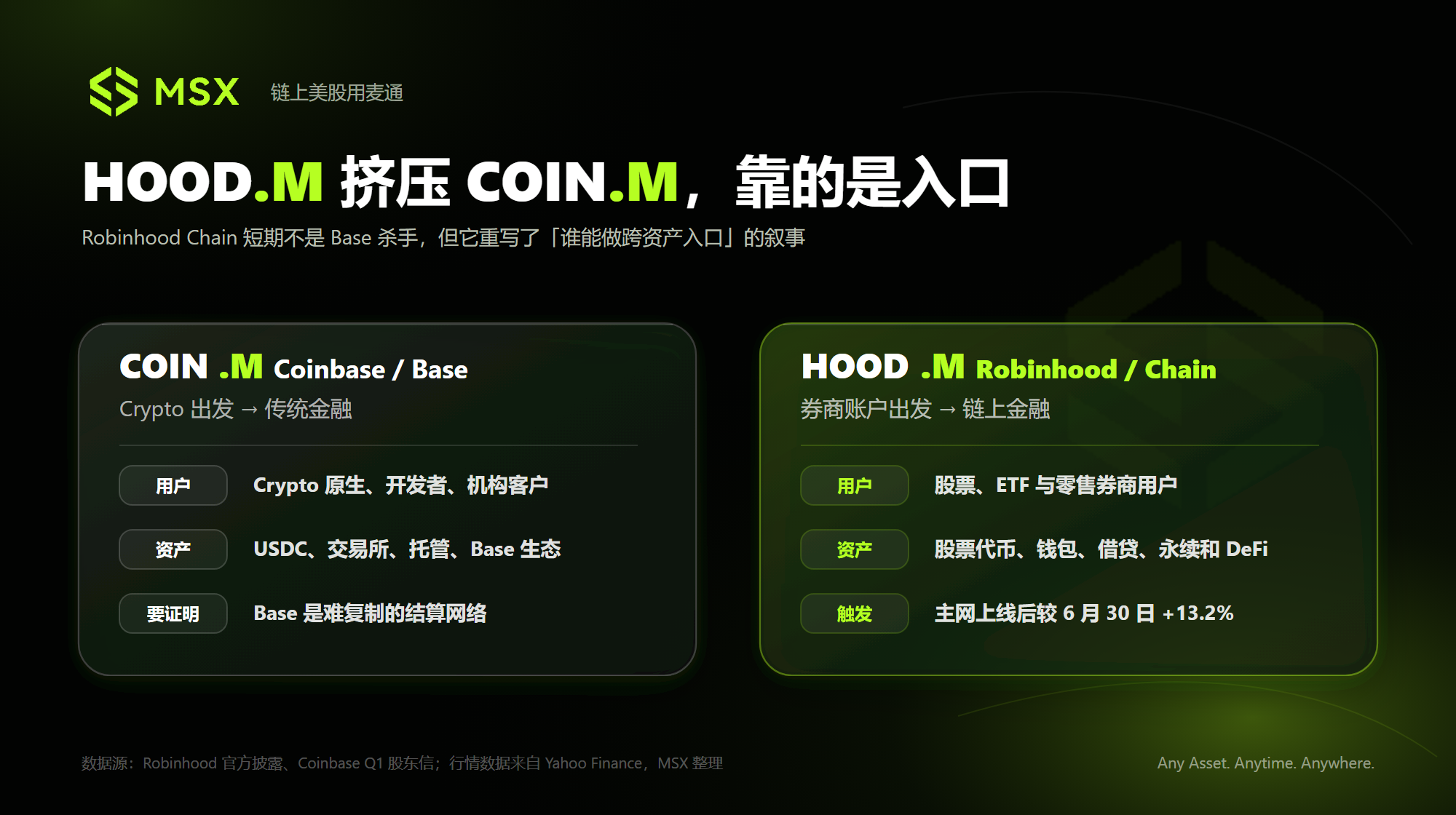
However, a closer comparison reveals that the primary difference between this chain and Coinbase's Base lies not in the underlying technology or TPS, but in the distinct user bases and distribution channels they control:
- Base is closer to native crypto users, striving to become a universal on-chain operating system for developers, stablecoin payments, and AI Agents;
- Robinhood Chain starts with traditional brokerage users, attempting to bring RWA assets like stocks and ETFs directly into on-chain trading and DeFi;
To be realistic, Robinhood Chain is not yet a "Base killer" in the short term.
According to statistics disclosed by Coinbase based on Artemis data, Base accounted for approximately 62% of global adjusted stablecoin transaction volume in Q1 2026. During the same period, over 90% of on-chain AI Agent stablecoin transaction volume occurred on Base.
Coinbase's advantage in stablecoin distribution is equally significant. In Q1, its products held an average of about $19 billion in USDC, exceeding one-fourth of the total USDC circulation, and captured roughly 50% of the overall economic benefits of USDC over the past year.
This means that Base currently possesses not only on-chain traffic but also the network effects formed by Coinbase Exchange, custody, institutional clients, and USDC distribution. Whether considering stablecoin balances, developer ecosystem, or on-chain liquidity, Robinhood Chain cannot yet directly challenge the established advantages of Base.
But Robinhood's deeper threat to Coinbase was never about taking Base's TVL in the short term.
Instead, it demonstrates that a publicly listed brokerage with tens of millions of retail users, brokerage licenses, and an entry point to securities assets can also build its own wallet, public chain, and on-chain financial products, keeping its users, assets, order flow, and fees within its own ecosystem as much as possible.
If Coinbase's path is "starting from Crypto and expanding into traditional finance," then Robinhood Chain represents the completely opposite trajectory—starting from U.S. stocks and the brokerage system, entering Crypto and on-chain finance from the other direction.
From this perspective, Coinbase controls native crypto users, stablecoins, and on-chain infrastructure; Robinhood controls traditional investors, securities accounts, and stock assets. When both types of platforms ultimately evolve towards a complete "account + assets + trading + wallet + public chain" system, the competition is no longer just about developers or TVL on a single chain, but about who can become the next-generation cross-asset financial gateway.
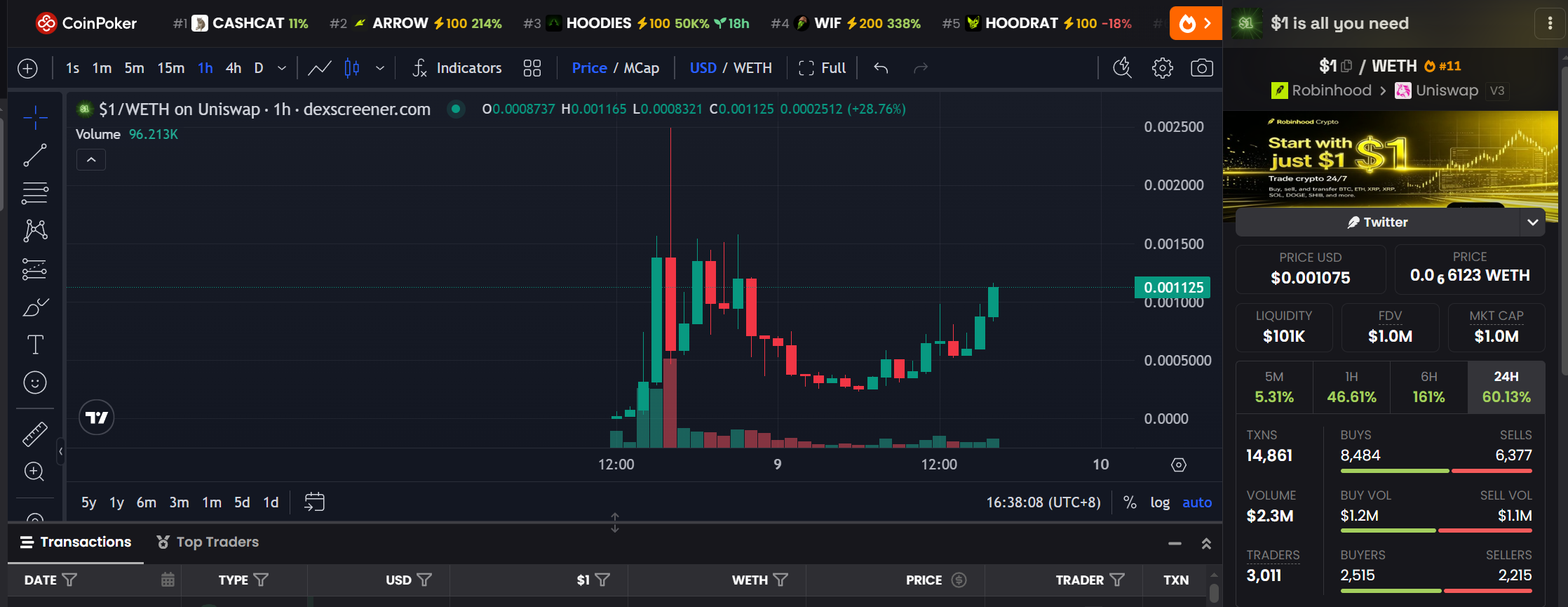
An interesting observation sample is the rapid emergence of a wave of meme token speculation following the Robinhood Chain mainnet launch, reminiscent of the early Base days. For example, "$1" token, whose name borrows from Robinhood's long-standing brand memory of "low-barrier investing" starting with just $1.
As the speculative fervor for related tokens quickly heated up, many Robinhood users, typically trading U.S. stocks, were seen flocking to ask how to get on-chain to buy memes.
These memes naturally have no direct relationship with the stock tokens officially launched by Robinhood, but for a new chain, they are an undeniably efficient cold-start tool, quickly attracting native on-chain capital, traders, and developers into the new ecosystem.
From this perspective, the meme craze at least indicates that Robinhood Chain can not only carry traditional assets but also possesses the potential to attract native crypto capital and speculative traffic, potentially becoming the most differentiated incremental source in this wave of on-chain traffic growth.
Of course, the business loop for Robinhood Chain is not yet fully closed. According to official Robinhood disclosures, Robinhood Chain currently operates independently from its main brokerage and crypto accounts, not yet a fully integrated settlement network connected to existing brokerage accounts, capital, and order systems.
But the change has already become irreversible.
In the past, Coinbase enjoyed the scarcity premium of being "the purest Crypto infrastructure platform in the U.S. stock market." However, as Robinhood builds its own on-chain settlement network, this scarcity is being gradually diluted, making Coinbase no longer the only publicly traded company capable of packaging traditional financial assets, stablecoins, trading, and a public chain altogether.
Therefore, the near-term impact of Robinhood Chain on Coinbase may not immediately manifest in Base's TVL or Coinbase's current revenue. The more significant concern is that COIN.M's long-term valuation narrative and infrastructure scarcity are being re-evaluated.
3. Strategy's Big Ship Turns: From 'Buy, Buy, Buy' to 'Starting to Sell'
Another piece of news changing market perceptions comes from Strategy (formerly MicroStrategy).
Strictly speaking, this isn't Strategy's first Bitcoin sale. In early June, the company sold 32 BTC, but the consecutive sale of 3,588 Bitcoin from June 29 to July 5 carried real symbolic weight regarding capital management:
- On June 29-30, sold 1,363 BTC at an average price of approximately $59,256, yielding about $80.8 million;
- On July 1-5, sold 2,225 BTC at an average price of approximately $60,773, yielding about $135.2 million;
These two transactions together generated about $216 million. The proceeds were used to pay preferred stock dividends and replenish the dollar reserves drawn down for this purpose. As of July 5, Strategy still held 843,775 BTC, with an average purchase price of approximately $75,476; its dollar reserves stood at $2.55 billion.
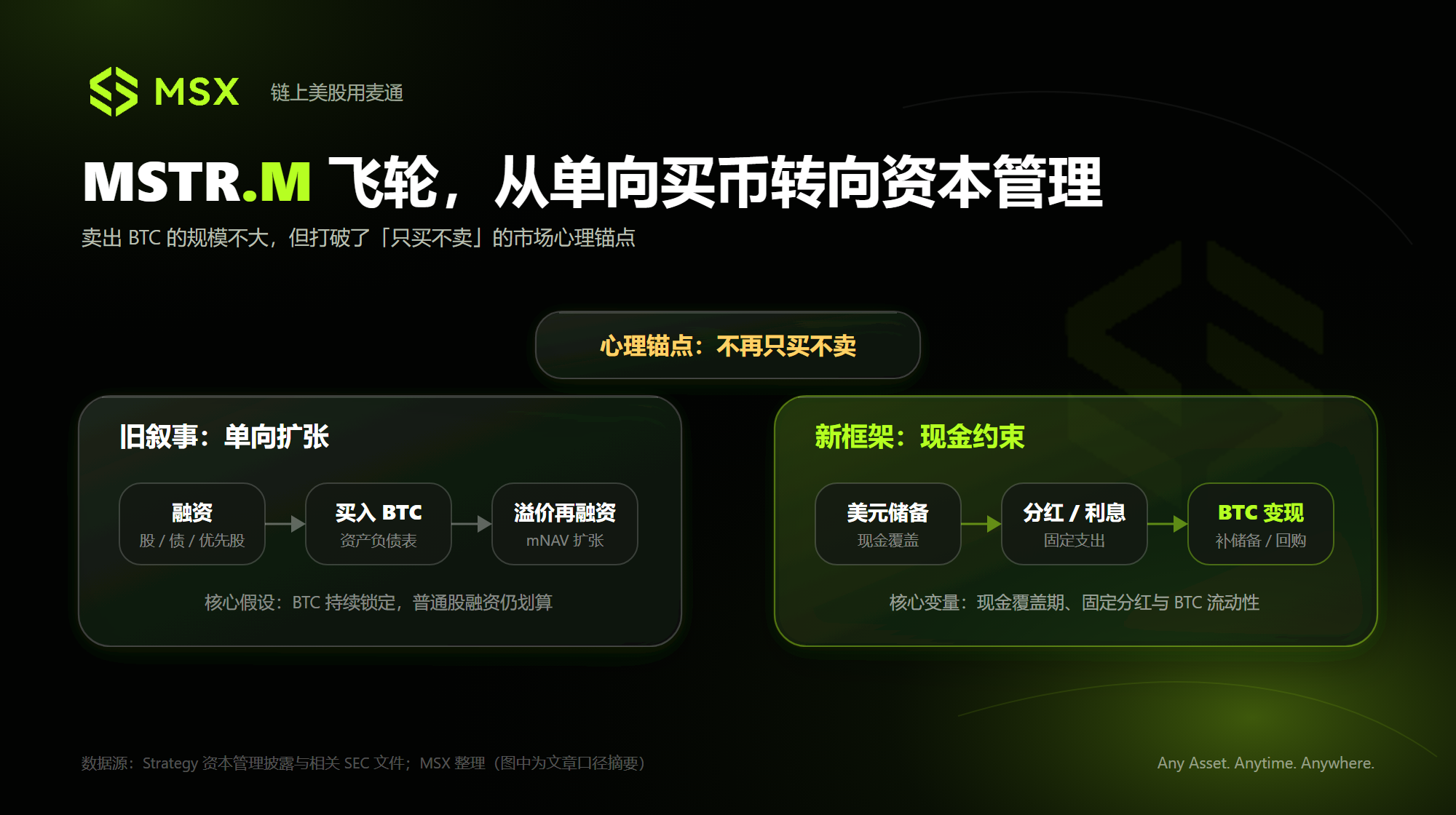
In terms of scale, this sale represents only about 0.42% of the Bitcoin holdings before the sale. Clearly, this doesn't indicate that Strategy has begun systematically betting against Bitcoin. However, it breaks a significant market psychological anchor—Strategy's Bitcoin is no longer just a reserve permanently locked on the balance sheet; it can also be actively sold to meet the real costs of its capital structure.
So why now?
For the past few years, Strategy's business model could be simplified as a unidirectional financing flywheel: "Issue common stock, convertible bonds, or preferred stock → Raise capital to buy Bitcoin → BTC price increase boosts net assets and stock price → Use valuation premium to continue financing and buying more BTC."
The most critical variable in this is MSTR's premium relative to its Bitcoin net asset value, commonly known as mNAV.
This also means:
- When MSTR's mNAV is significantly above 1x, the company can issue stock at a price higher than its Bitcoin net asset value, using the proceeds to buy BTC. If the issuance price is high enough, this operation can potentially increase the amount of Bitcoin per share, achieving the so-called "accretion";
- But when mNAV contracts towards 1x, the effect of continuing to issue common stock weakens rapidly. At this point, the scale of financing obtained may be insufficient to compensate for the dilution caused by newly issued shares.
Ultimately, when common stock financing is no longer advantageous, the optimal direction for capital allocation can reverse. The company may actively choose to sell BTC to supplement cash.
This is precisely the core change in Strategy's new capital management framework launched on June 29. The framework includes a dollar reserve policy, STRC dividend policy, authorization for up to $1 billion in preferred stock repurch