当 AI 開始擁有身體:物理 AI 會成為下一輪科技主線嗎?


- 核心觀點:AI產業正從生成式AI的「大腦」階段邁向物理AI的「身體」階段,核心趨勢是讓AI走出螢幕,在汽車、工廠等真實世界中感知、決策並行動,這將催生一條從算力到應用的全新產業鏈。
- 關鍵要素:
- 物理AI涵蓋人形機器人、自動駕駛、工業機器人等,核心是讓機器理解物理規律並在真實環境中互動,其發展依賴算力、模型、模擬、感知及應用五層產業鏈的協同。
- 產業鏈中「賣鏟子」的底層平台(如算力、模擬軟體)確定性最高,NVIDIA 透過整合晶片、模型和模擬生態成為關鍵基礎設施商。
- 工廠和倉庫等封閉場景可能最早跑通商業閉環,因為其環境標準化且投資報酬率可量化,如 Amazon 和 Teradyne 已有實際部署。
- 人形機器人(如 Tesla Optimus)市場想像力最大,但商業化週期長,需重點關注單機成本和實際創造的價值能否覆蓋成本。
- 自動駕駛(Robotaxi)在商業驗證上領先於人形機器人,Waymo 已完成超 2000 萬次全無人駕駛出行,而無人機和國防機器人因需求明確,訂單驗證更為直接。
In the past two years, the AI traded in capital markets has primarily been the "brain" of AI.
From ChatGPT and large models to GPUs, HBM, data centers, optical communications, and power infrastructure, almost all core themes have revolved around how to make models larger, training faster, and inference cheaper.
However, these AIs can generate text, images, code, and videos, yet most still operate within screens and the digital world.
Therefore, as large model capabilities and computing infrastructure gradually mature, the market naturally begins to ask the next question: Can these increasingly intelligent models eventually step out of the screen and into cars, factories, warehouses, hospitals, and the real world?
This is precisely why Physical AI is beginning to take center stage in the industry.
1. From "Thinking" to "Acting": Why is Physical AI Important?
According to NVIDIA's definition, Physical AI is about bringing AI out of the screen, enabling robots, cameras, autonomous vehicles, and other autonomous systems to perceive and understand their surroundings, perform reasoning, decision-making, and complex actions.
In other words, if Generative AI solves "how machines think," then Physical AI attempts to solve how machines, after thinking, can act correctly, safely, and cost-effectively, thereby giving machines the ability to truly interact with the real world.
Based on Jensen Huang's recent public speeches, NVIDIA is continuously strengthening its product lines like Isaac, GR00T, Cosmos, Omniverse, and Jetson. The goal isn't simply to bet on a single type of robot but to build a comprehensive underlying platform covering training, simulation, inference, and deployment for machines entering the physical world.
True Physical AI is not as simple as plugging a large model into a robot. It also requires understanding spatial relationships and physical laws, necessitating world models, training data, simulation environments, edge computing, machine vision, sensors, and motion control, along with extensive safety testing before deployment.
In a market context, Physical AI heavily overlaps with "embodied intelligence," but the former has a broader scope. It includes not only humanoid robots but also autonomous driving, industrial robots, drones, smart factories, warehouse systems, and intelligent spaces driven by cameras and sensors.
Of course, Physical AI is not a sudden new concept.
Autonomous driving, industrial robots, machine vision, and warehouse automation have been developing for years. What has truly changed is that large models, world models, simulation technology, and edge computing are connecting these previously fragmented technological paths.
Many traditional industrial robots rely on pre-programmed instructions to repeatedly perform standard actions in relatively fixed environments. The goal of Physical AI is to enable machines to adjust their judgment and behavior based on real-time information when facing different objects, unfamiliar environments, or unexpected situations.
This means the AI industry chain is extending from the "brain" to the "body."
Over the past two years, the market first revalued the GPUs, storage, servers, networks, and power needed to train and run AI. Next, capital may further seek carriers that can leverage this computing power and translate model capabilities into real-world productivity: robots, autonomous vehicles, drones, industrial automation equipment, and vision and sensing systems deployed across factories, warehouses, and cities.
Therefore, Physical AI is not a single-point concept equatable to "humanoid robots." What it truly opens up is an entire industry chain from computing power to action.
2. The Five-Layer Physical AI Industry Chain: From Computing Power to Robotics
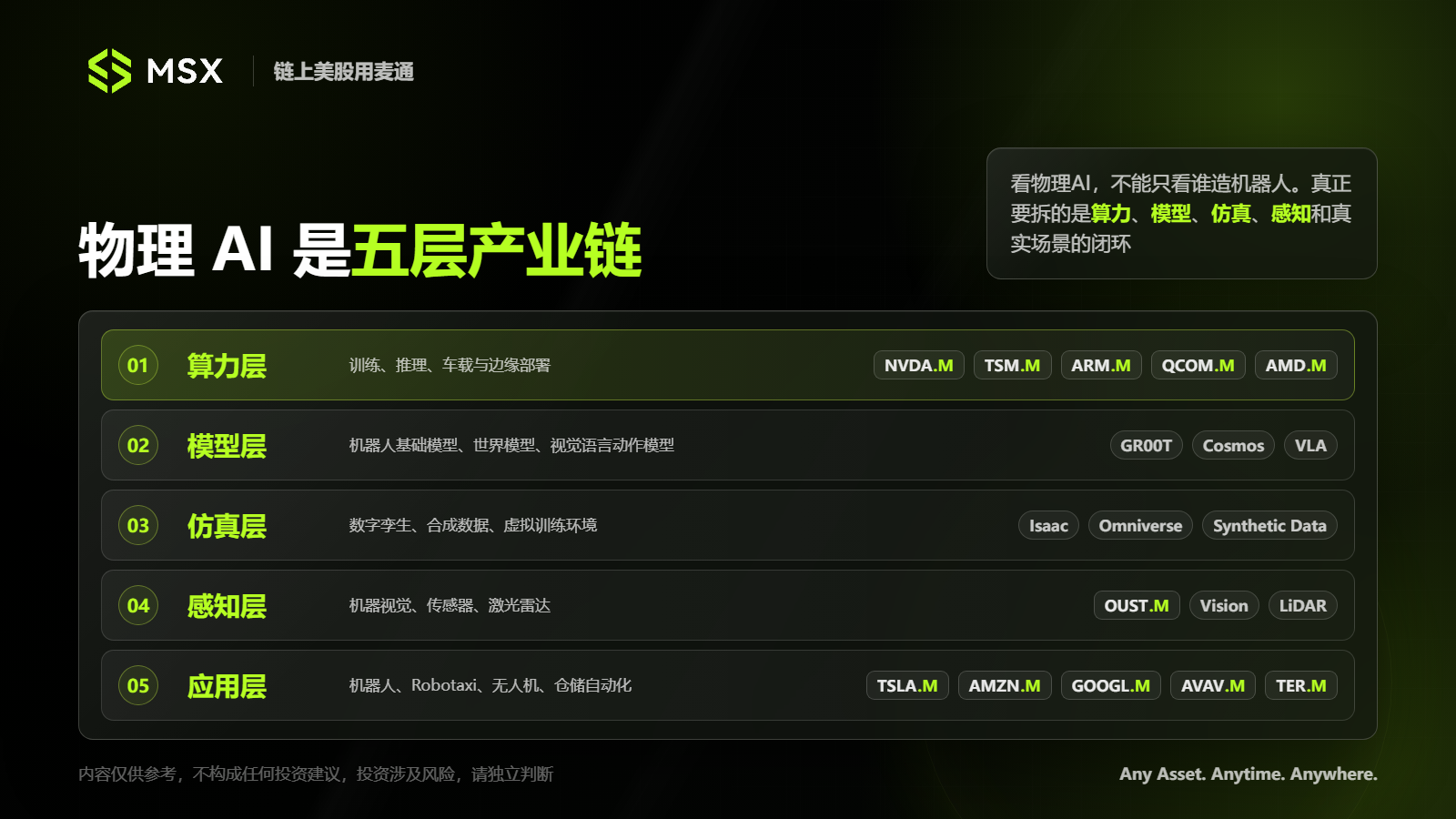
For ease of understanding, the MSX Research Institute roughly breaks down the Physical AI industry chain into five key segments.
1. Layer One: The Computing Layer
Whether it's training robot models, building virtual environments, or performing real-time inference in cars and robots, computing power is indispensable.
This layer encompasses data center GPUs, edge AI chips, in-vehicle computing platforms, and low-power processors. Corresponding key stocks include:
- NVIDIA (NVDA.M): Covers training computing, the Jetson edge computing platform, and the robotics development ecosystem.
- TSMC (TSM.M): The manufacturing base for AI chips, in-vehicle chips, and edge computing chips.
- Arm (ARM.M): Low-power computing architecture widely used in cars, robots, and smart devices.
- Qualcomm (QCOM.M): Invested in in-vehicle AI, edge inference, and smart terminals.
- AMD (AMD.M): A potential beneficiary in AI computing and embedded computing.
The logic for this layer is similar to the generative AI rally of the past two years, continuing the "selling picks and shovels" rationale. No matter which robotics company ultimately wins, the underlying layers require chips, computing power, and computing architectures.
2. Layer Two: The Model Layer
This is also easy to understand. Physical AI requires not just language models but also robot foundation models, world models, and vision-language-action models.
Language models understand human commands, vision models help machines recognize environments, action models convert judgments into specific actions, and world models go further, attempting to help AI understand relationships between objects, predict what might happen next, and simulate actions before execution.
This layer is currently primarily driven by large tech companies and platform enterprises, including NVIDIA, Tesla, Google, and some robotics startups.
Compared to large language models, the biggest problem facing robot models is data. Although the internet contains vast amounts of text, images, and videos, high-quality robot operation data is scarce. How to generate sufficient training data will be a critical barrier in the development of Physical AI.
3. Layer Three: The Simulation Layer
Because real-world training is expensive, slow, and risky, robots need to learn in virtual worlds first. Therefore, digital twins, synthetic data, and virtual training environments constitute a crucial layer of Physical AI.
NVIDIA has built a relatively complete toolchain in this layer: Omniverse for building digital twins and simulation environments, Isaac Sim and Isaac Lab for robot training, testing, and validation, and Cosmos for world models and data generation capabilities.
The value of this layer lies in shifting expensive, dangerous, and slow trial-and-error processes from the real world to virtual environments. Developers can run numerous scenarios simultaneously, testing different lighting, weather, terrains, and unexpected events, then deploy the validated models to real devices.
In essence, a robot might take minutes to train once in reality, but can run thousands of parallel iterations in a simulation environment.
4. Layer Four: The Perception Layer
For a robot entering the real world, the first step is often not having dexterous hands, but being able to stably "see" and understand its surroundings.
It must identify objects, judge distances, understand environmental changes, navigate complex spaces, and then, after making a judgment, convert decisions into real actions through controllers, motors, robotic arms, and joint modules.
This layer includes machine vision, cameras, LiDAR, sensors, control chips, motion control, and various actuation components:
- Cognex (CGNX.M): Industrial machine vision and identification systems.
- Ouster (OUST.M): LiDAR and perception platforms.
- Qualcomm, NVIDIA: Provide in-vehicle and edge vision computing platforms.
Ouster has integrated its new digital LiDAR into the NVIDIA Jetson and Isaac ecosystem, advancing applications in industrial robots, inspection, and autonomous systems. Cognex continues to deploy AI vision systems in manufacturing inspection and automation scenarios.
Compared to humanoid robots, the potential scope for machine vision and sensors might seem smaller, but they are closer to real-world orders and existing customers.
As for actuation components like motors, reducers, and joint modules, pure-play stocks in the US market are relatively limited. Related opportunities are more scattered among industrial automation, analog chip, and specialized component companies.
5. Layer Five: The Application Layer
As the top layer of the industry chain, this includes the most familiar robots, autonomous vehicles, drones, and industrial automation equipment. Corresponding stocks include:
- Tesla (TSLA.M): Optimus, FSD, and Robotaxi.
- Alphabet (GOOGL.M): Autonomous driving through Waymo.
- Amazon (AMZN.M): Warehouse robots, logistics automation, and Zoox.
- Teradyne (TER.M): Collaborative robots and mobile robots.
- AeroVironment (AVAV.M), Kratos (KTOS.M), Ondas (ONDS.M): Drones and unmanned systems.
- Palantir (PLTR.M): Software platform connecting data, decisions, and unmanned devices.
Among these, Palantir is not a robot manufacturer; it's more of a software platform connecting data, decisions, and unmanned devices. Uber could become a traffic gateway for different Robotaxi fleets to acquire users, dispatch orders, and complete transactions. Both represent indirect beneficiaries.
This is also the segment of Physical AI most prone to high elasticity. Once a particular robot, Robotaxi, or drone enters mass production, the market will quickly revise its revenue and valuation expectations upward.
However, simultaneously, the application layer is the most competitive and challenging to deliver results.
3. Who Will Profit First: Selling Picks and Shovels, or Building Robots?
From the perspective of industrial realization sequence, the incremental revenue and profit from Physical AI may not appear first on the most sci-fi humanoid robots.
A more likely path is to first sell the underlying platforms, then enter controlled scenarios; first solve standardized tasks, then challenge open worlds. In a nutshell, the certainty of "selling picks and shovels" remains the highest.
So, if NVIDIA was the biggest beneficiary in the first phase of Generative AI, it will still be difficult to bypass NVIDIA in the early development of Physical AI. Whether Tesla, Amazon, or some robotics startup ultimately wins, they will all need model training, simulation testing, real-time inference, and edge deployment.
NVIDIA's advantage isn't just GPUs; it's its integration of chips, models, simulation software, and edge computing platforms into a complete development ecosystem. This means it doesn't need to manufacture every robot itself, just to get more robots using its computing power and software ecosystem.
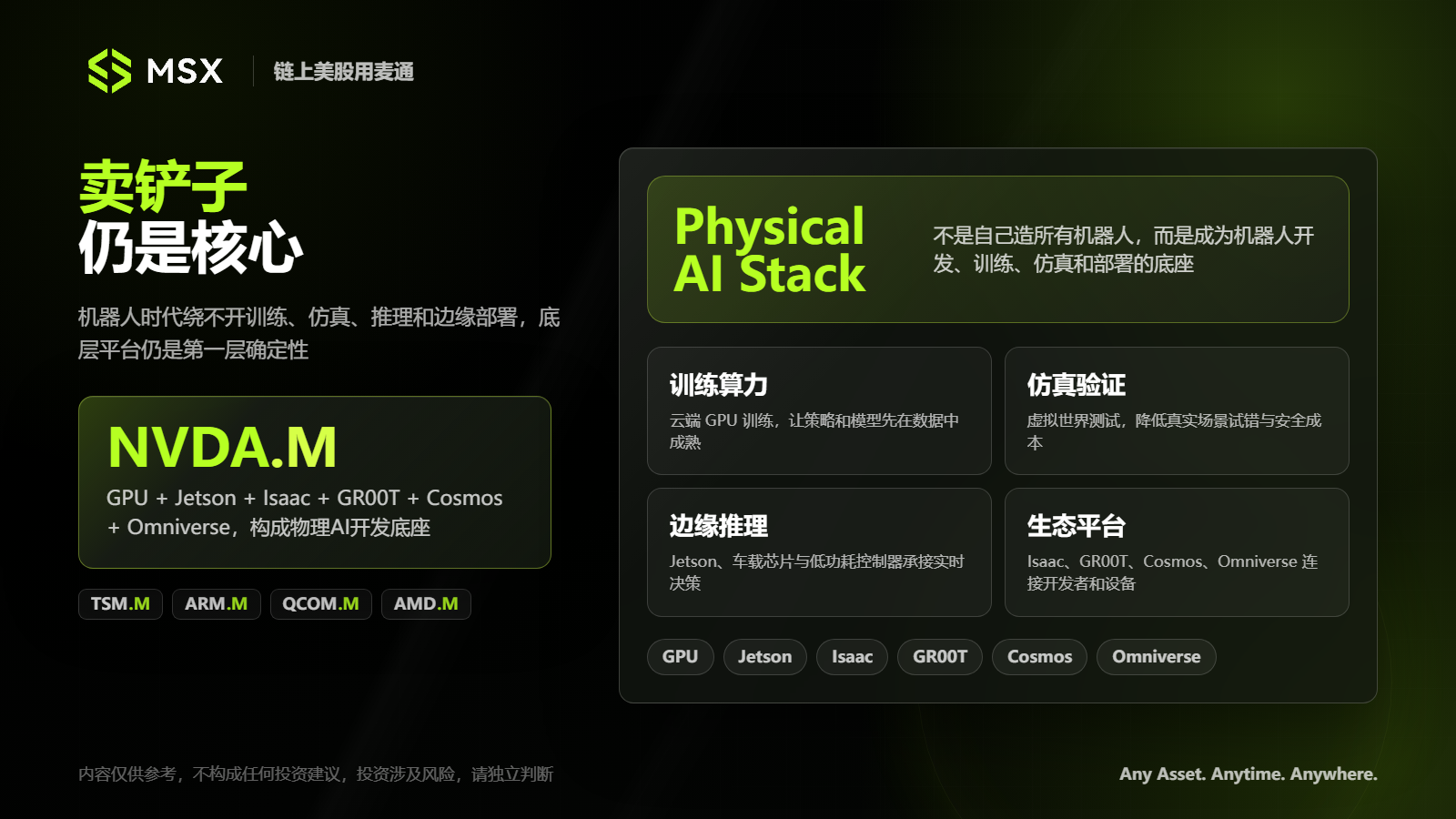
From this perspective, the clearer beneficiaries in the first phase of Physical AI are likely still the "picks-and-shovel sellers" providing computing power, simulation, chips, and development tools. However, a "clear benefit path" does not mean stock prices are risk-free. It still requires monitoring whether the market has already priced in growth expectations, whether the software ecosystem can generate recurring revenue, and whether competitors can offer alternatives.
Secondly, factories and warehouses might achieve commercial viability earlier. The earliest scenarios for Physical AI to impact financial statements are likely in manufacturing, warehousing, and logistics.
These environments are relatively controlled, routes and tasks are more standardized, and companies can more easily calculate return on investment—measuring exactly how much labor a deployed robot reduces, how much efficiency it improves, and how much waste it cuts.
Amazon already uses robots extensively in its warehouse network and optimizes scheduling and routing between devices with AI models. Teradyne's subsidiaries, Universal Robots and MiR, cover collaborative robotic arms and autonomous mobile robots, already deployed in manufacturing, logistics, and semiconductor production environments.
A common characteristic of these companies is that they aren't just demonstrating what robots can do; they are putting robots into factories and warehouses to solve real production problems. In contrast, getting robots to cook, clean, and care for the elderly in homes requires facing much more complex environments and safety liabilities, implying a significantly longer commercialization timeline.
Finally, humanoid robots undoubtedly hold the largest market imagination. Theoretically, they can enter human-designed factories, warehouses, hospitals, and homes, directly using existing roads, tools, and workstations.
Tesla's Optimus has thus become one of the most watched directions in the Physical AI theme. However, this doesn't mean mass commercialization is imminent. For humanoid robots, what truly needs monitoring isn't the smoothness of movements at a launch event, but the per-unit cost, continuous operating time, and whether the value they create can cover procurement and maintenance costs.
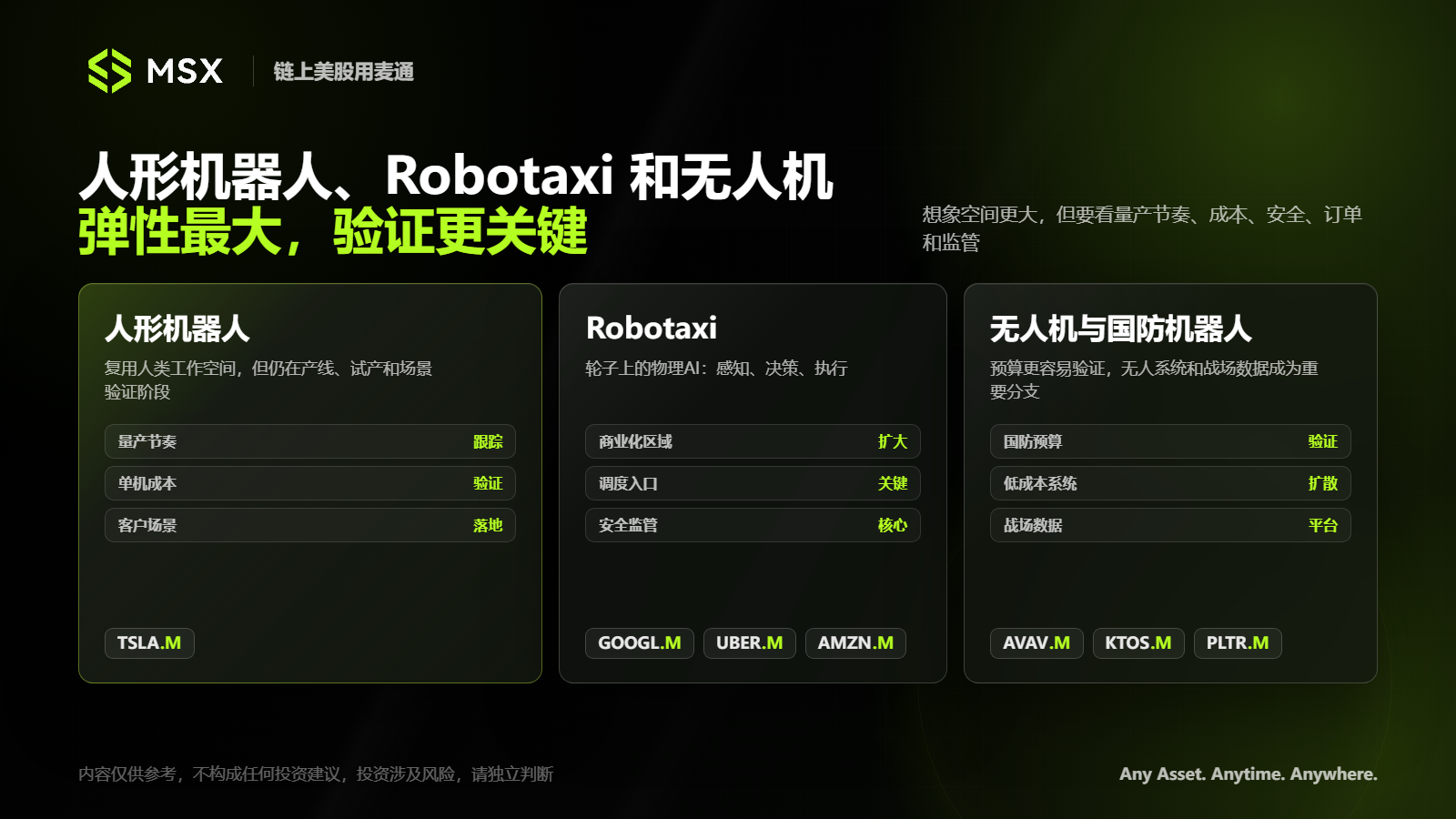
In comparison, Robotaxis are already further along. Autonomous vehicles are essentially "Physical AI on wheels"—the vehicle perceives its environment using cameras, radar, and LiDAR, a model makes judgments, and the car executes the actual action.
Tesla, Waymo, and Zoox represent the vehicle hardware-software integration, autonomous driving system, and purpose-built Robotaxi approaches respectively. Uber is attempting to become the platform connecting different autonomous fleets with passengers. Waymo has begun fully driverless operations of its sixth-generation autonomous driving system; with its latest vehicle equipped with this system, the company reports having completed over 20 million fully driverless trips. This indicates that Robotaxis are significantly ahead of general-purpose humanoid robots in commercial validation.
Furthermore, drones and defense robots find it easier to obtain order validation. Defense customers have clearer needs for autonomous, low-cost unmanned systems and anti-drone equipment. Companies like AeroVironment and Kratos have shown revenue and order growth in their autonomous and unmanned systems businesses. Ondas continues to secure orders for anti-drone systems, loitering munitions, and autonomous defense systems.
However, these smaller companies often carry higher risks related to project concentration, financing, and execution.
Therefore, judging whether a Physical AI company is worth following ultimately comes back to three questions:
- Is it an indispensable core link in the industry chain?
- Does it have real customers, orders, and application scenarios?
- Can its technological progress eventually translate into revenue, profit, and cash flow?
Final Thoughts
Physical AI will not materialize overnight.
Based on industry patterns, it is more likely to progress along a path gradually moving from certainty to high elasticity: first computing power, simulation, and edge platforms; then warehouses, factories, and specialized robots; followed by Robotaxis, drones, and general-purpose humanoid robots.
Ultimately, what truly determines how far this theme can go is not how many actions a robot performs at a launch event, but whether, after leaving the stage, it can enter factories, warehouses, roads, and real businesses, and create value that can be verified in financial reports.
When that happens, AI will have truly stepped out of the screen and into reality.