链遊龍頭YGG「斷臂求生」:關停發行平台,All In AI數據經濟


- 核心觀點:Yield Guild Games(YGG)宣布關閉其遊戲發行部門YGG Play,並全面轉型AI數據經濟,標誌著鏈遊行業「邊玩邊賺」模式的不可持續性,因投機性金融設計與玩家娛樂需求存在結構性錯位,導致大量資本毀滅。
- 關鍵要素:
- YGG Play因宏觀經濟流動性不足和用戶信心下降,於7月31日前關閉,35名員工獲8週補償,部分遊戲移交或退役。
- YGG Play自2025年推出以來,累計收入超900萬美元(2026年Q1單季87.6萬美元),但收入峰值出現在2025年10月後受市場清算打擊。
- YGG從2020年Axie Infinity公會起家,2021年巔峰代幣價格超10美元,但2022年熊市後經P2E模式崩潰,轉型僅1年即宣告失敗。
- 鏈遊行業整體衰退:追蹤的約3200個項目中93%已「實際死亡」,代幣均價較2022年高點跌95%,原因在於「邊玩邊賺」的龐氏分紅邏輯導致死亡螺旋。
- YGG Play關閉被視作鏈遊行業縮影,其團隊強調這是一個市場決策,而非產品失敗,驗證了休閒賽道但無法維持商業可持續性。
Original author: Ma He, Foresight News
On July 6, the official account of Yield Guild Games (YGG) and co-founder Gabby Dizon simultaneously issued a statement announcing the decision to shut down its game publishing division, YGG Play. The team is scheduled to gradually take the platform and some games offline by July 31, with 35 employees receiving an additional 8 weeks of salary compensation. Some games, such as GIGACHADBAT, will be handed over to developer Delabs to continue operations, while LOL Land and Waifu Sweeper will be officially retired. Games published by YGG Play have generated a cumulative revenue of over $9 million, with a single quarter in Q1 2026 contributing $876,000.
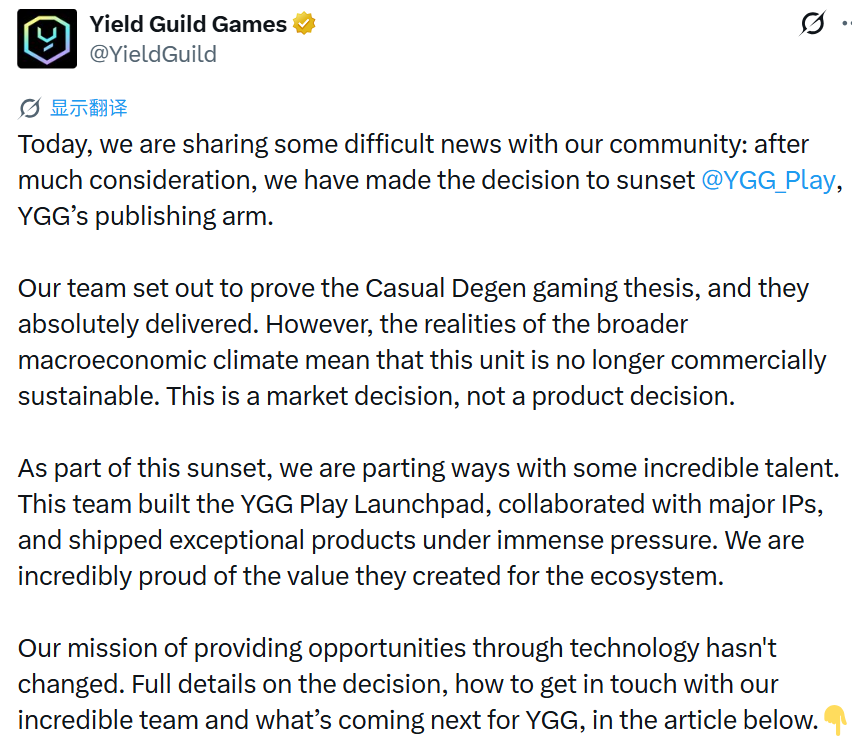
In the statement, Gabby Dizon said: "This is a market decision, not a product decision. Although the team successfully validated the casual gaming track—short sessions, high engagement, and fast feedback loops for crypto-native users—insufficient liquidity and declining user confidence in the current macroeconomic environment have rendered this business no longer commercially sustainable."
Alongside shutting down YGG Play, YGG also announced a complete pivot towards the AI Data Economy, aiming to capture the multi-billion dollar market for AI training datasets. The initial focus will be on building B2B pipelines centered around gaming datasets.
The Chain Game Publishing Platform: YGG Play
YGG Play was launched by YGG in 2025 as its Web3 game publishing arm, specifically targeting casual gamers within the crypto space. It focused on short, fast-paced mobile experiences with social and reward elements, helping independent studios quickly deploy their games on-chain and acquire and manage users through YGG's community network. These games generated substantial revenue between 2025 and 2026, proving that even in the tail-end of a bear market, specific verticals could still produce real paying users.
However, revenue peaked around October 2025. The large-scale liquidation events in the crypto market in October further dampened the target users' willingness to pay and their retention rate. The closure of YGG Play marks a strategic contraction for YGG, moving away from its dual-engine approach of "guild operations + publishing."
To understand the weight of this closure, one must trace back YGG's complete trajectory.
In 2020, Filipino gaming veterans Gabby Dizon and Beryl Li, along with the anonymous partner Owl of Moistness, co-founded YGG. This was during the peak of the COVID-19 pandemic when many service industry workers in the Philippines lost their jobs. Axie Infinity, then the most popular Play-to-Earn (P2E) game, used a "scholarship" model, allowing players to borrow Axie NFTs for free to battle and share the earnings.
YGG seized this opportunity. Starting as a small guild, it raised funds to purchase Axie assets, organized and trained players, and quickly became one of the largest and most scaled guilds in the Axie ecosystem.
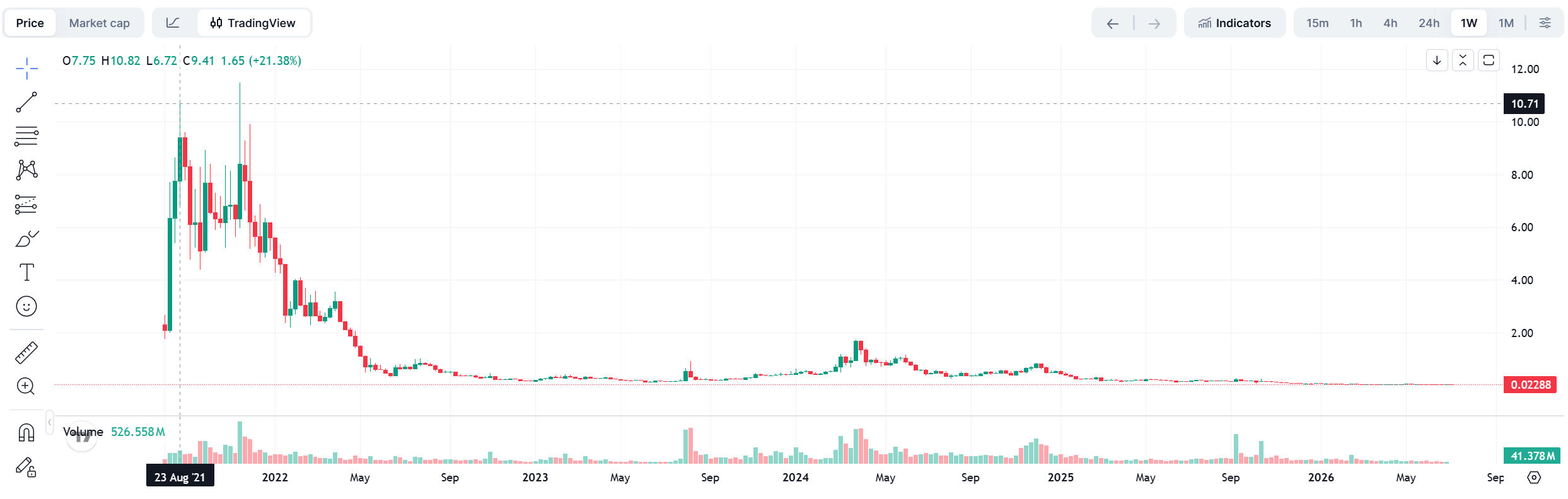
2021 was YGG's peak year. Driven by both the bull market and the P2E narrative, its token price soared, reaching a high of over $10. YGG expanded from a single Axie guild into a global network, covering dozens of regional guilds and establishing partnerships with over 80 blockchain games and infrastructure projects. It didn't just provide asset lending; it helped players maximize earnings through quests, events, and community operations. In places like the Philippines, a real economic phenomenon of "gaming as a job" emerged, with YGG seen as the benchmark for the P2E model.
At its peak, YGG's model was widely replicated: guilds became key intermediaries connecting players, assets, and games, with DAO governance and token incentives allowing participants to share in the growth dividends. YGG also evolved from a simple "asset manager" into an investment, content, and community platform.
When the crypto bear market arrived in 2022, the fragility of Axie Infinity's economic model was laid bare—new user inflow slowed down, token prices crashed, and player attrition was severe. Guilds and P2E projects disappeared directly, and the entire industry entered a downturn. YGG didn't collapse but began a long period of adaptation. In 2025, YGG bet on a new direction again: launching YGG Play to formally enter the game publishing field, as heavy P2E was no longer sustainable, and crypto users naturally preferred high-frequency, instant-reward casual experiences.
This cessation of operations comes just about a year after that last pivot.
A Microcosm of the Chain Game Industry
The closure of YGG Play can be seen as a concentrated embodiment of the development trajectory of chain games over the past five years.
In April of this year, Caladan, a crypto quantitative trading and market-making firm, reviewed the five-year journey of the Web3 gaming sector from frenzied explosion to total collapse. Their core conclusion was that the decline of Web3 games was not a normal cyclical trough but stemmed from a fundamental "structural mismatch" between its underlying speculative financial design and players' genuine need for entertainment, leading to a devastating capital destruction of up to $15 billion.
Examples abound: Pixelmon, which raised $70 million and failed to launch an open beta in 4 years; Ember Sword, which burned through $18 million before directly liquidating; and Hamster Kombat, which lost 96% of its users within 6 months.
As of April 2026, among approximately 3,200 chain game projects tracked in the report, 93% were classified as "effectively dead" or had completely lost activity. The average price of crypto tokens in the entire gaming sector has fallen 95% from their all-time highs in 2022.
The boom in chain games was entirely built on the Ponzi-like dividend logic of "play-to-earn." This model is essentially an unsustainable speculative financial closed loop: the earnings of early players and token prices depend entirely on a constant influx of new players buying tokens or NFTs to sustain them. Once the growth rate of new users slows and external capital inflow decreases, severe token inflation quickly destabilizes the economy, triggering a "death spiral" of token crashes, dwindling rewards, and mass user exodus.
YGG Play was not a failure in terms of product delivery or revenue figures, but it was defeated by "market timing."
The story of chain games may be nearing its end.