欧盟 MiCA 正式落地:一文读懂 CASP 授权体系与主流交易平台合规格局


- 核心观点:欧盟《加密资产市场法案》(MiCA)于2025年7月1日结束过渡期,未获加密资产服务提供商(CASP)授权的交易平台将被禁止向欧盟用户提供服务。CASP并非单一牌照,而是基于服务代码(a至j)和最低资本要求(Class 1-3)的授权体系,目前仅18个实体获得含交易平台运营权(b类)的Class 3授权,而 Coinbase、Bybit 等主流平台多集中在Class 2,Binance等头部平台尚未明确获得授权。
- 关键要素:
- MiCA 核心是为欧盟27个成员国建立统一的加密资产监管规则,涉及稳定币发行和加密资产服务提供,过渡期结束后所有未获 CASP 授权的平台原则上无法在欧盟运营。
- CASP授权细分为a(托管)至j(转账)10个服务代码,Class 1(5万欧元资本)覆盖经纪、咨询等轻资产服务;Class 2(12.5万欧元)增加托管与兑换;Class 3(15万欧元)为含交易平台运营(b类)的最完整授权。
- 截至2026年7月,共有279个CASP授权实体,但仅18个获得含b类服务的Class 3授权,包括OKX、Kraken、Bitstamp、Bitvavo等,不同平台授权服务代码范围各异。
- Coinbase、Bybit、Crypto.com、KuCoin、Robinhood Europe等主流平台目前为Class 2授权,覆盖托管、兑换、转账等服务,不包含交易平台运营(b类)服务。
- Binance、Bitget、MEXC、HTX等全球主流平台暂未在ESMA CASP授权表中显示获得MiCA授权,可能面临业务收缩、用户迁移或退出欧盟市场的压力。
The EU MiCA is Officially Implemented: A Guide to the CASP Authorization System and the Compliance Landscape of Major Trading Platforms
As of July 1st this year, the CASP transition period under the MiCA regulation officially ended. This means that any crypto-asset trading platform that has not obtained CASP authorization will, in principle, no longer be able to provide services to users within the EU.
For the entire industry, this day feels like a watershed moment.
Some are happy, some are worried: Several mainstream platforms have already obtained licenses and smoothly entered the MiCA regulatory framework. However, many other platforms have yet to make substantial progress and may soon face pressure to scale back operations, migrate users, or even gradually exit the EU market.
In fact, the MiCA regulatory framework for crypto-asset service providers had already come into effect by the end of 2024. However, over the past year or so, the market has mostly been digesting the rules, applying for licenses, and adjusting business structures during the transition period. Now that the transition period is over, MiCA has truly entered its enforcement phase.
Of course, many people still lack a clear understanding of how MiCA's CASP authorizations are categorized, what the differences in regulatory requirements are for various platforms, and what the practical impact will be on exchanges and EU users.
Markets in Crypto-Assets Regulation
MiCA is a unified regulatory framework established by the EU for the crypto-asset market. Its full name is the Markets in Crypto-Assets Regulation.
Its core purpose is to create a set of common regulatory rules for crypto-assets across the 27 EU member states, covering the issuance, trading, custody, exchange, order execution, transfer of crypto-assets, and related service provision. Its goal is to unify the fragmented crypto regulatory rules previously spread across EU member states, allowing crypto-asset issuers and crypto-asset service providers to operate under clear requirements for licensing, capital, governance, risk control, information disclosure, and client asset protection.
Focusing on the MiCA framework itself, it primarily targets two types of entities:
The first type is crypto-asset issuers, especially issuers of Asset-Referenced Tokens (ARTs) and Electronic Money Tokens (EMTs).
These entities must obtain relevant issuer authorization, comply with regulatory requirements to publish a whitepaper, establish reserve arrangements, and meet standards for governance, risk management, and ongoing compliance.
For the market, ARTs and EMTs are the two most critical types of issuers under MiCA's issuance regulation. ARTs are more akin to stablecoins anchored to a basket of assets, while EMTs mainly correspond to stablecoins anchored to a single fiat currency, such as USDC.
However, the regulation of issuers is not the focus of this article. We can potentially open a new article to discuss this part in detail later.
The second type is Crypto-Asset Service Providers, or CASPs for short.
This category mainly includes crypto exchanges, custodians, brokers, order executors, and crypto-asset transfer service providers. Unlike the issuer system, the focus of CASP regulation is on how platforms provide crypto-asset-related services to clients, including trading, custody, exchange, order execution, investment advice, portfolio management, and asset transfers.
Accordingly, MiCA's regulatory requirements for CASPs are also mainly concentrated on capital requirements, corporate governance, risk control, client asset protection, information disclosure, and operational compliance.
From July 1st this year, only crypto-asset service providers that have obtained the corresponding CASP service authorization can legally provide services such as client asset custody, order matching, asset exchange, order execution, and asset transfers within the EU.
It's important to note that, strictly speaking, a CASP authorization is not a so-called "all-purpose exchange license." Under the MiCA framework, having "CASP authorization" cannot be simply equated with being able to "operate a trading platform."
CASP authorization is actually granted based on specific service types. In other words, what business a platform can do depends on which specific service codes it has applied for and received authorization for. This is somewhat similar to the business scope listed on a business license: even different entities with CASP authorization might have different approved business scopes.
Currently, there are 279 entities that have received MiCA CASP authorization. Among them, about 222 are major service providers that can offer crypto trading-related services such as exchange or order execution.
However, among these entities, only 18 have actually been authorized to operate a crypto-asset trading platform, i.e., to hold the MiCA Class b service authorization.
Therefore, to understand the CASP authorization system under MiCA, one must look at the specific types of services it covers.
Next, we will break this down in detail.
What are the Categories of MiCA CASP Authorizations?
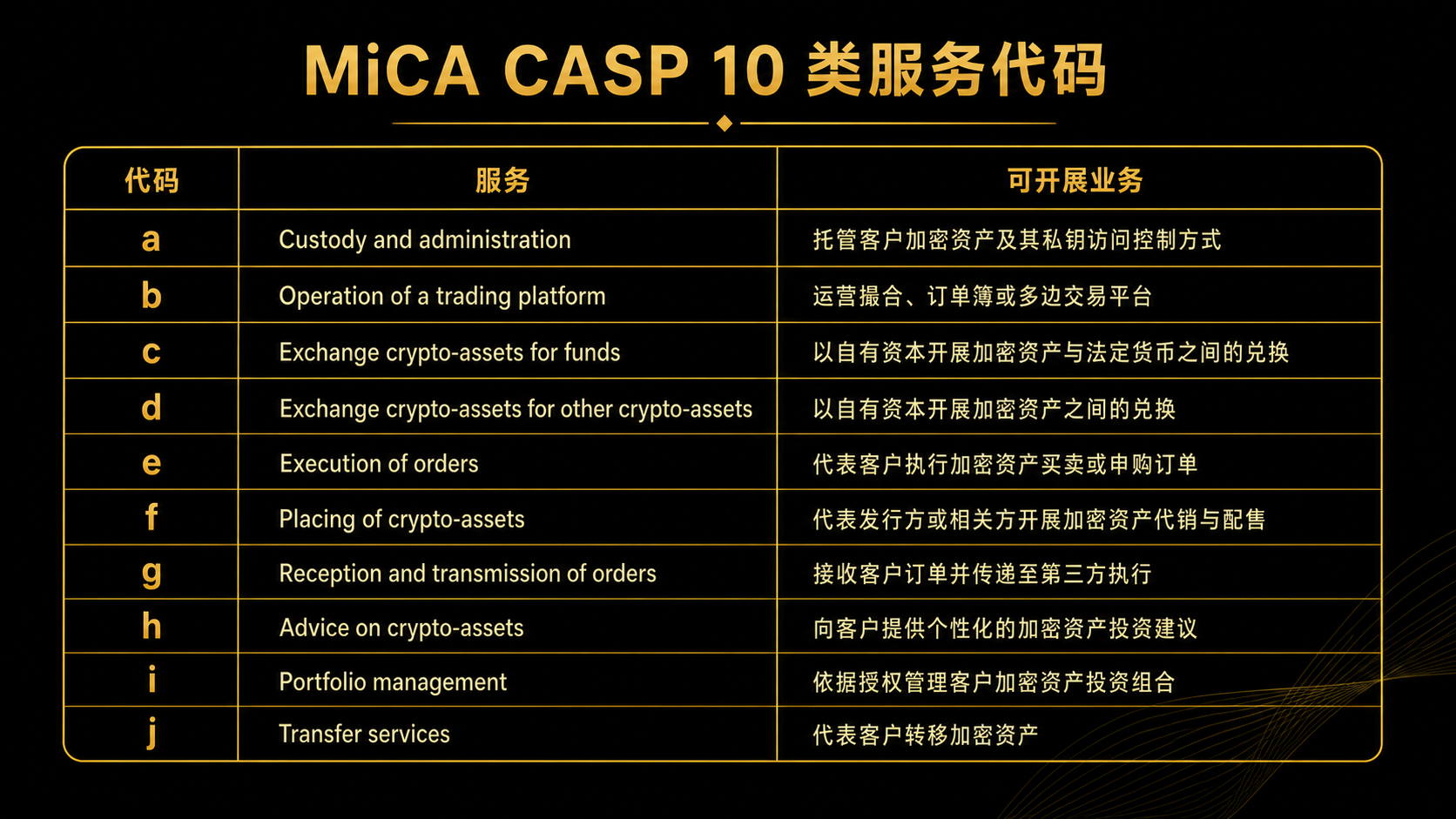
Within the MiCA CASP authorization system, crypto-asset services are subdivided into 10 major categories, represented by service codes from 'a' to 'j'. These codes determine the business a platform is permitted to operate.
Based on these 10 service categories, Annex IV of MiCA further divides the minimum capital requirements for CASPs into three tiers: Class 1, Class 2, and Class 3, determining the minimum capital requirements a platform must meet.
The 10 Service Codes
Category a: Custody and administration of crypto-assets on behalf of clients
Category a mainly corresponds to custody services, i.e., the platform holding crypto-assets on behalf of clients or controlling the means of client access to these assets, such as private keys, account permissions, and custodial wallets.
For a CEX, as long as users keep their coins in the platform's accounts, the platform effectively assumes custody responsibilities. The core concerns for this type of business are client asset security, private key management, asset segregation, and the platform's ability to control client assets.
Category b: Operation of a trading platform
Category b is the closest to what people commonly understand as "exchange business." It refers to a platform operating a trading system that allows multiple buyers and sellers to transact under the platform's rules, such as order books, matching engines, and multilateral trading facilities.
Therefore, if a platform only trades with its clients, it might not necessarily fall under Class b. But if it allows many users to trade with each other via an order book, it falls under the operation of a trading platform.
Category c: Exchange of crypto-assets for funds
Category c refers to a platform using its own capital to exchange crypto-assets for fiat funds with clients. In simpler terms, a user uses euros, dollars, or other funds to buy crypto, or sells crypto to the platform for fiat currency. The platform itself is the counterparty to the trade, somewhat similar to the commonly known OTC trading.
The key point here is that the platform is not simply matching third-party trades but is using its own asset pool to exchange crypto-assets for fiat currencies with clients.
Category d: Exchange of crypto-assets for other crypto-assets
Category d refers to what is commonly known as crypto-to-crypto trading services, i.e., exchanging one crypto-asset for another. If a platform uses its own capital or asset pool to complete the exchange with a client, it falls under this category.
Category e: Execution of orders on behalf of clients
Category e means the platform executes buy, sell, or subscription orders for crypto-assets on behalf of a client. It is similar to a brokerage service. After the user places an order, the platform executes the trade for the client, rather than the user directly performing the operation on the trading platform. The platform not only receives the order but actually completes the trade for the client.
Category f: Placing of crypto-assets
Category f mainly corresponds to issuance-side business. If a platform promotes, sells, or places a particular crypto-asset to investors on behalf of a project party, issuer, or related party, it likely falls under this category. For example, Launchpads, IEOs, and new token distribution events can often be classified under this service.
Category g: Reception and transmission of orders
Category g means the platform receives client orders and transmits them to a third party for execution. It can be easily confused with category e. The difference is that for Category e, the platform executes the order on behalf of the client. For Category g, the platform only receives and transmits the order; the actual execution likely happens on another platform or a third party.
Some aggregators, order routing platforms, and brokerage entry points may involve this type of service.
Category h: Advice on crypto-assets
Category h refers to providing personalized advice to clients regarding crypto-assets. For example, recommending that a client buy, sell, or use a particular crypto-asset service based on their personal circumstances, risk appetite, and investment objectives. It leans more towards advisory and consulting services.
Category i: Portfolio management of crypto-assets
Category i corresponds to crypto asset management services. This is where the user authorizes a platform or service provider to manage their crypto-asset portfolio on their behalf. The service provider must have a certain degree of discretion over the client's asset allocation, meaning the platform can buy, sell, and rebalance the portfolio on behalf of the client based on the authorization.
Category j: Transfer services for crypto-assets
Category j means the platform transfers crypto-assets from one address or account to another on behalf of a client. This includes exchanges helping users withdraw coins, custodial platforms helping clients transfer assets, and payment platforms facilitating crypto-asset transfers for clients.
Minimum Capital Categories
Besides these 10 service codes, you'll often see references to MiCA's Class 1, Class 2, and Class 3.
In fact, Class 1/2/3 are not three different types of MiCA licenses. Essentially, they are classifications of minimum capital requirements defined in MiCA's Annex IV.
Class 1 corresponds to services e, f, g, h, i, and j. This includes order execution, placing of crypto-assets, reception and transmission of orders, investment advice, portfolio management, and transfer services. The minimum capital requirement is €50,000.
These services are generally more focused on brokerage, advisory, asset management, order transmission, and transfers. Since they don't necessarily involve the platform holding large amounts of client assets or operating a trading platform, the minimum capital requirement is set at €50,000.
Class 2 builds upon Class 1 by adding services a, c, and d. This means, in addition to the services in Class 1, it covers client asset custody, exchange of crypto-assets for funds, and exchange of crypto-assets for other crypto-assets. The minimum capital requirement is €125,000.
Class 2 begins to involve custody of client assets and the platform using its own capital to conduct exchange transactions with clients. In other words, it extends beyond basic brokerage, order, advisory, and transfer services to further cover custody and exchange operations.
Class 3's key feature is the inclusion of Category b: operation of a trading platform. Class 3 can be for Category b alone, or it can combine it with custody, exchange, order execution, transfer, and other services (adding Category b on top of a complete or partial Class 2 set). Class 3 is therefore closest to a full-fledged exchange business, with a minimum capital requirement of €150,000.
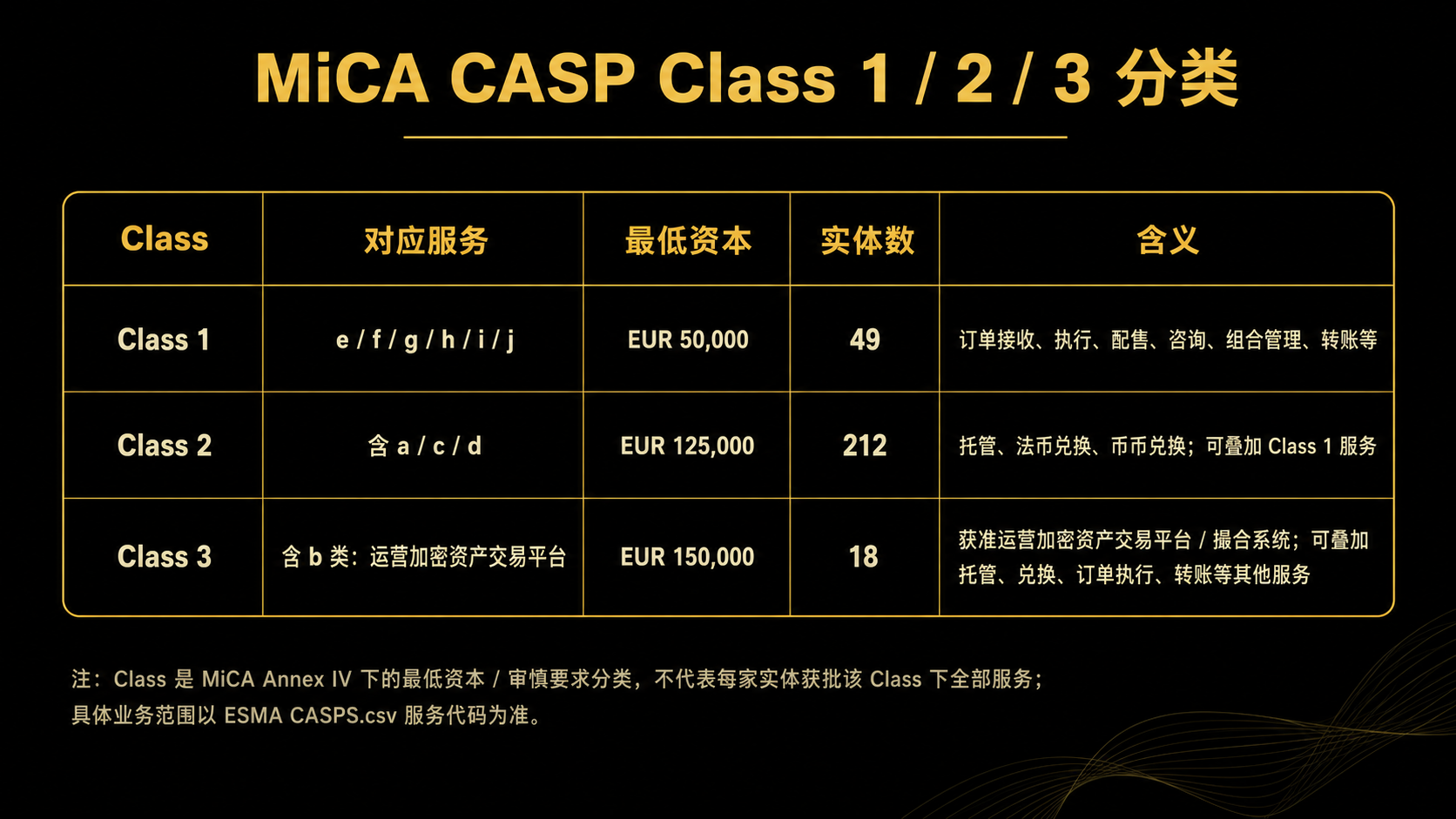
So, in summary, the core of MiCA CASP is authorization based on service codes. Codes 'a' to 'j' represent the specific crypto-asset services a platform can offer. Class 1/2/3 simply set different minimum capital requirements based on the risk and business complexity of these services.
Therefore, if you understand this rule, you can better determine what business a platform can legally conduct under MiCA.
Current Authorization Status of Major Crypto Trading Platforms
As of the latest update from ESMA on July 3, 2026 (updated weekly), there are 279 authorized MiCA CASP entities. Apart from those in Class 1, the vast majority are in Class 2, with a small number in Class 3.
Class 3: Includes Category 'b' Authorization for "Operation of a Trading Platform"
Currently, there are 18 entities that have obtained Class 3 authorization, including the Category 'b' service code for operating a trading platform.
1. OKX
OKX obtained its MiCA CASP authorization through its Maltese entity, OKX Europe Limited, authorized on January 27, 2025. Its service codes are a, b, c, d, e, f, g, i, j, covering client asset custody, trading platform operation, fiat exchange, crypto-to-crypto exchange, order execution, placing of crypto-assets, reception and transmission of orders, portfolio management, and crypto-asset transfer services. In terms of service code coverage, OKX is one of the more comprehensive Class 3 platforms.
2. Gate.io EU
Gate.io EU obtained its MiCA CASP authorization through its Maltese entity, Gate Technology Limited, authorized on September 29, 2025. Its service codes are a, b, c, d, e, j, covering client asset custody, trading platform operation, fiat exchange, crypto-to-crypto exchange, order execution, and crypto-asset transfer services.
3. Kraken
Kraken obtained its MiCA CASP authorization through its Irish entity, Payward Global Solutions Limited, authorized on June 25, 2025. Its service code is b, i.e., operation of a trading platform. It's important to note that Kraken also has another Class 2 entity, with the two entities having different service scopes.
4. BSDex
BSDex obtained its MiCA CASP authorization through its German entity, Baden-Württembergische Wertpapierbörse GmbH, authorized on July 3, 2025. Its service code is b, i.e., operation of a trading platform.
5. flatexDEGIRO / 360T
flatexDEGIRO / 360T obtained its MiCA CASP authorization through its German entity, 360 Treasury Systems AG, authorized on April 2, 2025. Its service code is b, i.e., operation of a trading platform.
6. PAYMIUM
PAYMIUM obtained its MiCA CASP authorization through its French entity, PAYMIUM SAS, authorized on June 22, 2026. Its service codes are a, b, c, d, e, j, covering client asset custody, trading platform operation, fiat exchange, crypto-to-crypto exchange, order execution, and crypto-asset transfer services.
7. Coinmate
Coinmate obtained its MiCA CASP authorization through its Czech entity, COINMATE a.s., authorized on February 27, 2026. Its service codes are a, b, c, d, j, covering client asset custody, trading platform operation, fiat exchange, crypto-to-crypto exchange, and crypto-asset transfer services.
8. Webot
Webot obtained its MiCA CASP authorization through its Irish entity, Pionew Ireland Limited, authorized on December 18, 2025. Its service codes are a, b, c, j, covering client asset custody, trading platform operation, fiat exchange, and crypto-asset transfer services.
9. RULEMATCH
RULEMATCH obtained its MiCA CASP authorization through its Liechtenstein entity, RULEMATCH Europe AG, authorized on June 1, 2026. Its service codes are a, b, j, covering client asset custody, trading platform operation, and crypto-asset transfer services.
10. Bitstamp
Bitstamp obtained its MiCA CASP authorization through its Luxembourg entity, Bitstamp Europe S.A., authorized on May 15, 2025. Its service codes are a, b, c, d, e, g, j, covering client asset custody, trading platform operation, fiat exchange, crypto-to-crypto exchange, order execution, reception and transmission of orders, and crypto-asset transfer services.
11. Kanga Exchange EU
Kanga Exchange EU obtained its MiCA CASP authorization through its Latvian entity, SIA AlphaRoute, authorized on June 18, 2026. Its service codes are a, b, c, d, f, j, covering client asset custody, trading platform operation, fiat exchange, crypto-to-crypto exchange, placing of crypto-assets, and crypto-asset transfer services.
12. Anycoin
Anycoin obtained its MiCA CASP authorization through its Czech entity, MP Developers s.r.o., authorized on February 11, 2026. Its service codes are a, b, c, d, e, covering client asset custody, trading platform