底部反彈已3倍,Lighter 怎麼就起飛了?


- 核心觀點:去中心化永續合約交易所 Lighter(LIT)近三個月幣價上漲超過 3 倍,主要源於合規進展、與 Robinhood 的戰略合作、代幣經濟模型重塑以及籌碼結構優化等多重基本面敘事的共振。
- 關鍵要素:
- 合規進展:Lighter 創始人加入 CFTC 創新諮詢委員會,並啟動美國鏈上衍生品交易牌照申請,凸顯其「美國本土」合規優勢,有別於競品 Hyperliquid 的離岸風險。
- 渠道拓展:與 Robinhood Wallet 深度綁定,成為其永續合約交易的默認執行層與流動性引擎,Robinhood 龐大用戶群可直接訪問 Lighter 服務。
- 代幣經濟:協議收入全額用於回購並永久銷毀 LIT,累計回購約 1550 萬枚(占流通供應 6.26%),銷毀力度超過 Hyperliquid;同時引入生態代幣質押收益(目標年化 6%)。
- 籌碼結構:前期持續下跌中完成底部換手,籌碼從鬆散分布轉向集中沉澱,市場結構從拋壓主導切換至增量資金定價,空頭回補放大價格彈性。
- 市場表現:LIT 暫報 2.65 USDT,24 小時漲幅 19.4%,近三個月從低點 0.78 USDT 反彈超 3 倍。
Original: Odaily Planet Daily (@OdailyChina)
Author: Azuma (@azuma_eth)
Decentralized Perp DEX project Lighter (LIT) has shown a strong price performance recently.
According to OKX market data, as of 14:30 today, LIT is trading at 2.65 USDT, with a 24-hour increase of 19.4%. Calculated from its historical low of 0.78 USDT in early April, LIT has achieved a strong rebound of over 3 times in the past three months.
Considering Lighter's recent moves in regulation, products, and tokens, the strong price performance of LIT can be attributed to the simultaneous resonance of multiple fundamental narratives.
Compliance Progress: The Narrative Advantage of a "U.S.-Based" Exchange
The first main theme of Lighter's current rally is the rapid clarification of its compliance path. This is particularly evident when comparing Lighter with its biggest competitor, Hyperliquid (HYPE). The latter has long held the leading position in the on-chain Perp DEX track, but its offshore nature is often viewed as a potential compliance risk, especially against the backdrop of a gradually tightening U.S. regulatory framework, implying persistent policy uncertainty.
In contrast, Lighter's positioning leans more towards being a "trading infrastructure born within the U.S. regulatory system." As a U.S.-based project, Lighter is actively embedding itself within the regulatory framework, thereby gaining a new "compliance premium."
During the Q1 investor conference call in early April, Lighter founder and CEO Vladimir Novakovski explicitly stated that the company has initiated the application process for on-chain derivatives trading licenses in the United States. Vladimir said bluntly: "If you want to serve traditional financial institutions like Citadel, having a license is not unrealistic."
Yesterday, Novakovski again stated on X that he has become a member of the U.S. Commodity Futures Trading Commission's (CFTC) Innovation Advisory Committee. The significance of this in the market context goes far beyond the surface-level title. The CFTC's Innovation Advisory Committee essentially serves as an "institutional buffer layer" between the regulator and market participants, providing policy advice to the CFTC on the intersection of technology, law, and finance. Under the current regulatory trends, Vladimir's new role means Lighter is not just "adapting to regulation" but can participate in the early stages of rulemaking.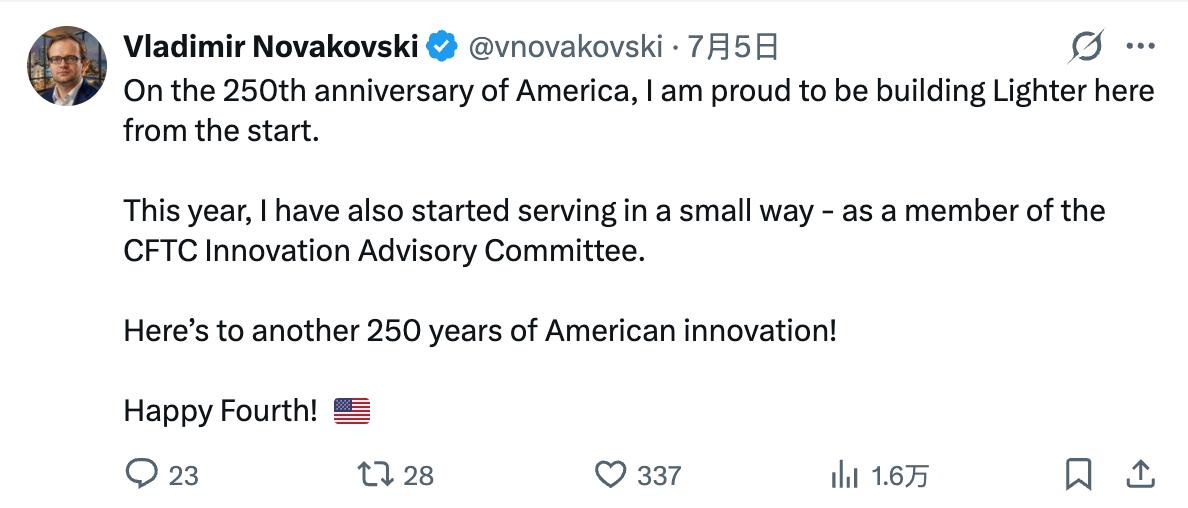
Additionally, there's another noteworthy piece of information: before taking office, new Federal Reserve Chairman Kevin Warsh disclosed holding some LIT in his financial disclosure report. While this doesn't imply Warsh will use his position for any specific purpose, this "potential policy network connection" nonetheless reinforces the market's valuation perception of Lighter's compliance resource advantage.
New Channels Unlocked: Deep Integration with Robinhood
Beyond compliance progress, the second key variable in Lighter's recent surge is the opening of new distribution channels, particularly its deep integration with Robinhood.
Last week, Robinhood and Lighter jointly announced that Robinhood Wallet now supports a native Perp trading entry powered by Lighter, allowing users to trade perpetual contracts and tokenized stock assets directly within the wallet, using USDG as the quote asset.
As an investor in Lighter, the market had previously anticipated some form of cooperation between Robinhood and Lighter, but some users worried Robinhood might choose to build its own Perp product, creating a competitive relationship. However, the latest announcement means Robinhood ultimately chose to integrate perpetual contract trading capabilities through Lighter.
For Lighter, this signifies a qualitative shift in its role — it is no longer merely an independent DEX but is gradually becoming the default execution layer and liquidity engine within the Robinhood Wallet ecosystem, giving Robinhood's vast user base more convenient access to its services.
Renowned trader Ansem, who recently gained significant attention due to the surge of his own Meme token, also gave high praise: "The collaboration between Lighter and Robinhood looks like it's going to be big."

Tokenomics Reshaped: All Repurchased Tokens Burned
Another major move by Lighter recently was the official announcement on July 1st of an update to its tokenomics model, further strengthening the pricing logic of LIT as a "cash-flow-driven asset."
In this update, Lighter explicitly committed to using all protocol revenue to repurchase LIT, upgrading the buyback mechanism from "programmatic buying" to "permanent burning." As of that time, Lighter had repurchased approximately 15.5 million LIT, representing about 6.26% of the circulating supply, and will execute the first on-chain burn after the end of Q2.
Concurrently, the staking mechanism for LIT has been redesigned. After subsidizing staking rewards with pre-TGE revenue in the early stages, the team announced it will gradually introduce ecosystem tokens for staking rewards, targeting an annualized yield of approximately 6%. With the current staked amount of about 125 million LIT, this corresponds to an annual distribution of roughly 7.5 million tokens.
Under this framework, LIT's economic model presents a relatively clear structure: on one end, consistent protocol revenue ➡️ full repurchase and burn ➡️ reduction in circulating supply; on the other end, staking rewards for long-term holders ➡️ directed distribution in the form of ecosystem tokens.
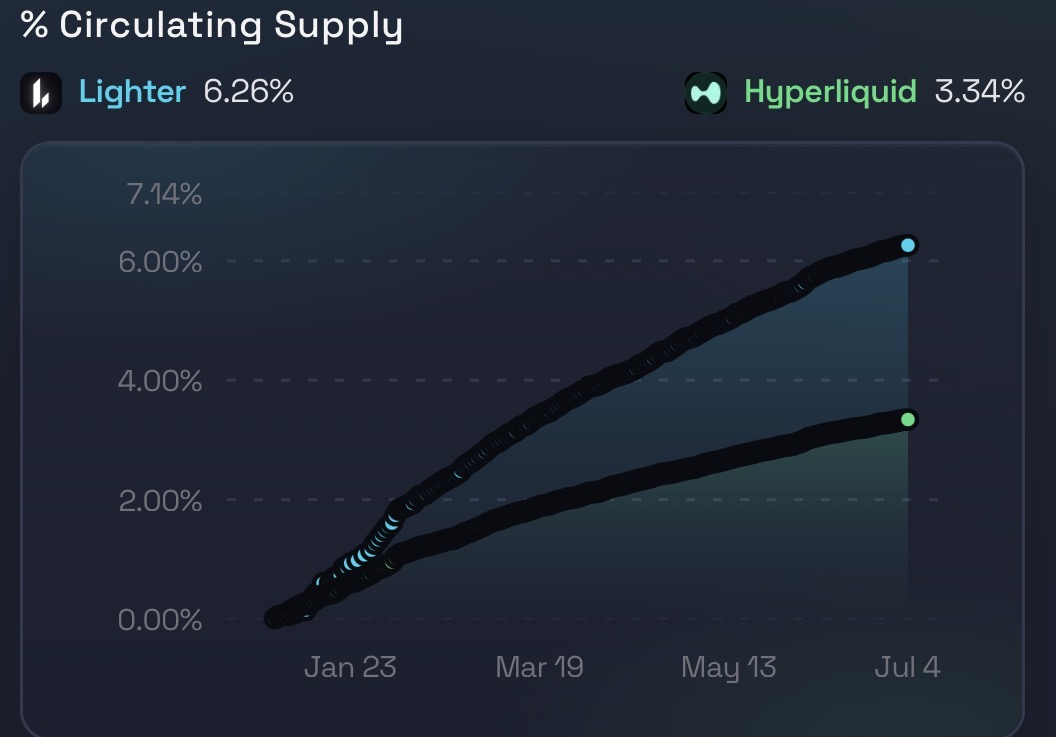
Data analyst ajey.lit, who tracks the Perp DEX track, posted a comparison of buyback data between LIT and HYPE, with quite surprising results. Compared to HYPE, which has always emphasized revenue and buybacks, LIT's buyback intensity is relatively even stronger — as of now, the number of Lighter repurchased tokens accounts for approximately 6.26% of the circulating supply, significantly higher than Hyperliquid (HYPE)'s roughly 3.34%; calculated by comparing buyback amount to market cap, Lighter's buyback ratio is about 4%, also higher than the latter's approximately 1.8%.
Chip Structure Transformation: Handover Complete, a Lighter Load Makes for Easier Lifting
Looking at the three lines of compliance, distribution, and tokenomics together, LIT's rise is not driven by a single catalyst but represents a typical process of "delayed pricing + collective revaluation."
And all of this is predicated on the fact that LIT's bottom chips underwent a thorough washout during the preceding sustained decline.
Since LIT's TGE, due to the overall sluggishness of the cryptocurrency market, intense competition in the Perp DEX track, and the continuous exit of early airdrop users, LIT formed a typical downward selling pressure structure. Simultaneously, market makers and long-term capital completed continuous accumulation at lower levels, causing the chips to gradually shift from "loosely distributed" to "concentrated and settled." In essence, this process can be understood as a bottom-level handover.
As Lighter's fundamentals gradually improved, LIT's market structure also shifted from being "dominated by breakout selling and selling pressure" to "dominated by incremental capital pricing." In this structural change, marginal improvements in fundamentals began to be truly amplified. Furthermore, this structure overlapped with the concentrated existence of short positions. During prolonged periods of sideways trading and bearish expectations, some short positions accumulated. When the price started breaking through key ranges, market liquidity showed clear asymmetry — insufficient selling pressure above, while short covering became a new source of buying pressure, thus amplifying price elasticity.
In summary, the current rally in LIT should not be understood as being driven by a single factor but rather by the combined effect of three layers: First, fundamentals transitioning from uncertainty to verifiability; second, chip structure shifting from sell-pressure dominance to handover completion; and third, short positions and liquidity structures inversely amplifying elasticity.
LIT has not "suddenly become stronger," it is merely "gradually being repriced."