Gate 機構週報:DVOL 低位反彈,加密 ETF 資金持續外流


- 核心觀點:上週市場受聯準會鷹派訊號壓制,風險資產承壓,加密市場同步回調,BTC、ETH均跌超4%。市場整體處於宏觀不確定性下的謹慎博弈階段,鏈上交易溫和修復但未放量,DeFi進入結構性修復階段,穩定幣發行端仍是行業收入核心來源。
- 關鍵要素:
- 聯準會6月議息會議鷹派,點陣圖移除降息預期,9位官員預計年內升息,推動美債殖利率和美元走強,加密市場承壓。
- 美國比特幣現貨ETF 6月累計淨流出約21億美元,但貝萊德IBIT持續吸金,並推出新品iShares溢價收益比特幣ETF(BITA),目標年化收益15%-25%。
- 鏈上DEX成交分化,Uniswap週成交約141.1億美元,反超PancakeSwap;Solana生態交易回暖,但整體未形成全面放量行情。
- 穩定幣市場供給分化,頭部資產數據回落,但DAI、PYUSD等中腰部資產展現韌性,顯示資金以存量輪動為主,無新增美元流入訊號。
- DeFi市場進入結構性修復階段,Lido、Aave等協議TVL和借貸餘額回升,但主要由資產價格修復驅動,資金偏好成熟抵押品和穩定收益協議。
- BTC衍生品市場去槓桿中,OI快速回落至約210億美元,但資金費率仍維持正值,表明多頭情緒降溫但未轉空;期權25D Skew走弱,DVOL低位反彈,短期防禦性需求回升。
Summary
• Last week, global markets traded around the Fed's hawkish signals. Cooling rate-cut expectations boosted U.S. bond yields and the U.S. dollar, putting pressure on risk assets. The crypto market saw a synchronized pullback, with BTC and ETH both falling over 4%.
• The overall trend of ETF fund outflows remains unchanged. Gate TradFi Perp trading stayed active, with coverage of U.S. equity assets continuing to expand. Short-term order book liquidity for XAUT weakened. The market remains in a cautious game under macro uncertainty.
• On-chain transaction activity saw a moderate overall recovery but did not form a fully-fledged volume surge. DEX trading volumes showed divergence, with Uniswap slightly overtaking PancakeSwap, and the Solana ecosystem seeing a rebound in activity. Stablecoin supply showed no significant new USD inflows; capital movement remains primarily rotational among existing holdings, with mid-tier stablecoins demonstrating certain resilience.
• The DeFi market entered a phase of structural repair. LST, Aave lending, and protocol revenues all showed improvement, driven mainly by asset price recovery and the repair of core liquidity markets. Capital shows a preference for mature collateral, stable yields, and trading-focused protocols, with stablecoin issuance remaining the core revenue source for the industry.
• The BTC derivatives market continued its deleveraging process. OI fell rapidly, but the funding rate remained positive, indicating cooling long sentiment without turning bearish. Concurrently, options trading volume cooled, Skew weakened, and DVOL rebounded, reflecting a resurgence in short-term hedging demand and renewed volatility expectations in the market.
1. Market Focus Analysis
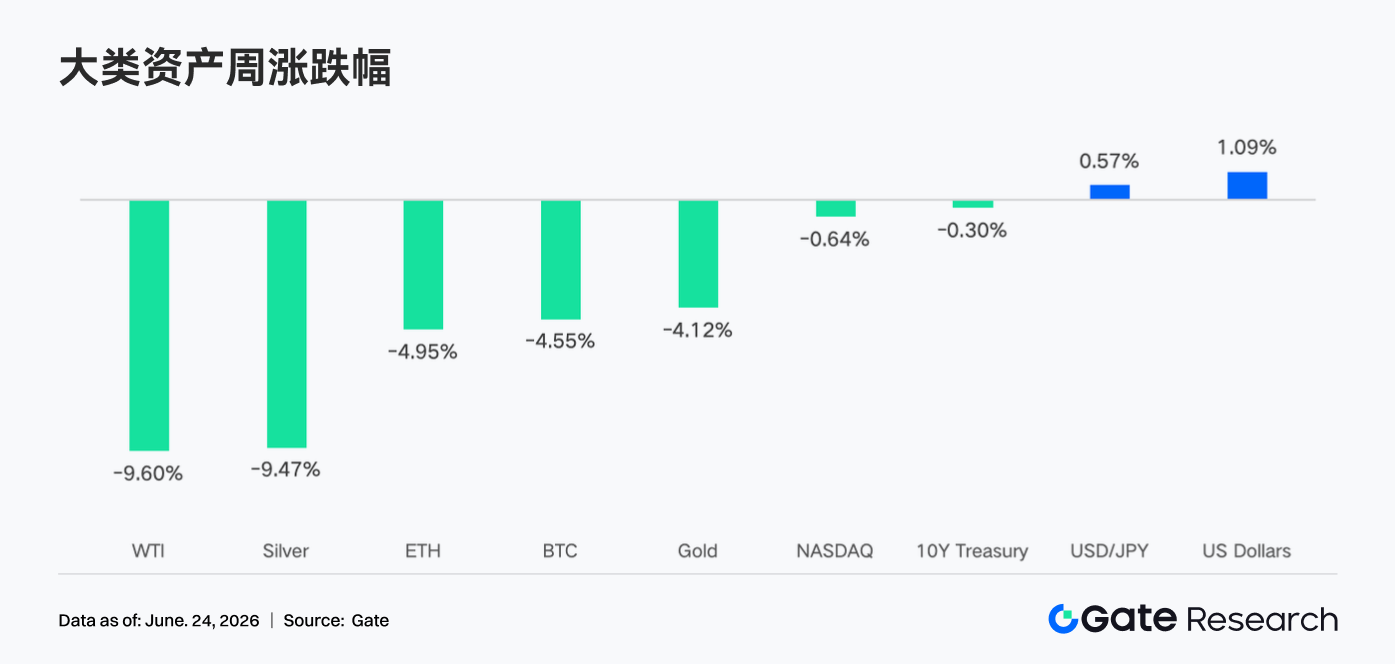
Last week (June 15-21, 2026), the core event for the global macro market was the Fed's June FOMC meeting. Fed Chair Kevin Warsh, in his first post-meeting press conference as the new chair, made comments interpreted by the market as hawkish. The federal funds rate target range was held steady at 3.50%–3.75%, but the latest dot plot completely removed rate-cut expectations for 2026, with 9 out of 18 officials even forecasting at least one rate hike within the year. Warsh also stated that forward guidance is no longer suitable for the current policy environment. Consequently, U.S. bond yields rose sharply, with the 2-year yield hitting a one-year high. Stocks experienced significant volatility on Fed day—although on a weekly closing basis, the Nasdaq Composite Index gained 2.43%, the S&P 500 rose 0.93%, and the Russell 2000 gained 1.21%, the intraday sell-off on Wednesday was described by the media as the "worst Fed day since the new chair took office." The U.S. dollar index strengthened on hawkish expectations, pressuring commodity prices. Gold prices fluctuated amidst the tug-of-war between safe-haven demand and a strong dollar. Oil prices edged lower, dragged down by demand concerns. On the economic data front, the market is closely monitoring the evolution of inflation and employment data to gauge whether the Fed might truly shift to a tightening stance within the year. No major nonfarm payrolls or CPI data were released during the week, so market sentiment was driven primarily by expectations. Geopolitically, the situation in the Middle East, as well as domestic U.S. tax reform and debt ceiling negotiations, continued to unnerve the market, with overall risk appetite remaining cautious.
At the crypto market level, liquidity tightening concerns stemming from hawkish Fed expectations had a significant impact on digital assets. BTC fell about 4% for the week, sliding from a Monday high of $67,300 to a Thursday low near $62,300, before staging a slight rebound to close the weekend near $63,300. ETH fell deeper than BTC for the week, dropping roughly 5%. It hit a high of around $1,850 on Monday before retreating with the broader market and closing Sunday near $1,700. Altcoins generally followed the major coins lower, under pressure from the tightening liquidity. The total global crypto market cap fluctuated in the range of approximately $2.2 trillion to $2.29 trillion. The Fear & Greed Index moved further towards the fear zone after the Fed meeting, reflecting cautious market sentiment.
2. Liquidity Analysis
2.1 The Overall Trend of Sustained Outflows from Crypto ETFs Has Not Yet Reversed
Last week, U.S. spot Bitcoin ETFs saw a slight overall net inflow, but the cumulative net outflow for spot Bitcoin ETFs in June still stands at approximately $2.1 billion, indicating that the overarching trend of persistent outflows this month hasn't fundamentally reversed.
Looking at major products, BlackRock's IBIT continued to lead, recording a net inflow of about $16.4 million on Tuesday, showcasing its strong capital-attracting ability. The combined AUM of all U.S. spot Bitcoin ETFs is currently around $82.5 billion, holding approximately 1.284 million BTC. IBIT leads decisively with an AUM of about $66 billion, followed by Fidelity's FBTC at roughly $14 billion. Additionally, on June 16, BlackRock officially listed a new product on Nasdaq—the iShares Premium Income Bitcoin ETF (ticker: BITA). This product features monthly cash dividends, targeting an annualized return of 15%–25%, specifically aimed at income-oriented institutional investors, adding a new category to the Bitcoin ETF product matrix.
Last week, liquidity performance for Ethereum spot ETFs showed some divergence, with a few products showing signs of recovery. On June 16, Ethereum spot ETFs recorded a net inflow of approximately $9.6 million, marking a second consecutive day of positive flows, a signal of recent phased improvement. BlackRock's ETHA continued to play the primary role in attracting capital, recording a net inflow of about $17.3 million that day, single-handedly supporting the overall positive flow. Meanwhile, Bitwise's ETHW saw a net outflow of about $3.5 million, Fidelity's FETH had a net outflow of about $2.2 million, and Grayscale's Mini ETH had a net outflow of about $2 million, indicating a continued trend of capital concentrating towards top-tier products.
Overall, institutional willingness to allocate via the ETF channel still exists. However, under the headwind of adverse macro interest rate expectations, the pace of short-term incremental capital entering the market has clearly slowed. The market is awaiting further clarity on the Fed's policy path.
2.2 TradFi Liquidity
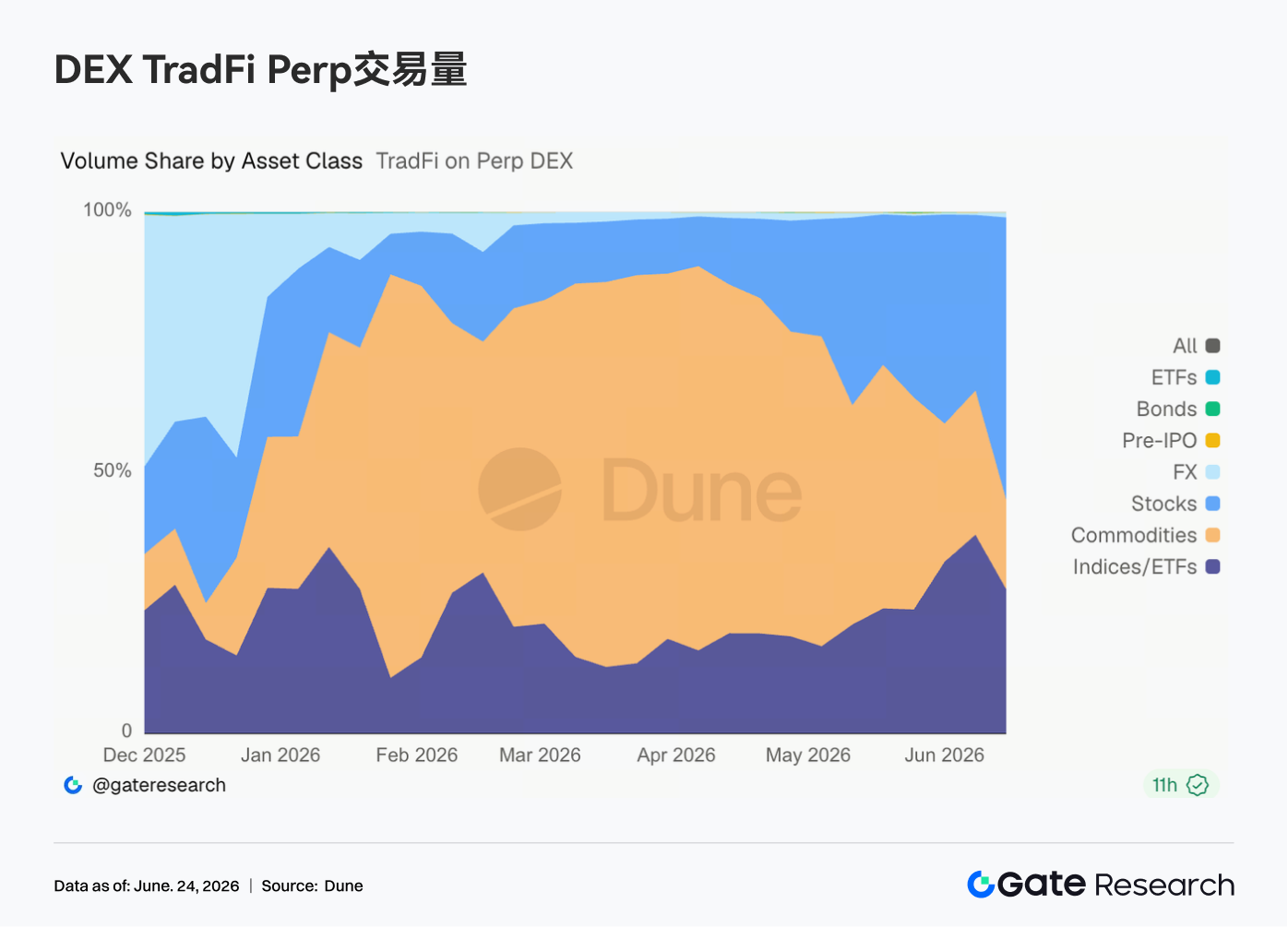
• TradFi Perp DEX: Over the past week, the trading structure of TradFi Perp DEXs showed significant changes. The share of commodities continued to decline, while the share of stocks and indices/ETFs saw a marked increase. Since mid-May, the commodities sector's share has gradually dropped from a previous high of nearly 70% to about 25%–35%. Meanwhile, the stock sector's share quickly rebounded to around 30%, and the indices/ETF share rose to approximately 35%–40%, becoming the main source of recent incremental growth. This shift is closely related to the recent market environment. On one hand, safe-haven trading triggered by the Middle East situation pushed commodity prices like gold to highs before entering a consolidation phase, cooling related trading activity. On the other hand, the SpaceX IPO and continued activity in tech sectors like AI and chips have attracted capital back to U.S. stocks and related index products. For TradFi Perp platforms, user demand is expanding from pure gold trading to a richer set of asset classes including stocks, ETFs, and Pre-IPO products.
• Gate TradFi Perp Trading Volume: In the past week, Gate TradFi Perp trading volume remained relatively high overall, with daily volume mainly in the $300 million to $800 million range. Volatility narrowed compared to the previous period, but activity remained stable. There were several instances of rapid volume spikes, peaking near $800 million, indicating robust demand for leveraged trading during major macro events and asset price volatility. By asset class, metals continued to dominate. Stock-related assets saw significant volume increases on certain days, with the blue area often expanding alongside the total volume, suggesting users' participation in U.S. equity-related perpetual contracts is strengthening. Overall, Gate TradFi Perp trading volume performed steadily over the past week. Market demand was primarily driven by precious metals perpetual contracts, while participation in stock-related assets also increased.
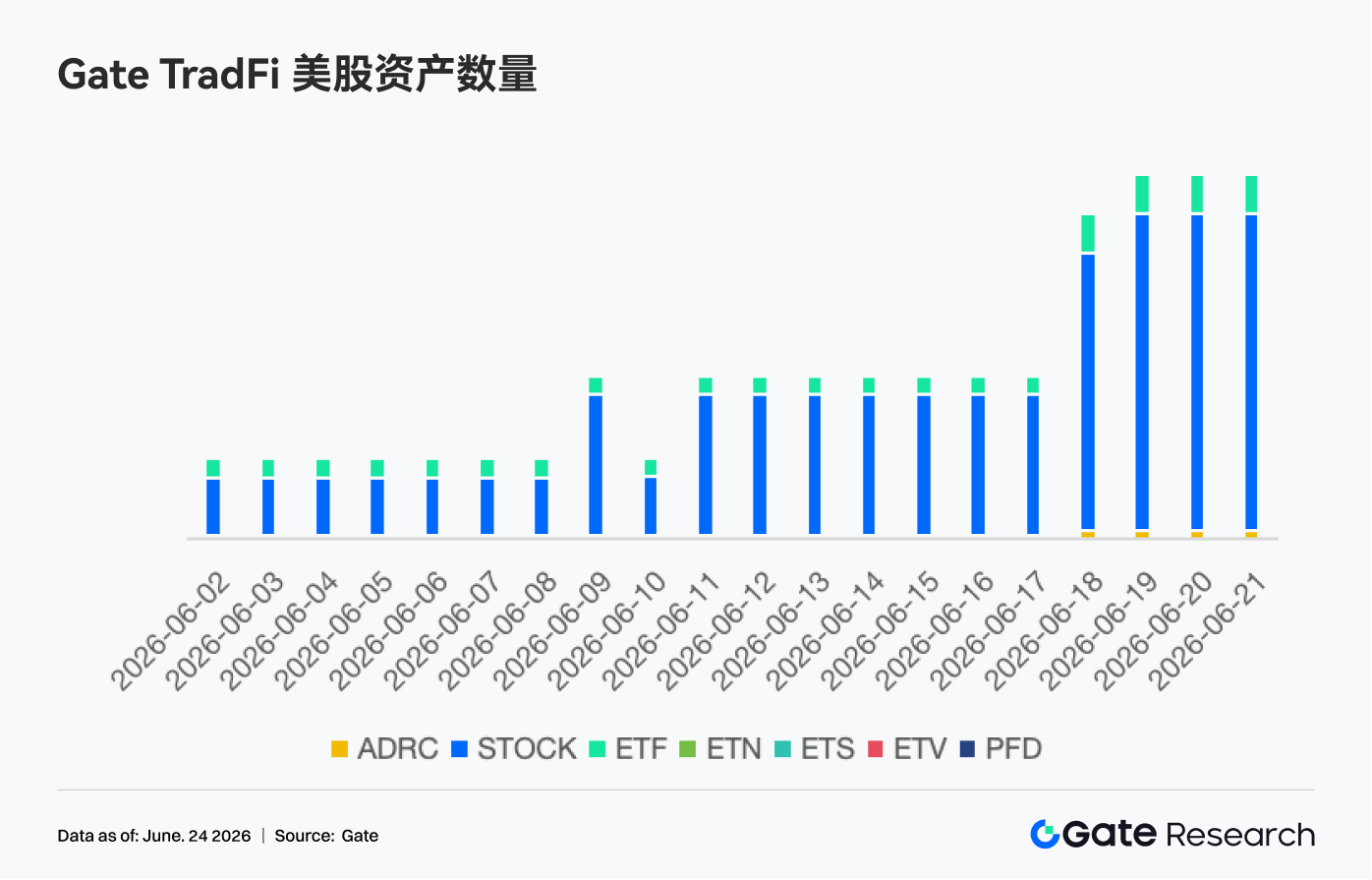
• Number of Gate TradFi U.S. Stock Assets: Gate officially launched its U.S. stock trading service on June 2. Leveraging advantages such as real underlying asset backing, direct trading with USDT, no overnight holding fees, and high liquidity, the service has continuously garnered market attention since its launch, with trading volume growing steadily. Currently, Gate supports ADRCs, stocks, ETFs, ETNs, ETSs, ETVs, and PFDs—7 major asset classes in total—and continues to expand product coverage. In terms of the number of assets, the total number of tradable instruments has doubled since launch. Among them, the stock category has grown most significantly, increasing its share of total assets from about 70% at launch to 85%, further enriching users' investment options. Looking ahead, Gate will continue to promote access to more markets, integrate global liquidity, and build cross-market trading capabilities, continuously expanding diversified asset coverage and further strengthening its strategic positioning as a global asset trading and market access platform.
• TradFi Order Book Depth: We selected XAUT, the TradFi product with the highest trading volume, to analyze its order book depth (Delta). Over the past week, XAUT's order book liquidity showed clear divergence. In the first half of the week, buy-side liquidity held the advantage multiple times, with Delta turning significantly positive, peaking near $2.5 million, pushing the XAUT price up from roughly the $4,050 area to near $4,300, indicating strong market absorption. However, after June 18, as the price peaked and then fell, sell-side liquidity gradually strengthened, with Delta turning persistently negative, signaling increasing overhead supply pressure. Since June 22, the negative Delta has widened markedly, with short-term aggressive sell orders dominating, pulling the XAUT price back to around $4,120. Overall, the gold token still has buy-side support, but the short-term liquidity structure is leaning defensive as the market awaits further resolution of macro uncertainty.
3. On-Chain Data Insights
3.1 DEX Volume Did Not Increase in Tandem; Uniswap Slightly Overtakes PancakeSwap
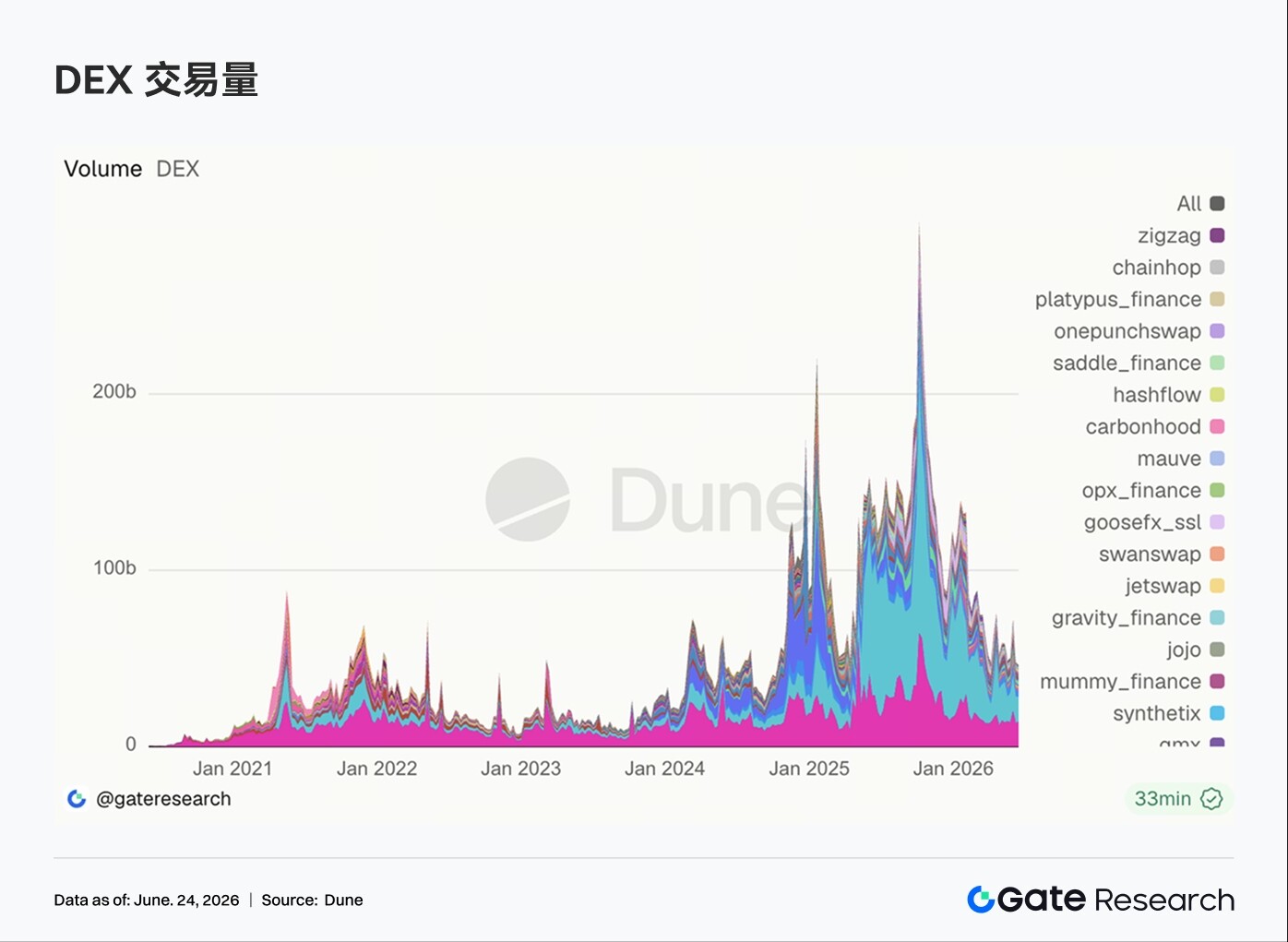
Last week, DEX trading volumes showed divergence, and the market rebound did not translate into a full-scale volume surge. Uniswap achieved a weekly volume of approximately $14.11 billion, slightly overtaking PancakeSwap's $13.98 billion. PancakeSwap's volume declined from the previous week, while Uniswap continued its recovery. Aerodrome and Curve cooled from their highs of the prior week, indicating that turnover demand on Ethereum and Base did not expand persistently. The Solana side performed stronger, with volumes on Raydium and Meteora recovering, while Whirlpool remained largely flat. PumpSwap's volume rose to about $458 million, with active traders remaining above 1.26 million, though the number of transactions was slightly lower than the prior week. This suggests last week's growth was more driven by an increase in average trade size rather than pure retail high-frequency expansion.
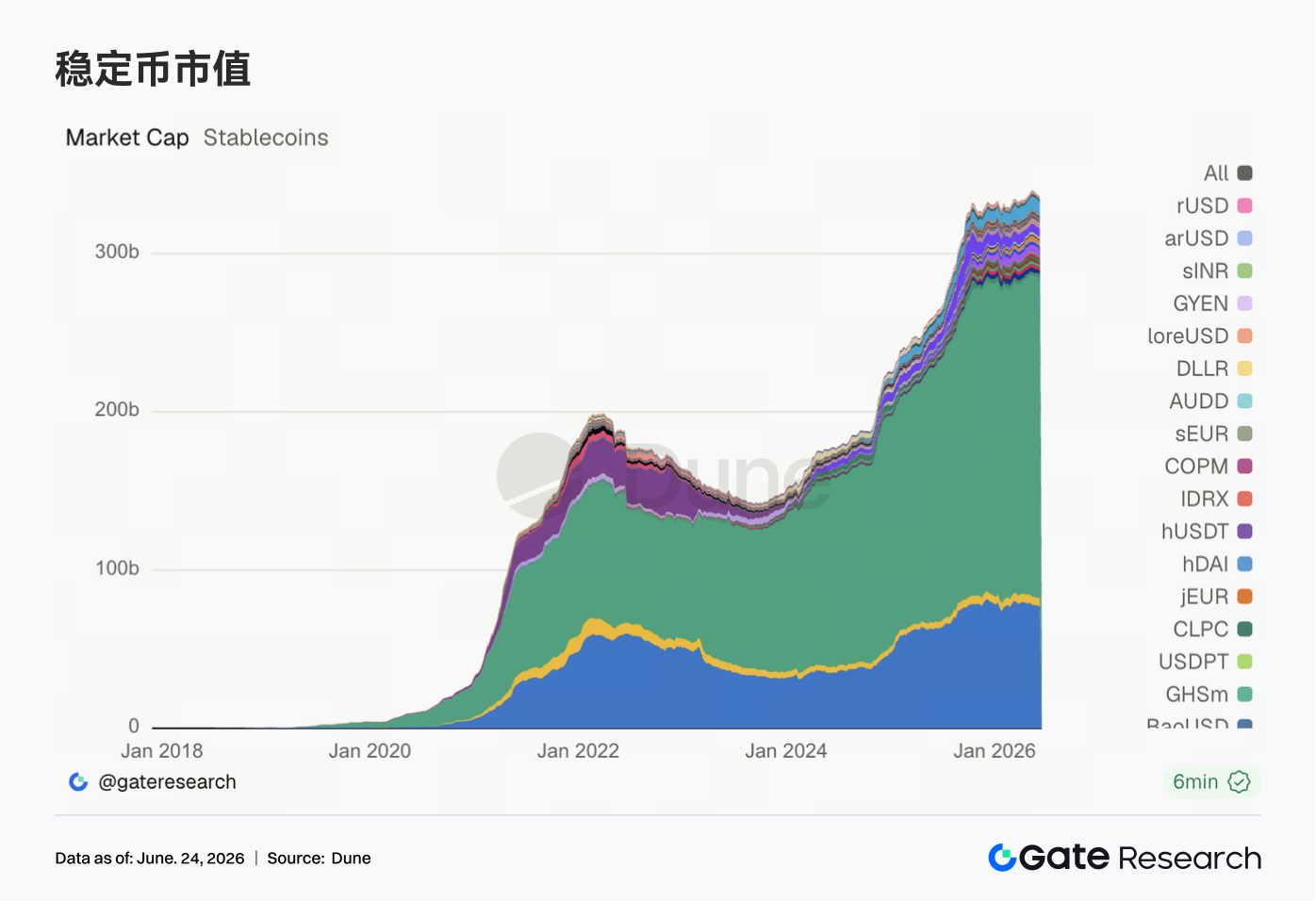
3.2 Divergence in Stablecoin Supply; Mid-Tier Asset Performance Better Reflects On-Chain Dollar Structure Changes
Last week, the stablecoin market showed clear divergence, with data for top assets like USDT and USDC declining. Notably, DAI stabilized around $4.96 billion, PYUSD edged up to about $2.09 billion, and GHO held steady near $600 million, indicating resilience among some mid-tier stablecoins. USDe and USDS also saw declines, suggesting a slowdown in the expansion pace of yield-bearing and protocol-based stablecoins. Overall, the stablecoin market last week did not provide clear signals of new USD inflows. On-chain capital continues to circulate among existing holdings, with institutional allocations favoring assets that have already proven their liquidity, reserve transparency, and cross-chain usability.
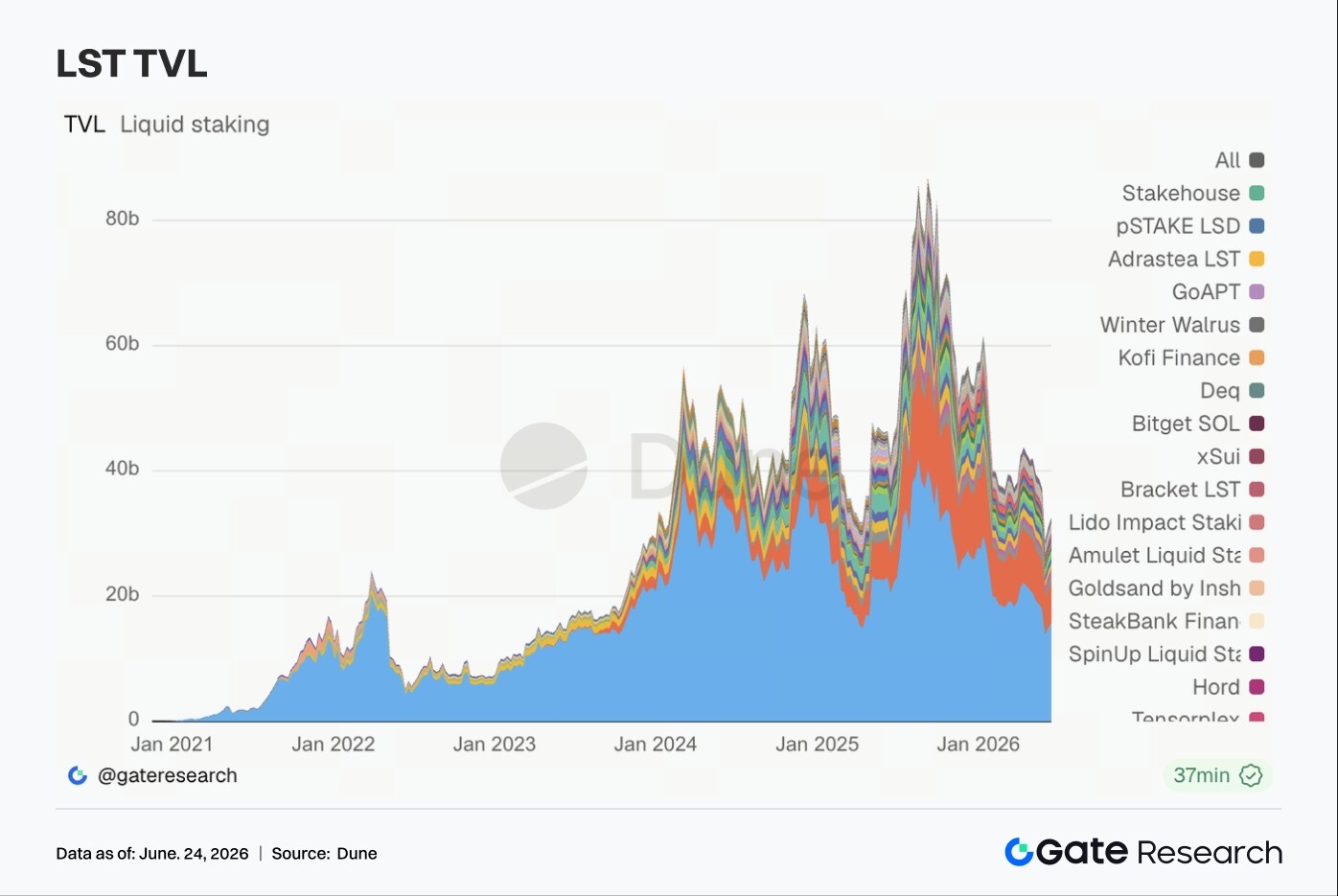
3.3 LST Valuation Recovery Spreads; SOL and HYPE Sides Show Greater Elasticity
Last week, the LST sector recovered overall, with Ethereum's major staking protocols continuing their moderate repair. Lido's TVL rose to approximately $15.71 billion. Rocket Pool and StakeWise both recorded growth of around 3% to 5%, suggesting the capital flow into ETH staking has not deteriorated further. The SOL side showed greater elasticity, with Jito and Jupiter Staked SOL recovering noticeably, and Sanctum Validator LSTs also continuing to expand. Kinetiq kHYPE performed most prominently, with TVL growing about 15% from the previous week. However, as TVL is denominated in USD, last week's rise likely stems significantly from the price recovery of ETH, SOL, and HYPE, and cannot be directly equated to net inflows of staked tokens. The current situation is more akin to valuation recovery and position replenishment.
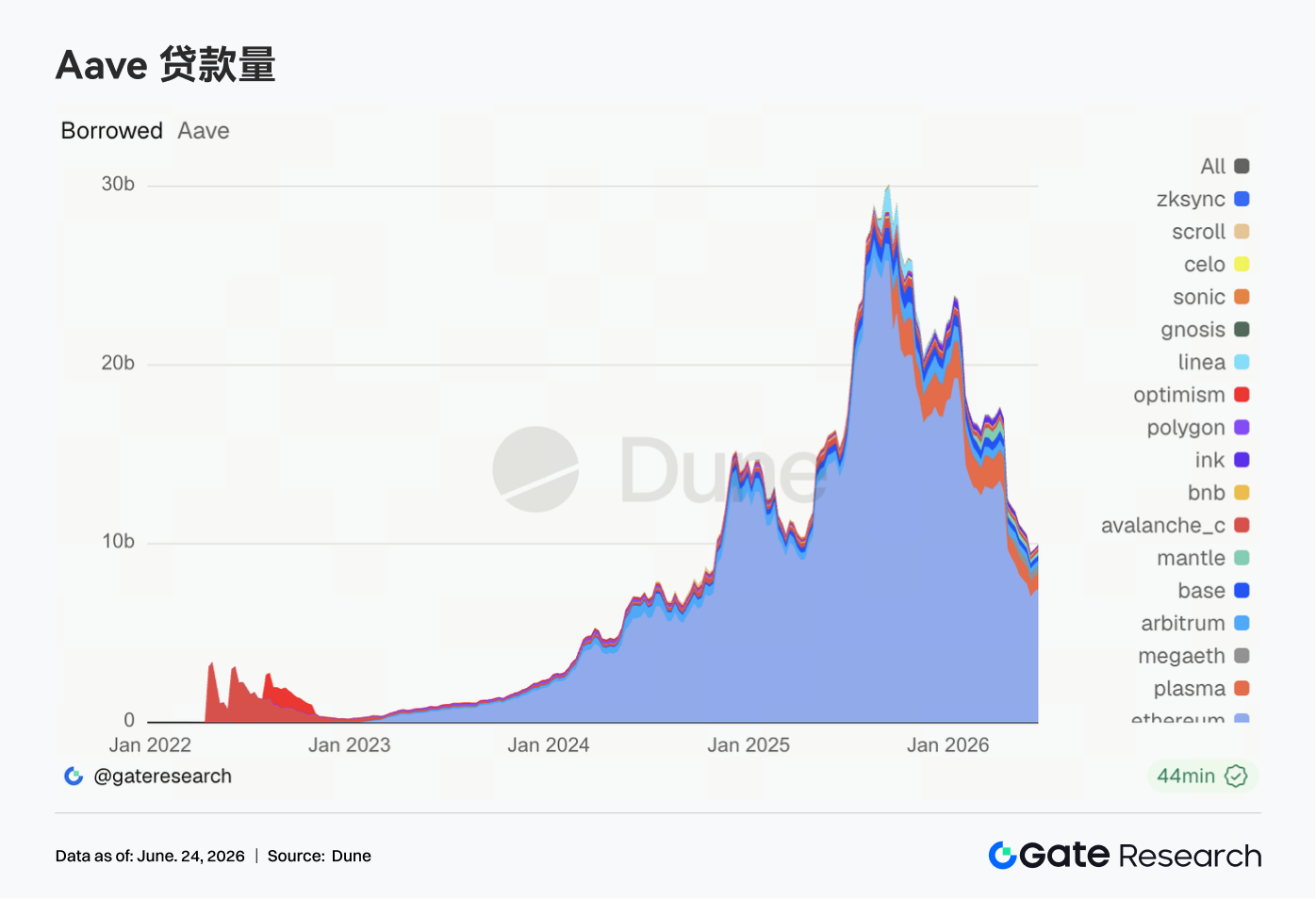
3.4 Aave Lending Volumes Recover Moderately; Ethereum Provides Foundation but Multi-Chain is No Longer Weakening Unilaterally
Aave's lending balances continued their recovery last week. The Ethereum market remains the core support, with borrow volume rising to approximately $7.48 billion, a gain of about 2% from the previous week. Multi-chain markets are no longer weakening unilaterally. Plasma, Mantle, Avalanche, and Ink all saw relatively significant recoveries. Arbitrum and Base also improved slightly, while MegaETH and BNB Chain saw some declines. Capital is returning first to markets with deeper collateral pools, more mature liquidation liquidity, and well-defined risk parameters. However, lending demand on some emerging chains has already begun to recover. Overall, Aave has transitioned from a post-incident defensive phase to a phase of selective repair, though expansion remains concentrated in markets with more reliable liquidity.
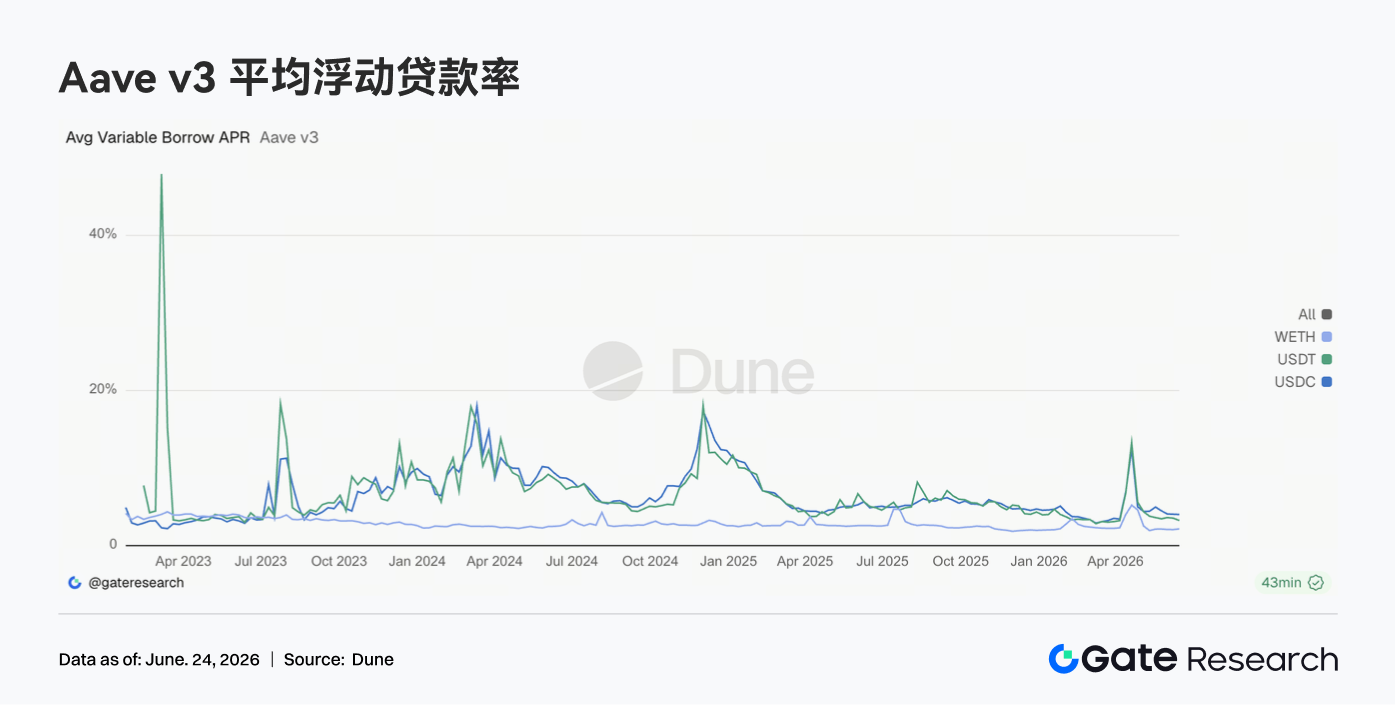
3.5 Aave Lending Rates Stabilize at Low Levels; USDC Tail Risk Further Eases
Last week, borrowing rates for major assets on Aave remained stable at low levels. The average USDC borrow rate was approximately 4.02%, roughly flat from the prior week, but the weekly high rate dropped from about 10.84% to 9.36%, indicating that short-term funding stress caused by extreme utilization continues to ease. The average USDT rate fell to about 3.24%, while the average WETH rate edged up slightly to around 2.16%, still within a low range. The recovery in lending balances did not trigger a rapid rise in funding costs, suggesting that leverage demand remains restrained. The current interest rate environment is suitable for capital rotation, carry trades, and market-neutral strategies, but has not yet shown signs of borrowers competing for liquidity.
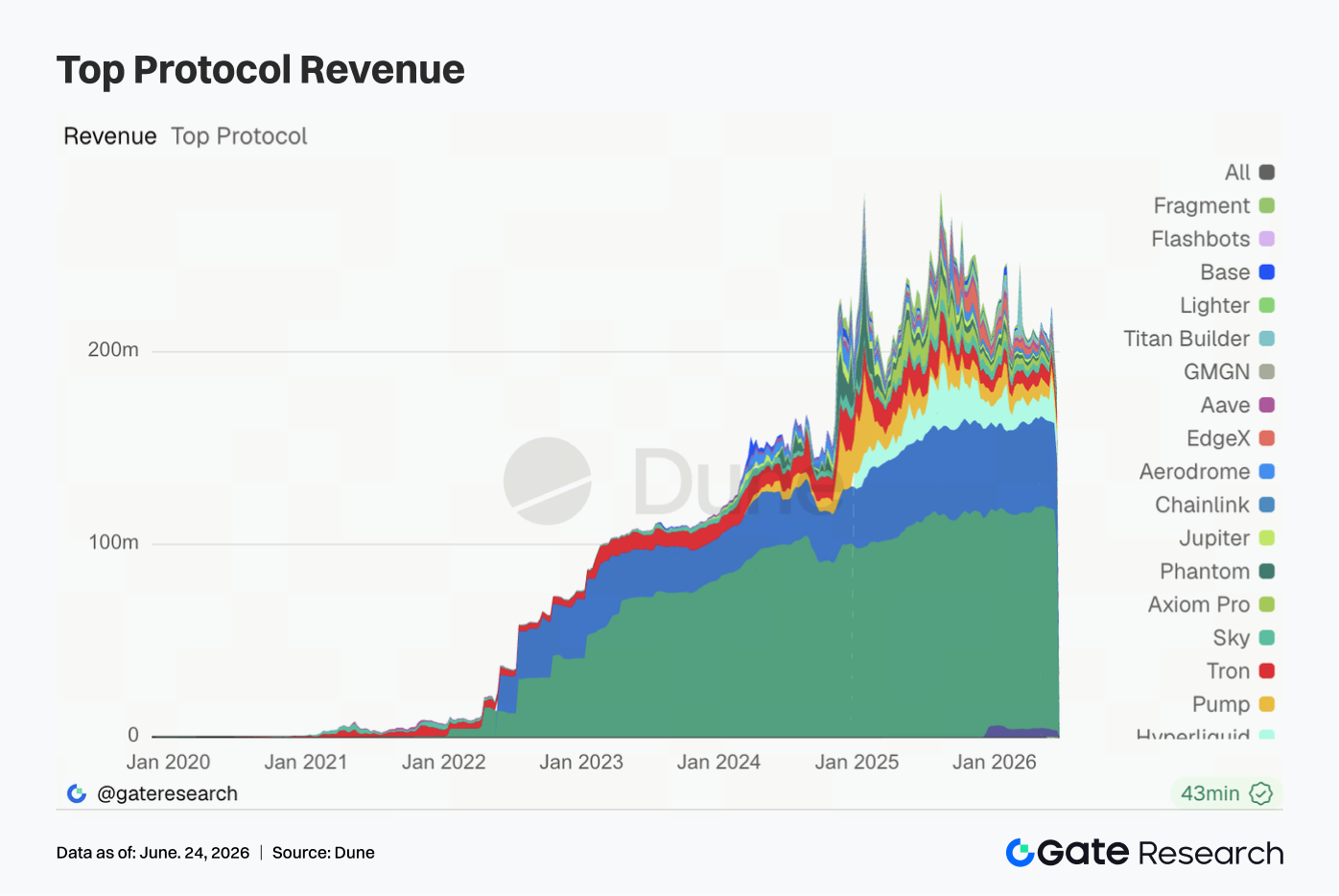
3.6 Protocol Revenues Declined but Structure Unchanged; Stablecoin Issuance Remains the Revenue Foundation
Last week, overall protocol revenues were relatively weak. Tether's revenue fell to approximately $96.76 million, down about 15.5% from the prior week, but still significantly ahead of other protocols. Circle's revenue was roughly $45.19 million, remaining largely stable. Hyperliquid's revenue was about $11.57 million, a slight decrease from the previous week, yet it remains a core revenue source among on-chain trading protocols. Revenues for Pump, Tron, Titan Builder, and Base declined, while Axiom Pro, Jupiter, Aerodrome, and Aave bucked the trend with improvements. The revenue structure has not fundamentally changed: stablecoin issuers continue to provide the industry's revenue foundation, derivatives and trading applications contribute cyclical elasticity, and lending protocols maintain relatively stable but limited revenue recovery in a low-rate environment.
4. Derivatives Tracking
4.1 BTC Funding Rate Remains Positive but OI Rapidly Declines; Leveraged Positions Continue to Be Flushed Out
Last week, BTC prices consolidated near their lows overall. Early in the week, the price traded around $65,000 to $66,000, before falling back to the $62,000 to $63,000 range around June 17. Although there was a phased recovery afterward