I used AI to build myself an investment workstation


- Core Insight: Through practicing "Vibe Coding" (using natural language to let AI write code), the author successfully turned multiple long-conceived investment and productivity tools into reality. This signifies a fundamental change in how ordinary people conduct research and investment, drastically lowering the technical barrier and achieving a rapid "idea → implementation → feedback" loop.
- Key Elements:
- The author used tools like Codex and Claude Code to develop four rough but practical tools in half a month, including a cross-market asset panel, prediction market monitoring, an operations backend, and a one-click formatting tool.
- The cross-market asset panel integrates holdings in US stocks, Crypto, Hong Kong stocks, and A-shares, along with abnormal movement monitoring, investment maps, and review functions, ensuring privacy through local deployment.
- A prediction market (PM) monitoring dashboard that centrally tracks specific bets (e.g., valuations of unlisted companies) and sorts them by T1/T2/T3 tiers, seeking opportunities from pricing lags in Chinese information and East Asian political/economic dynamics.
- The author emphasizes that AI's core change for ordinary investors is enabling the rapid creation of prototypes for things they "wanted to do but couldn’t," suggesting building four basic systems: asset observation, signal monitoring, map organization, and review.
- Vibe Coding's rapid feedback iteration mechanism (idea today, test today, modify immediately) is the core driving force, replacing the lengthy cycle from idea to implementation in traditional development.
In the past half month, I've become a bit obsessed with Vibe Coding.
Not the kind of obsession where "I want to build a super impressive product," but rather a sudden realization that many of the small ideas that have been lingering in my mind can actually be brought to life bit by bit.
As everyone knows, Vibe Coding means using natural language to command AI to write code for you and build a product.
I mainly use the Codex and Claude Code clients together, describing requirements and functional modules. They help me write the code. When my quota runs out, I switch to CLI connected to the DeepSeek API to continue.
1. Thoughts I've "Wanted to Do, but Never Did"
I used to have a ton of ideas pop into my head.
For example, could I have a dashboard that puts US stocks, crypto, Hong Kong stocks, and A-shares all in one place, instead of switching between several apps every day?
For example, could I create an anomaly monitor so that when an asset suddenly surges or plummets, I see it immediately, and also know which other assets or sectors it's related to?
For example, could I make an investment map so that when researching a sector, I'm not just looking at one project, but mapping out the entire network: upstream, downstream, beneficiary assets, potential risks, and related assets.
For another example, Prediction Markets (PM) have many bets on private company valuations, market cap overtakes, and macro events. Could I put this data side-by-side with news events and secondary market changes?
Plenty of ideas, but actually executing them? Too much trouble.
You need to know code, design the page, connect data sources, and revise repeatedly. Hiring someone is expensive, and it's hard to even articulate the requirements clearly. After going back and forth a few times, most ideas end up with the thought – "Forget it, let's just make do with Excel for now."
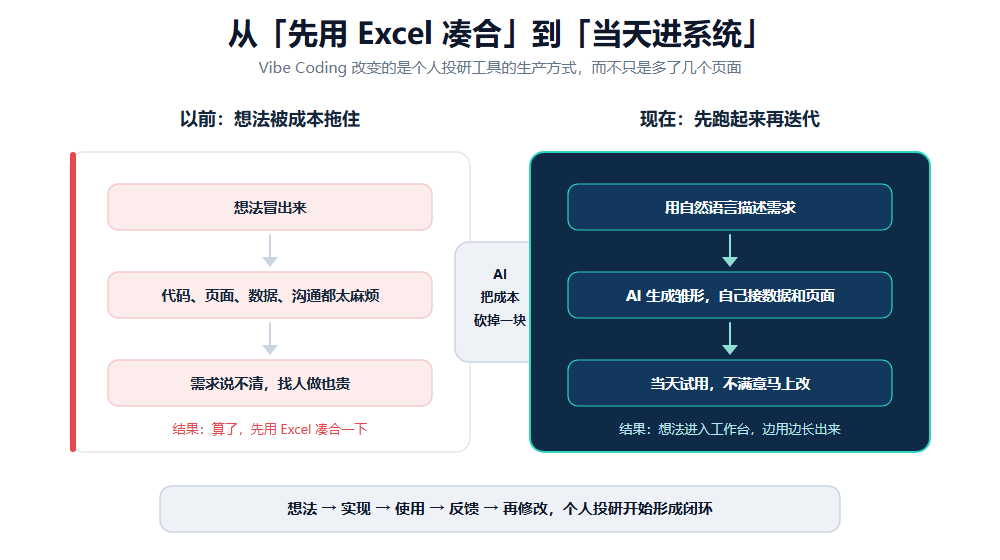
But after tinkering with Vibe Coding for these two weeks, I realized things are genuinely different now.
I started building rough but functional tools for myself. When an idea pops up, it can enter the system on the same day, instead of getting scattered across chat records, bookmarks, and my own mind.
2. Four Small Tools I Built in Half a Month
In these two weeks, I mainly built four things (not counting other minor tools).
First, the Cross-Market Asset Dashboard
The reason was very simple. My assets are scattered everywhere: Hong Kong and US stocks in a broker app, crypto on an exchange, A-shares in yet another software.
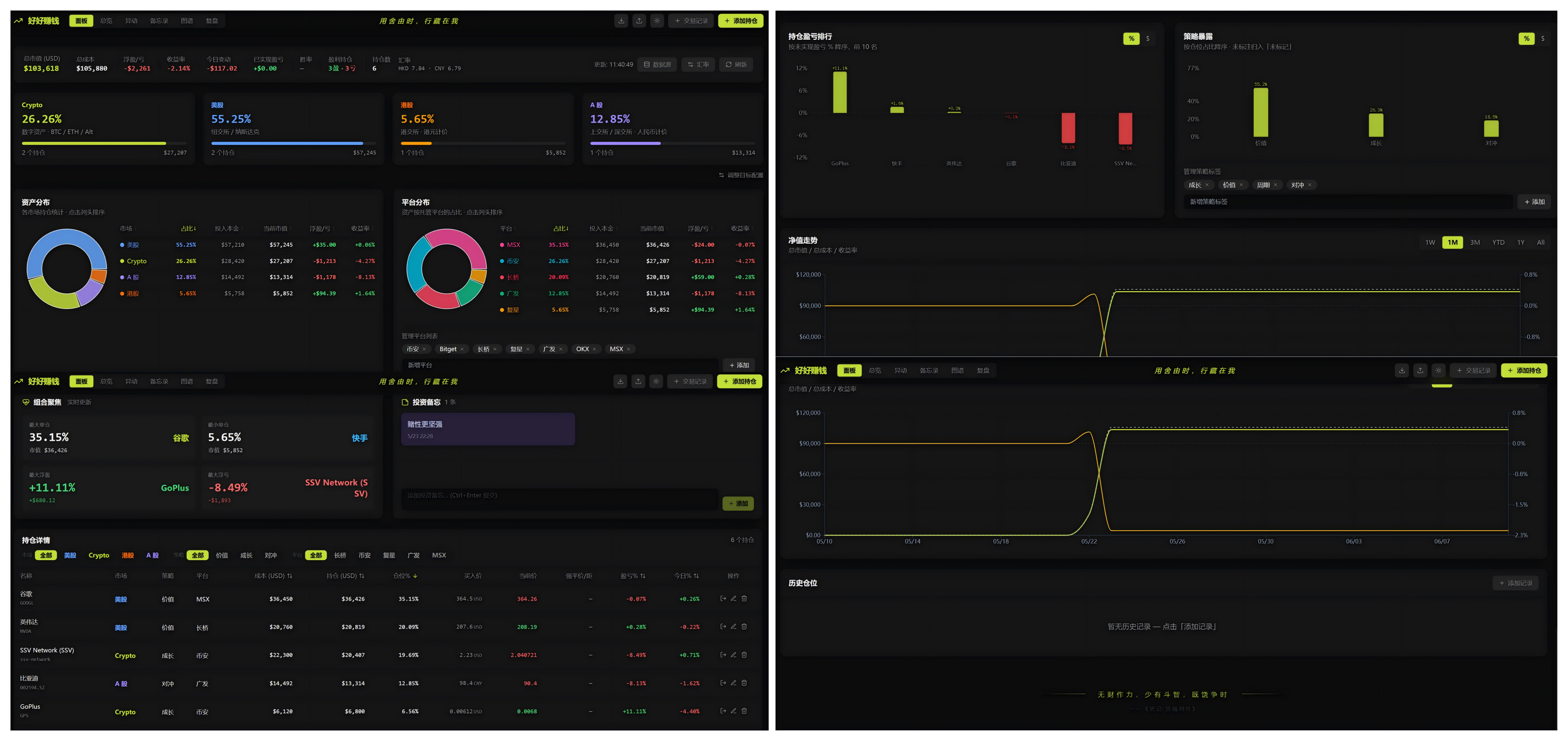
Every day, to get a sense of my overall situation, I had to open each one and switch back and forth. After looking at all of them, I still couldn't piece together the full picture. So, the first thing I did was stuff all my holdings into a single page:
The top shows total assets and today's P&L, below divided by market – a US stock section, a crypto section, Hong Kong stocks, A-shares. A single glance tells me exactly what my overall situation is and who's up or down today.
After building it, I found it quite useful, and I couldn't help but keep adding tabs one by one. As I used it, new requirements emerged:
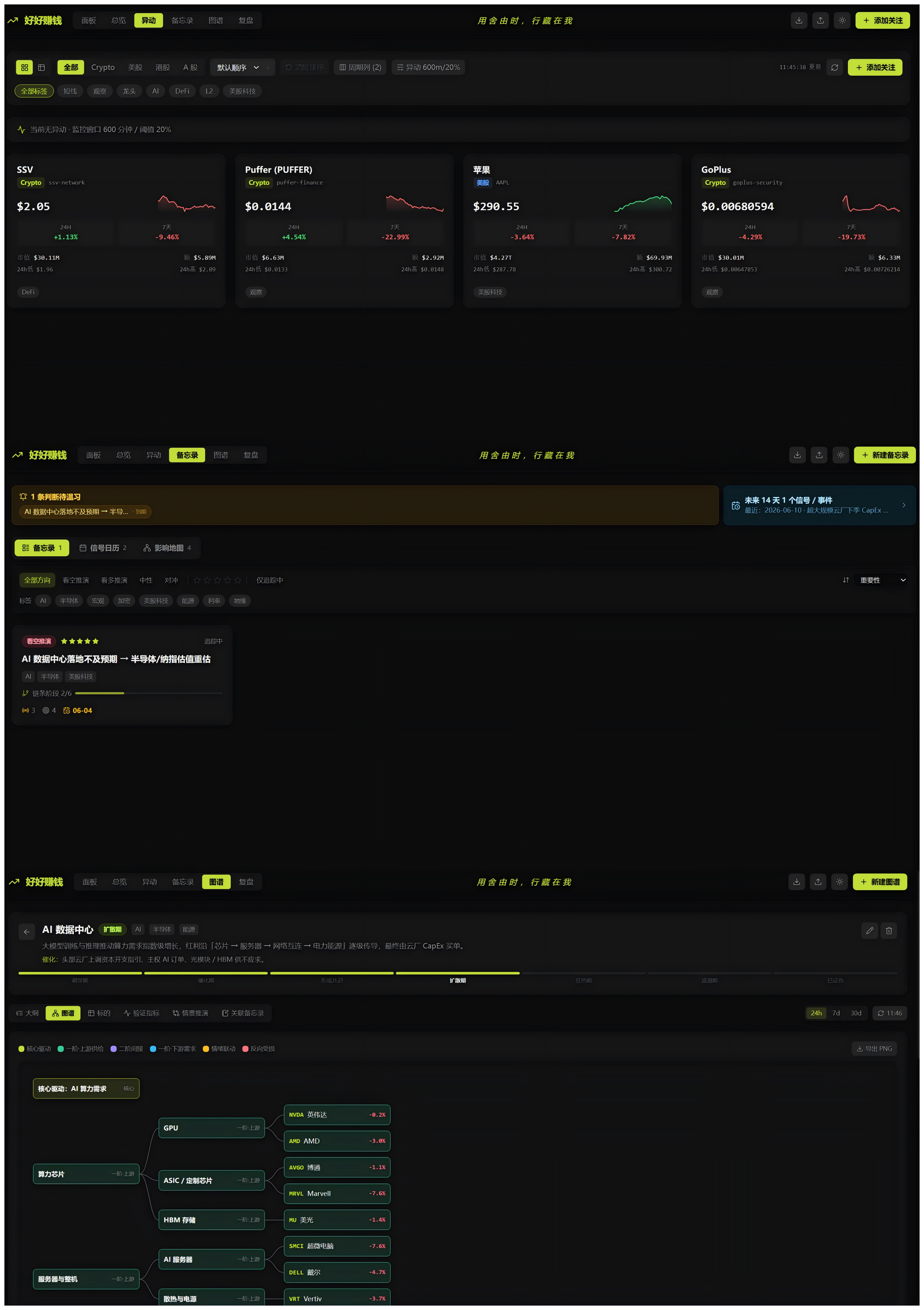
- Anomaly Monitor: I set up the assets and thresholds I care about in advance. If something suddenly surges or drops, it flags it directly, saving me from constantly staring at the screen.
- Investment Map: When researching a sector, I map out the upstream, downstream, beneficiary assets, risk points, and related assets into a network. This makes it easier to trace the flow of capital and relationship networks.
- Memo + Review: I jot down why I was bullish at the time, what happened later, what I got right or wrong. I can look back at it later.
Since this dashboard contains all my real holdings, it's quite private, so I deployed it locally.
Second: PM Bet Monitor
This one is specifically for tracking prediction markets.
Simply put, prediction markets (like PM) are where people bet real money on whether a future event will happen. The price itself represents the market's perceived probability – for example, if a "yes" bet for "SpaceX's market cap reaches $2 trillion by end of June" is priced at 0.8, it means the market thinks there's an 80% chance it will happen.
For the bets I care about, like "Will OpenAI/Anthropic's valuation increase by year-end?", "Will a specific Magnificent Seven stock overtake another in market cap?", "Will person X meet with person Y?" – I used to have to look them up one by one. Now, I consolidate them onto a single dashboard. By placing probability changes alongside news events and secondary market fluctuations, it's crystal clear who moved first and who followed.
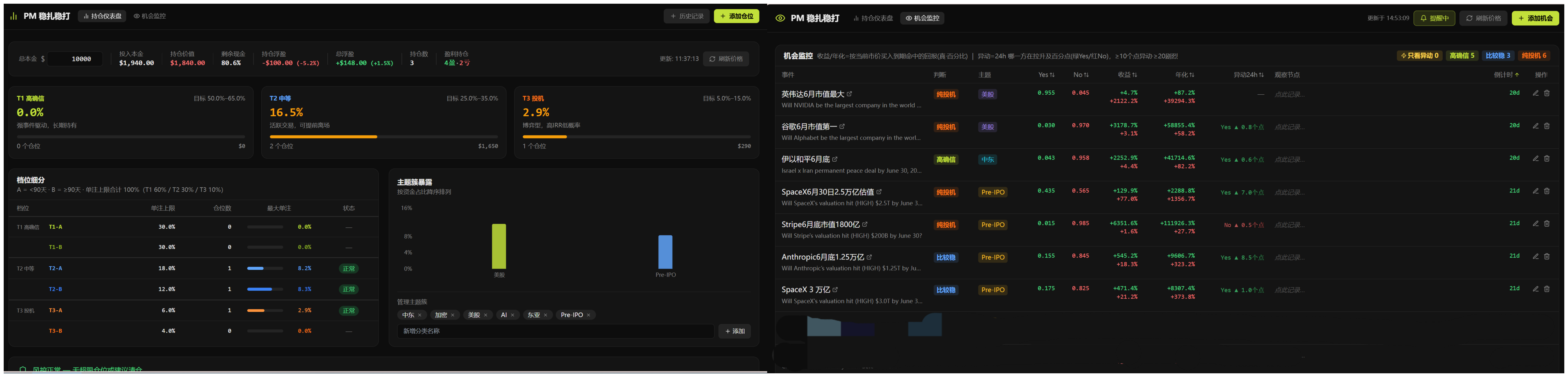
I also tiered these bets based on my own criteria (internally: T1 for high conviction, T2 for relatively stable, T3 for pure speculation) and sorted them by expected return. This way, I can immediately tell what's just noise.
Honestly, my slight edge in this market comes from Chinese-language information and political/economic dynamics in East Asia – the market is largely dominated by Western players, and they are often slow to price in this information. The opportunity lies in this time lag.
Third: An Operations Backend
This one isn't related to investing. I use it for my own writing.
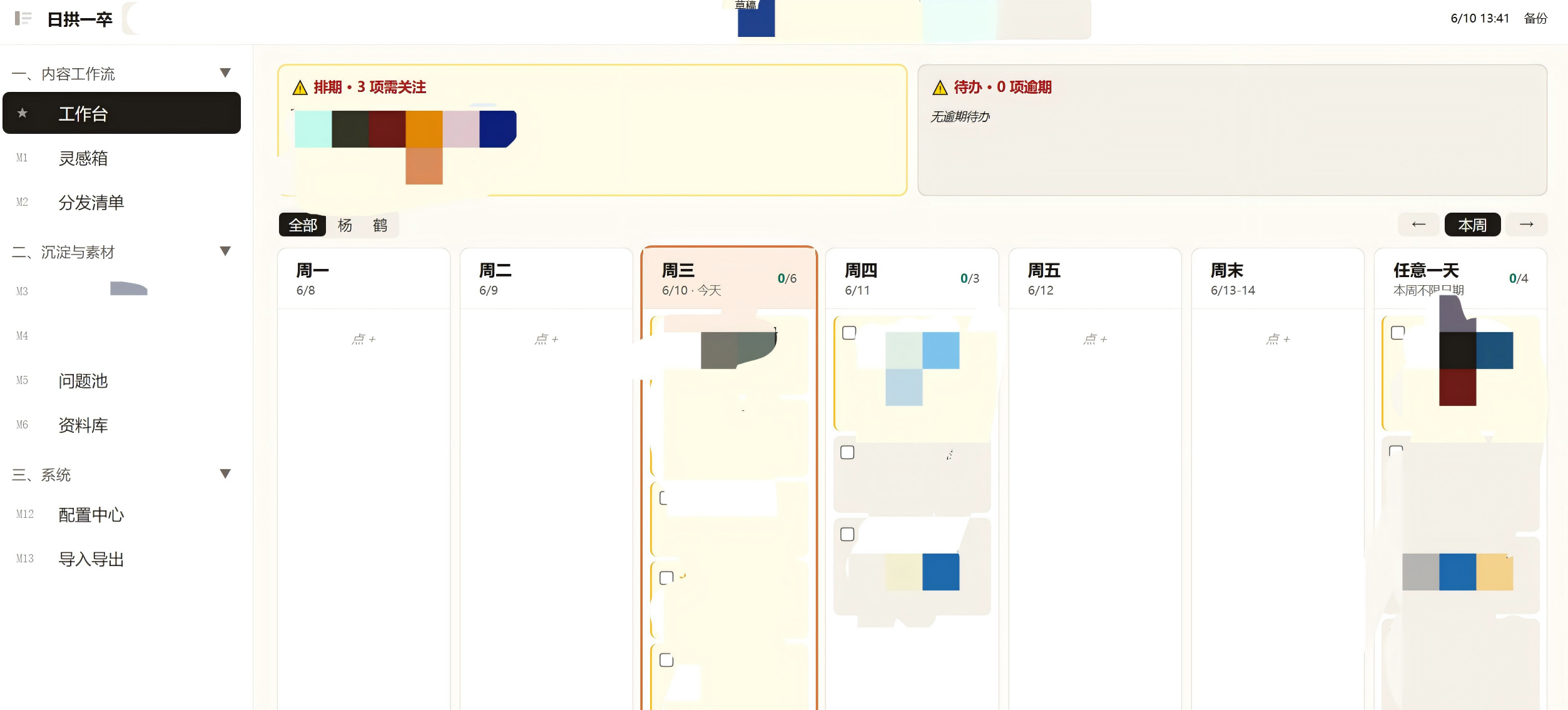
I usually select topics, write drafts, and publish on several platforms. I used to track everything using my memory and by scrolling through chat records, which often got messy. So, I built a simple backend to manage it all, including a topic list, article progress, publication platforms, and an inspiration box.
Since I might need to access it when I'm out and about, I didn't keep it local. Instead, I deployed it to the cloud using GitHub + Vercel. I can open it and make changes on my phone, which is very convenient.
Fourth: A One-Click Formatting Tool
This one mainly solves a personal pain point. After finishing an article, I have to publish it on many platforms. The formatting rules for each platform, especially for Web3 media outlets, are different, and manually adjusting everything is very time-consuming.
So, I created a small tool. Paired with a pre-configured browser userscript, I just paste a Markdown or Word original draft into it, and it automatically converts it to the format required by each platform, directly inserting images. It's not anything super advanced, but it saves me some mechanical work every day.
Actually, these four things are all very rudimentary right now. You could even say they're a bit ugly, and far from polished products. But they've been incredibly useful to me because, after an idea appears, I can immediately put it into a system instead of letting it scatter and be forgotten.
This is the most important change I've noticed.
3. How Ordinary People Do Research Has Truly Changed
Because of this, I increasingly feel that for ordinary people investing, you don't necessarily need to jump straight into building complex models. But at the very least, you should have a few basic systems of your own.
The change AI brings to ordinary people isn't about suddenly turning you into a master. It's about allowing many things you "wanted to do but couldn't" to be done, at least as a prototype.
This is especially noticeable for someone like me who looks at the markets every day. As long as you have an idea, every ordinary investor can gradually piece together a few of their own basic systems:
- Asset Observation System: What assets are you tracking? Which markets are they in? What's changed recently?
- Signal Monitoring System: What events, if they happen, might signal that market expectations are shifting?
- Knowledge Graph System: A sector isn't a single point; it's a network. Who is upstream, who is downstream, who is driven by sentiment, who by earnings, who by capital flow. This was especially true over the past year, where AI-related stocks almost exclusively rewarded those who could deeply understand an entire sector (from HPC to optical modules to the memory supply chain).
- Review System: Why were you bullish at the time? What happened later? What did you get right, and what wrong?
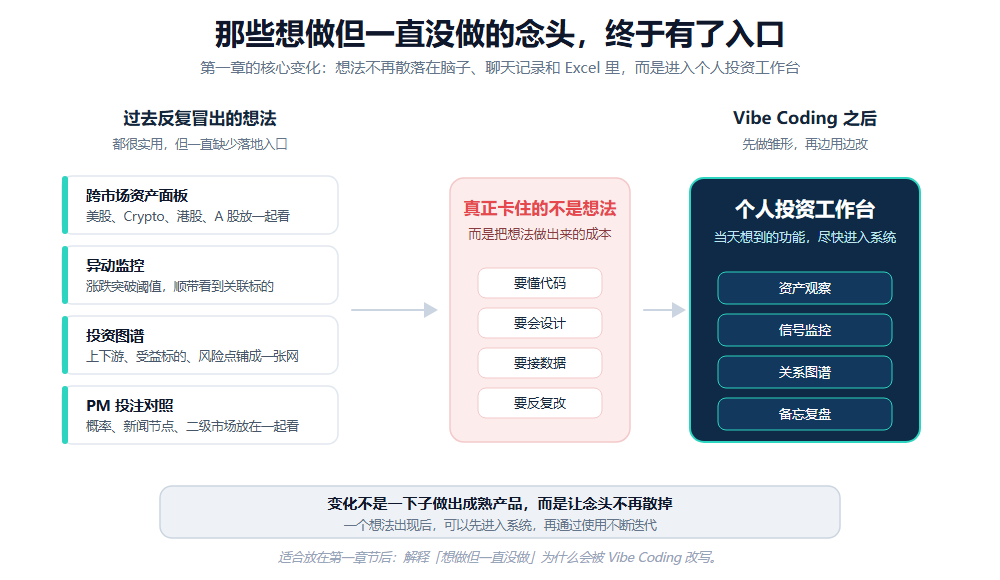
These things weren't impossible to do before, just too troublesome to sustain. The greatest significance of AI is that it removes a huge chunk of that "trouble."
You might not know how to write code, but you can describe the requirements and slowly build up your own product design. You don't need to finish it all at once. Release version one, and improve it as you use it.
This is what attracts me most to Vibe Coding: the feedback loop is incredibly fast. Before, the time between an idea popping into your head and it becoming a reality could be so long that you forgot why you wanted to do it in the first place.
Now, if I think of a feature today, I can try it the same day. If I'm not satisfied after trying it, I change it immediately. After using it for two days, a new need arises, and I iterate again.
This closed loop of "Idea -> Implementation -> Use -> Feedback -> Modification" – once it gets going, it really makes you unable to stop.
Final Thoughts
Consider this the first piece of writing for a new phase of "Tyler."
Going forward, I'll try to update regularly, documenting my investment thoughts, tool tests, on-chain operations, arbitrage research, as well as some educational/introductory Web3 practical tips and investment knowledge points.
Welcome to follow me, and feel free to exchange ideas anytime.