






SK海力士史上最賺錢的季度,為何仍「不如預期」?


- 核心觀點:SK海力士2026年第二季度創下歷史最高利潤,但營收與營業利潤均低於市場預期,導致股價劇烈波動。市場分歧在於如何重新定價其未來成長空間,多空雙方尚未達成共識。
- 關鍵要素:
- SK海力士第二季營收79.32兆韓元(年增257%),營業利潤60.54兆韓元(年增557%),利潤率76%,均創新高,但略低於市場預期。
- 股價在財報發布後先跌約9%,隨後收復跌幅轉漲,再跌超過9%,反映市場對AI存儲超級週期可持續性的分歧。
- HBM產品占比提升及長期協議定價機制,限制了傳統DRAM/NAND現貨漲價帶來的利潤彈性,導致業績「不如預期」。
- 公司預估2026年全球DRAM需求成長約20%中段、NAND需求成長較高的十位數百分比,管理層未釋放AI投資放緩訊號,仍看好長期成長。
- SK海力士已完成約10家客戶的長期供應協議,並計劃提前擴產(如M15X工廠、龍仁Fab),資本支出維持高檔,顯示對AI存儲需求的信心。
- 下一代HBM4已於第二季出貨,HBM4E已送樣,產品節奏領先,鞏固了在AI高端存儲市場的龍頭地位。
Original | Odaily Planet Daily (@OdailyChina)
Author: Azuma (@azuma_eth)
On July 29, Beijing time, SK Hynix released its Q2 2026 financial results.
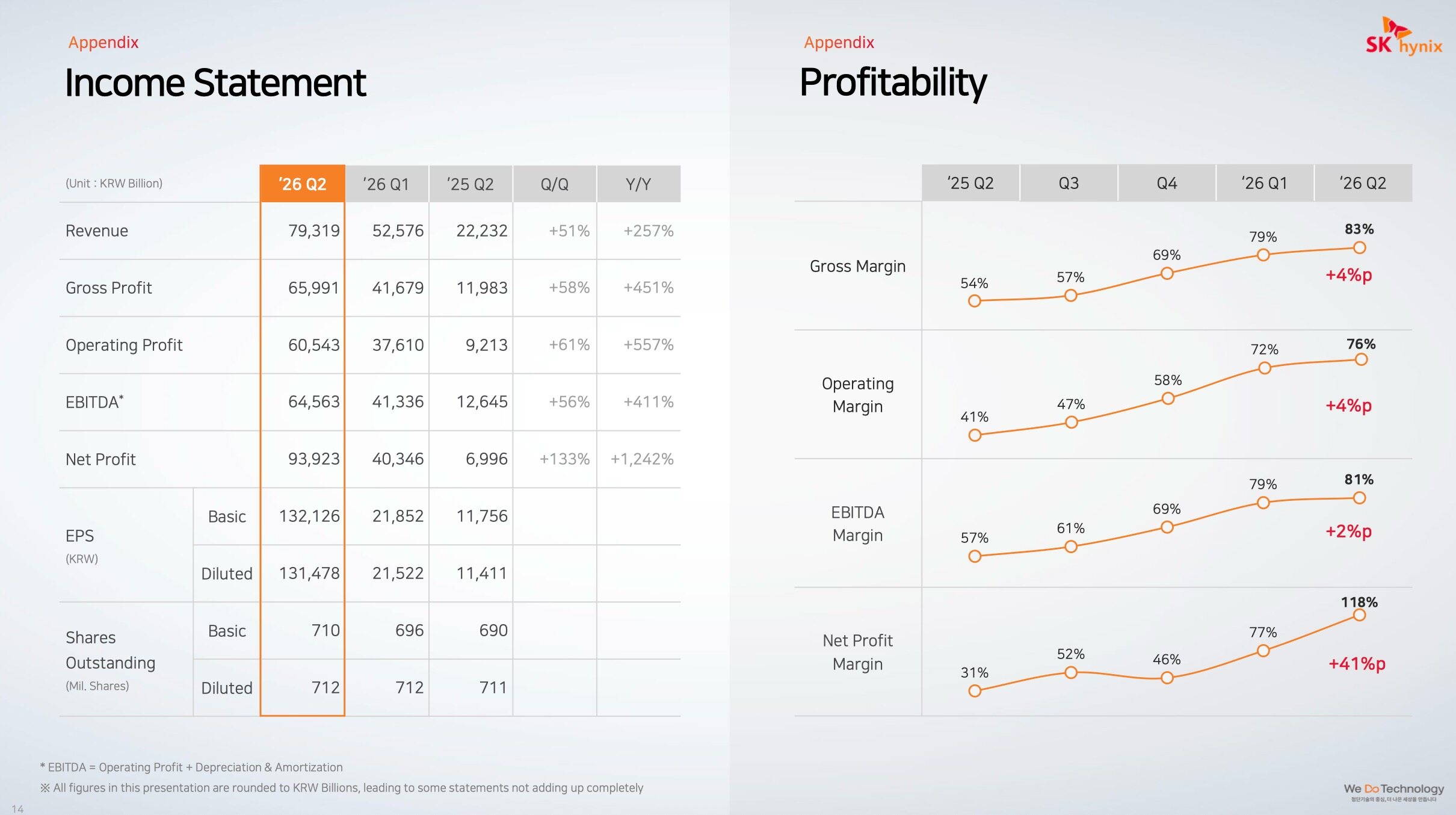
The financial data shows that SK Hynix achieved revenue of 79.32 trillion KRW in the second quarter, a year-over-year increase of 257% and a quarter-over-quarter increase of 51%; operating profit reached 60.54 trillion KRW, up 557% year-over-year and 61% quarter-over-quarter, with the operating profit margin further rising to 76%, hitting an all-time high; including the one-time investment gain of 62.166 trillion KRW from selling a portion of its stake in Kioxia, the company's net profit reached 93.92 trillion KRW.
In any industry, this would be a report card shocking enough to shake the market.
However, the market's initial reaction was the complete opposite. Since revenue (actual 79.32 trillion KRW vs. market expectation of 84 trillion KRW) and operating profit (actual 60.54 trillion KRW vs. market expectation of 64 trillion KRW) both slightly missed the market's previous expectations, coupled with SK Hynix's stock price having already dropped over 40% in the past month, pessimistic sentiment intertwined. After the earnings release, SK Hynix's US ADR (American Depositary Receipt) fell about 9% in after-hours trading (its US stock had already closed down nearly 9% the previous day). However, as investors gradually digested the earnings details, the stock price quickly recovered all losses and even turned positive.
Meanwhile, after the opening of the Korean stock market this morning, SK Hynix's stock price initially opened higher, rising as much as 4%, but then gradually weakened, falling over 9% again by 10:00 AM local time.
Why did a record-breaking earnings report first face a frantic sell-off, then quickly recover its losses, only to take a sharp downturn again? The answer may lie in the fact that what the market truly cares about is far more than how much SK Hynix earned in Q2; it's about how to reprice future growth potential—and the bulls and bears have clearly not yet reached a consensus on this.
The Most Profitable Quarter Ever, Yet Still Below Expectations?
Looking purely at the numbers, SK Hynix remains at the peak of its profitability.
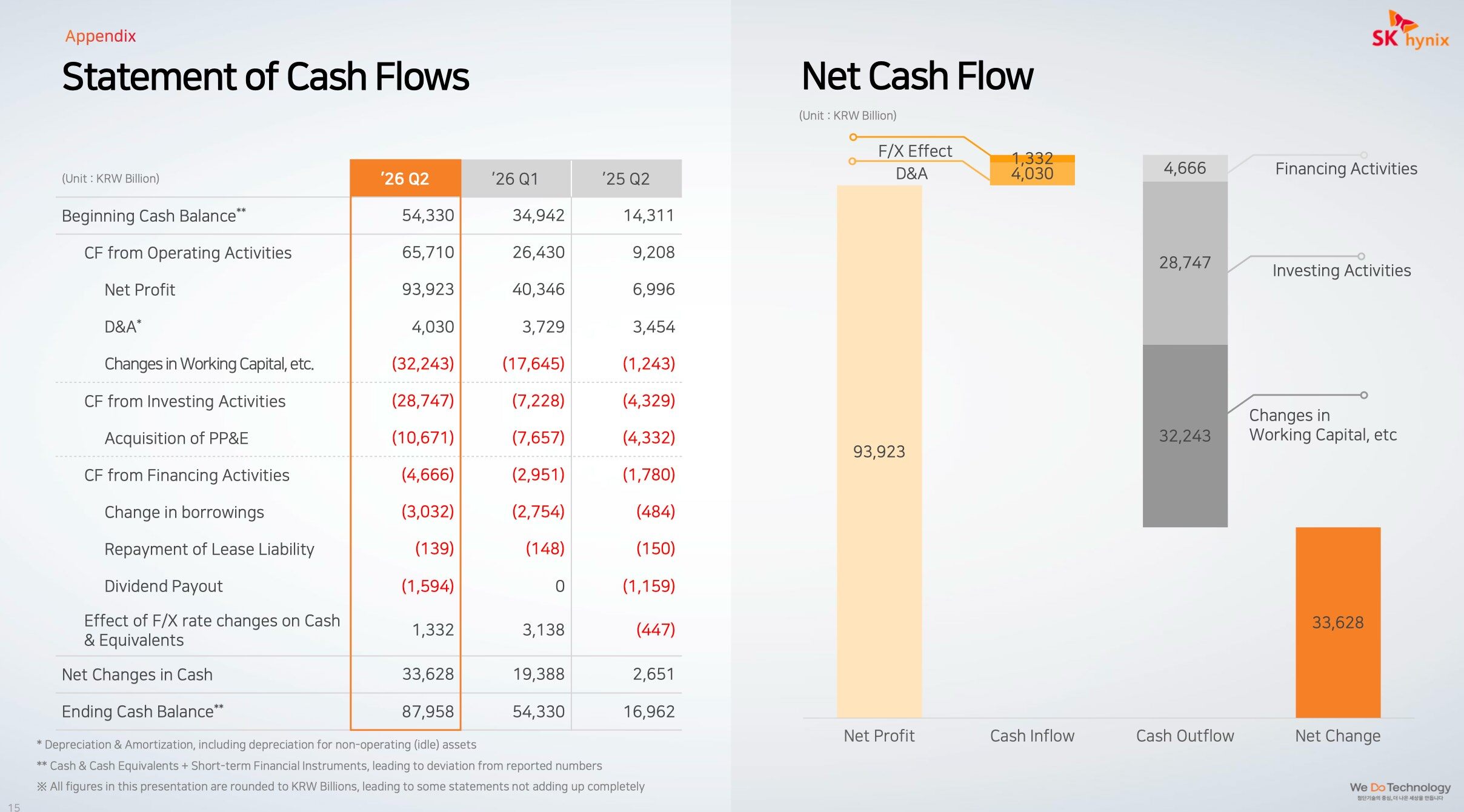
In the second quarter, the company's gross margin reached 83%, and the operating profit margin hit 76%. This means for every 100 KRW of products sold, about 76 KRW is converted into operating profit—a profitability level that surpasses even the vast majority of global semiconductor companies. Meanwhile, the company's cash and short-term financial assets continued to grow rapidly, reaching 87.96 trillion KRW. Its net cash position further expanded, providing ample ammunition for future capacity expansion.
But the problem is that the market had already raised expectations even higher. Prior to the release, the market consensus expected SK Hynix's Q2 revenue to be around 84 trillion KRW and operating profit around 64 trillion KRW. The final actual figures were about 5% and 6% lower than these expectations, respectively.
For an average company, such a deviation might not be significant. However, for SK Hynix, which has been labeled a "biggest beneficiary of AI" and whose valuation is built on high growth expectations, any data falling short of expectations is magnified by the market.
A closer look at the earnings report reveals that this "miss" actually stemmed more from a change in the profit structure than from a deterioration in market demand.
First, a somewhat counterintuitive point: the increasing share of HBM (High Bandwidth Memory) products has actually reduced profit elasticity. In past quarters, a key driver of the rapid profit expansion across the memory industry was the continuous rise in spot prices for traditional DRAM and NAND. However, because SK Hynix's HBM revenue share is significantly higher than its peers, and HBM pricing relies more on long-term supply agreements (LTAs), the company cannot fully capture the benefits of rapid spot price increases like it can with ordinary DRAM.
Additionally, SK Hynix disclosed that the average selling price (ASP) for ordinary DRAM in Q2 rose approximately 30% quarter-over-quarter. While still growing, this was a noticeable slowdown from Q1. The ASP for NAND rose 50%-55% quarter-over-quarter, also decelerating compared to the previous quarter.
In other words, AI products are selling more, but the price increases for traditional products are slowing down. Long-term contracts secure future revenue but also limit short-term profit elasticity. This explains why even record-breaking profits failed to meet the numbers the market had already "fantasized" about.
Is the Memory Supercycle Still Alive? How the Earnings Report Answers This
If the operational data answers how much money SK Hynix made in Q2, the information provided by management in the earnings report and subsequent conference call addresses another question the market cares about more—is the AI memory supercycle starting to cool down?
Based on the current information, SK Hynix's answer remains leaning towards the optimistic side.
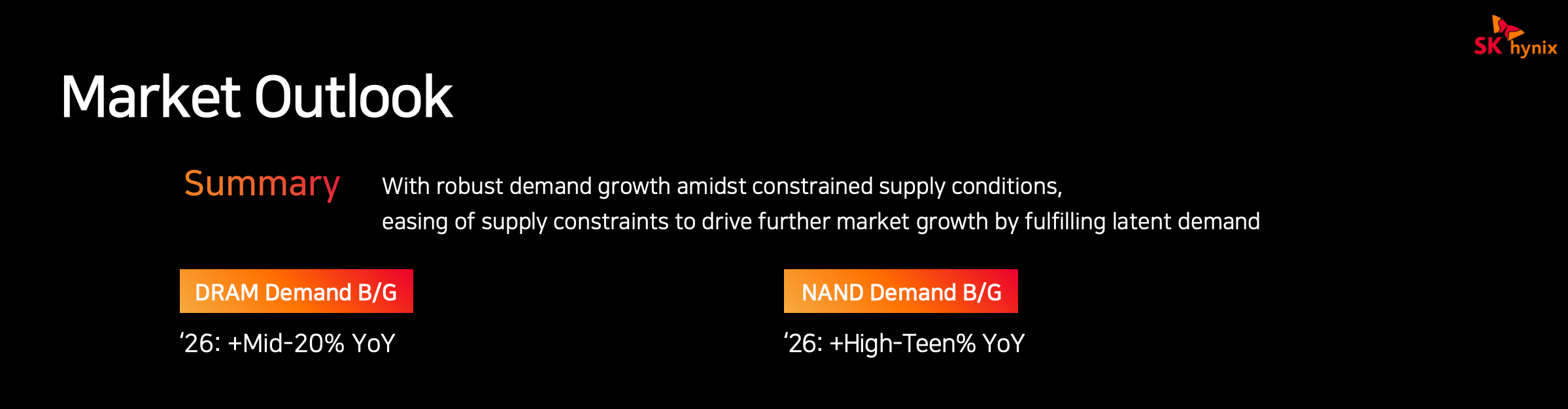
First, regarding the demand outlook, the company did not emit any significant cautionary signals as the market had feared. SK Hynix expects that global DRAM market demand will still grow year-over-year in the mid-20% range in 2026, while NAND market demand will grow by a high-teen percentage year-over-year. During the post-earnings conference call, management also stated that they have not yet observed signs of a slowdown in AI investment and expect AI infrastructure investments to maintain steady growth beyond 2027.

Second, another key point worth noting is the further progress of long-term supply agreements (LTAs). SK Hynix disclosed that the company has currently finalized LTA negotiations with approximately 10 customers and continues to engage in discussions with other major industry clients. The new generation of long-term agreements will adopt pricing mechanisms capable of handling price fluctuations and will be backed by corresponding financial mechanisms to ensure contract performance, thereby enhancing the stability and predictability of future demand.
For the memory industry, the significance of this change is considerable. In the past, products like DRAM and NAND relied more heavily on spot market pricing, and their sharp price volatility kept the entire industry labeled as "cyclical stocks." However, with the increasing proportion of HBM products in the AI era, more and more large cloud providers are locking in supply capacity years in advance. This is gradually shifting the supply-demand relationship from short-term speculation to a more long-term and stable cooperative partnership. While long-term agreements can compress profit elasticity during periods of rapid spot price increases (as seen this quarter), they offer higher revenue certainty for the coming years in return.
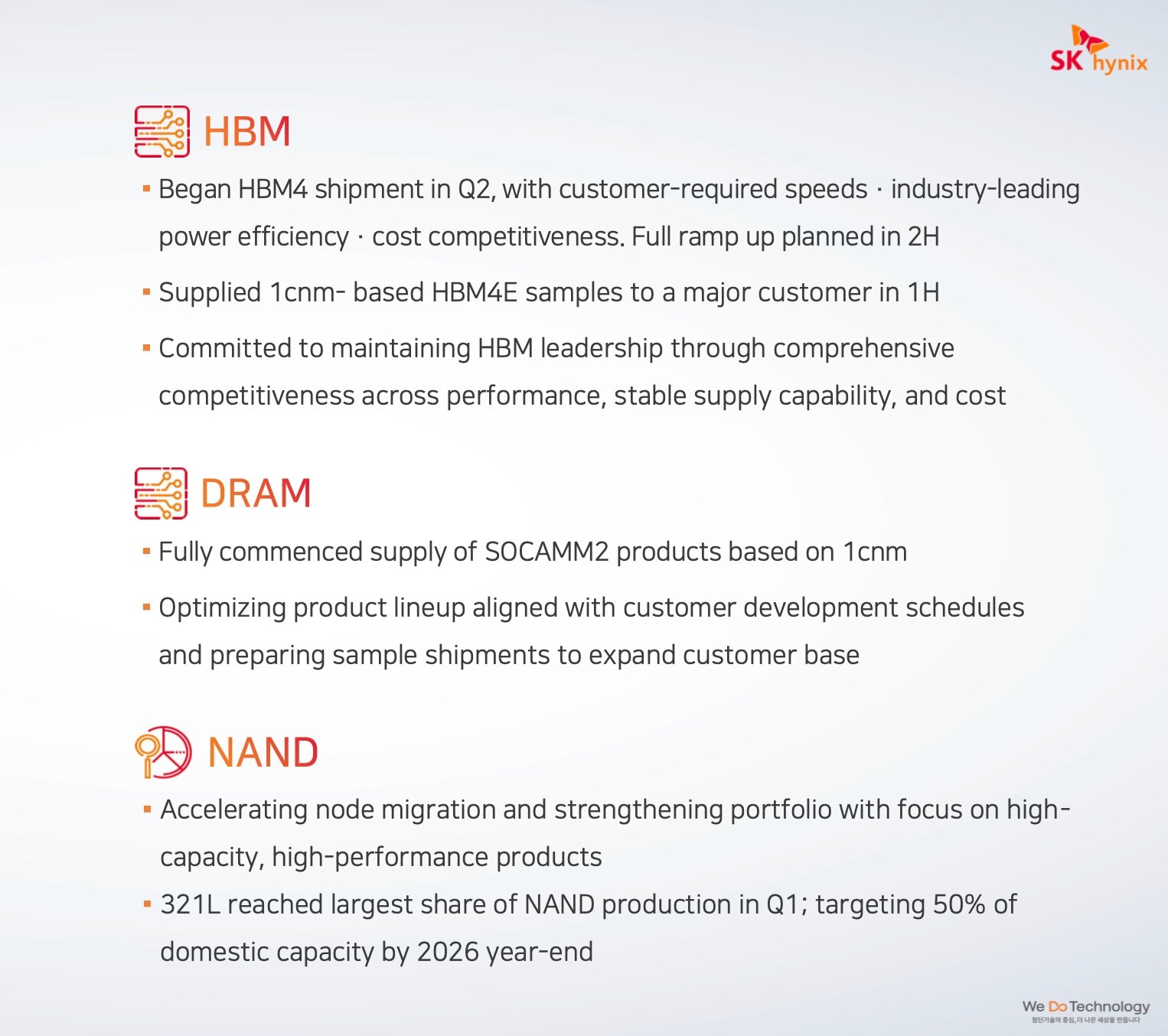
Furthermore, the rollout pace of SK Hynix's next-generation products also showed no surprises. The earnings report states that SK Hynix began shipping HBM4 products in the second quarter and plans to achieve full-scale volume production in the second half of the year. The next-generation HBM4E has already been sampled to key customers in the first half of the year. Additionally, the SOCAMM2 product based on the 1cnm process node has also started formal supply.
This means that SK Hynix maintains its leading product roadmap pace for next-generation AI GPU platforms. Considering that HBM4 will be a crucial companion memory for NVIDIA's next-gen AI platforms like Rubin, its smooth ramp-up also signifies that the company firmly holds its leading position in the high-end AI memory market.

Finally, in terms of capital expenditure (CapEx)—often the most accurate reflection of management's true judgment—SK Hynix not only maintained its 2026 CapEx guidance at the high end of the over 40 trillion KRW range but also plans to accelerate the mass production timeline for the M15X factory, speed up the construction of Phase 1 in Yongin, and continue advancing medium-to-long-term projects like P&T7, M17, and the new semiconductor cluster in South Korea.
For a company that has weathered multiple memory cycles, such an aggressive expansion plan is a statement in itself—management remains confident that the AI memory demand over the next few years will be sufficient to absorb this new capacity.
The Focus of the Bull-Bear Battle
Today, SK Hynix has become a core battleground for bulls and bears in the AI memory cycle.
For the bulls, record-breaking profits, continuously expanding HBM demand, and the AI infrastructure investment cycle still underpin the company's long-term growth story. For the bears, the lower-than-expected earnings, valuation pressures, and market concerns about the sustainability of AI capital expenditures are continuously amplifying short-term adjustment pressures. Bulls are betting on the continued expansion of AI infrastructure, while bears worry that the market has already over-anticipated future growth.
Heavy is the head that wears the crown. SK Hynix enjoys the valuation of an industry leader, but it must also bear the pressure that comes with it. When the market already believes your story, good performance is no longer enough. Only by continuously exceeding ever-higher expectations can the valuation continue to climb.





