Coding 的投注面板賺錢了,但 Polymarket 真不是個「套利」的好地方


- 核心觀點:Polymarket 並非適合套利的穩定收益工具,其二元市場結構存在尾部風險與數學期望陷阱。透過自建風控面板(T1/T2/T3 分層、主題簇曝險監控),核心價值在於紀律化風控而非收益統計,實測 30%+ 收益的可持續性依賴資訊差與倉位分散。
- 關鍵要素:
- 面板建構邏輯:透過「持倉儀表板」+「機會監控」兩個 Tab,實現 PM 即時數據抓取、Tier 檔位風控、主題簇曝險上限(12%)設置,以及異動彈窗提醒,減少情緒化下單。
- 數學期望陷阱:即使 q≥c(例如 q=90%,c=80%),但一旦判斷錯誤,虧損 100% 而非預期收益 12.5%;高確信投注的長期標的 IRR 可能僅 3-4%,鎖定本金錯失更高機會。
- T1/T2/T3 分層原則:T1(高確信)需控制長期倉位避免資金效率損耗;T2(有 edge)單注上限 8-10%,容忍錯誤;T3(高賠率)最小倉位搏反彈,累積盤感。
- 尾部風險量化:連續 10 個獨立 95% 勝率投注,至少錯一個的機率 ≈ 40%;現實中多市場(如中東主題)存在相關性,導致集體虧損風險。
- 實操建議:不當穩定收益工具,高勝率不等於好交易(需比較 q-c 差),避免偽分散(底層變數相同),將 PM 視為判斷力訓練場而非套利場。
A couple of days ago, I published an article titled "I Built an Investment Dashboard for Myself with AI," sharing a few tools I coded: a cross-market asset panel, an investment map, a personal content operation station, and a Polymarket betting monitoring panel that I've been using frequently recently.
Over the past two weeks or so, using a principal of about 1,600 USD, I achieved a return of over 30%. The real-time statistical data from the panel basically matched the actual final net profit, with a difference of only about 6 U, accounting for small discrepancies like pending orders/liquidity rewards.
But what I really want to convey in this article isn't exactly "Polymarket is great for making money," nor do I intend to package it as some kind of arbitrage tutorial.
On the contrary, after going through this round, I feel more and more strongly that Polymarket is not a suitable platform for charging in with an "arbitrage" mindset.
1. Let's First Talk About What This Panel Is
I started building this panel around May 21st.
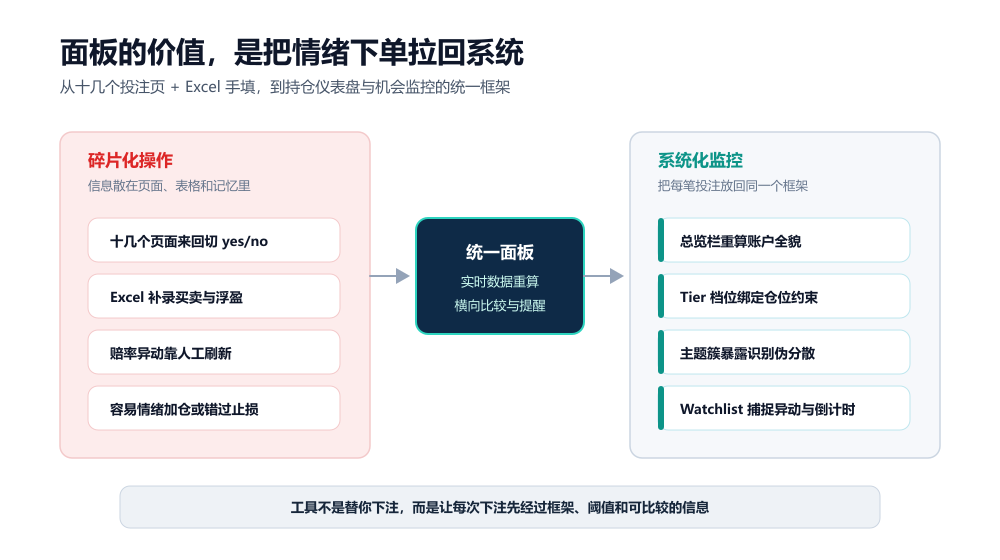
The initial need was simple: I didn't want to open a dozen betting pages repeatedly to check the fluctuating yes/no prices, nor did I want to manually record everything in Excel.
That's right, before this, I was using Excel to track buys, sells, unrealized gains/losses, settlement dates, and event types. Just a simple approach for a simple person.
But as anyone who has actually played knows, betting on Polymarket can easily spiral out of control precisely because manual recording is functionally very poor. For example, you might initially intend to bet just a small amount, but then the odds move, and you want to add more because there's no intuitive feel for it. Another scenario: a certain betting event suddenly fluctuates, but you don't update the spreadsheet in time, missing the window for a stop-loss or adding to the position. Cases like this, and so on.
Fundamentally, the whole process is too fragmented. Without a system, people easily place orders based on emotions.
So, from the very beginning of building this panel, my goal was to put every single bet into a unified framework, turning this feeling into a relatively visual and comparable information display.
After several iterations, I divided it into two tabs: "Position Dashboard" + "Opportunity Monitor."
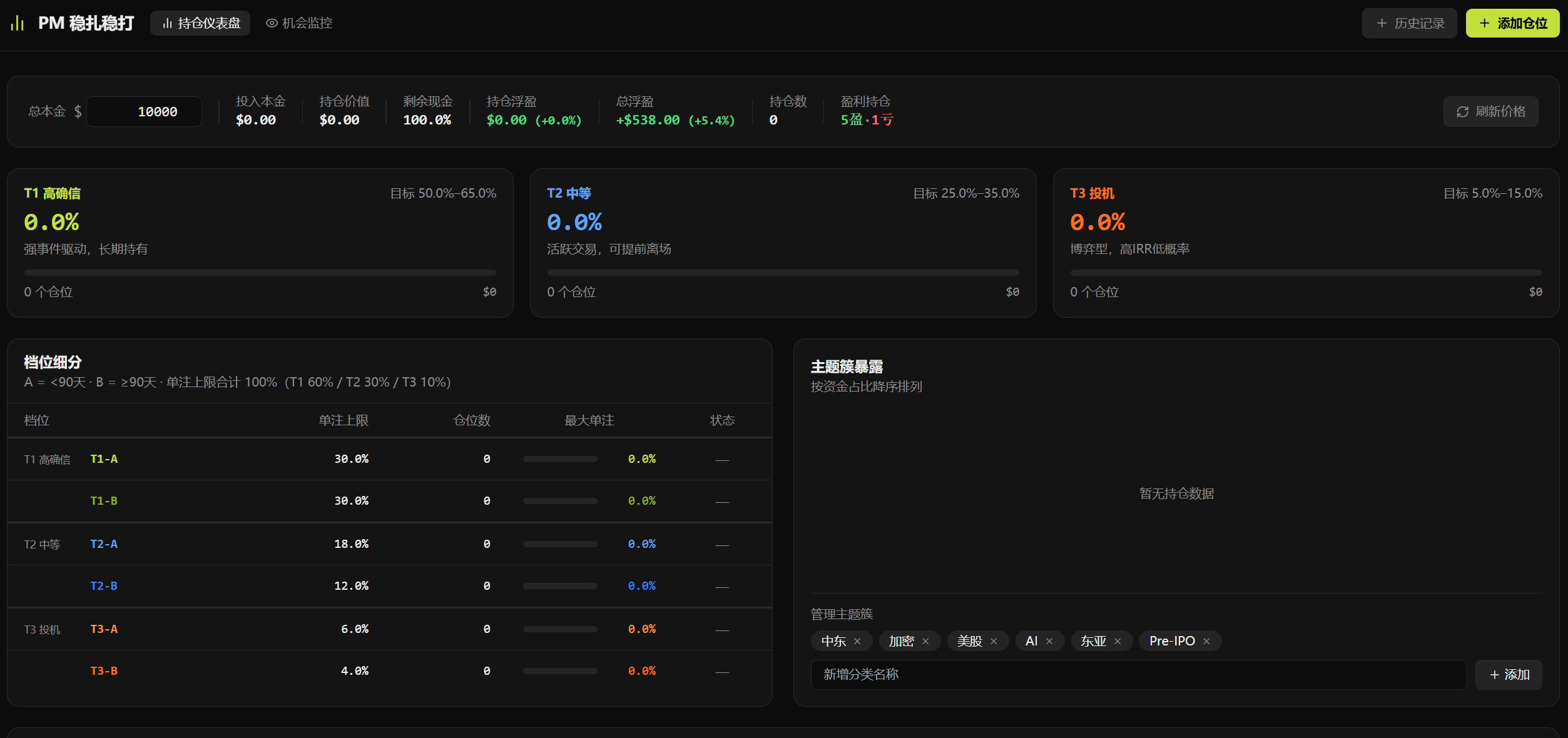
The "Position Dashboard," as the core of the panel, is a dynamic system that fetches real-time data from Polymarket and recalculates. It is divided into several functional areas (refer to the image at the beginning of the article):
- Overview Bar: Total Capital (planned, actual reference is limited), Invested Capital, Position Value, Position P&L, Total P&L (including closed positions), giving a clear snapshot of the entire account.
- Tier Allocation: This is the panel's core risk management module and, in my opinion, the most counterintuitive and crucial area. I'll hold off on the details for now, explained in the next section.
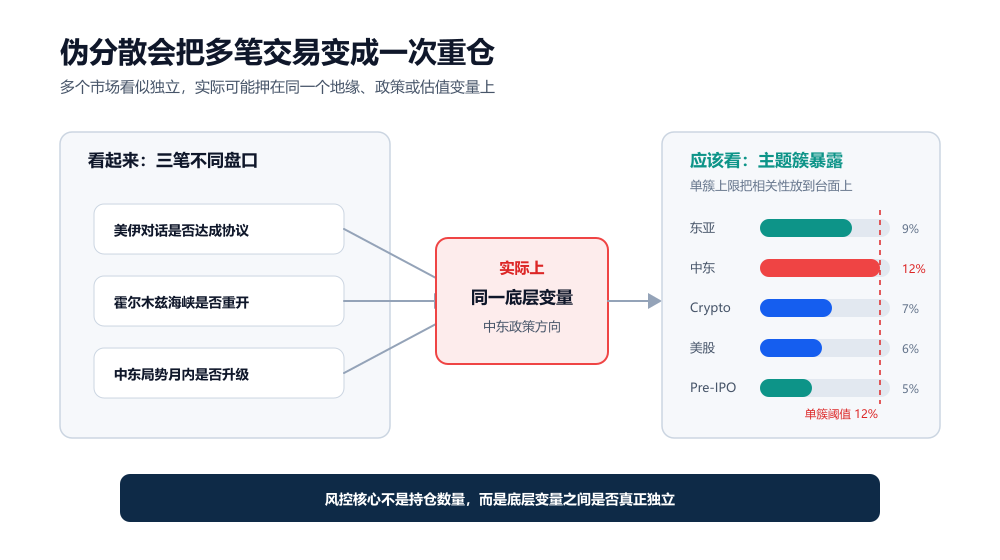
- Theme Cluster Exposure: I tagged each bet with a "Theme Cluster" label, dividing them into East Asia, Middle East, Crypto, US Stocks, Pre-IPO (customizable). The panel automatically sums up the percentage for each cluster and sets a 12% upper limit threshold per cluster. Why design it this way? Mainly to counter the most insidious trap on Polymarket – false diversification. More on this in the next chapter.
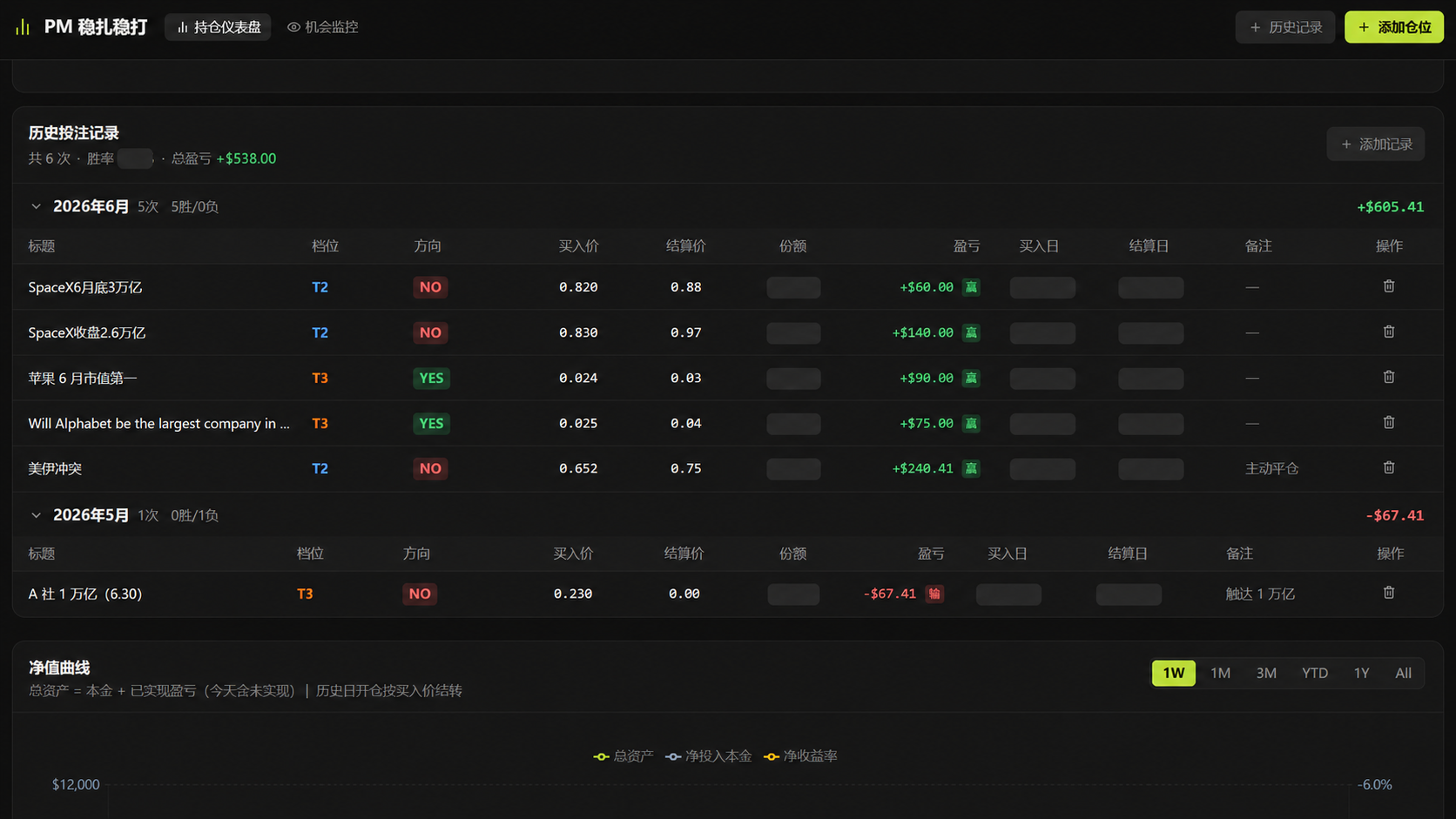
- Individual Position Details: Tier, Direction, Entry Price, Settlement Price, Shares, P&L, Entry Date, Settlement Date, Notes, etc. Each row is clear, with options for ascending/descending sorting and filtering by tags.
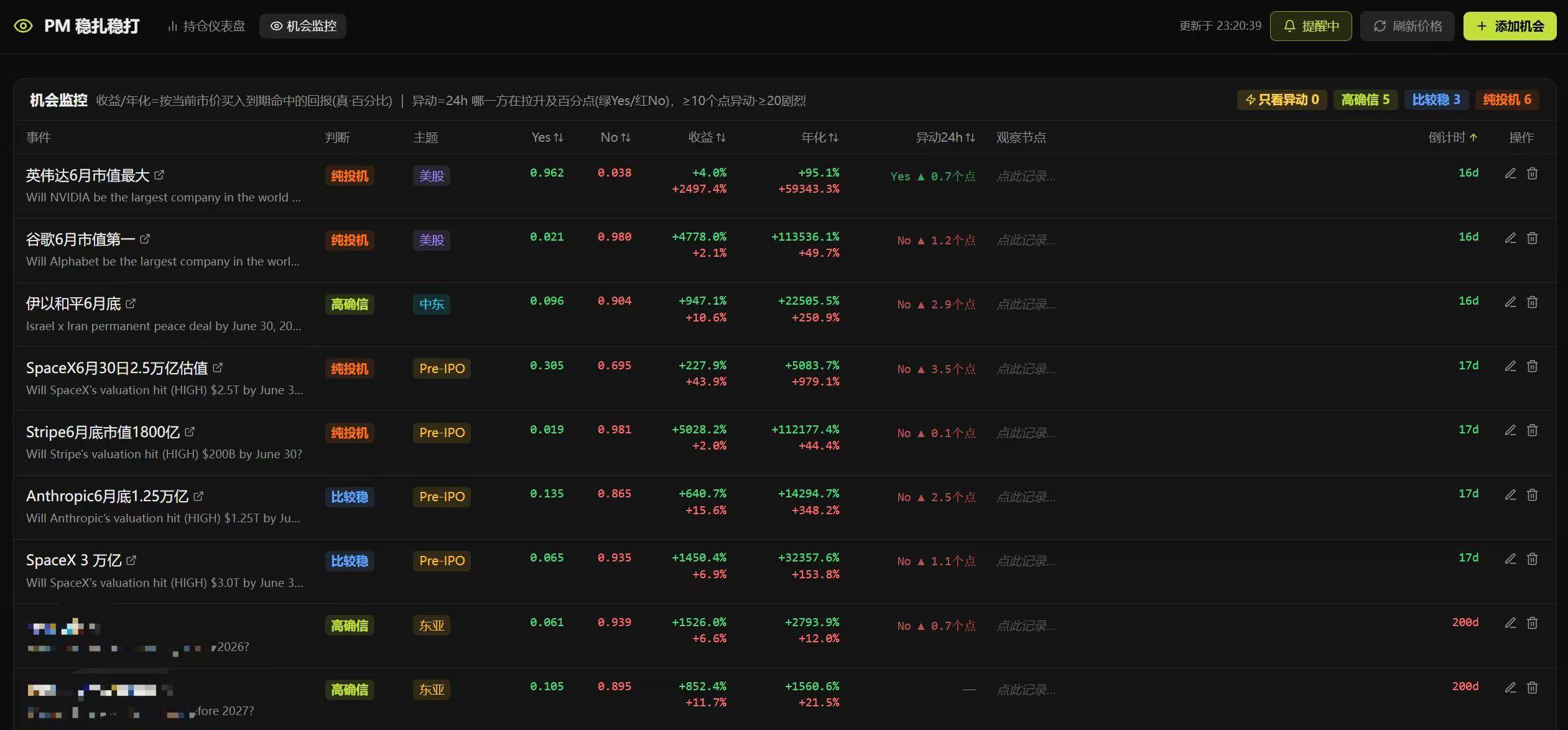
The "Opportunity Monitor" is a watchlist where I place markets I'm interested in but haven't bet on yet.
Each market records several key fields, including the event name (with a hyperlink directly to the trading page), T1/T2/T3 tier classification, current yes/no price, profit, annualized profit, anomaly detection (customizable threshold, e.g., if the price moves over 20% within 24 hours, a pop-up alert appears as long as the webpage is open), my set observation points, and a countdown to the bet's expiration.
I'm particularly satisfied with two small design details here. First, I found a suitable Polymarket API interface; by pasting the betting event's webpage link into the system for parsing, it automatically suggests yes/no options, corresponding prices, and the classification of different options under the same event, significantly reducing manual input effort. Second, the Tier classification for the same bet automatically re-calculates based on the remaining days.
Not long ago, before Anthropic released "Mython," there was a noticeable price anomaly in the watchlist, which could basically be judged as a high-probability deterministic event. Entering at that time would have yielded around a 10% return – opportunities like this are very hard to capture stably without a watchlist.
2. Polymarket's Expected Value Trap, and the "T1, T2, T3" Design Principle
The above is a brief introduction. What I really want to discuss is a thought I had after the practical testing.
In binary markets like Polymarket, there's a significant structural trap. It's unfavorable for players who like to "go all-in on one bet," but relatively suitable for diversified allocators who "open a supermarket and buy a bunch."
I'll try to articulate my thoughts clearly. If there are any errors or omissions, just pretend you didn't see them:
Suppose the yes price 'c' for a certain betting event is 0.80, meaning the market thinks there's roughly an 80% probability of the event occurring. If you judge the true probability 'q' of this event to be 0.90, then the expected return for this bet can be roughly calculated as:
EV = q / c - 1 = 0.90 / 0.80 - 1 = 12.5%
This looks good, but Polymarket isn't a bond. Behind this 12.5% lies a sharp tail risk: if your judgment is wrong, the loss isn't 12.5%, it's 100%.
So, in my panel, I don't just look at the "expected return." I also track two things simultaneously:
- One is the gap between my own probability judgment and the market price, which is q - c (I have an automatic take-profit alert target set at the midpoint between the entry price and 100). This is the core of whether an 'edge' truly exists.
- The other is the impact of this single position going to zero on the total account if the event goes wrong.
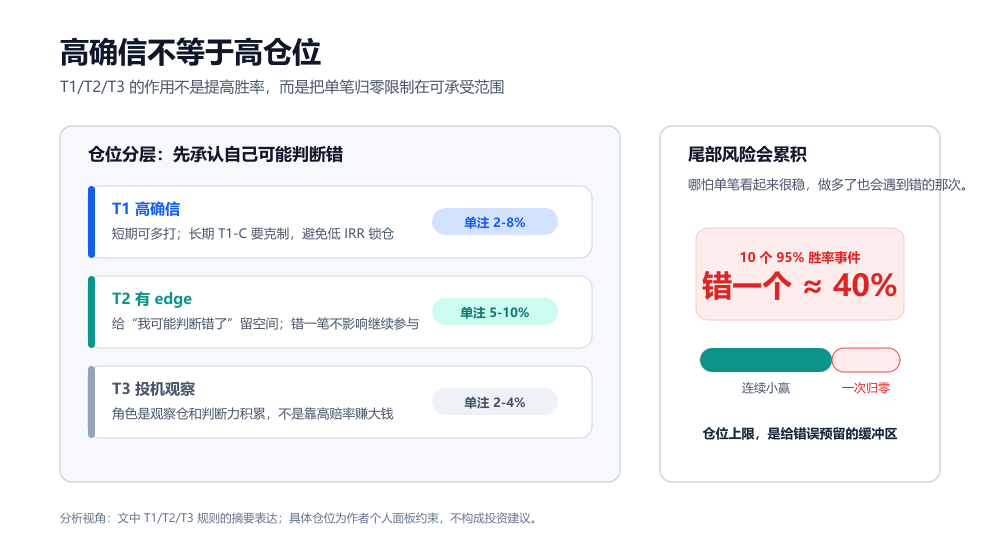
The second reason is also the origin of the T1, T2, T3 tier classification mentioned in the first chapter.
Simply put, I divided them into three categories:
- T1 High Conviction: For me, my comfort zone lies in areas related to East Asia and some geopolitical events where I believe there is an information asymmetry between East and West. I add them after repeated verification.
- T2 Relatively Stable: Events where I feel the current implied probability is significantly lower than the actual yes or no pricing.
- T3 Pure Speculation: Events with very high odds. These shouldn't be held for long; the best strategy is often to trade the contrarian move, betting on price reversion to capture short-term gains.
However, it's important to note that T1 has hidden costs, especially for long-term targets. For example, a T1 bet might have a static return of 18%, but if it settles after 180 days, the annualized IRR might only be 3-4%, which is worse than just holding cash. During this time, your principal is locked up, causing you to miss later opportunities with higher IRRs.
Therefore, within T1, I further break it down into time buckets (this is purely personal methodology, so I won't share the details; same for the rest). In short, short-term T1-A can be bet on more aggressively, while long-term T1-C requires restraint. Allocating too much to long-term, low-IRR bets is a hidden efficiency loss on capital.
T2 has an edge, but room must be left for "being wrong." I set a single bet limit of 8-10% of the total account. This means even if this bet loses entirely, the total account loss is controlled within 10%, allowing me to continue participating in subsequent opportunities.
T3 odds are attractive, but use minimal positions. Don't rely on it for big profits. Instead, use it to trade contrarian moves and capture short-term reversion – keeping yourself continuously tracking high-odds events to build a feel for this type of market.
Overall, the position size limit essentially creates affordable space for the possibility that "I might have misjudged."
Here's a very counterintuitive but crucial point: high conviction does not equal high position size. Even if you believe an event has a 95% probability of occurring, as long as there's a 5% chance of going to zero, the position size must be limited.
Consider an extreme example: suppose you make 10 consecutive bets, each with a self-assessed 95% win rate. Each one sounds very safe. But if they are independent of each other, the probability of at least one losing is roughly 1 - 0.95^10 ≈ 40%.
Do it enough times, and you will eventually encounter that loss.
And this is just with independent events. In reality, many Polymarket markets are not independent; they are often correlated. For example, "Will the US-Iran dialogue reach an agreement?", "Will the Strait of Hormuz reopen?", "Will the Middle East situation escalate within the month." These three bets look like three independent markets, but the underlying variable is almost the same – the direction of Middle East geopolitical policy. If you get this direction wrong, all three bets bleed simultaneously.
This is the biggest help the panel provides me: not to increase win rate, but to limit my ability to make big mistakes. In essence, the core value of this panel isn't profit statistics; it's risk management.
3. My Real View on Polymarket After This Round
After over two weeks of deep practical testing, my biggest takeaway is this: it's not that there are no opportunities on Polymarket, but it's definitely not the arbitrage playground many imagine it to be.
Previously, when we engaged in on-chain arbitrage, the rules were mostly clear, and price discrepancies could be locked in. But Polymarket is different; it heavily tests your logical understanding of the shifting winds around a specific bet (this feeling is hard to articulate precisely with words).
For example, regarding political and economic dynamics related to East Asia, Chinese-speaking users might indeed have a certain information asymmetry advantage. This is worth exploring, but it doesn't guarantee you'll win. Ultimately, Polymarket doesn't settle according to your perceived reality; it settles based on market rules and specified data sources (and UMA manipulation issues are not uncommon).
Furthermore, just because you think something is a done deal in the Chinese context doesn't mean the definition is the same under English rules. The rule set for each bet often contains subtle textual traps.
So, based on my actual experience, Polymarket doesn't have that many arbitrage opportunities. It mainly relies on information asymmetry and position diversification. Even high-conviction bets can encounter black swan events.
And when that happens, you lose your entire principal.
As a friend once said, "In investing, even if there's only a 1% probability of going to zero, you shouldn't entertain wishful thinking."
Because over the long run, the mathematical expectation of such a strategy is negative.
So, my understanding of Polymarket is now more conservative:
- First, don't treat it as a stable income tool. Even for high-conviction bets, especially after winning several times in a row, don't think you've found an ATM. The scariest thing about binary markets is they can make you believe you can predict everything after a winning streak, leading you to increase your final position size significantly, only to give back all your previous profits.
- Second, don't equate high win rate with good trades. If an event has a 90% win rate, but the market price is already 0.95, it might actually be a negative expectation trade. Conversely, an event with only a 40% win rate might have a positive expectation if the market price is only 0.20.
- Third, don't ignore tail risk. This is particularly important. Many people see a 10% or 20% return and think it's very safe. But if the loss on this trade is a complete loss of principal (going to zero), then it's not a low-risk return in the traditional sense (From this perspective, I even believe there are no so-called low-risk opportunities on Polymarket; every single one is high-risk).
- Fourth, avoid false diversification. Buying into multiple different markets doesn't automatically mean diversification. As mentioned earlier with the three bets "Will the US-Iran dialogue reach an agreement?", "Will the Strait of Hormuz reopen?", and "Will the Middle East situation escalate within the month," they look like three independent markets, but the underlying variable is virtually the same.
So now, I prefer to view Polymarket as a judgment training ground.
It perfectly complements the political, economic, tech, and financial news I, as a homebody, love to browse daily. It transforms those judgments that used to stay at the level of "I think so" into something tangible that can provide positive feedback.
These skills are useful beyond Polymarket as well.
By the way, in addition to this Polymarket betting panel, I also used Codex to build a private market valuation dynamic monitoring panel. It mainly tracks valuation changes of pre-IPO unicorn companies like Anthropic, OpenAI, Stripe, Kraken, etc., in the private market, and the relationship between these changes and the corresponding bets on Polymarket.
Essentially, Polymarket is a prediction market. Sometimes, signals in the private market are already changing, but the Polymarket price hasn't moved yet. Other times, the Polymarket price moves first, but the actual data hasn't caught up. The discrepancy between the two is definitely worth continuous observation.
Of course, this isn't risk-free arbitrage either. Private market valuations themselves aren't entirely transparent, and different data sources might vary. But as an observation framework, it's quite interesting. I'll look for an opportunity to write a dedicated article about it later.
Summary
The entire point of this article was never "I made 30% with my panel, and you can too."
What I find more valuable is being able to create a tool that helps you turn feelings into a framework, and that framework into discipline. Many times, making money doesn't mean you've found a secret formula; it just means your judgment happened to be correct in that particular round.
This distinction is crucial.
I also recommend everyone start trying Vibe Coding. You don't necessarily have to use Claude Code; you can start with Codex, or even Kimi's recently launched Kimi Work. If anyone finds it inconvenient to subscribe to overseas services, I can share some of the smooth methods I use in a future article.