






Data Deciphering BTC Cycles: Three Major Bottoming Signals Align, Q4 Could Be the Key Turning Point?


- Core Viewpoint: By analyzing historical cycles, on-chain data, and capital flows, this article suggests that despite BTC's price retracing over 52% from its June 2026 high of $126,000, current valuation indicators (such as MVRV Z-Score nearing its bottom), institutional accumulation, and easing macro risks (US-Iran ceasefire) imply the market may be in a cyclical bottoming zone, rather than a point for panicked exit.
- Key Elements:
- Historical Retracement Comparison: BTC's current maximum drawdown of ~52% is far lower than the bear market declines of 2014 (86%), 2018 (84%), and 2022 (77%), suggesting market fear may be disproportionate to fundamental risks.
- Halving Cycle Pattern: The 4th halving (April 2024) saw a peak approximately 18 months later in October 2025. Following historical patterns, a bottom could form around October 2026, aligning with the window for the 2028 halving.
- On-Chain Undervaluation Signals: The MVRV Z-Score has dropped to ~0.27 (near historical bottoms), the market price is only 9% above the global realized price (~$53,600), and it has touched the 200-week moving average (~$62,200) for the first time – all common characteristics of major historical bottoms.
- Capital Flow Divergence: While retail and ETF capital continue net outflows (totaling $4.4 billion from mid-May to early June), the number of whale addresses has hit a new high in 2026. Institutions like Strategy are adding positions, BTC exchange balances are declining, and long-term holders control a record-high 78% of the supply.
- Macro Risk Mitigation: A ceasefire agreement with Iran was reached on June 14th. Falling oil prices and fading expectations of Fed rate hikes fueled a single-day BTC surge of over 5%. Previously, high interest rates and geopolitical risks were the core factors suppressing the market.
Original | Odaily Planet Daily (@OdailyChina)
Author|jk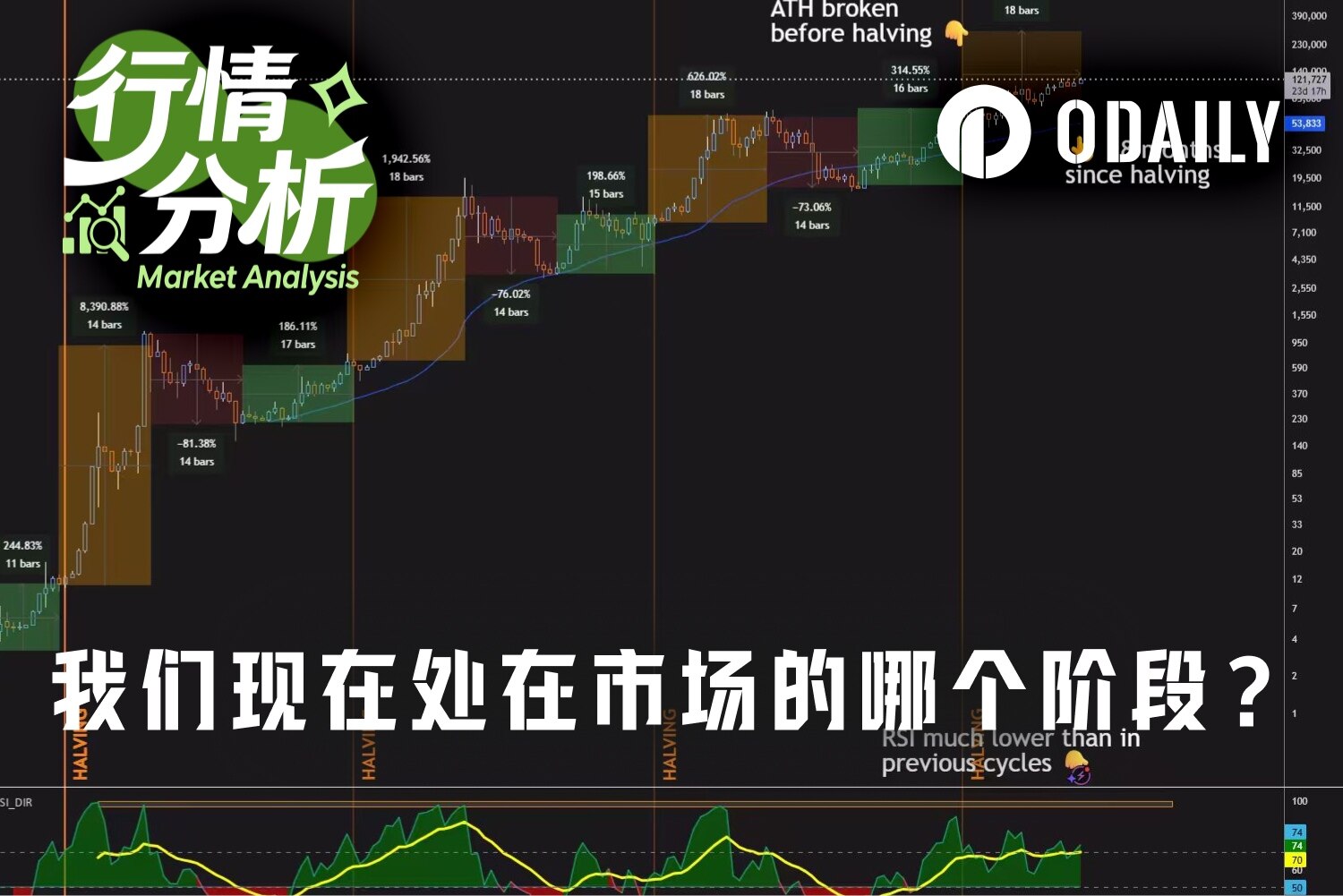
In October last year, the night BTC broke through $120,000, countless people screenshotted the chart and posted it on their social media, captioning it "Witnessing history." Just eight months later, the same people are staring at the $59,100 price, their captions changed to "Will it drop further?"
From the peak of $126,198 to the low of $59,100, BTC has retraced over 52%; in early June, the crypto market Fear & Greed Index plummeted to 8, its lowest level since 2022.
Entering now – is it brave bottom-fishing, or passively catching a falling knife?
In 2018, people said BTC would eventually go to zero; in 2022, they claimed the crypto industry was finished after the FTX collapse; by 2026, the narrative has shifted to "the four-year cycle is broken," "institutional entry only leads to selling pressure," and "risk assets have no hope in a high-interest-rate era." Every time, these narratives sound most indisputable when prices are at their lowest.
However, narratives are emotional; data is neutral. Only by separating the two can the current market position become clear. Let's take a look together: where exactly are we standing in the BTC cycle right now?
Where does a 52% decline stand in historical cycles?
On October 6, 2025, BTC hit its all-time high of $126,198. From that day to the intraday low of approximately $59,100 on June 5, 2026, this retracement peaked at over 52%.
A 52% drop sounds alarming, but compared to BTC's past three full bear markets, this figure is slightly below the historical median. The 2014 bear market saw an 86% peak-to-trough decline, 2018 saw 84%, and the 2022 decline from $69,000 to $15,479 was approximately 77%. The current cycle's maximum drawdown so far is about 52%, significantly milder than the previous three.
In other words, historically, prices have recovered after deeper falls. While this statement might be somewhat assertive in itself, from a market confidence perspective, the market's fear of the current price likely exceeds the actual risk corresponding to the fundamentals.
This is exactly why everyone says market confidence is more precious than gold.
Four Halvings, Three Almost Identical Curves
Understanding the current position is inseparable from the halving cycle framework.
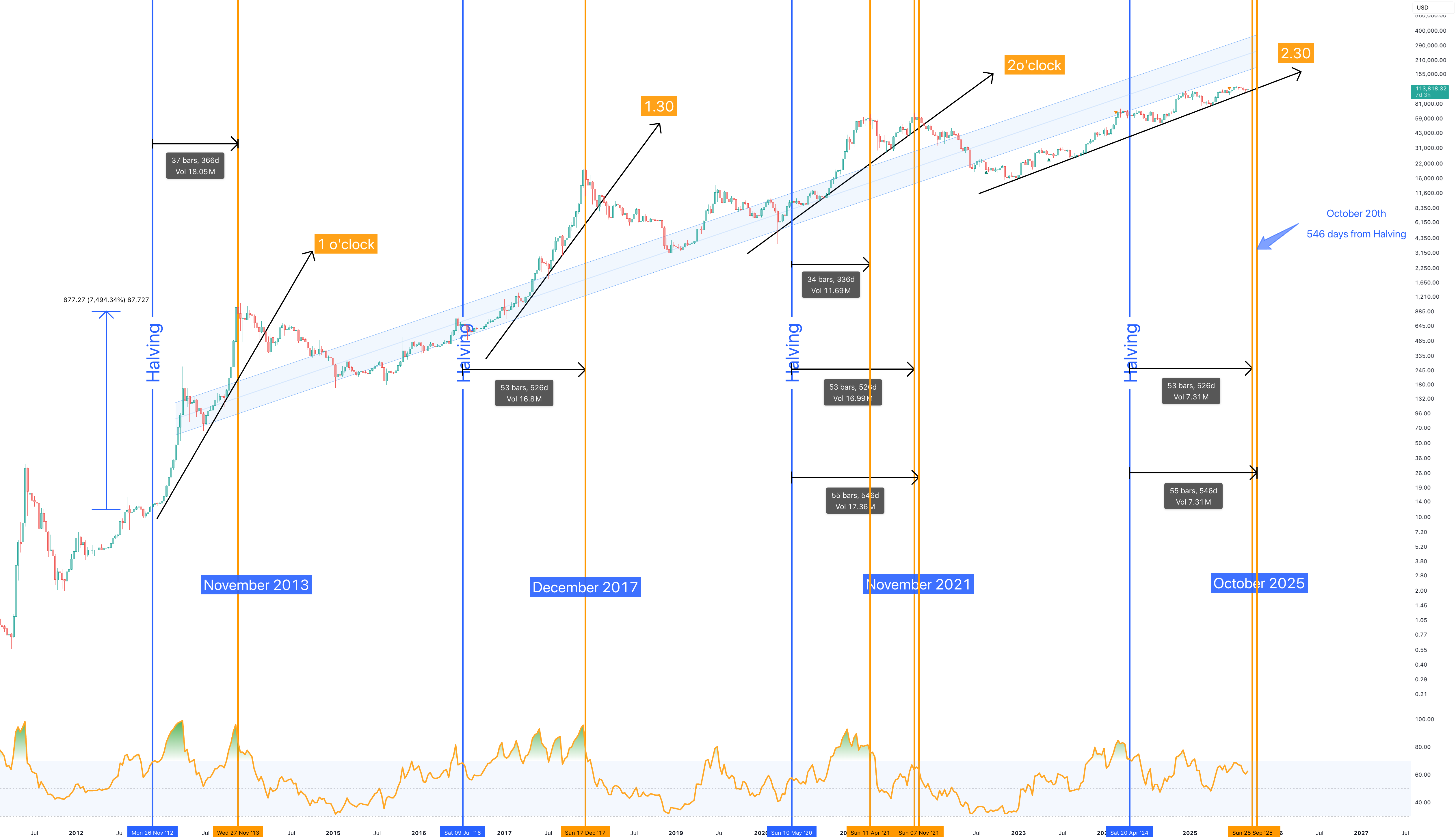
BTC halves approximately every four years, halving the block reward for miners and contracting new supply. Around these halvings, the past three cycles have exhibited highly similar bull-bear rhythms: peaking 12 to 18 months after the halving, bottoming 12 to 14 months after the peak, with the bottom typically occurring about 17 months before the next halving.
- First Cycle: The halving was in November 2012, when BTC was only $12. About 12 months later, in November 2013, the price peaked at $1,150. The subsequent bear market lasted about 13 months, bottoming around $160 in January 2015, which was about 18 months before the next halving (July 2016).
- Second Cycle: The halving was in July 2016, with BTC around $650. About 17 months later, in December 2017, the price peaked at $19,800. A roughly 12-month bear market followed, bottoming around $3,200 in December 2018, which was about 17 months before the next halving (May 2020).
- Third Cycle: The halving was in May 2020, with BTC around $8,600. About 18 months later, in November 2021, the price peaked at $69,000. A roughly 13-month bear market followed, bottoming around $15,500 during the FTX collapse in November 2022, which was about 17 months before the next halving (April 2024).
- Now is the fourth cycle. The halving occurred on April 19, 2024, reducing the block reward from 6.25 to 3.125 BTC, with the price around $63,000. About 18 months later, BTC peaked at $126,198 on October 6, 2025, perfectly falling within the historical "12 to 18 months to peak" window.
As of June 2026, it's about 26 months since the 2024 halving and about 8 months since the peak in October 2025. According to historical patterns, the bottom forms 12 to 14 months after the peak, suggesting that the bottom window might fall around October 2026, which would be roughly 17 months before the next halving (April 2028), aligning almost perfectly with the previous three cycles.
BTC Halving Timeline
From the current vantage point, the second half of 2026 looks more like a phase in this cycle worth reassessing risk-reward ratios, rather than a simple phase for panicked exits.
Supply contraction post-halving is ongoing, and the persistent buying pressure from spot ETFs and institutional funds has also changed BTC's market structure, which was previously solely driven by retail sentiment. If historical cycles continue to function, the area around Q4 2026 could be a key window for the market to transition from pessimism to recovery, from deleveraging to re-accumulation. For investors bullish on BTC's long-term value, a short-term correction might instead offer more attractive opportunities for phased accumulation. As the bottom zone gradually approaches, market confidence is likely to rebuild, and the foundation for the next upward cycle may be quietly forming during this phase.
On-Chain Data: Three Low Signals Flashing Simultaneously
Beyond price charts, on-chain data provides a more fundamental valuation reference.
- Indicator 1: MVRV Z-Score. This measures the deviation between the current market price and the average cost basis of all holders. Historically, a Z-Score above 7 indicated severe overvaluation, near the top; dropping to near 0 or negative corresponds to deep undervaluation zones. When BTC peaked in October 2025, the Z-Score was around 5 to 6. According to MacroMicro data from June 9, the current Z-Score is approximately 0.27, nearing the boundary of historical bottom zones.
- Indicator 2: Realized Price (Network-wide). This is the average cost basis of all circulating BTC, weighted by their last on-chain movement price. CryptoQuant Research Head Julio Moreno pointed out on June 10 that this figure is currently around $53,600. Based on the current market price of approximately $62,000, the market price is only about 9% above the network-wide cost basis. This premium is an extremely rare low-level signal in history. In the past three cycles, major bottoms formed near or slightly below the realized price. It briefly dipped below in November 2022.
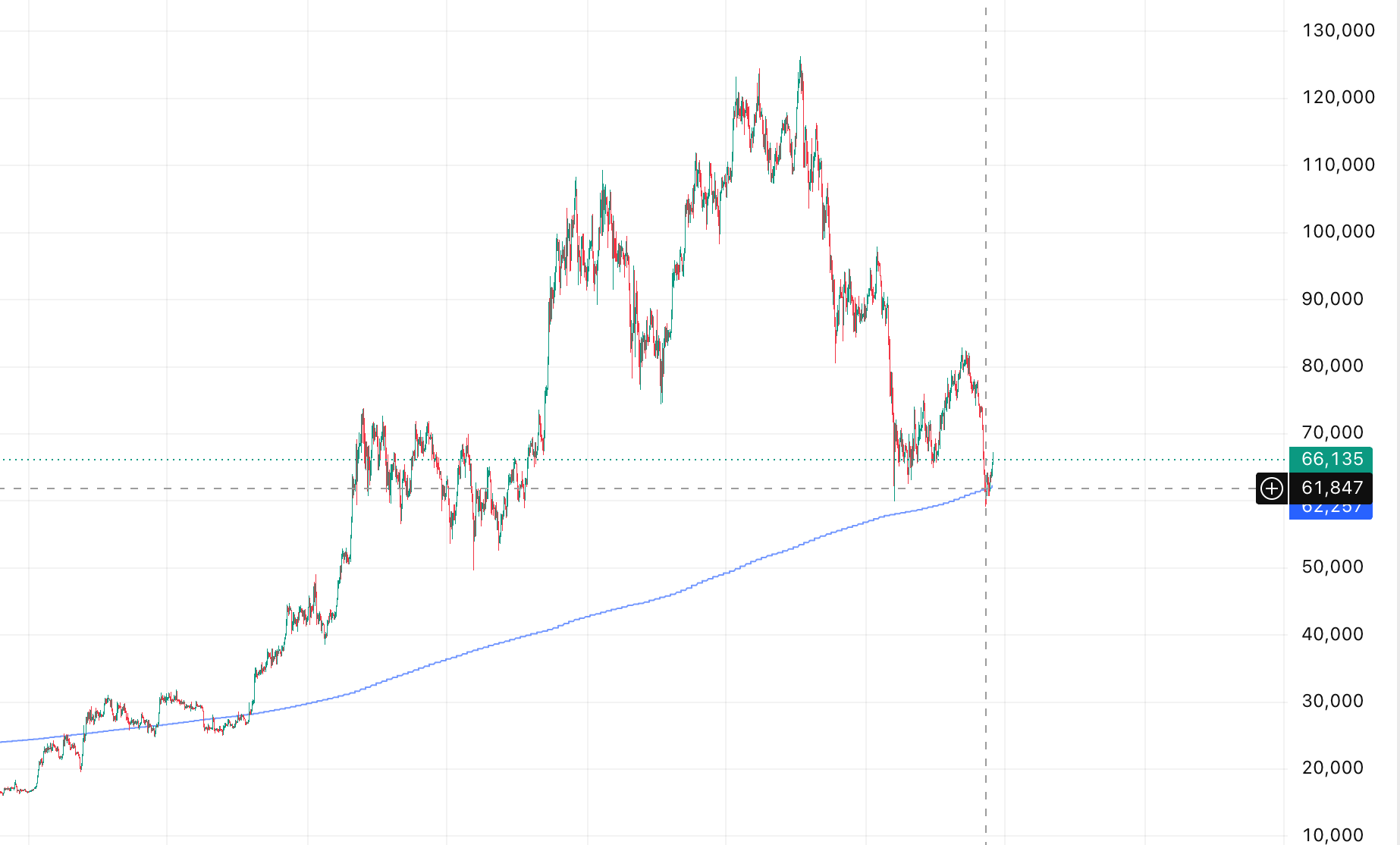
- Indicator 3: 200-Week Moving Average (200WMA). This represents the average price over the past nearly four years and is currently around $62,200. On June 4, 2026, BTC touched this line for the first time in the current cycle. The major bear market bottoms in 2015, 2018, and 2020 all occurred precisely near this line. 2022 was the only exception, where the price broke through the moving average and stayed below it for about 16 months, ending with the FTX collapse.
200-Week Moving Average Price. Source: TradingView
Capital Flow: Retail Exits, Whales Enter
Beyond the low-level valuation signals, the structure of capital flows also shows some bottoming characteristics.
At the ETF level, from mid-May to early June, US spot BTC ETFs saw net outflows for 13 consecutive trading days, totaling approximately $4.4 billion (equivalent to about 59,400 BTC), the longest continuous outflow streak since the ETFs launched. BlackRock's IBIT saw outflows of about $980 million in a single week, a historical worst. This reflects panicked redemptions from short-term capital and retail investors.
Concurrently, an opposing move appeared on-chain. The number of whale addresses holding 100 BTC or more hit a new all-time high in 2026, reaching approximately 20,229. Net whale buying volume in the first five months of 2026 was already equivalent to the total for the entire year of 2025. Strategy sold 32 BTC in late May to pay preferred stock dividends, its first sale in four years, sparking market concerns about a strategy shift. However, two weeks later, on June 8, the company bought 1,550 BTC at an average price of $65,332, increasing its total holdings to 845,256. Michael Saylor described this as “a good time to add positions.”
At the exchange level, BTC balances on major exchanges have been declining over the past few months, as tokens flow from exchanges to long-term holders and institutional cold wallets. Currently, long-term holders (holding for over 155 days) control approximately 78% of the circulating supply, one of the highest proportions in history.
Macro: The Biggest Uncertainty, Just Half Removed
The core macro logic suppressing BTC over the past few months mainly stems from two lines: high interest rates and the Iran conflict.
In early 2026, the US and Israel launched military strikes against Iran, leading to a partial blockade of the Strait of Hormuz. The IEA classified this as the largest supply disruption in global oil market history. International oil prices surged to $105-$120 per barrel. Inflation rebounded, with the US May CPI rising to 4.2%, far exceeding the 2% policy target. The federal funds rate was forced to remain unchanged in the 3.50% to 3.75% range. The market priced in roughly a 79% probability of "zero rate cuts" in 2026. The US Dollar Index subsequently strengthened to near 99-100. The dual pressure of high interest rates and risk aversion meant that despite ongoing global liquidity expansion, capital was slow to flow into the crypto market.
However, on the night of June 14, US President Trump announced that an agreement between the US and Iran had been completed. In the early hours of June 15, Iran's Supreme National Security Council issued a statement formally confirming a ceasefire memorandum of understanding. The official signing ceremony is scheduled for June 19 in Switzerland, and the Strait of Hormuz will subsequently reopen.
The market reaction was immediate and intense. WTI crude oil fell over 4% that day to around $80.25/barrel; Brent crude fell to around $83.51. BTC jumped from about $61,500 before the announcement to over $65,000, recording a single-day gain of over 5%, the largest one-day rebound in three months, accompanied by increased volume. Futures for the three major US stock indices surged over 300 points, and Asian stock markets rose in tandem.
After the agreement was reached, Deutsche Bank stated that it expected the risk of Fed rate hikes would subside in the short term. However, due to persistent inflation, labor market resilience, and the possibility that the neutral interest rate might be higher than expected, the possibility of rate hikes still exists in 2027. The specific situation for the Fed will depend on the debut of the new chair, Kevin Warsh.
Conclusion: It's a Bottom, but Also When Confidence is Most Lacking
When BTC stands above $120,000, everyone is willing to believe it can go higher; but when it falls back to around $60,000, and on-chain valuations, cycle positioning, long-term holder percentages, and macro variables are all pointing towards a bottom zone, that's precisely when the market lacks confidence the most.
But investing is never done when emotions feel most comfortable. Historically, every major BTC bottom has been accompanied by the skepticism of "this time is different," as well as complete doubt about the industry, the cycle, and the asset itself. The only difference is whether people use this doubt as a reason to exit or as an opportunity to re-price risk-reward.
Current BTC doesn't mean it can't fall further, and it doesn't mean this is *the* final bottom. But by extending the timeframe and separating short-term panic from long-term structure, the current zone is no longer suitable for being described as "chasing highs." It's closer to a phased accumulation window that requires patience, discipline, and conviction.
Market confidence is more precious than gold. Gold can only hedge against inflation, but confidence can transcend cycles. For those who still believe in BTC's long-term value, in scarcity, and in global liquidity eventually returning to risk assets, the most important question for the second half of 2026 might not be "will it drop further?" but rather "when the market starts to believe in it again, will you already be in position?"
What will you choose?


