自由现金流暴跌91%,Meta的AI豪赌有多贵?


- Quan điểm cốt lõi: Doanh thu quý II năm 2026 của Meta tăng trưởng mạnh nhờ quảng cáo AI, nhưng chịu ảnh hưởng từ các vụ kiện tụng, chi phí tái cơ cấu và chi phí đầu tư cho sức mạnh tính toán AI tăng vọt, lợi nhuận ròng giảm 14%, dòng tiền tự do giảm mạnh 91%, gây lo ngại trên thị trường về tỷ suất hoàn vốn đầu tư cho AI.
- Các yếu tố then chốt:
- Phân hóa doanh thu và lợi nhuận: Tổng doanh thu đạt 60,8 tỷ USD, tăng 28% so với cùng kỳ; lợi nhuận ròng đạt 15,848 tỷ USD, giảm 14% so với cùng kỳ, thu nhập trên mỗi cổ phiếu thấp hơn kỳ vọng của Phố Wall.
- Tăng trưởng mảng quảng cáo: Lượt hiển thị quảng cáo do AI thúc đẩy tăng 14% so với cùng kỳ, đơn giá trung bình tăng 12%, số người dùng hoạt động hàng ngày của toàn bộ hệ sinh thái ứng dụng đạt 3,6 tỷ.
- Lỗ của Reality Labs: Doanh thu đạt 431 triệu USD, lỗ hoạt động kinh doanh 4,62 tỷ USD, lũy kế lỗ kể từ năm 2021 khoảng 85,6 tỷ USD.
- Chi phí sức mạnh tính toán tăng vọt: Chi tiêu vốn đạt 31,08 tỷ USD, chi phí nghiên cứu và phát triển tăng 67% so với cùng kỳ lên 21,7 tỷ USD, dòng tiền tự do giảm mạnh từ 8,55 tỷ USD xuống còn 784 triệu USD.
- Gánh nặng chi phí một lần: 3,58 tỷ USD chi phí phi hoạt động, bao gồm 2,4 tỷ USD dự phòng cho các vụ kiện tụng pháp lý và 1,18 tỷ USD chi phí sa thải nhân viên.
- Lộ trình thương mại hóa AI: Lên kế hoạch sử dụng sức mạnh tính toán để huấn luyện các mô hình lớn, tối ưu hóa quảng cáo, phát triển các tác nhân cá nhân, và thử nghiệm thâm nhập thị trường dịch vụ doanh nghiệp thông qua dòng sản phẩm Mô hình Muse.
- Hướng dẫn tương lai thận trọng: Doanh thu quý III dự kiến ở mức trung bình 62,5 tỷ USD thấp hơn kỳ vọng, giới hạn dưới của hướng dẫn chi tiêu vốn cả năm được điều chỉnh tăng lên 130 tỷ USD, tốc độ tăng trưởng dự kiến chậm lại.
Original Author: Helen Li
Original Editor: Xu Qingyang
Original Source: Tencent Tech
Meta's revenue surged in Q2 thanks to AI-driven advertising, but profits took a hit due to litigation, layoffs, and rising computing costs.
On July 29, local US time, Facebook parent company Meta Platforms released its Q2 2026 financial report for the period ending June 30, after the US stock market closed.
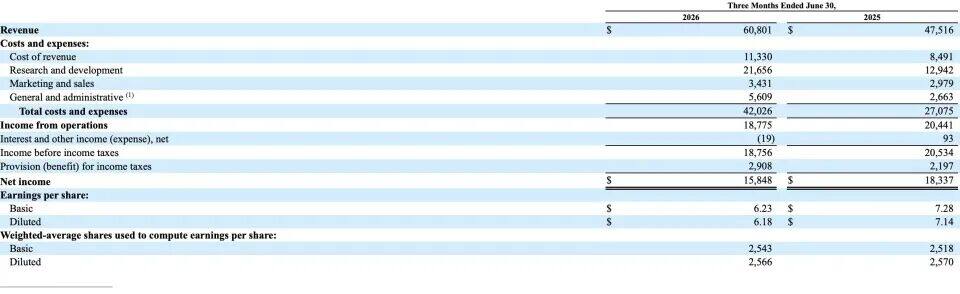
The report showed Meta's total quarterly revenue reached $60.801 billion, a 28% year-over-year increase. However, dragged down by one-time expenses including legal provisions, restructuring severance costs, and surging computing expenditures, net profit fell 14% year-over-year to $15.848 billion, with diluted earnings per share at $6.18.
Market sentiment quickly turned cold after Meta's earnings release. As earnings per share missed Wall Street expectations and the midpoint of Q3 revenue guidance was $62.5 billion, slightly below the average Wall Street estimate of $63.1 billion, Meta's stock fell over 6.37% in after-hours trading, dipping to $548.30. Before the report, Meta's stock had already declined for 10 consecutive trading days, losing about 13% of its market value since July 15.
As tech giants compete in the final stage of AI dominance, with open-source large models, agent ecosystems, and computing infrastructure development entering deep waters, Wall Street's scrutiny of "AI Return on Investment (ROI)" is becoming unprecedentedly direct and stringent.
The strong revenue growth juxtaposed with a cool market response reveals investors' deeper concerns beneath top-line growth: Can Meta's robust digital advertising base support the pressure from trillion-level computing expenditures and a sharp decline in free cash flow amid surging AI infrastructure investment?
AI Drives Ad Growth, Reality Labs Continues to Burn Cash
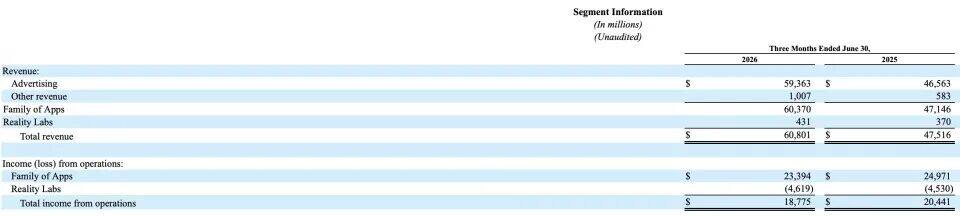
Looking at specific business segments, Meta's core operations this quarter showed a pattern of "strong ad revenue base supporting growth, while Reality Labs sees revenue recovery but expanding losses."
The "Family of Apps" division, Meta's core cash flow source encompassing social platforms like Facebook, Instagram, WhatsApp, and Threads, performed steadily. In June 2026, the Family of Apps' daily active people (DAP) averaged 3.60 billion, up 3% year-over-year. Notably, Instagram's daily active users officially surpassed the 2 billion mark in Q2, and Threads' monthly active users (MAU) reached 500 million.
Meta's advertising business in Q2 showed both volume and price growth: ad impressions increased 14% year-over-year, and the average price per ad rose 12% year-over-year. Regarding this performance, Meta founder and CEO Mark Zuckerberg stated in the earnings release: "AI is accelerating our core business today, driving our next-generation products, and opening up entirely new enterprise-level opportunities. The financial results are already beginning to show, and I'm optimistic about the potential ahead."
CNBC analysis suggests that despite macroeconomic uncertainties, the AI algorithm-driven ad targeting system (e.g., Advantage+) is continuously improving conversion efficiency, providing Meta with a stable cash flow foundation.
For the Reality Labs division, responsible for the metaverse and smart hardware, Q2 revenue was $431 million, higher than $370 million in the same period last year and exceeding analyst expectations of $423.4 million. The quarterly operating loss was $4.620 billion, widening from $4.53 billion a year ago but better than the analyst estimate of a $5.07 billion loss.
Since 2021, Reality Labs has accumulated approximately $85.6 billion in operating losses. The division's current focus is primarily on the Ray-Ban Meta smart glasses, developed in partnership with EssilorLuxottica. With new frame styles and AI features, Meta is attempting to position them as hardware terminals for personal AI assistants.
Computing Investment Surges, Meta's Free Cash Flow Plummets 91%
Analyzing the total costs and expenses of $42.026 billion in Q2 (up 55% year-over-year) reveals that the increase stems mainly from two drivers: rigid infrastructure investment and non-operating one-time expense provisions.
In terms of R&D and hardware construction, Meta's Q2 R&D expenses surged 67% year-over-year to $21.7 billion. Meta is accelerating its data center布局 globally.
Meta also announced a joint venture with BlackRock to build a data center in El Paso, Texas, with a total development cost of approximately $14 billion. The regional investment scale following the expansion of its Louisiana data center will exceed $50 billion. The company also plans to invest over CA$13 billion to build its first data center in Alberta, Canada.
Beyond computing costs, the Q2 income statement also included $3.58 billion in one-time non-operating expenses, the primary factor dragging down earnings per share. Of this, $2.40 billion relates to legal proceedings, stemming from regulatory scrutiny the company faces regarding youth social media use and mental health. The Wall Street Journal noted that multiple lawsuits are scheduled for trial in the US this year, potentially leading to further losses.
Another $1.18 billion was for severance costs related to the approximately 8,000-person restructuring initiated in May 2026. As of June 30, Meta's global workforce was 75,472, down 1% year-over-year.
Meta CFO Susan Li explained during the conference call that excluding the $2.4 billion legal provision and the $1.18 billion severance costs, Meta's Q2 operating profit would have achieved approximately 9% year-over-year growth, instead of the reported 8% decline.
However, the metric that most alarmed the capital market was the shrinking free cash flow. Quarterly operating cash flow was $31.86 billion, but after deducting a massive $31.08 billion in capital expenditures for the quarter, free cash flow fell from $8.55 billion in the same period last year to $784 million, an 91% year-over-year decline.
Ryan Lee, Senior Vice President of Products and Strategy at Direxion, noted in an interview that while Meta didn't slip into negative free cash flow, falling below $1 billion is still noteworthy, reflecting the company's immense current cash burn rate.
Zuckerberg Seeks New AI Exits: Personal Agents and Enterprise Services
In analysts' view, Meta's business model differs from competitors with cloud service systems. Microsoft has Azure, Google has Google Cloud, and Amazon has AWS, all enabling them to sell computing power directly to external enterprise customers via their cloud businesses. Meta lacks a large-scale native cloud business, so its AI capital expenditures rely mainly on revenue generated by its advertising business.
Consequently, Meta is attempting to adjust its AI layout and monetization strategy.
In early July, Meta launched the Muse Spark 1.1 model. This is a significant product following Meta's $14.3 billion investment and the appointment of Scale AI founder Alexandr Wang to lead the technical team in June 2025, focusing on agents and code generation with pricing lower than comparable products from OpenAI and Anthropic. However, the Muse Image feature introduced during this period drew criticism for generating images using public Instagram accounts and has since been suspended.
Regarding the subsequent application of its vast infrastructure, Zuckerberg outlined a clear vision for analysts during the earnings call. He explicitly stated that the vast majority of computing power the company acquires will be prioritized for training next-generation large models, optimizing core advertising business drivers, and delivering personal AI agents and new products to users. Simultaneously, the company also expects to build the capability to serve large enterprise clients.
Just a day before the earnings release, Zuckerberg also published an op-ed in the Wall Street Journal and gave an exclusive interview. Zuckerberg clearly stated that powerful AI tools should be widely accessible and benefit the entire society. He opposed monopolizing AI power in the hands of a few closed-source institutions and reiterated Meta's core vision of delivering "personal superintelligence" to every ordinary user, thereby seeking broader technological and commercial justification for its high capital expenditures.
Capital Expenditure Guidance Raised, Q3 Growth Slows
Regarding future performance outlook, Meta provided cautious financial guidance, which was a primary reason for the after-hours stock pressure.
For Q3 2026, the company expects total revenue to be between $61.0 billion and $64.0 billion (assuming a roughly 1% negative currency impact). The midpoint of this guidance is $62.5 billion, below the average analyst estimate of $63.15 billion to $63.24 billion. Some foreign media analysis indicates that this implies Q3 revenue growth will decelerate from Q2's 28% to a range of 19% to 25%, sparking market concerns over slowing ad revenue growth and the AI return realization cycle.
In terms of expenditure guidance, Meta further raised its investment floor. The company adjusted its full-year 2026 capital expenditure guidance range from the previous $125 billion to $145 billion to $130 billion to $145 billion, raising the lower bound by $5 billion.
Considering the $2.4 billion in legal costs recognized in Q2, the lower bound for full-year total expense guidance was raised to $165 billion to $169 billion. The estimated effective tax rate for the second half of the year is 15% to 17%. However, the company clearly stated it still expects operating income for this year to exceed 2025 levels.
Meta's Q2 earnings report reflects the reality the company faces during its AI transformation: its core advertising business foundation remains solid, providing cash flow for frontier exploration. However, on the other hand, the extremely high capital threshold for AI infrastructure like data centers and GPU procurement significantly squeezes free cash flow, and one-time legal and restructuring costs depressed current profits.
For the capital market and investors, the key to observing Meta going forward lies in whether its hundreds of billions of dollars in annual hardware infrastructure investment can be utilized through the Muse series of large models to penetrate enterprise services, achieve high-priced computing power leasing, and quickly transform into commercializable output.
During the Q2 earnings call, Zuckerberg emphasized that while earnings per share fell short of expectations due to legal expenses and significant investments in AI computing and talent this quarter, the company's revenue surged 28% year-over-year to $60.8 billion, demonstrating strong underlying business vitality.
Zuckerberg stated that AI technology has fully accelerated its core advertising and recommendation algorithm systems and driven the implementation of new product lines such as personal and enterprise AI agents. Addressing market concerns over rising capital expenditures, he reiterated that Meta's goal is to "put superintelligence directly into everyone's hands" and emphasized that in the context of AI computing shortages, the full-stack self-development and forward-looking infrastructure construction plan will create irreplaceable long-term competitive advantages and high returns for the company.
Special compilation by Wu Ji contributed to this article.