






Bề mặt chịu áp lực, nền tảng tích lũy, Bitcoin đang ở giai đoạn đầu của quá trình tạo đáy?


- Quan điểm cốt lõi: Sau khi Bitcoin giảm xuống dưới 60.000 USD, những người nắm giữ dài hạn và người mua kiên nhẫn đang bắt đầu hấp thụ dần áp lực bán. Dữ liệu on-chain cho thấy thị trường đang chuyển từ giai đoạn phân phối sang giai đoạn tích lũy, nhưng dòng vốn tổ chức chảy ra và các vị thế đòn bẩy cao trên thị trường phái sinh vẫn ám chỉ rằng có thể cần một đợt bán tháo hoảng loạn cuối cùng trong ngắn hạn để xác lập đáy.
- Các yếu tố chính:
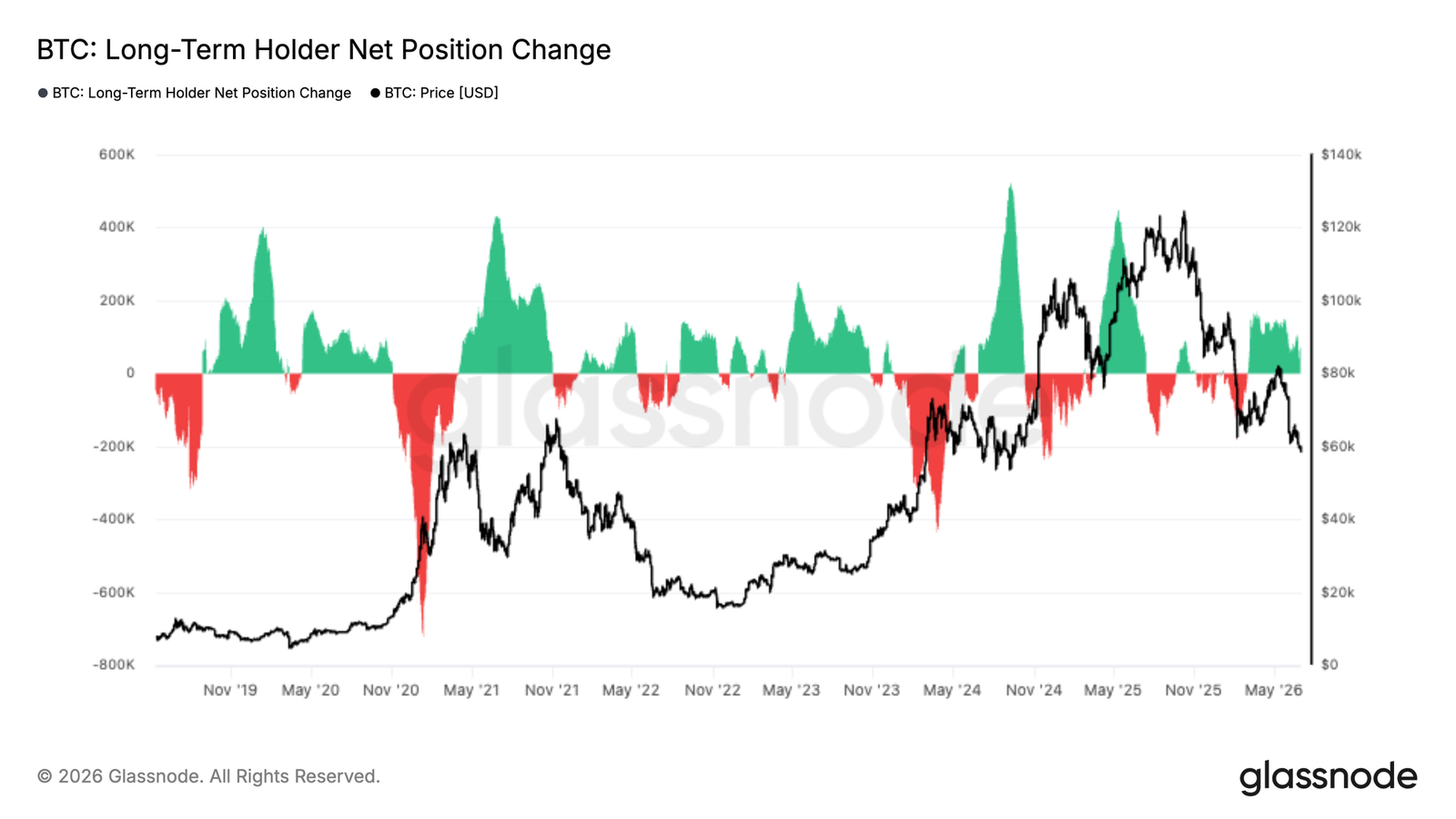
- Sự thay đổi vị thế của người nắm giữ dài hạn chuyển sang tích cực, bắt đầu tái xây dựng vị thế khi giá giảm về mức 60.000 USD, đánh dấu hành vi của họ chuyển từ phân phối sang tích lũy.
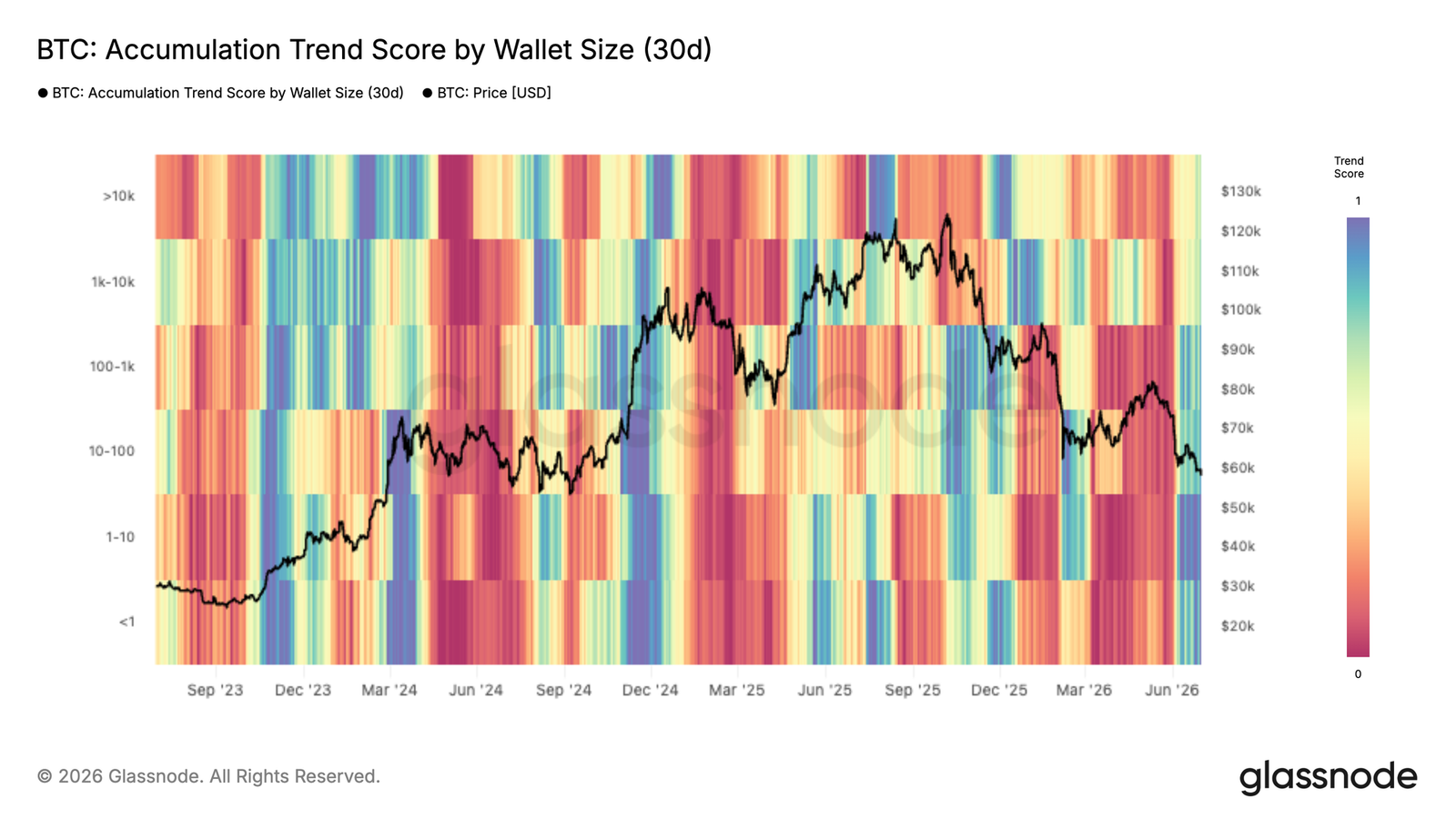
- Nhiều nhóm ví (đặc biệt là người nắm giữ nhỏ lẻ và các thực thể nắm giữ 100-1000 BTC) tích lũy rộng rãi, điểm số xu hướng tích lũy tăng đáng kể, cho thấy sự điều chỉnh đang thu hút nhu cầu mới.
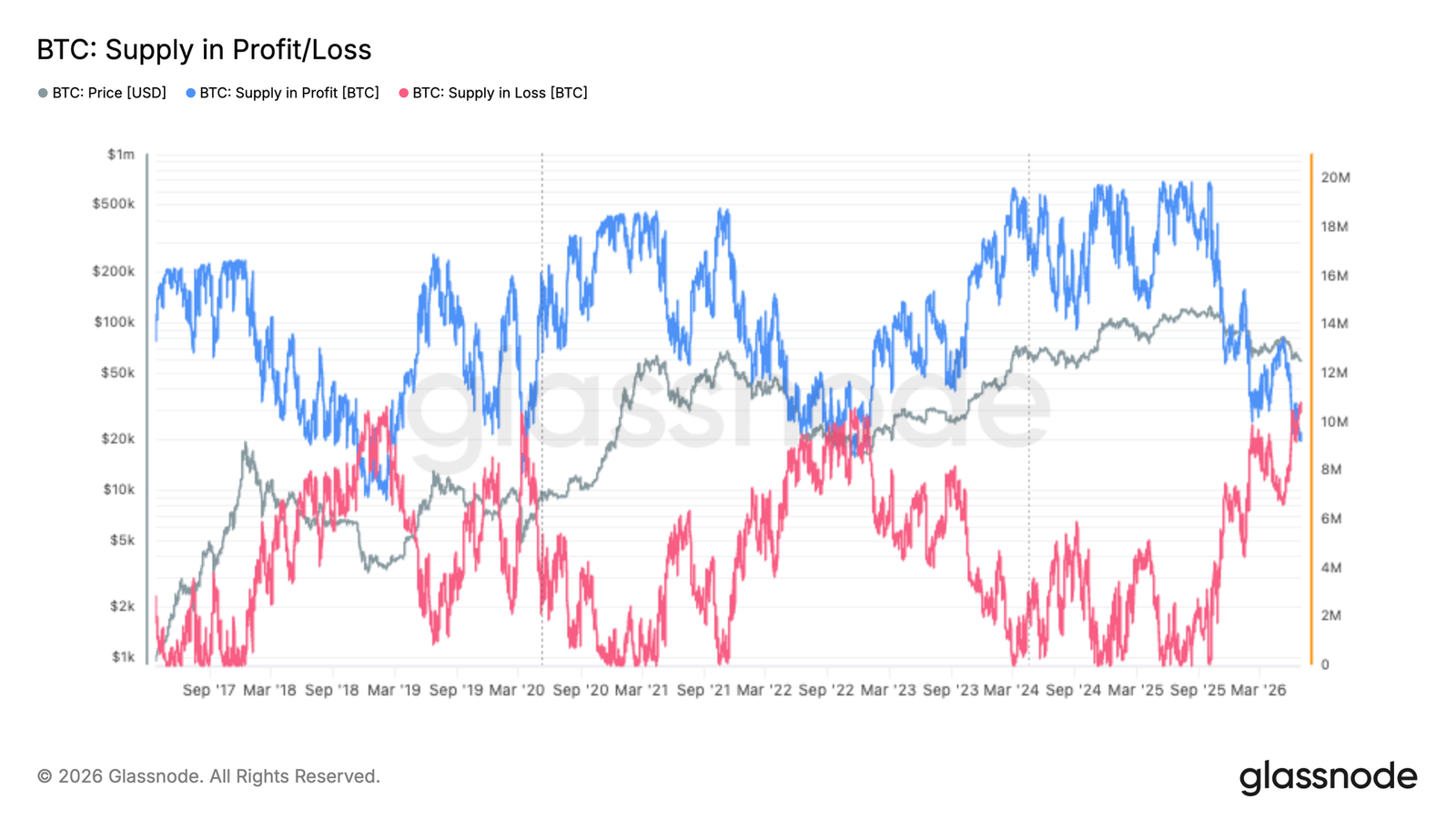
- Hiện tại, khoảng 10,83 triệu Bitcoin đang trong trạng thái thua lỗ, vượt qua 9,22 triệu Bitcoin đang có lãi, cho thấy thị trường đang ở giai đoạn áp lực tài chính cao độ và sự dịch chuyển chip sang tay những người nắm giữ có niềm tin cao.
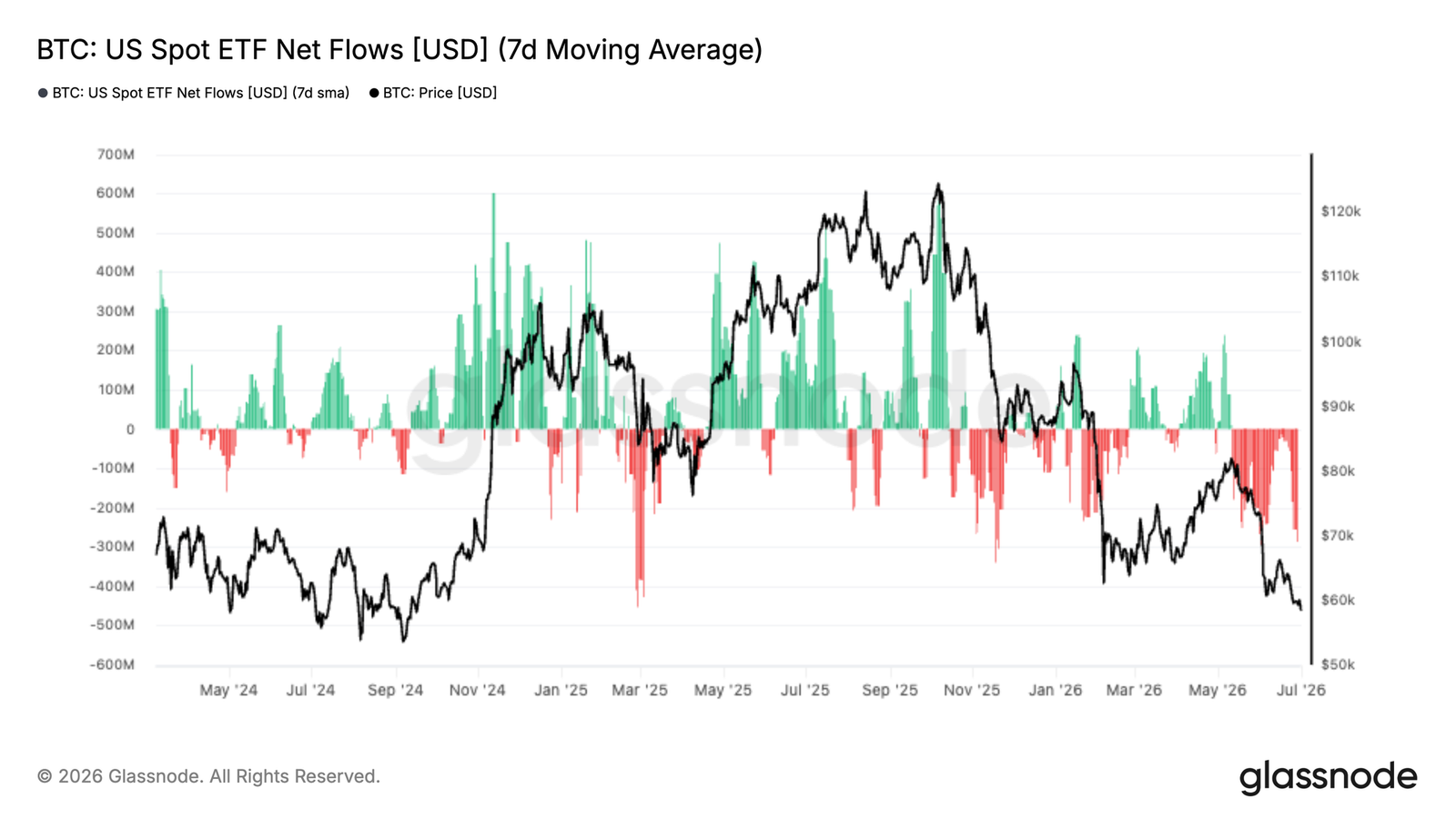
- Dòng vốn ròng trung bình 7 ngày của các quỹ ETF Bitcoin giao ngay tại Hoa Kỳ tiếp tục giảm sâu, các tổ chức vẫn giữ thái độ phòng thủ, tạo ra sự phân hóa với hoạt động tích lũy trên chuỗi.
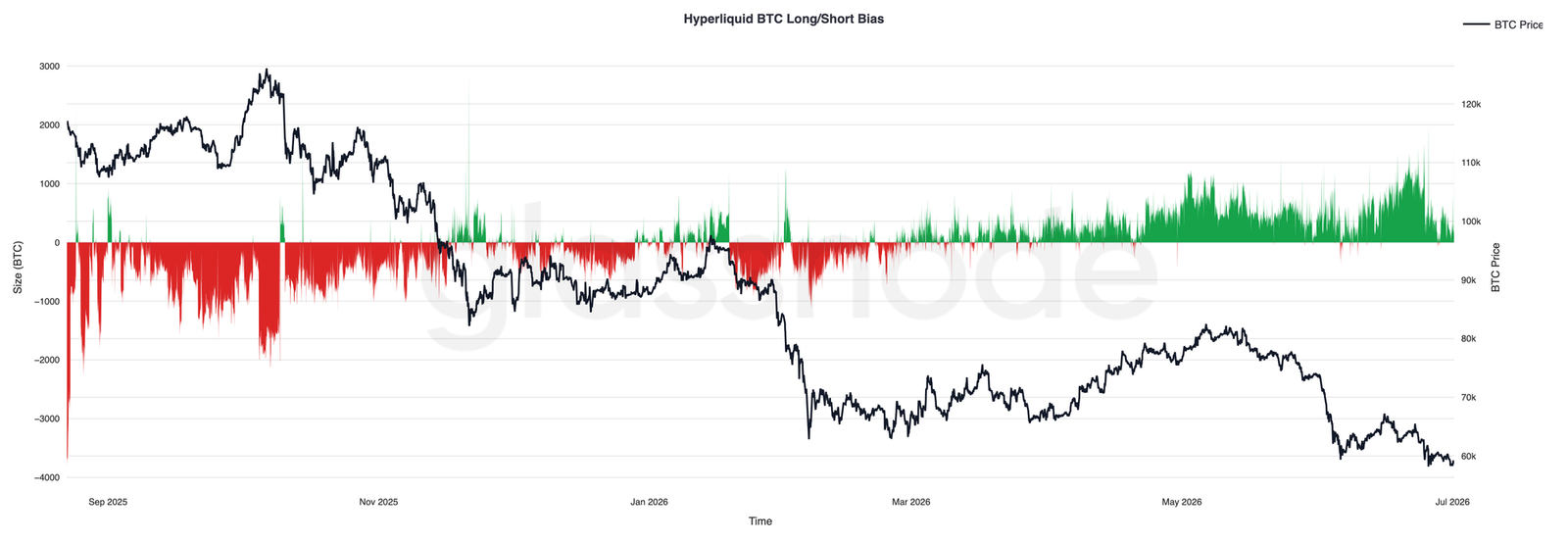
- Các nhà giao dịch đòn bẩy trên Hyperliquid đang lạc quan mạnh mẽ, vị thế mua ròng tăng lên mức cao nhất trong giai đoạn quan sát, cấu trúc thị trường mất cân đối, dễ gây ra các đợt bật tăng mạnh hoặc giảm giá do thanh lý.
Original Author: Glassnode
Original Translation: AididiaoJP, Foresight News
Bitcoin's price has fallen below $60,000, with institutional capital outflows and defensive positioning in the options market together suppressing market sentiment. However, beneath the surface, long-term holders and patient buyers are gradually absorbing sell pressure, suggesting that a bottoming process may have quietly begun.
Key Takeaways
- Long-term holders have returned to accumulation mode, with experienced investors once again accumulating coins during the market pullback.
- Broad accumulation is appearing across multiple wallet cohorts, as investors gradually show confidence in the face of weakening prices.
- The number of Bitcoins currently in a loss has surpassed those in profit, reflecting widespread investor stress and a shift of coins towards more steadfast holders.
- US spot Bitcoin ETFs continue to see net outflows, extending the institutional de-risking trend.
- The Coinbase order book is notably skewed towards bid orders, with institutions patiently providing liquidity and rebuilding support below the market.
- Leveraged traders have significantly increased long exposure, which could lead to either a sharp rebound or another round of long liquidations.
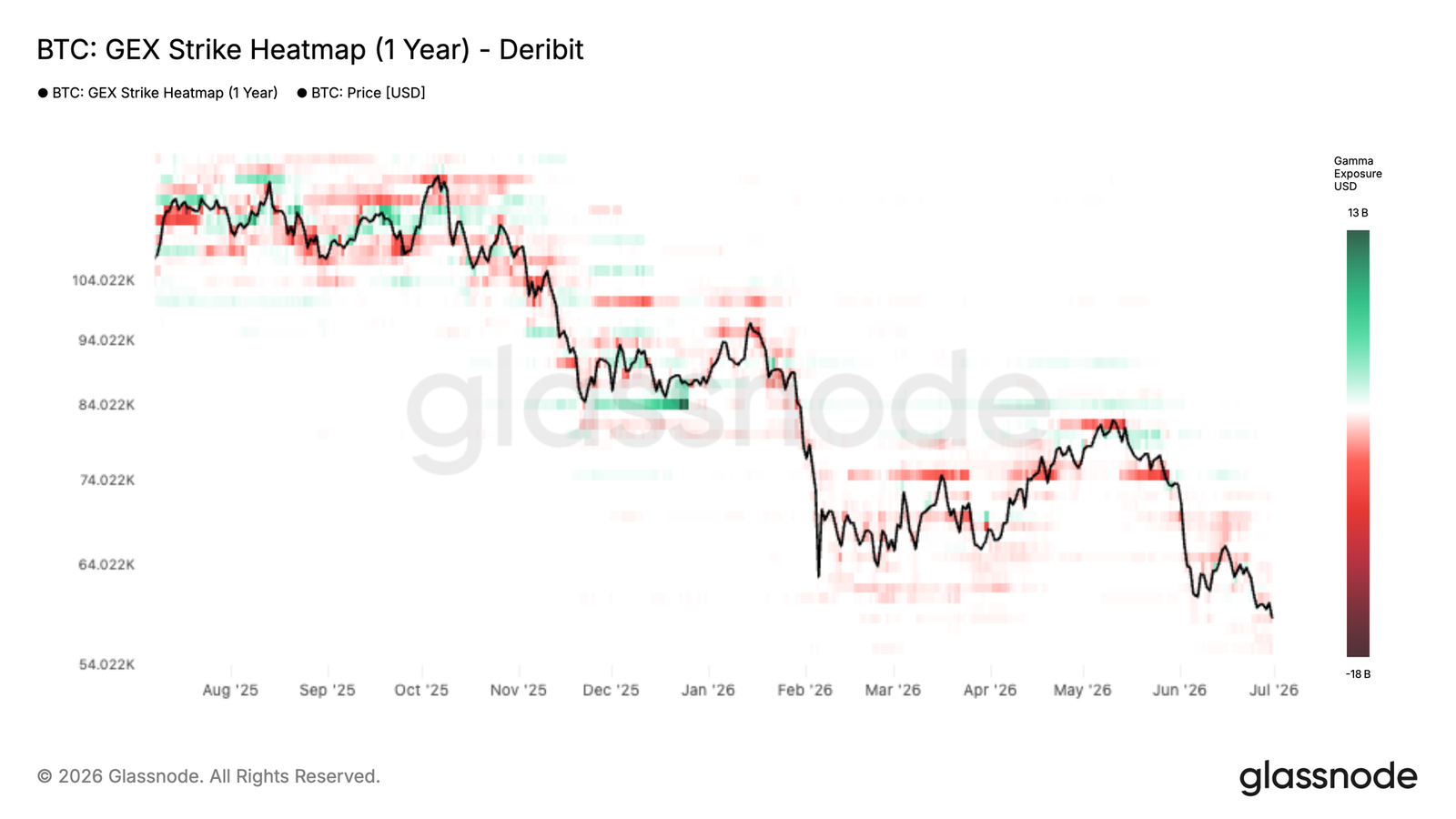
- Market makers' gamma positioning is becoming increasingly favorable, with hedging flows potentially dampening volatility and promoting price stability.
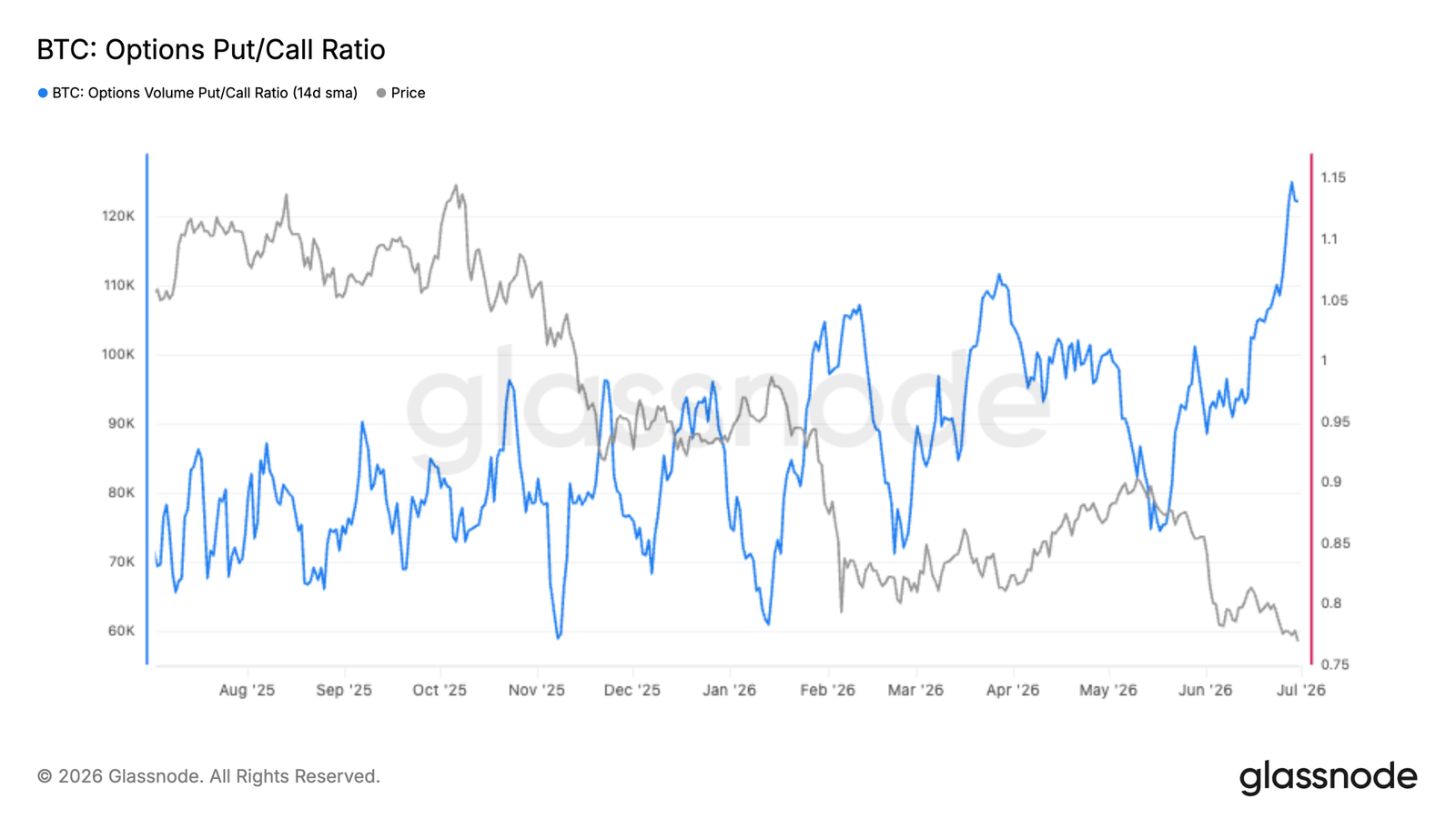
- Options traders are paying a premium for downside protection, indicating a clear defensive market mindset and elevated demand for hedging.
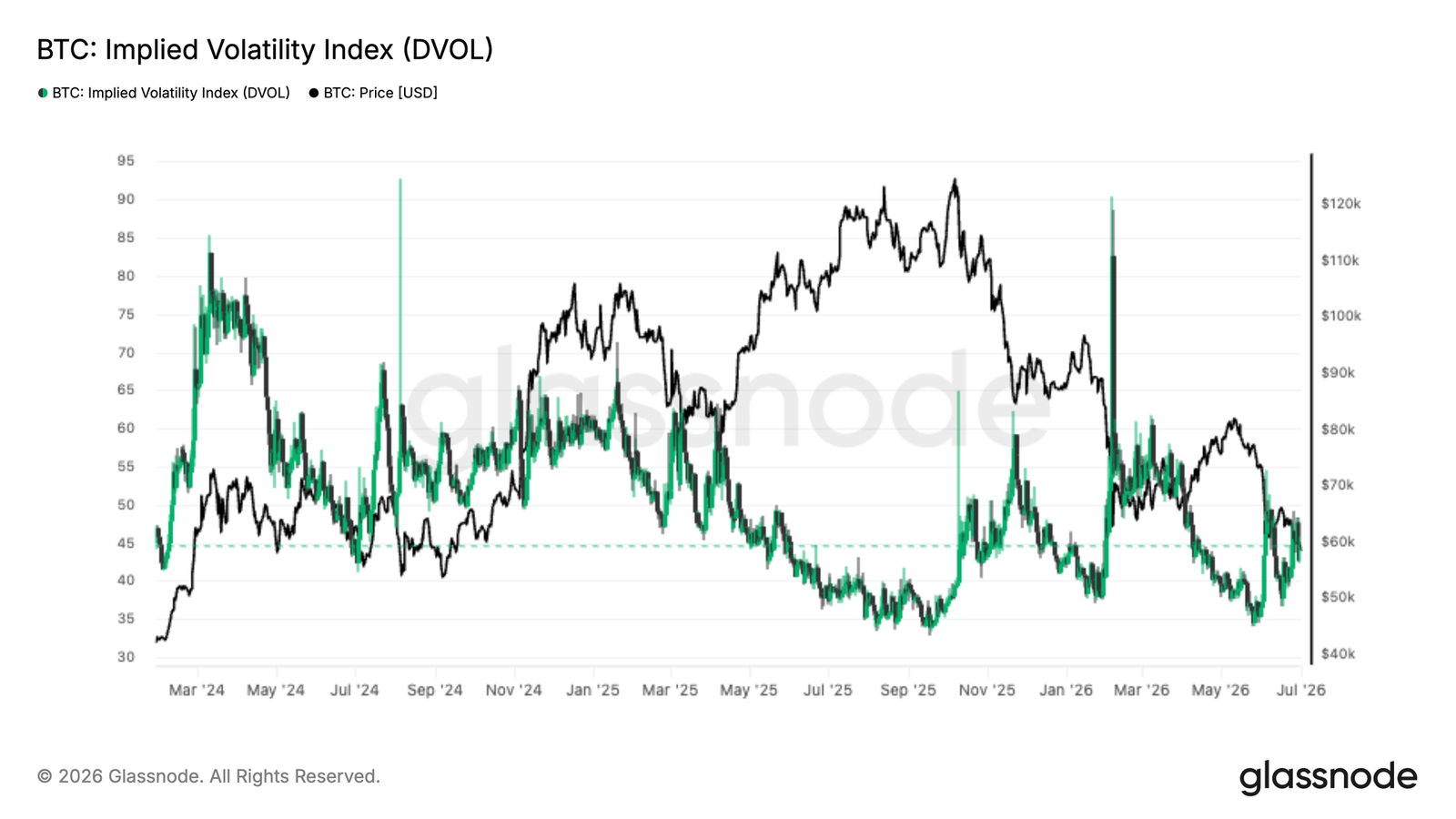
- Implied volatility is rising, suggesting Bitcoin might be entering a bottoming phase, but a final panic-driven volatility spike cannot be ruled out.
Macro Overview
The Fed kept rates unchanged for the fourth consecutive time at its June meeting, but it was the tone, rather than the decision itself, that affected the market. New Fed Chair Kevin Warsh adopted a markedly hawkish stance. With inflation stubbornly above target and tariff transmission continuing to push up consumer prices, the market has largely abandoned expectations of rate cuts this year. The earliest possible easing of rates would not be until 2027. Treasury yields have climbed back near 2026 highs, the dollar is strengthening, and while the labor market continues to add jobs, there are signs of narrowing concentration. Financial conditions are not easy, and there are no short-term catalysts to improve the situation.
Bitcoin has been a major casualty of this repricing. After a strong first quarter, June witnessed the most significant institutional retreat since the launch of spot ETFs: the sustained redemption wave is more about rational profit-taking than panic selling – many institutional positions were built at price levels well below the current ones. The selling pressure is orderly yet persistent, pushing Bitcoin's price back into a range that resets short-term expectations. As we enter the third quarter, the key question is whether the macro environment can stabilize to restore risk appetite, or if sticky inflation and a strong dollar will continue to weigh on the most liquidity-sensitive assets.
On-Chain Insights
Long-Term Holders Return to Accumulation
Long-term holders are rebuilding their positions after a prolonged period of distribution, with the net position change firmly turning positive. While the accumulation pace is still modest compared to the massive buying seen in previous bull market expansion phases, this marks a significant behavioral shift – Bitcoin's most conviction-driven investor group is once again absorbing coins.
This shift coincides with Bitcoin's pullback towards the $60,000 level, indicating that experienced holders view the recent decline as an opportunity rather than a reason to sell. Historically, a sustained transition from net distribution to net accumulation often occurs during periods of market weakness, where long-term investors incrementally add to their positions while short-term participants de-risk. Although it is too early to declare a full-fledged accumulation phase, the consistent return of long-term buying is a positive signal: conviction is being rebuilt beneath the surface.
Broad Accumulation Apparent
Bitcoin's Accumulation Trend Score has increased notably over the past month, with buying behavior becoming more widespread across investor cohorts. After sustained distribution during the market decline in previous months, most wallet groups have now shifted to accumulation, suggesting the recent pullback is starting to attract new demand.
The strongest accumulation currently comes from small holders (less than 1 BTC) and entities holding 100-1000 BTC, with both groups showing trend scores near their highest levels. Meanwhile, larger groups including wallets with 1000-10000 BTC have also turned to net buying, albeit with less intensity than earlier in the cycle. This synchronized improvement across multiple investor cohorts suggests that confidence is being rebuilt after the pullback, and market participants are increasingly willing to absorb sell pressure around current price levels. Historically, when accumulation occurs broadly across different wallet sizes, it tends to lay constructive groundwork for long-term market recovery, although confirmation through sustained buying is still needed.
Majority of Bitcoin in Loss
The recent sell-off has pushed the market to a significant psychological and structural milestone: the number of Bitcoins currently in a loss has exceeded those in profit. According to the latest data, approximately 10.83 million Bitcoins are underwater, compared to about 9.22 million in profit. This represents one of the most severe deteriorations in investor profitability since the start of this bull run, highlighting the extent of the recent repricing.
Historically, when unprofitable coins outnumber profitable ones, it is often accompanied by high financial stress and widespread capitulation among newer market participants. While this weighs on sentiment in the short term, it also creates conditions for stronger hands to absorb coins from weaker ones. Combined with the re-accumulation by long-term holders and other groups, the sharp decline in profitability suggests the market is entering a phase where coins are migrating to higher-conviction investors.
Off-Chain Insights
ETF Outflows Accelerate
Institutional demand continues to deteriorate. The 7-day moving average net outflow for US spot ETFs has moved further into negative territory. After a brief recovery in May, capital flows have reversed again, with sustained outflows becoming the norm as Bitcoin trends towards $60,000. The persistence of redemptions indicates that institutions remain in a defensive posture, opting to reduce positions rather than stepping in to absorb weakness.
This stands in stark contrast to the strong ETF demand that previously drove market advances. While on-chain data shows long-term holders and multiple other groups re-accumulating, ETF investors have not yet demonstrated the same conviction. This divergence highlights a market currently supported by patient on-chain capital, while price-sensitive institutional participants continue to withdraw liquidity. Stabilization in ETF flows will be an important signal to watch for confirming the restoration of broader investor confidence.
Hyperliquid Leveraged Traders Heavily Bullish
Positions on Hyperliquid have largely turned long, with net long exposure steadily increasing even as Bitcoin's price continues to decline. Rather than reducing positions during weakness, leveraged traders have been adding to their bullish bets, pushing long preference to the highest levels observed during the period.
This creates an increasingly asymmetric market structure. If buyers regain control, the large pool of long positions could fuel a sharp rebound. However, as long as the price remains in a clear downtrend, the accumulation of leveraged longs also leaves the market vulnerable to a further downward move if support breaks. If that happens, forced liquidations of overextended longs would amplify volatility and accelerate the decline. Current data suggests derivatives traders are positioning for a reversal, but this conviction is yet to be validated by price action.
Options Market Maker Positioning Favorable for Volatility Dampening
The Deribit GEX strike heatmap shows that the options market near the current price is dominated by positive gamma positions. A significant concentration of positive gamma has formed around the low $60,000s. When market makers are in a positive gamma state, they typically hedge by buying into weakness and selling into strength, a dynamic that naturally dampens volatility and encourages price stabilization near strikes with high open interest.
This implies that, despite the recent sell-off, the options market is no longer preparing for an accelerated downside move. Instead, market maker hedging flows are increasingly acting as a source of liquidity, helping to absorb directional volatility and reducing the likelihood of disorderly price action. This does not necessarily herald an imminent reversal, but it does suggest the market is transitioning from a period of high instability during the decline. Unless a major macro catalyst forces the price away from these gamma-dense zones, the options positioning points towards a period of consolidation and lower realized volatility, rather than a new wave of panic selling.
Options Traders Pay Premium for Downside Protection
The options market has turned defensive. The 14-day put/call volume ratio surged above 1.0, reaching its highest level in the past year. This indicates that put option activity has exceeded call buying, reflecting traders prioritizing downside protection over upside participation as Bitcoin fell towards $60,000.
Historically, high put/call ratios occur during periods of heightened uncertainty, where investors either hedge spot exposure or express a bearish view. While this reinforces the cautious tone set by ETF flows and recent price action, it can also act as a contrarian signal if hedging demand becomes excessive. When a large number of participants are already defensively positioned, the market's vulnerability to incremental selling pressure decreases. For now, however, the options market suggests that risk management, rather than recovery speculation, remains the dominant priority.
Implied Volatility Rebounds
Bitcoin's implied volatility index (DVOL) has started to recover from historical lows following the recent sell-off, but remains far below the panic extremes typically seen during major market dislocations. This suggests that options traders are beginning to price in larger future price swings and rising uncertainty, but expectations have not yet reached the levels of fear historically associated with durable lows.
Structurally, this looks more like the early stages of a bottoming process rather than the end. Volatility is beginning to reprice as the market searches for a bottom, but previous cycle lows were often accompanied by a final volatility spike triggered by forced selling, liquidations, or a macro shock causing capitulation. If such a spike occurs, it will likely coincide with indiscriminate selling and high stress in the derivatives market. Until then, the gradual rise in implied volatility indicates traders are preparing for larger moves, although the final washout needed to establish a durable bottom has not yet happened.
Summary
Bitcoin remains in a clear correction phase, but beneath the weak price performance, some important structural shifts are beginning to emerge. Long-term holders are accumulating again, buying activity is broadening across multiple wallet cohorts, and Bitcoin spot order books (Binance and Coinbase) are increasingly skewed towards bid orders. These changes are typically associated with patient capital stepping in as weaker hands exit.
At the same time, caution is warranted. Institutional capital continues to flow out of US spot ETFs, options traders are actively hedging downside risks, and leveraged long positions have reached elevated levels, leaving the market vulnerable to another round of liquidation-driven selling. Implied volatility also suggests the market may still need to experience one final washout to establish a low.
Overall, the data indicates that Bitcoin is transitioning from a distribution phase into an accumulation phase, but confirmation is still needed. While the foundation for a long-term recovery is gradually being laid, the market may first need to endure one final test of conviction before a sustainable uptrend can emerge.


