比特币「反弹结束」,正式进入熊市后期?


- Quan điểm chính: Bitcoin giảm 13% trong tuần này, khả năng sinh lời suy giảm nghiêm trọng, lỗ thực tế tăng vọt, bên bán giao ngay chiếm ưu thế trên thị trường. Nhà đầu tư ETF gặp rào cản ở vùng giá vốn 83k USD và quay trở lại trạng thái lỗ, thị trường quyền chọn tiếp tục định giá rủi ro cao, cấu trúc tổng thể vẫn đang trong giai đoạn thị trường gấu, quá trình điều chỉnh chưa hoàn tất.
- Các yếu tố chính:
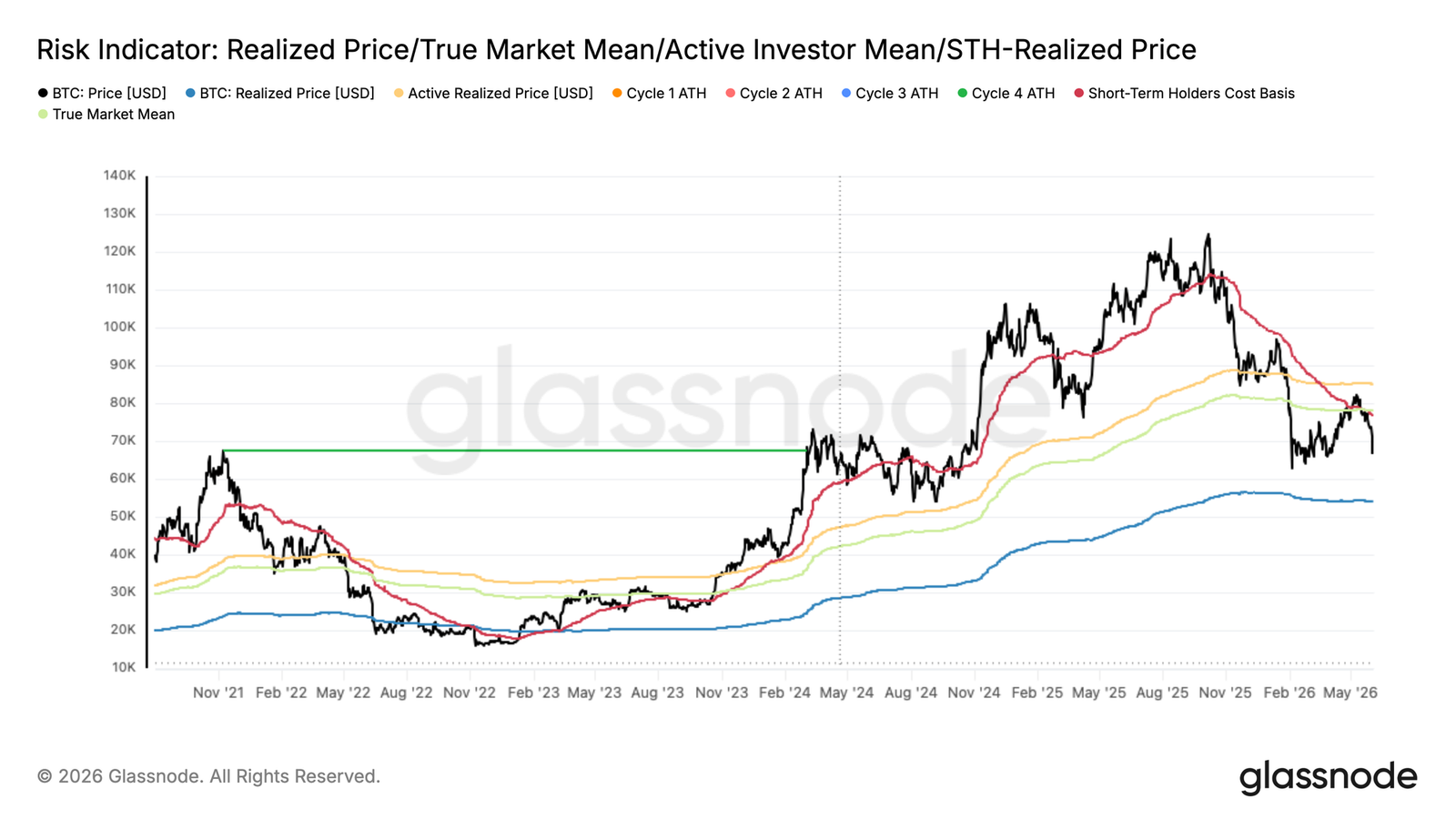
- Bitcoin giảm 13%, giá giảm xuống vị trí giữa giá thực tế và giá trị trung bình thị trường thực; chi phí cơ sở của nhà đầu tư ngắn hạn lần đầu tiên phá vỡ giá trị trung bình thị trường thực (kể từ tháng 1 năm 2022), xác nhận đặc điểm của giai đoạn cuối thị trường gấu.
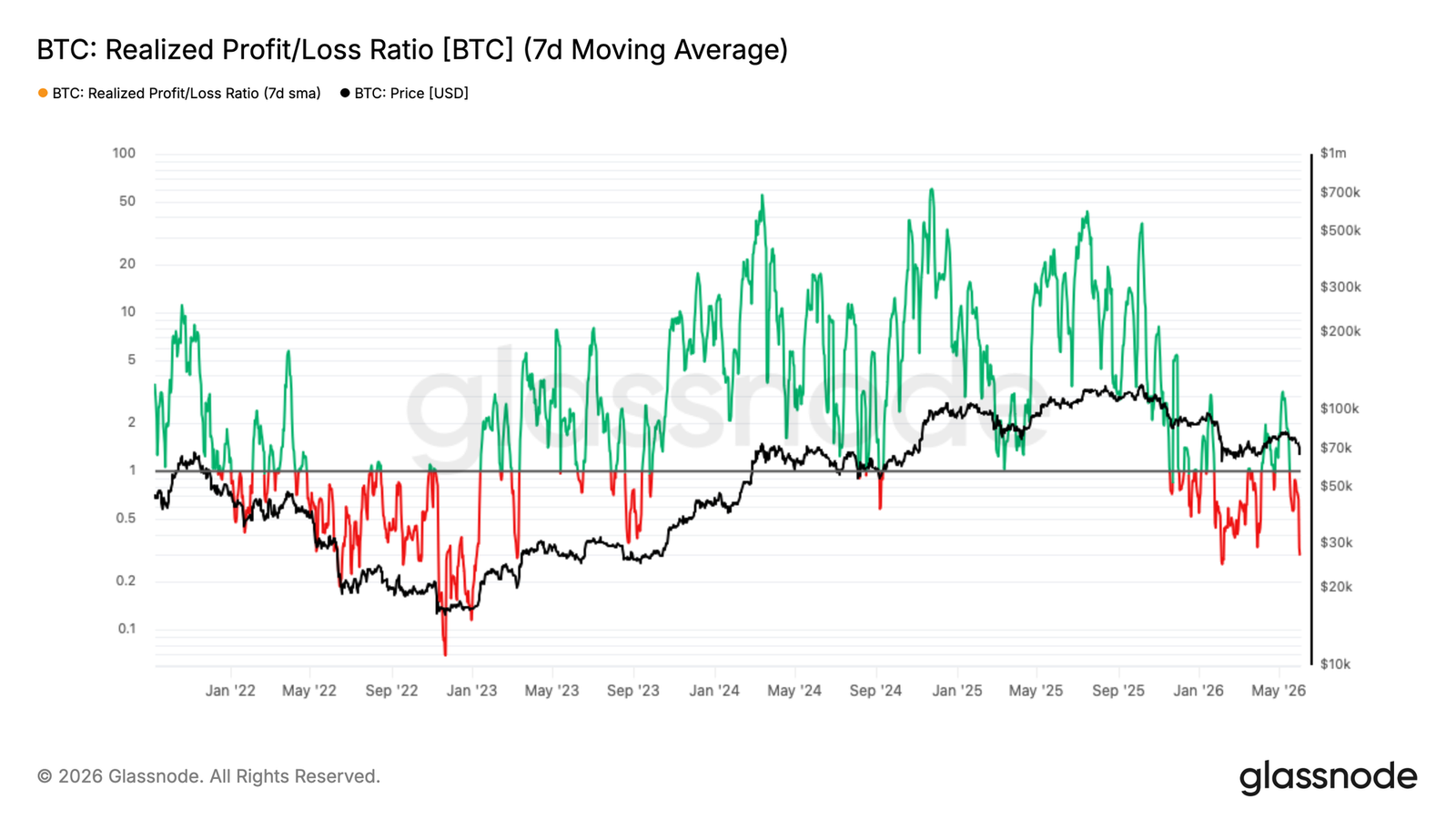
- Tỷ lệ lợi nhuận/thua lỗ thực tế trung bình động 7 ngày giảm mạnh từ 3,16 xuống 0,29, tương ứng với đợt hoảng loạn hồi tháng 2; trung bình động 90 ngày không vượt qua ngưỡng 2, xác nhận đợt phục hồi 82k USD chỉ là phục hồi trong thị trường gấu, không phải sự chuyển đổi cấu trúc.
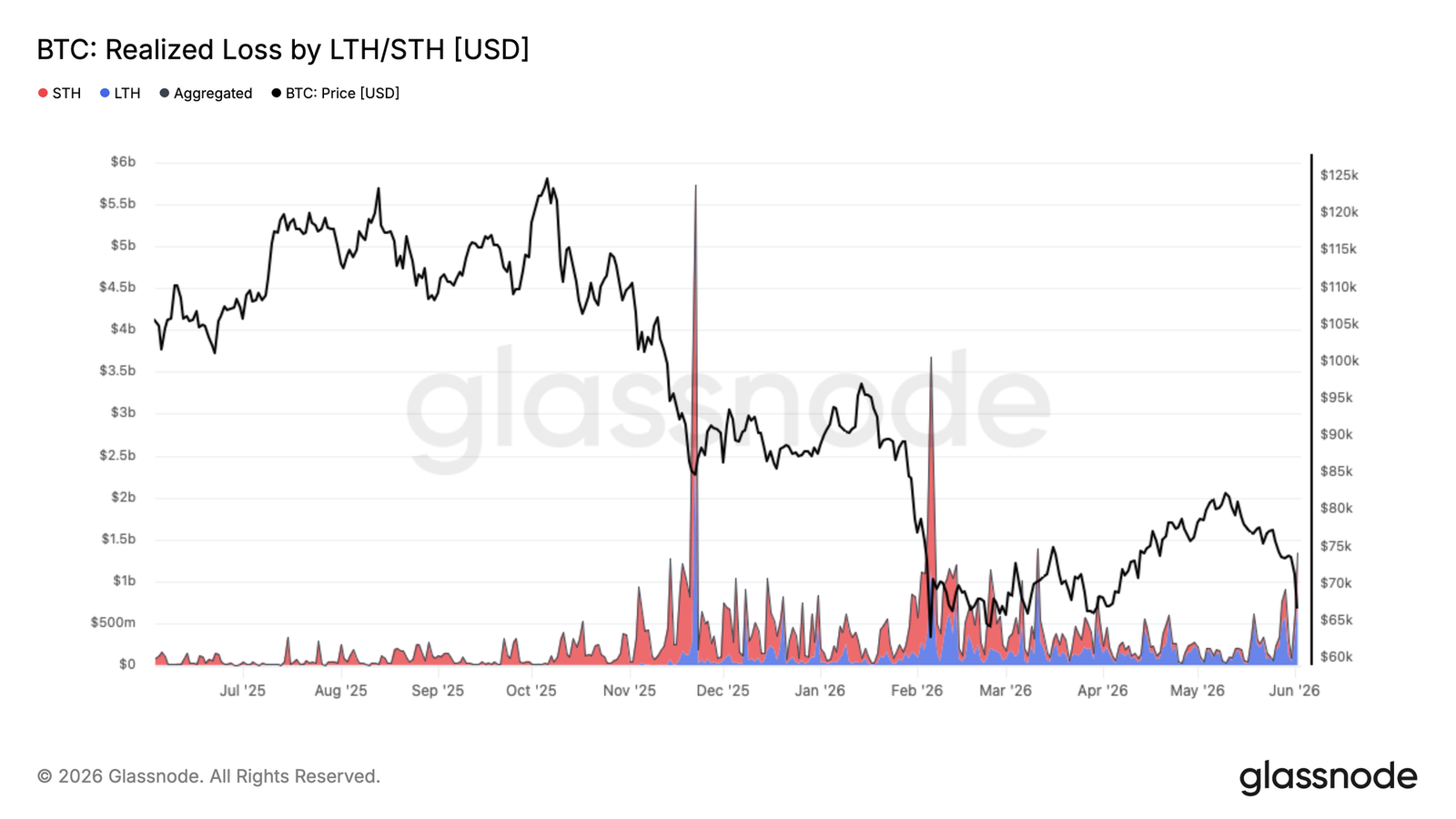
- Tổng lỗ thực tế hàng ngày tăng vọt lên 1,35 tỷ USD, trong đó 770 triệu USD đến từ việc cắt lỗ của nhà đầu tư dài hạn ở vị trí đỉnh chu kỳ, cho thấy sự phân phối lại nguồn cung đang tăng tốc nhưng chưa hoàn tất.
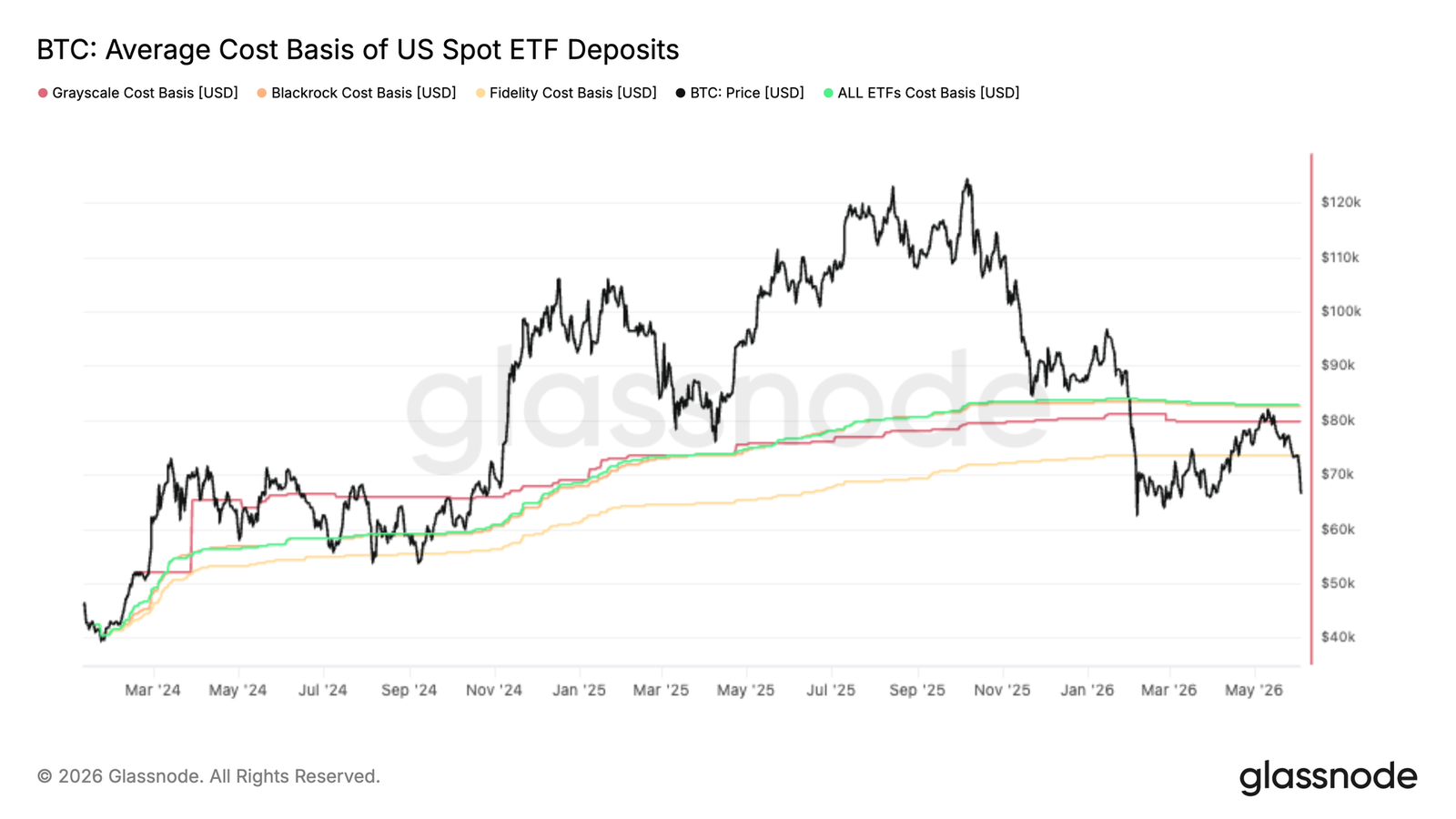
- Giá vốn 83k USD của ETF giao ngay Mỹ tạo thành ngưỡng kháng cự mạnh, nhà đầu tư ETF trung bình quay trở lại trạng thái lỗ; ETF chảy ra 4,21 tỷ USD trong ba tuần liên tiếp, các tổ chức đã giảm rủi ro trước khi giá giảm.
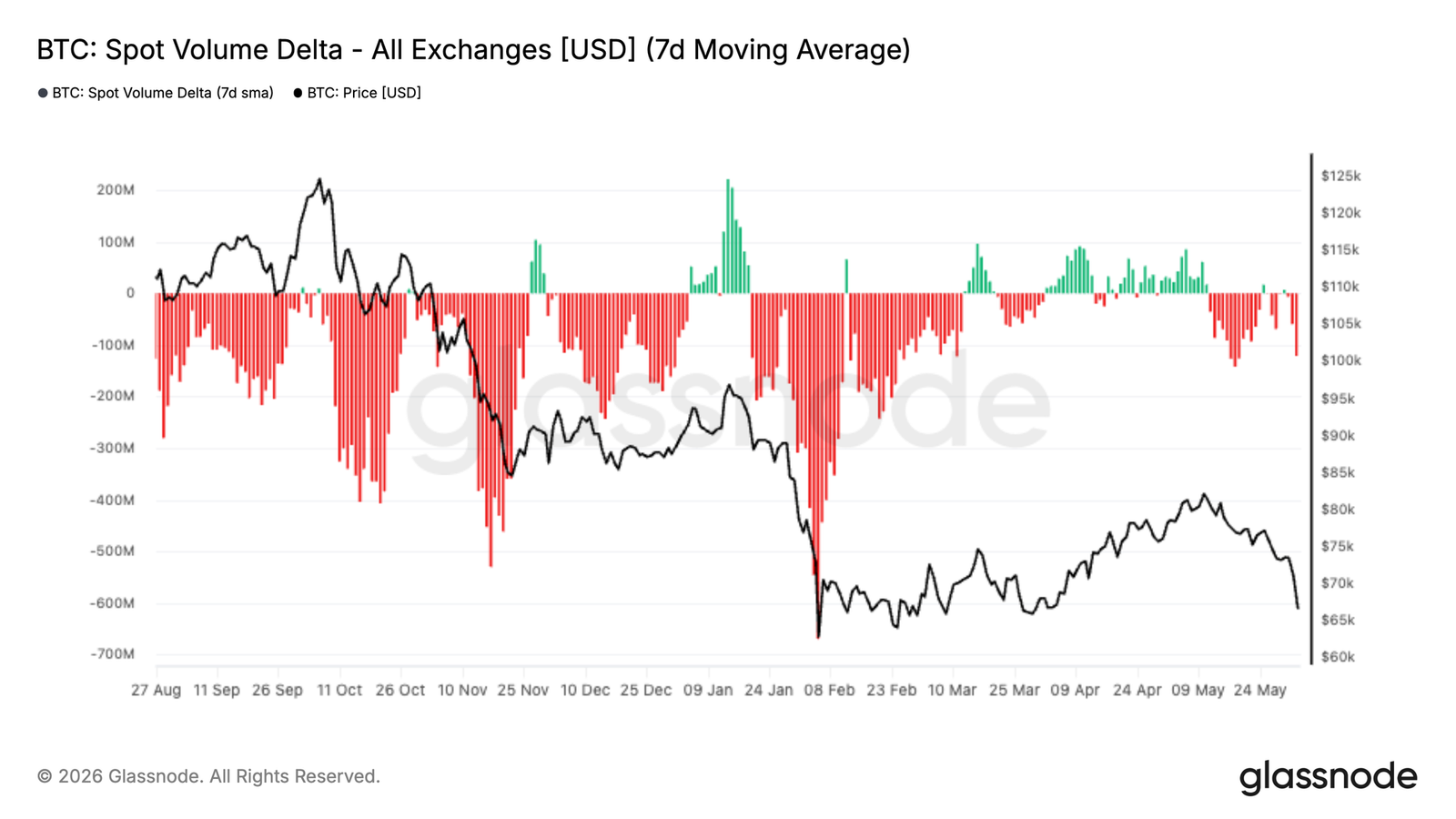
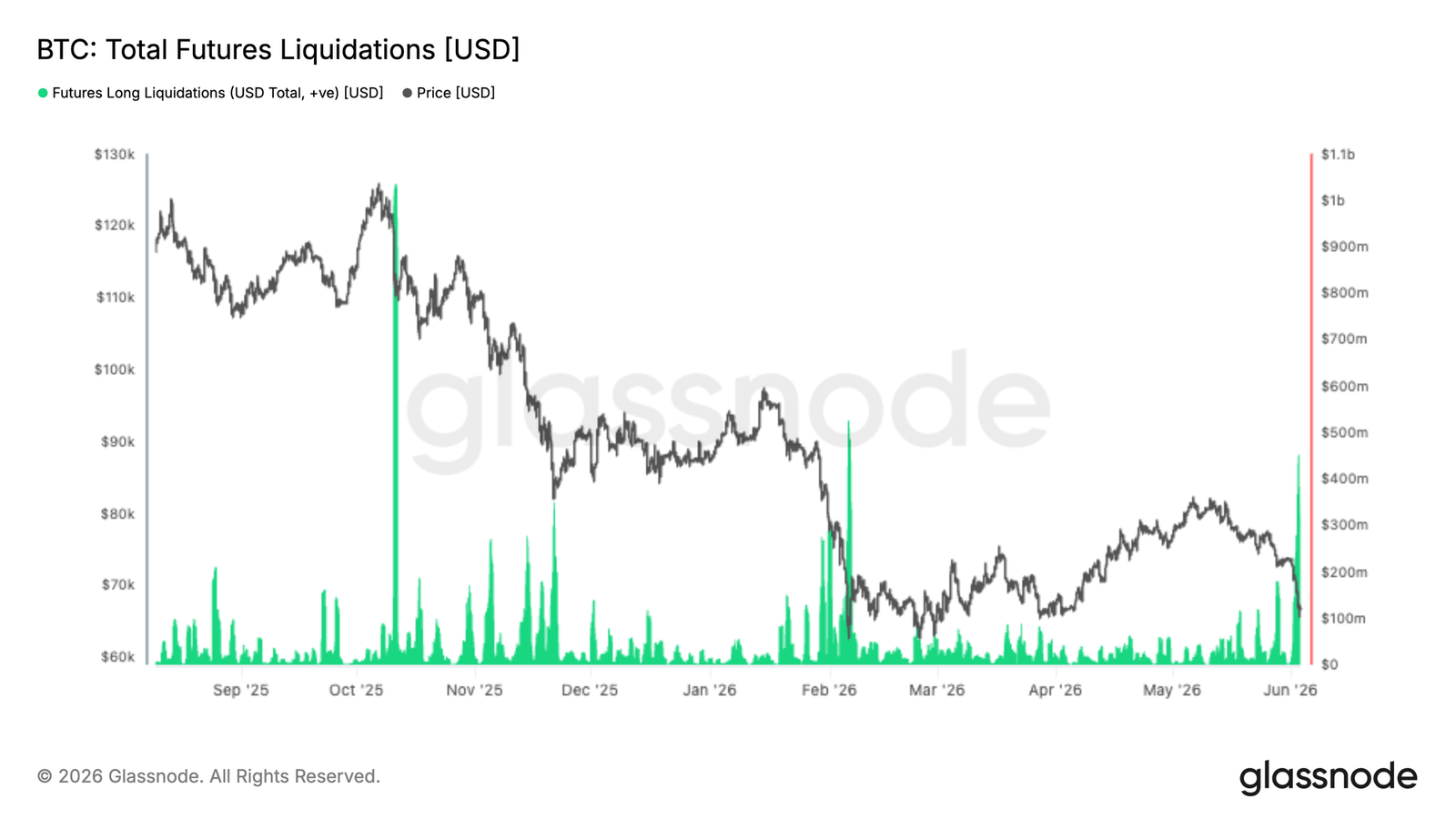
- Delta khối lượng giao dịch giao ngay 7 ngày chuyển sang âm đáng kể, đạt mức yếu nhất kể từ tháng 2, bên bán chi phối sổ lệnh giao ngay; 400 triệu USD vị thế long đòn bẩy bị thanh lý, nhưng quy mô thấp hơn các đợt điều chỉnh lịch sử.
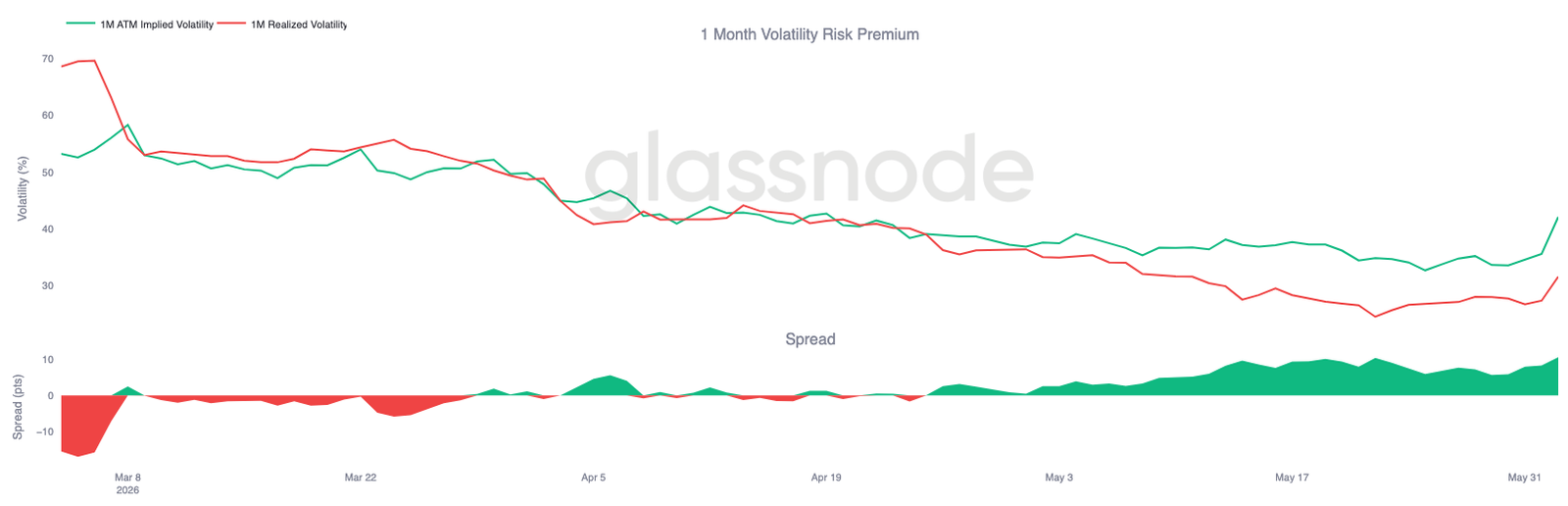
- Đường cong biến động ngụ ý toàn kỳ hạn bị nén, kỳ hạn 1 tháng giảm từ 38% xuống 34%; phí bảo hiểm rủi ro biến động mở rộng lên mức cao nhất ba tháng, thị trường quyền chọn tiếp tục định giá biến động cao trong tương lai, độ lệch duy trì mức phí bảo hiểm cho quyền chọn bán.
- Ở cấp độ vĩ mô, số lượng vị trí tuyển dụng tại Mỹ tháng 4 tăng lên 7,62 triệu (cao nhất trong gần hai năm), lợi suất trái phiếu kho bạc Mỹ kỳ hạn 10 năm tăng lên trên 4,45%, xác suất thị trường định giá Fed tăng lãi suất vào cuối năm vượt quá 50%, điều kiện tài chính thắt chặt nhẹ.
Original author: Glassnode
Original translation: AididiaoJP, Foresight News
Bitcoin fell 13% this week, with profitability collapsing sharply, realized losses surging, and spot sellers regaining control. US spot ETF investors have fallen back into unrealized losses after encountering resistance near their cost basis, while the options market continues to price in high risk.
Summary
- Bitcoin fell 13% over the past 7 days, with the price retreating to the midpoint between the realized price and the true market mean. The short-term holder cost basis broke below the true market mean for the first time (first since January 2022), confirming late-stage bear market characteristics.
- The 7-day moving average of the realized profit/loss ratio plummeted from a local high of 3.16 to 0.29, almost identical to the February panic wave; while the 90-day moving average never breached the threshold of 2, confirming that the 82k rebound was merely a bear market rally, not a structural turning point.
- Total daily realized losses surged to $1.35 billion, with $770 million coming from long-term holders capitulating at cycle top levels, indicating that the supply redistribution process is accelerating but remains incomplete.
- Bitcoin was rejected almost precisely around the aggregate US spot ETF cost basis of $83k, pushing the average ETF investor back into unrealized losses and reinforcing this level as a significant overhead resistance.
- Spot market selling pressure intensified, with the 7-day spot volume delta turning significantly negative, reaching its weakest level since February, indicating that sellers continue to dominate the order book despite the pullback.
- Implied volatility continues to compress while the volatility risk premium expands, with the options market pricing in higher future volatility than recent actual market performance.
- Skew remains in put premium territory, but the recent sell-off has not triggered a significant increase in downside hedging demand.
- Market maker positioning is concentrated near the current spot price, with Bitcoin sitting in the zone of maximum negative gamma, and capital flows persistently favoring protective demand.
Macro Insight
US job openings rose to 7.62 million in April, the highest in nearly two years and 750,000 above market expectations. The 10-year Treasury yield climbed back above 4.45%, with the market pricing in over a 50% probability of a Fed rate hike by year-end and no further rate cuts expected for the year. The dollar index held above 99. Financial conditions are tightening marginally, not easing.
Bitcoin has absorbed this shift more intensely than any other risk asset, falling 13% over the past week to the $67,000 range. US spot ETFs saw $4.21 billion in outflows over three consecutive weeks, the largest institutional redemption wave of 2026. Institutions are de-risking ahead of price declines, not reacting afterward. Friday's non-farm payroll data is a key observation point. Strong data will extend the current distribution pressure; weak data could provide the first conditions for a reset.
On-Chain Insight
Back to Bear Market Territory
The macro headwinds above have translated directly into on-chain structural deterioration. The 13% decline over the past week pulled the price back from the true market mean of $77.8k, which tracks the cost basis of actively traded supply and historically serves as the dividing line between bull and bear markets. At $67k, the price is in the middle of this range. Failure to hold above the true market mean reaffirms that bear market continuation remains the dominant structure.
Notably, the short-term holder cost basis has now fallen to $76.4k and broken below the true market mean. This configuration was last seen in January 2022. This setup suggests that new buyers are accumulating below the market's key average valuation, a typical late-stage bear market characteristic: the duration of the pullback begins to test investor conviction, historically making this phase more prone to structural failures or large-scale capitulation.
Profitability Collapse on the Decline
Building on the structural deterioration above, the short-term capital flow environment has shifted sharply due to the recent price decline. The 7-day moving average of the realized profit/loss ratio has contracted to 0.29, indicating that realized losses now overwhelmingly dominate on-chain spending behavior. This is nearly identical to the panic wave in early February. On May 7th, this 7-day average spiked to 3.16 as investors took profits during the 82k rally, but the 90-day moving average never broke above the threshold of 2 corresponding to genuine bull market capital flows. This divergence between short-term and medium-to-long-term readings is a clear signal of a rebound lacking structural conviction, consistent with a local top formation within a bear market, rather than a credible structural shift. The subsequent fall back to 0.29 further confirms this assessment.
New Buyers Under Pressure
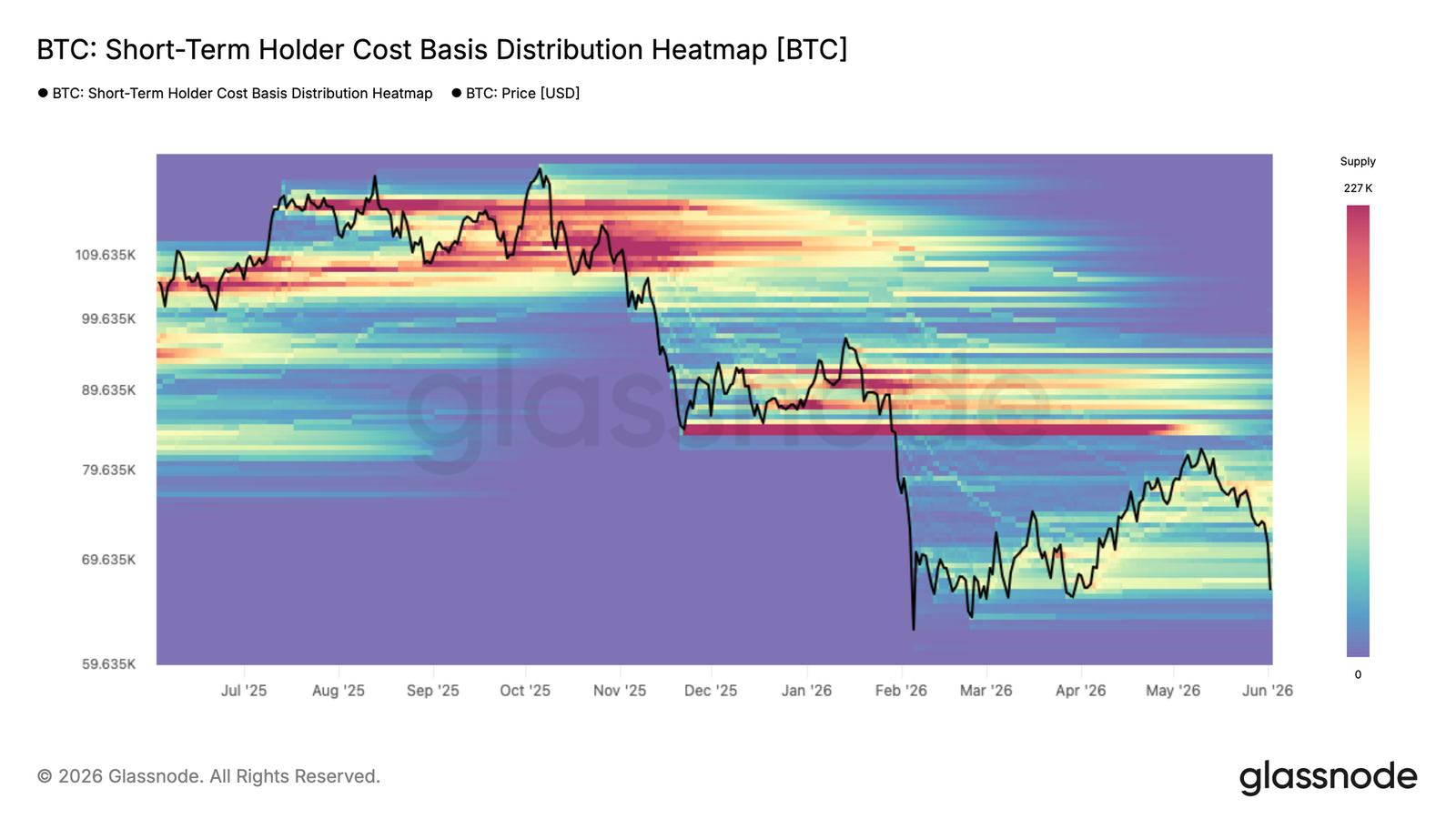
Resistance at the bear market top range has pushed recently accumulated supply directly into loss territory. The short-term holder cost basis distribution heatmap illustrates the supply density of recent buyers at different price levels, revealing concentrations in the short-term holder cost basis – the areas most likely to exhibit behavioral stress.
As the price retreats toward $67k, it is approaching the lower boundary of the supply cluster accumulated since February. In this zone, a large number of short-term holders are watching their unrealized gains shrink to breakeven or turn into losses. Those who accumulated near the $78k-$82k local top are facing the most immediate pressure. Their decision to hold or capitulate will determine whether current prices can absorb selling pressure or give way to a deeper decline.
Accelerating Realized Losses Across Cohorts
As recent buyers are pressed back to the lower boundary of the three-month range, the pressure from realized losses has expanded beyond the newest accumulators. The current pullback to $67k has pushed total daily realized losses to $1.35 billion, accelerating significantly from baseline levels during the preceding consolidation period.
Of this, $770 million in daily losses is realized by long-term holders who purchased before January 2026, reflecting continued capitulation by cycle top buyers as the bear market extends. The remainder comes from recent buyers who accumulated between $67k and $82k during 2026, who are being forced to exit at a loss as the price falls below their cost basis.
As the bear market matures, this pattern of long-term holders capitulating and passing supply to new buyers at lower prices is a recurring and necessary feature of the cycle bottoming process. However, the current pace of realized losses suggests that this process is not yet complete.
Off-Chain Insight
Breaking Below the ETF Cost Basis
The latest Bitcoin rally stalled almost precisely around the aggregate US spot ETF cost basis of $83k, turning a level that previously acted as support into a clear resistance. This suggests that a significant number of ETF investors, previously in unrealized losses, used the bounce to reduce positions or exit at breakeven.
This rejection is particularly noteworthy because ETF flows have been one of the dominant sources of demand this cycle. When the price struggles to reclaim the average holder cost basis, it often means that trapped investor supply is outweighing new demand, creating overhead resistance.
Looking ahead, the aggregate ETF cost basis remains a key level to watch. A decisive reclaim would bring the average ETF investor back into profit and could improve sentiment for this cohort. Until then, the failure to hold above this level indicates that ETF positioning remains a headwind, with investors using strength for de-risking rather than accumulation.
Spot Buying Disappears
Spot market capital flows have deteriorated sharply over the past two weeks, with the 7-day spot volume delta turning negative to its weakest level since the February sell-off. This indicates that aggressive sellers are once again dominating the spot order book, further reinforcing the weakness in recent price action.
What makes the current move peculiar is that it follows a sustained period of spot-dominated accumulation during April and early May. During that rally, buyers consistently lifted the offer, pushing the spot volume delta positive and helping Bitcoin recover from the mid-60k range to $80k. That demand impulse has now faded, and as the price failed to break higher, sellers have regained the upper hand.
A persistently negative spot volume delta is typically associated with either a capitulation event or the early stages of a broader trend reversal. For now, it indicates that the market remains in a distribution phase, with spot participants using rallies to sell rather than accumulate. A significant improvement in spot demand remains one of the key signals for a sustainable recovery.
Futures Liquidations
The latest market correction triggered one of the largest liquidation events of this cycle, with over $400 million in leveraged long positions forcibly liquidated as Bitcoin fell below $70k. While painful for late entrants, such events often help purge excess leverage from the system and reset market positioning.
Notably, the scale of this liquidation remains lower than during the corrections in October 2025 and February 2026, indicating that leverage was not excessively stretched heading into this decline. Historically, large-scale long liquidations often coincide with local exhaustion points, as forced selling cascades through the derivatives market and clears out weak hands.
The key question going forward is whether spot demand can step in to absorb the supply. If liquidation-driven selling pressure begins to fade while spot buyers return, the market could emerge with a cleaner positioning backdrop and lower leverage overhang, setting the stage for a more sustainable recovery.
Implied Volatility Continues Downward
From an implied volatility perspective, despite the spot price breakdown, the dominant trend remains compression along the entire term structure. The 1-month tenor has fallen from around 38% to 34%, while the 3-month and 6-month tenors have also compressed by about 3 volatility points over the past two weeks.
This movement reflects the market's continued reluctance to pay a premium for options, even after Bitcoin broke below its recent range. Although front-end volatility showed brief reactions during sharp spot price moves, these were quickly sold into, maintaining the broader downward trend.
The term structure remains in contango, with forward volatility trading at a premium to the front end. This indicates that traders continue to view the recent price weakness as a local event, rather than a catalyst for a broader volatility repricing.
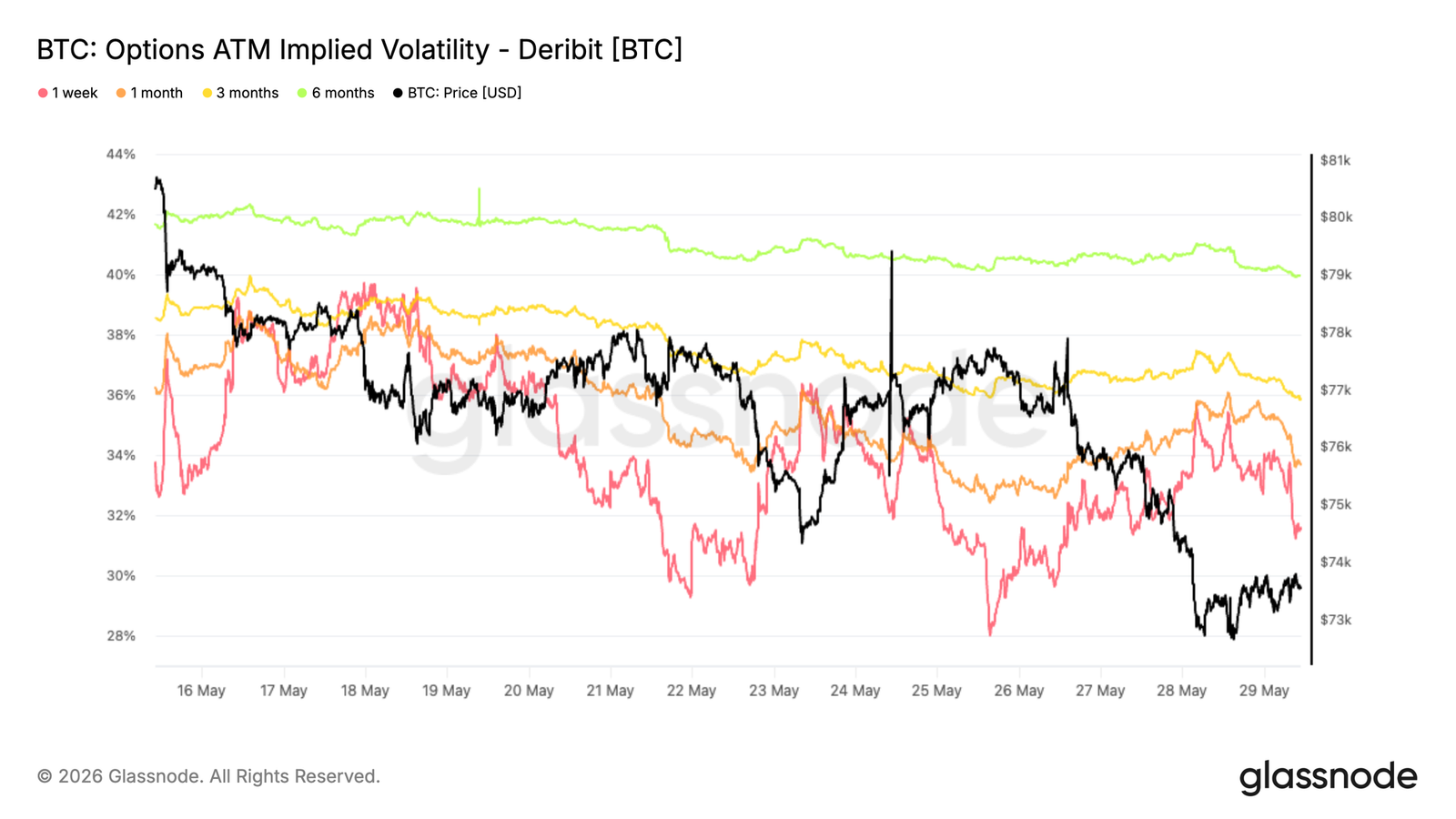
Volatility sellers remain dominant, and the demand for protection has not accelerated despite the weaker price.
Volatility Risk Premium Near Three-Month High
As implied volatility declines, the relationship between implied and realized volatility tells a different story. Despite Bitcoin undergoing a period of volatility, the options market continues to price in significantly higher future volatility than recent spot price action has delivered.
1-month implied volatility has risen back to around 42%, while realized volatility remains close to 32%. As a result, the volatility risk premium has expanded to near its highest level over the past three months.
This change has been particularly evident during the recent sell-off. While realized volatility rose as the spot price broke through key support, implied volatility increased even faster, reflecting new demand for options and protection.
The options market continues to assign a higher probability to future volatility than recent price behavior alone would suggest, keeping the volatility premium at a significant high.
Put Premium Remains Elevated
As the volatility risk premium expands, skew shows where traders continue to concentrate their option demand. Despite the spot breakdown, puts remain persistently more expensive than calls across the entire term structure.
Conclusion
Bitcoin's latest decline further confirms the view that the market remains fragile, with weakness evident across profitability, investor behavior, ETF positioning, and spot market demand. The rejection near the aggregate ETF cost basis of $83k suggests many investors remain trapped above current prices, creating selling pressure on rallies and persistently suppressing Bitcoin's recovery attempts.
At the same time, realized losses are accelerating, with long-term holders initiating large-scale selling, and spot order flow has clearly tilted in favor of sellers. While recent liquidation events have helped clear some leverage from the system, there is little evidence yet of a durable demand response capable of absorbing the resulting supply.
The situation is similar in the options market. Traders continue to pay for downside protection and future volatility, but without the panic typically accompanying sharp declines. Until spot demand strengthens, ETF investors return to profitability, and selling pressure begins to ease, the market is likely to remain exposed to further downside risk and will continue to consolidate within the broader bear market structure.