






Hỗ trợ dưới 1%, BIP-110 vẫn sẽ đưa Bitcoin vào hard fork?


- Quan điểm cốt lõi: Đề xuất BIP-110 của Bitcoin nhằm hạn chế dữ liệu phi tiền tệ như inscription. Mặc dù phải đối mặt với kích hoạt cưỡng chế do tỷ lệ ủng hộ thấp, nó có thể gây ra hard fork, và thành bại cuối cùng phụ thuộc vào sự đồng thuận của cộng đồng và sức mạnh hashrate của thợ đào.
- Các yếu tố chính:
- Tỷ lệ ủng hộ từ thợ đào dưới 1%, tỷ lệ ủng hộ từ node chỉ 14,64%, tỷ lệ ủng hộ BIP-110 cực kỳ thấp.
- Nếu ngưỡng kích hoạt 55% không đạt được vào tháng 8, đề xuất sẽ bước vào giai đoạn kích hoạt cưỡng chế. Các node thực thi có thể từ chối các block không tuân thủ, dẫn đến nguy cơ phân mảnh mạng lưới.
- Phía ủng hộ, đại diện là nhà phát triển Luke Dashjr, cho rằng inscription là "giao dịch rác", lấn át mục đích sử dụng tiền tệ của Bitcoin và gia tăng gánh nặng cho node.
- Phía phản đối cho rằng BIP-110 không thể giải quyết triệt để vấn đề, có thể kìm hãm sự đổi mới (ví dụ: BitVM), đi ngược lại tinh thần chống kiểm duyệt, gây ra rủi ro chi tiêu kép và chia tách chuỗi.
- Ocean chỉ chiếm 2,6% hashrate, trong khi các mining pool lớn như F2Pool công khai phản đối. Vì lợi ích của đa số thợ đào, chuỗi BIP-110 có thể "chết tự nhiên" do thiếu hashrate.
- Hiện tại, tỷ lệ giao dịch inscription đã giảm xuống 5%. Nếu BIP-110 được kích hoạt nhưng thiếu hashrate, chuỗi thiểu số khó trở thành "chuỗi dài nhất" và cuối cùng có thể hard fork độc lập thành một đồng tiền mới.
- Thị trường dự đoán cho thấy xác suất kích hoạt BIP-110 thành công chỉ là 10%, phe phản đối công khai đặt cược vào thất bại của nó.
Original by Odaily (@OdailyChina)
Author: Golem (@web3_golem)
As the August mandatory window approaches, discussions surrounding the BIP-110 proposal have recently heated up again.
BIP-110 was proposed by Dathon Ohm in December 2025 and is supported by Bitcoin Core developer Luke Dashjr. The proposal aims to limit arbitrary/non-monetary data in Bitcoin transactions over the next year, primarily targeting large data storage like Ordinals and Bitcoin NFTs, hoping to reduce "junk transactions" on the network and allow Bitcoin to focus on its monetary function.
The proposal has been controversial since its inception, but data shows that BIP-110 currently lacks mainstream support from miners and nodes. The activation threshold for BIP-110 is 55%. According to statistics, current miner support is below 1%, and out of a total of 102,674 nodes on the network, only 15,035 are willing to enforce BIP-110, a rate of 14.64%.
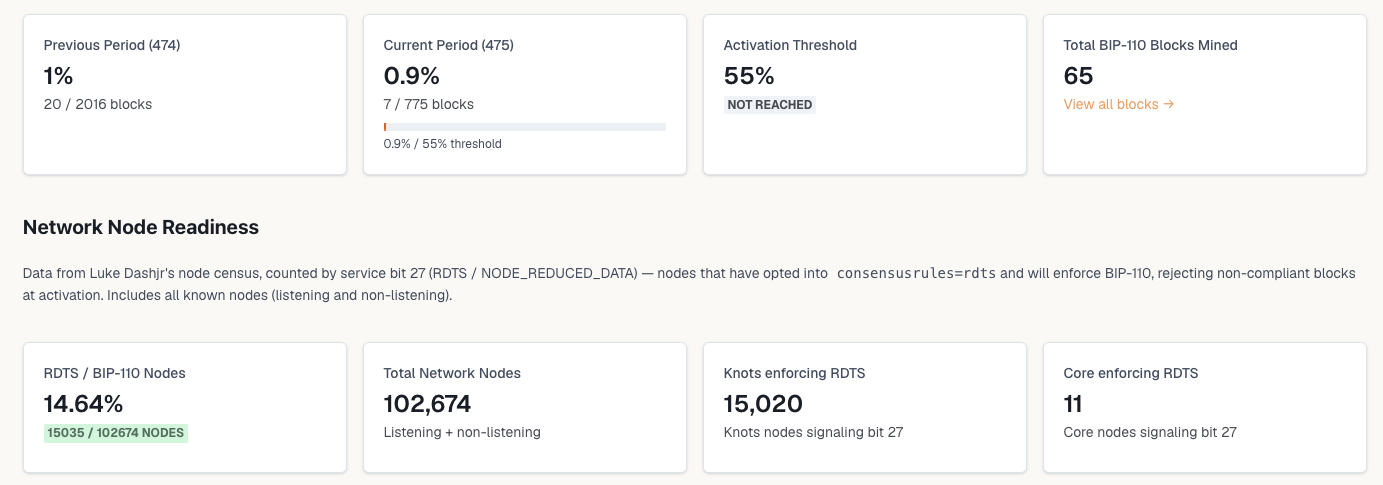
BIP-110 Miner and Node Support Rate
Typically, a proposal with such low support cannot pass on the Bitcoin network. However, the contentious point of BIP-110 is that even without consensus, nodes supporting BIP-110 will enforce it. If BIP-110 fails to reach the 55% activation threshold before block height 961,632, it will enter a mandatory window (block heights 961,632-963,647). During this period, nodes running BIP-110 will reject non-compliant blocks, forcing the adoption rate to 100%, allowing BIP-110 to be forcibly activated at block height 965,664.
Given the current block generation speed of the Bitcoin network, BIP-110 will enter the mandatory window in early August. This means that although BIP-110 is a soft fork proposal, the Bitcoin network will experience a chain split (the minority chain supporting BIP-110 and the main chain not supporting it).
BIP-110 Controversy Continues
According to Bitcoin's "longest chain rule," only when the actual mining power supporting BIP-110 constitutes the majority (>50%) will they become the longest chain, and the entire network will unify under the new rules, i.e., the soft fork succeeds. Therefore, although the forced activation of BIP-110 seems inevitable, its long-term sustainability still depends on consensus. Otherwise, BIP-110 will share the fate of most historical Bitcoin soft forks: natural death.
Supporters: BIP-110 is Not a Change, but a Denial of Change
The main representative supporting BIP-110 is Luke Dashjr and his mining pool, Ocean. Luke Dashjr was an early radical figure in the Bitcoin developer community opposing BRC-20 and inscriptions and provided draft suggestions for the BIP-110 proposal.
Luke Dashjr is seen as a representative of Bitcoin maximalism. They are unwilling to see Bitcoin block space used for any purpose other than Bitcoin transfers. The BIP-110 proposal views inscriptions, which emerged in 2022, as a "Bitcoin attack." The reasoning is that allowing arbitrary data embedded in Bitcoin transactions imposes a huge and unnecessary burden on nodes. Furthermore, this "junk data" occupies a large amount of block space, forcing monetary transactions to compete at higher fee thresholds to be included, crowding out Bitcoin's monetary usage.
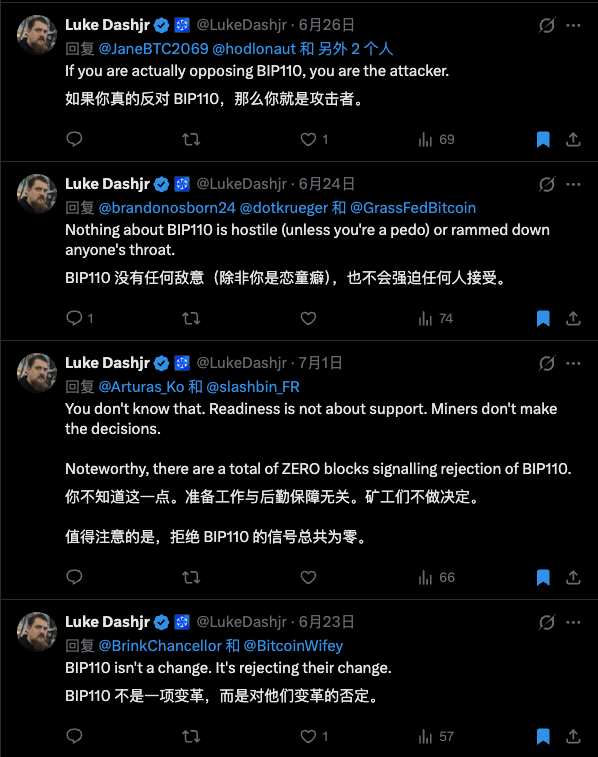
Therefore, Luke Dashjr stated on X that BIP-110 is not a change, but a denial of change. He also employed a sophistry when facing opponents of BIP-110, claiming on one hand that BIP-110 has no hostility and forces nothing on anyone, while on the other hand asserting that anyone opposing BIP-110 is the true Bitcoin attacker.
Moreover, despite the current low miner vote rate in favor of BIP-110 (<1%), Luke Dashjr remains optimistic, claiming that the miner vote rate directly opposing BIP-110 is also nearly 0%. His implication is that miners aren't making a decision; once BIP-110 activates, they will naturally follow.
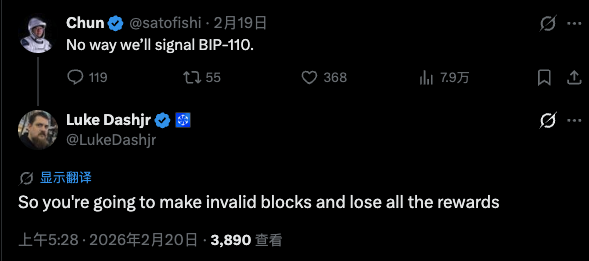
In reality, the only mining pool publicly supporting BIP-110 so far is Luke Dashjr's own Ocean. F2Pool co-founder Wang Chun publicly stated back in February that he would absolutely not support BIP-110. Luke Dashjr confidently replied under his post, "Then you will mine invalid blocks and lose all rewards."
According to miningradar data, F2Pool is the third largest Bitcoin mining pool globally, with a hashrate share of 13.6%; Ocean's current hashrate is only 24.6 EH/s, accounting for 2.6% of the network's total hashrate.
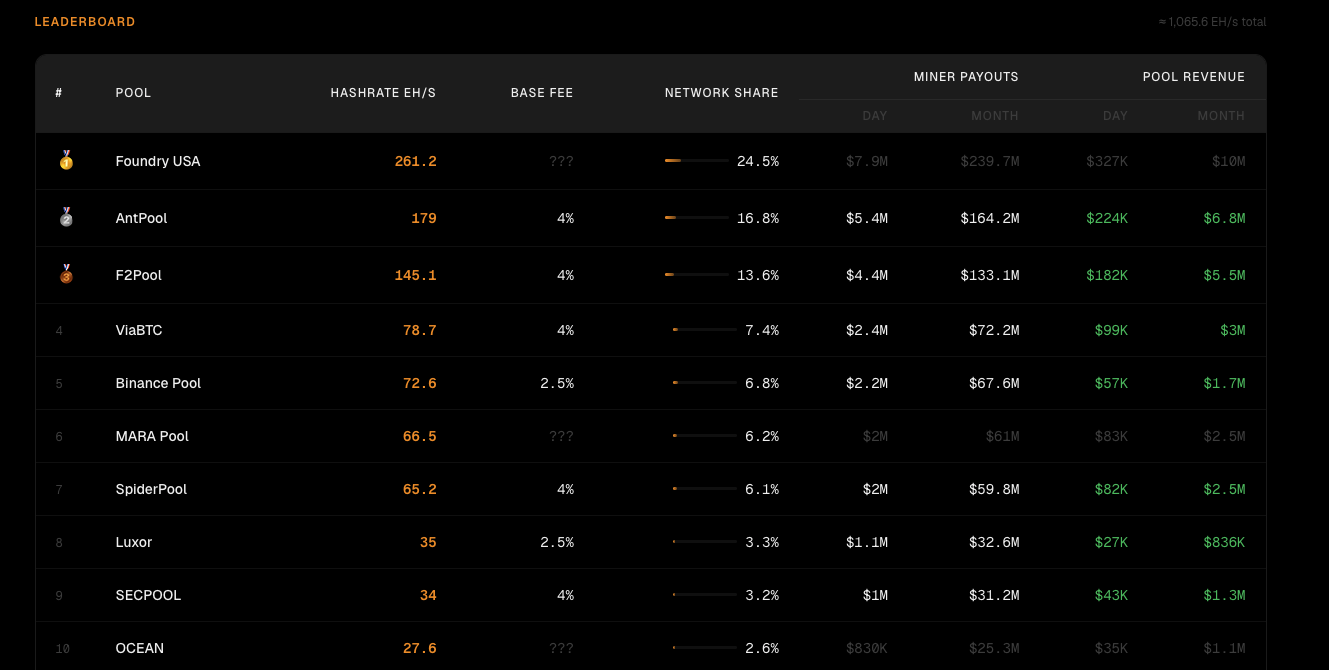
Bitcoin Mining Pool Rankings
If Ocean ends up as the only mining pool supporting the fork, they would only generate 3-5 blocks per day. Such efficiency and block generation speed would not make them the "longest chain" on the Bitcoin network.
Opponents: BIP-110 Doesn't Solve the Problem, It Creates New Ones
Opponents of the BIP-110 proposal don't just focus on whether it will succeed after activation. They criticize it for failing to solve the "junk transaction" problem on the Bitcoin network while simultaneously creating many potential new issues. In short, the strong opposition to BIP-110 stems from concerns about numerous unintended consequences, not from any nostalgia for Ordinals or inscriptions. Key representatives of the opposition include cypherpunk pioneer Adam Back, Bitcoin Core developer Jameson Lopp, and Strategy founder Michael Saylor.
Firstly, opponents argue that BIP-110 cannot completely solve the "junk transaction" problem facing the Bitcoin network. The author of the BIP-110 proposal also admits it can only provide temporary relief. Jameson Lopp believes that Bitcoin's block size limit and the competitive fee market for block space have already mitigated the junk transaction problem to some extent. However, Bitcoin remains a target for various junk transaction attacks because almost no one really uses the network, transaction fees remain low, preventing the formation of fee pressure sufficient to deter most junk transactions.
Furthermore, BIP-110 would stifle future innovation on Bitcoin. The BIP-110 proposal itself acknowledges that its restrictions on Taproot hinder the implementation of advanced features or complex covenants like BitVM on the Bitcoin network. Although BIP-110 is described as a temporary one-year restriction, Jameson Lopp believes this is merely Luke Dashjr's delaying tactic. If these restrictions severely impede future Bitcoin upgrades, it could lead to a hard fork of Bitcoin rather than a soft fork.
Adam Back focuses more on Bitcoin's censorship resistance and decentralized spirit. He argues that BIP-110 subjectively censors transactions within blocks, its fundamental purpose being to police others. This contradicts the principle of neutrality and censorship resistance that the Bitcoin network has upheld since its inception, marking a dangerous step towards centralization and control. Adam Back uses Bitcoin's original principles to refute Bitcoin extremists' change to the network, essentially "defeating magic with magic."
Michael Saylor summarized BIP-110 as a "Bitcoin Iatrogenic Proposal," implying that the "treatment plan" itself would cause harm to Bitcoin rather than solving existing problems.
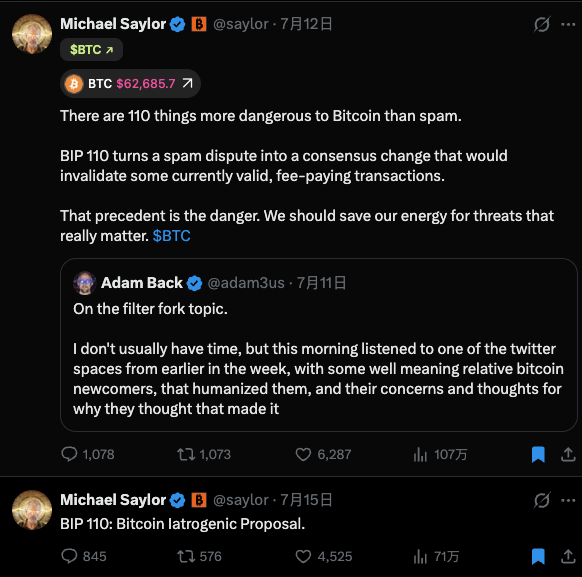
Furthermore, Michael Saylor believes that if BIP-110 is converted into consensus, some valid paid transactions would become invalid. Setting such a precedent for censorship is the real danger.
Another severe consequence feared by the opposition is that activating BIP-110 could split the Bitcoin chain ecosystem. Two competing chains would then vie for the status of the "real Bitcoin." In this scenario, the uncertainty of the fork outcome could create a risk of Bitcoin double-spending. Even without causing double-spending, if BIP-110 ultimately evolves into a new chain, it would fragment Bitcoin's developer resources, hashrate resources, and monetary consensus.
The opposition believes BIP-110 is attempting to solve a cultural issue with a technical solution, which could inevitably lead to more unpredictable problems.
Despite their concerns, the opposition remains confident about BIP-110's failure. Jameson Lopp challenged BIP-110 supporters back in February, with a minimum bet of 1 BTC. To this day, no BIP-110 supporter has publicly accepted the wager.
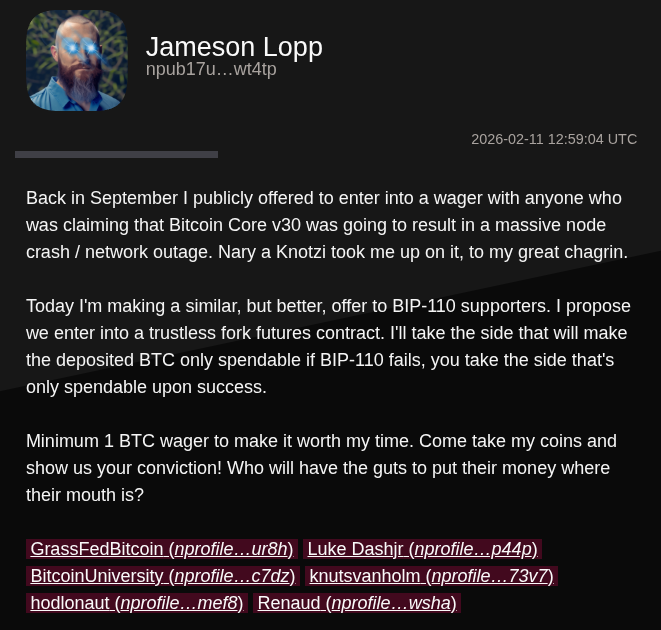
Jameson Lopp's Bet Invitation to BIP-110 Supporters
On the prediction market Polymarket, the probability of "BIP-110 will be activated and enforced on Bitcoin between September 1 and 7, 2026" is 10%. The "Yes" settlement condition requires the BIP-110 chain to become the "longest Bitcoin chain" accepted by the majority of nodes.
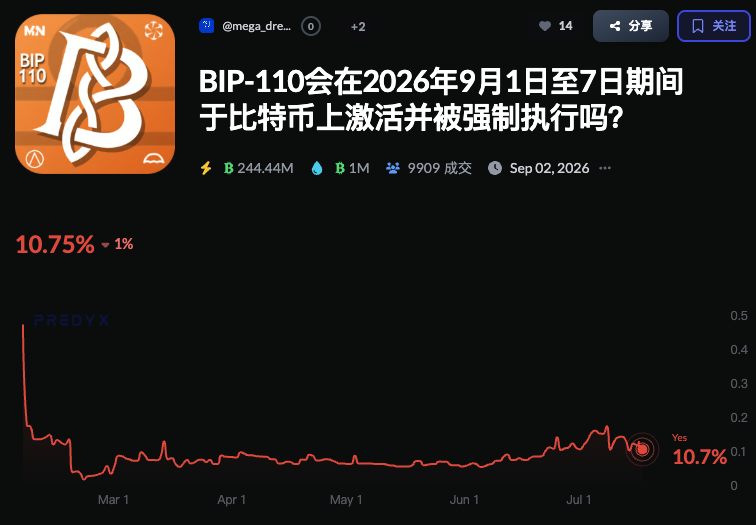
What Happens After BIP-110 Activates?
We can now consider some hypothetical scenarios for what happens after BIP-110 is forcibly activated at block height 965,664 (late August to early September).
The first scenario, as described above, is that upon reaching the activation height, BIP-110 nodes reject main chain blocks, but there is an insufficient proportion of miners producing new blocks that comply with BIP-110 rules. The BIP-110 chain would generate blocks extremely slowly and eventually stop producing them altogether, ceasing to "grow."
The second scenario involves a certain proportion of miners supporting BIP-110. BIP-110 supporters believe they have an "asymmetric advantage." Because BIP-110's rules are more restrictive, while BIP-110 nodes would reject blocks containing non-compliant data (like inscriptions), non-BIP-110 nodes (mainstream Core nodes) would still consider blocks produced by BIP-110 nodes as valid.
Moreover, currently, inscription transactions account for only 5% of Bitcoin block space, with over 95% being traditional Bitcoin transfer transactions. BIP-110 nodes can still receive and accept a large number of mainstream blocks. This is why Luke Dashjr believes BIP-110 could ultimately become the "longest chain" and unify the network.
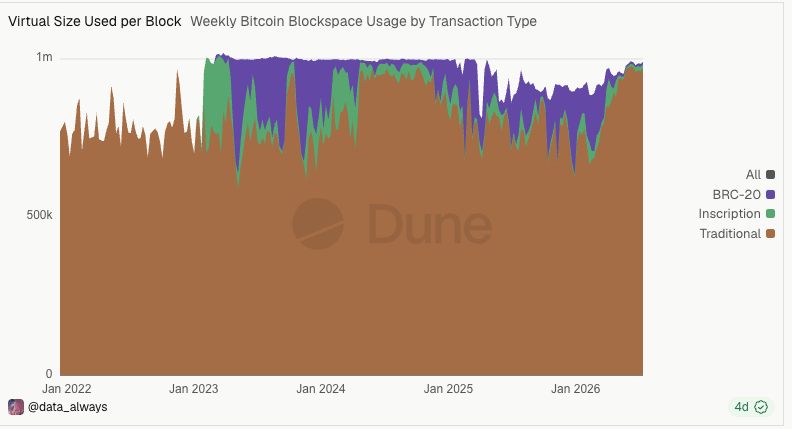
Usage Share of Different Transaction Types in Bitcoin Block Space
The third scenario is that a certain proportion of miners support BIP-110, but their hashrate can never surpass the existing majority chain. Generally, miners are extremely rational; once their machines start running, they consume electricity costs. In a competition between two chains, miners will weigh the pros and cons. Miners on the BIP-110 chain would be more likely to abandon sunk costs (mining rewards on the minority chain) and switch to the majority chain, which not only has a longer chain length but also accumulated more Bitcoin rewards. This would ultimately lead back to the first scenario.
So, what if Luke Dashjr's influence is strong, and miners act irrationally, persisting in mining on the BIP-110 chain? This chain would continue to operate independently, but block times would likely be very slow. Miners would be operating almost purely for ideological reasons, engaging in non-meaningful energy consumption. The most logical outcome in this case would be the BIP-110 chain permanently forking into an independent chain under BIP-110 supporters, "manually" adjusting the block difficulty, and launching a new network token.
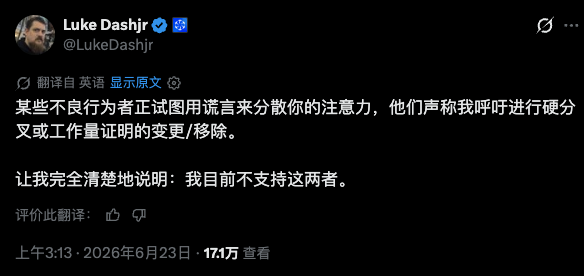
However, Luke Dashjr has repeatedly emphasized his rejection of a hard fork for BIP-110, stating that the time for using a hard fork has not yet come. But the water that buoys a boat can also sink it. At that point, Luke Dashjr might be swept along by popular will, with the arrow already loosed.
Therefore, the minority chain run by BIP-110 supporters can technically operate indefinitely, but it will likely struggle to thrive. This depends on economic and ecosystem factors, including support from wallets, exchanges, users, etc. There are many such examples on the Bitcoin network; the majority ultimately fail. Even if one successfully emerges, its ceiling is likely limited to independent coins like BCH or BSV.


