Gate Research: Chart Pattern Analysis and Breakout Trading Strategies


- Core Viewpoint: The article systematically elaborates on the theoretical framework of chart pattern analysis and breakout trading strategies, emphasizing that pattern analysis is not about mechanically identifying shapes but requires comprehensive judgment by integrating factors such as trends, volume, and support/resistance levels. Strict position management, stop-losses, and confirmation mechanisms are essential to cope with the high frequency of false breakout risks.
- Key Elements:
- Patterns are divided into reversal patterns (e.g., head and shoulders top/bottom) and continuation patterns (e.g., rectangle, flag, triangle). Their validity must be assessed comprehensively within the context of the prevailing trend.
- An effective breakout typically requires a clear support/resistance level, sufficient consolidation time, increased trading volume, and the characteristic of the price not retracing after the breakout. A close-based confirmation is superior to an intraday breakout.
- False breakouts are a common risk in live trading. They can be identified by dwindling volume, a rapid price reversal in the opposite direction, and the failure to continuously close beyond the key level.
- Entry strategies include entering immediately upon breakout, entering after a pullback confirmation, and entering in batches. The stop-loss principle is "stop-loss when the pattern is invalidated." Position sizing should be layered based on the strength of the signal.
- Take-profit and position management should follow the principle of "protect capital first, then amplify profits." Methods such as target-based take-profit, structural take-profit, and trend-based take-profit can be used to avoid exiting too early or stopping out too late.
- Volume is a core indicator for verifying the validity of a breakout. Supplementary confirmation can be obtained from support/resistance level flips, ATR, moving averages, Bollinger Bands, and momentum indicators like RSI.
Summary
• Chart patterns are important tools in technical analysis used to observe changes in market supply and demand, trend continuation, or trend reversal.
• Pattern analysis is not about mechanically memorizing shapes, but a comprehensive judgment of trends, volume, support and resistance, time cycles, and the validity of breakouts.
• Patterns can be broadly divided into two categories: reversal patterns, including double tops, double bottoms, head and shoulders tops, head and shoulders bottoms, etc.; and continuation patterns, including flags, triangles, rectangles, etc.
• Valid breakouts usually need to be based on clear support/resistance, a longer consolidation period, trend context, and volume confirmation.
• A breakout does not equal a guaranteed move. False breakouts occur frequently in live trading, so traders need to control risk through position sizing, stop-losses, confirmation by re-testing, and taking profits in batches.
1. Introduction
Chart patterns are crucial tools in technical analysis for observing shifts in market supply and demand, trend continuation, or trend reversal. Their core logic lies in the fact that price action reflects the buying and selling power of market participants, and patterns compress the struggle between bulls and bears into observable graphical structures. Pattern analysis is not about mechanically memorizing shapes, but a comprehensive judgment involving trends, volume, support and resistance, time cycles, and the validity of breakouts.
Breakout trading is a direct application of pattern analysis. A valid breakout typically requires a clear support/resistance level, a sufficiently long consolidation period, supporting trend context, and volume confirmation. However, a breakout does not guarantee a definitive move; false breakouts are frequent in live trading. Therefore, traders must control risk through position management, stop-losses, confirmation via re-testing, and scaling out of positions.
2. Theoretical Framework of Pattern Analysis
2.1 Two Fundamental Assumptions
Technical analysis is generally based on two fundamental assumptions:
1. Prices move in trends;
2. History tends to repeat itself in similar ways.
In an uptrend, bulls usually dominate; in a downtrend, bears usually dominate. However, trends don't last forever. When the forces of bulls and bears reach a balance, prices enter a consolidation phase, and patterns are formed. After consolidation ends, prices may either continue in the original trend or reverse direction.
2.2 Pattern Classification
Common chart patterns can be classified into the following categories. It's important to note that pattern classification is not absolute. The same pattern can have different meanings depending on its location, timeframe, and volume structure.

3. Major Pattern Types
3.1 Rectangle Pattern
A rectangle pattern forms when the price oscillates between two parallel support and resistance levels, indicating market indecision. The rectangle is usually a continuation pattern but can also evolve into a reversal pattern, depending on the breakout direction and volume confirmation. Typical characteristics of a rectangle pattern include:
• Price repeatedly tests the upper and lower boundaries;
• Support and resistance are relatively clear;
• Bull and bear forces are relatively balanced during the consolidation;
• Volume should noticeably increase upon a valid breakout or breakdown.
Rectangle patterns are mainly divided into bullish and bearish types. Whether breaking upwards or downwards, the subsequent price move is usually roughly equal to the width of the rectangle.
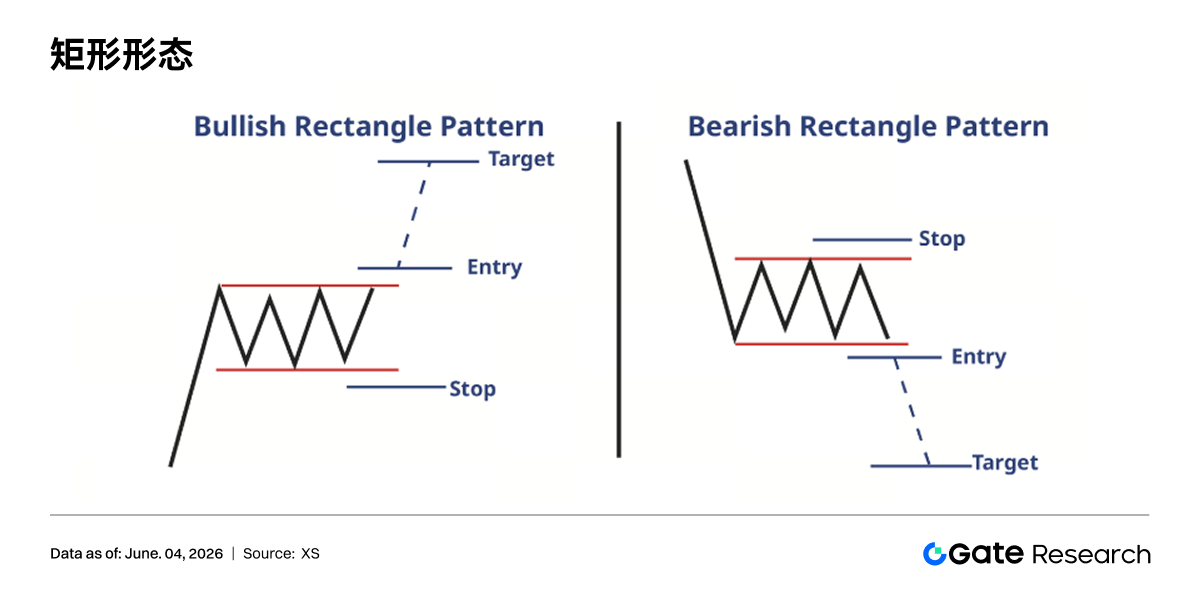
• Bullish Rectangle: A bullish rectangle forms during an uptrend when the price stops moving up and consolidates horizontally between two price levels. This pattern suggests the market is taking a brief pause before resuming its upward move. A break above the resistance level, accompanied by increased volume, confirms the uptrend will continue. After the breakout, traders can enter long positions, setting a target at the height of the rectangle above the resistance line.
• Bearish Rectangle: A bearish rectangle pattern appears when the price stabilizes within a horizontal range during a downtrend. The market uses this pattern for a brief consolidation before continuing its decline. A break below the support level confirms the downtrend will continue. Traders should enter short positions after the breakdown, anticipating that the price will fall by the height of the rectangle.
3.2 Flag Pattern and Pennant Pattern
Flags and pennants are both short-term continuation patterns that typically appear after a sharp price rise or fall. The flag pattern consists of a sharp price move (the flagpole) followed by a rectangular or parallelogram-shaped consolidation phase (the flag), which slopes against the trend. The pennant pattern also begins with a sharp price move (the flagpole) but is followed by a small symmetrical triangle formed by converging trend lines. Their typical characteristics include:
• A clear sharp rally or decline should precede the formation;
• The flagpole phase is usually accompanied by high volume;
• Volume may decline during the consolidation phase;
• Volume should expand again upon the next breakout.
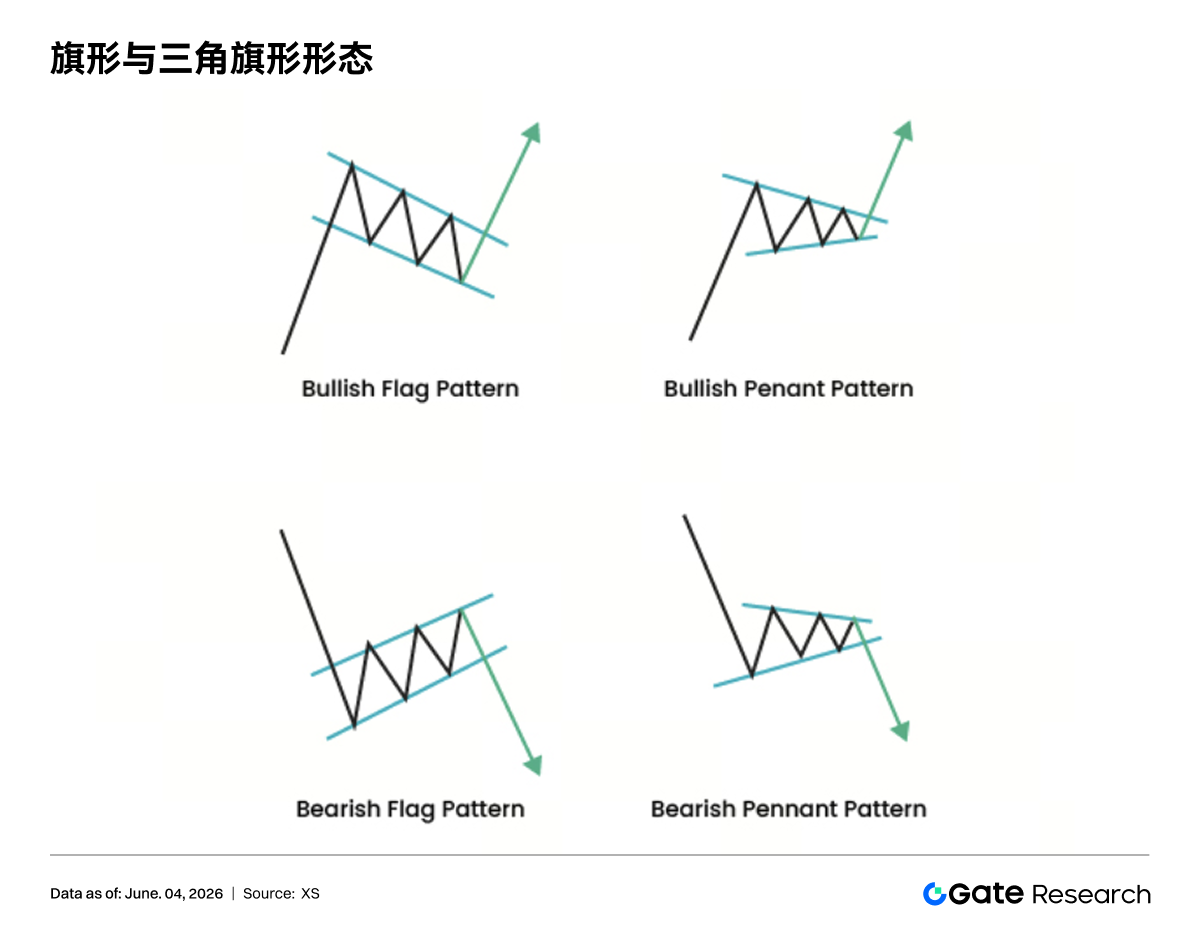
Flag patterns usually foreshadow a continuation of the existing trend in the near term. The breakout typically occurs in the direction of the initial flagpole, which is the rapid price move before the pattern forms. After the breakout, the length of the flagpole can be used to project the subsequent target.
Traders can enter when the price breaks out of the flag pattern. For a bullish flag pattern, look for a break above the upper trend line; for a bearish flag pattern, look for a break below the lower trend line. Set profit targets based on the height of the flagpole. Use stop-loss orders to manage risk and guard against false breakouts.
Note that rectangle patterns usually form over about 3 months, while flags typically form around 3 weeks.
3.3 Symmetrical Triangle
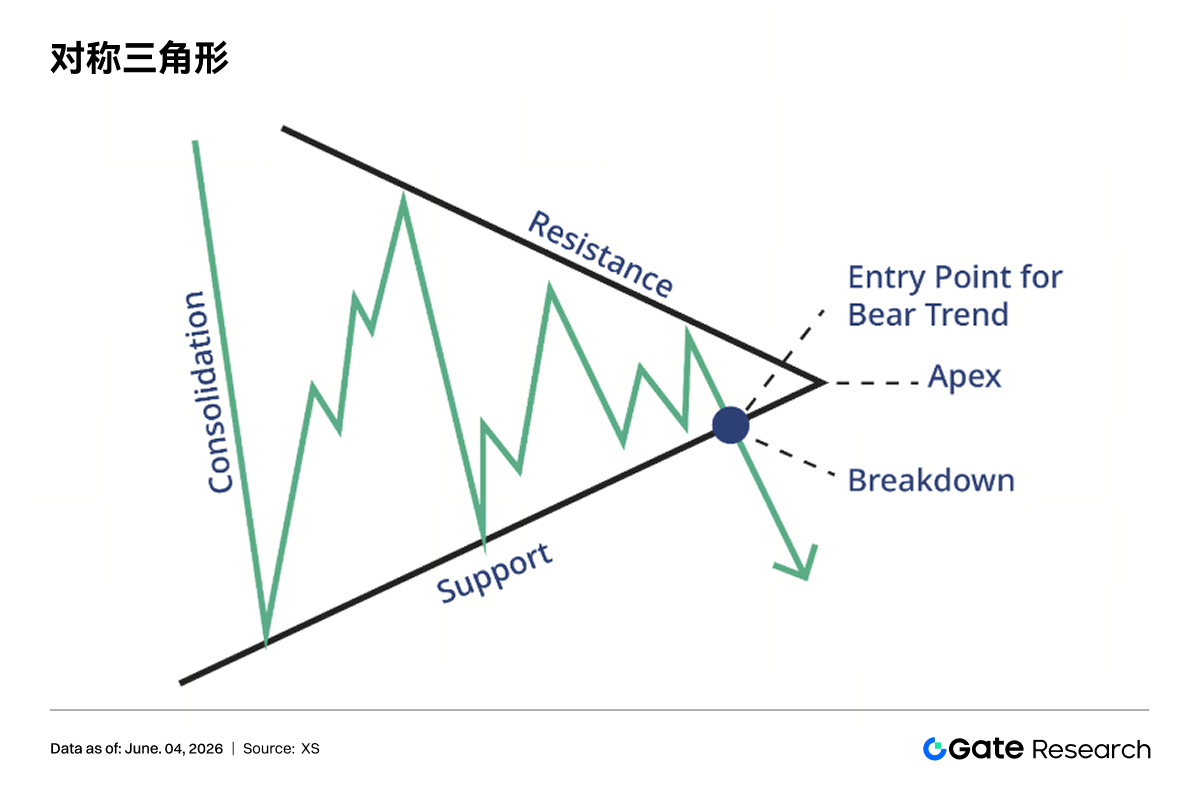
The symmetrical triangle is often slightly bullish, but it can break out either upwards or downwards. It is characterized by progressively lower highs and higher lows, causing the trading range to narrow. Unlike the pennant, the symmetrical triangle usually lasts longer than three weeks. This pattern reflects a period of market indecision, where the forces of bulls and bears are temporarily balanced. The symmetrical triangle often appears as a continuation pattern but can also be a reversal pattern. It is advisable not to predict the direction prematurely but to wait for a valid breakout or breakdown. Its typical characteristics include:
• At least two progressively lower highs;
• At least two progressively higher lows;
• Volume usually declines during the convergence;
• The ideal breakout often occurs between one-half and three-quarters of the way through the pattern's development;
• Monitor volume and price acceleration upon breakout or breakdown.
The target can be estimated in two ways: First, measure the height of the triangle at its widest point and project it from the breakout point. Second, draw a line parallel to the trend line and project the potential price range. The core of the symmetrical triangle is not to judge which side (bulls or bears) has already won, but to identify the process of gradually converging price volatility. Decreasing highs show that selling pressure is appearing earlier on each rally, while rising lows show that buying interest is entering earlier on each dip. Both forces are compressing, eventually requiring a breakout or breakdown to determine direction.
3.4 Ascending Triangle
The ascending triangle is generally considered a bullish pattern. Its upper boundary is roughly horizontal, representing a resistance area. Its lower boundary rises gradually, indicating that buyers are willing to step in at increasingly higher prices. The core meaning of this pattern is that sellers are repeatedly suppressing prices at the same resistance level, but buyers' strength is gradually increasing, potentially driving the price through the resistance. Its typical characteristics include:
• The top resistance is relatively flat;
• The bottom lows are progressively higher;
• Volume should expand noticeably on an upward breakout;
• The former resistance level post-breakout may turn into support.
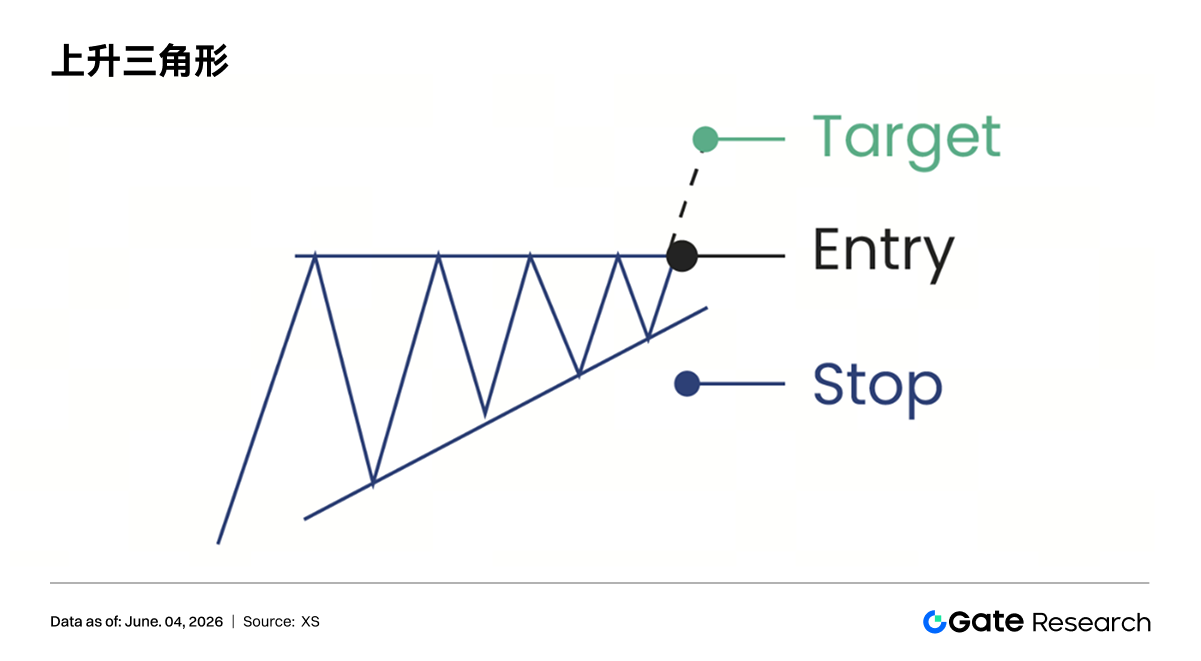
The target can be calculated by taking the height of the pattern at its widest point and adding it to the breakout level. The key to the ascending triangle lies in the relatively fixed top resistance and the rising bottom support. The resistance level being tested multiple times indicates persistent selling pressure there. However, each retracement forms a higher low, signifying that buyers are willing to take on shares at a higher cost. As the price range narrows and selling pressure is gradually absorbed, an eventual breakout above resistance with increased volume often opens up upside potential.
3.5 Descending Triangle
The descending triangle is the inverse structure of the ascending triangle and is generally considered a bearish pattern. Its lower boundary is roughly horizontal, representing a support area. Its upper boundary moves progressively lower, indicating that sellers are applying pressure at increasingly lower prices. Its typical characteristics include:
• The bottom support is relatively flat;
• The top highs are progressively lower;
• After a breakdown through support, the former support may turn into resistance;
• The target can be projected downwards using the pattern's height.
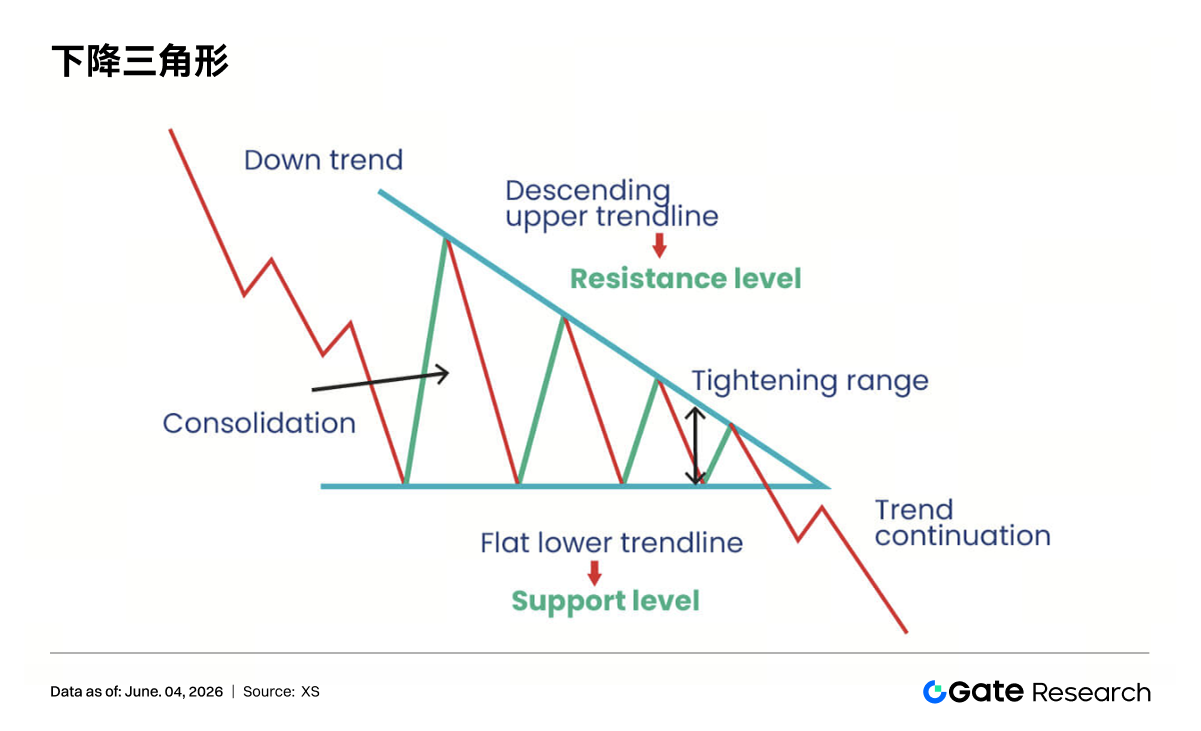
The core of the descending triangle is the repeated testing of the bottom support, while the rally highs consistently decline. The support level is touched multiple times, suggesting there is still buying interest in that area. However, each rally is lower, meaning sellers are willing to sell continuously at lower prices, and the buyers' counterattack is weakening. When the price finally breaks down through the horizontal support, the previous buying support may turn into stop-loss orders and new selling pressure, leading to further declines.
3.6 Head and Shoulders Top and Head and Shoulders Bottom
The head and shoulders top is a major top reversal pattern. It's a classic bearish reversal pattern that usually appears at the end of an uptrend. It consists of a left shoulder, a head, a right shoulder, and a neckline. Connecting the lows on either side of the head and extending them to the right forms the neckline. The head is higher than the left and right shoulders, which are roughly equal in height. The formation logic is as follows:
• Price hits a phase high during an uptrend, forming the left shoulder;
• Price then rallies to a new high (higher than the left shoulder), forming the head, but volume may be weaker;
• A third rally fails to exceed the head's high, forming the right shoulder;
• A breakdown below the neckline completes the pattern, confirming the trend reversal signal.
The left shoulder forms with relatively high volume, volume diminishes on the head rally, and volume is weakest on the right shoulder rally. Volume expands upon the breakdown below the neckline, enhancing the credibility of the reversal signal. The target is calculated by measuring the vertical distance from the head to the neckline and projecting it downward from the neckline breakdown point. After the neckline is broken, the former support level usually turns into resistance.
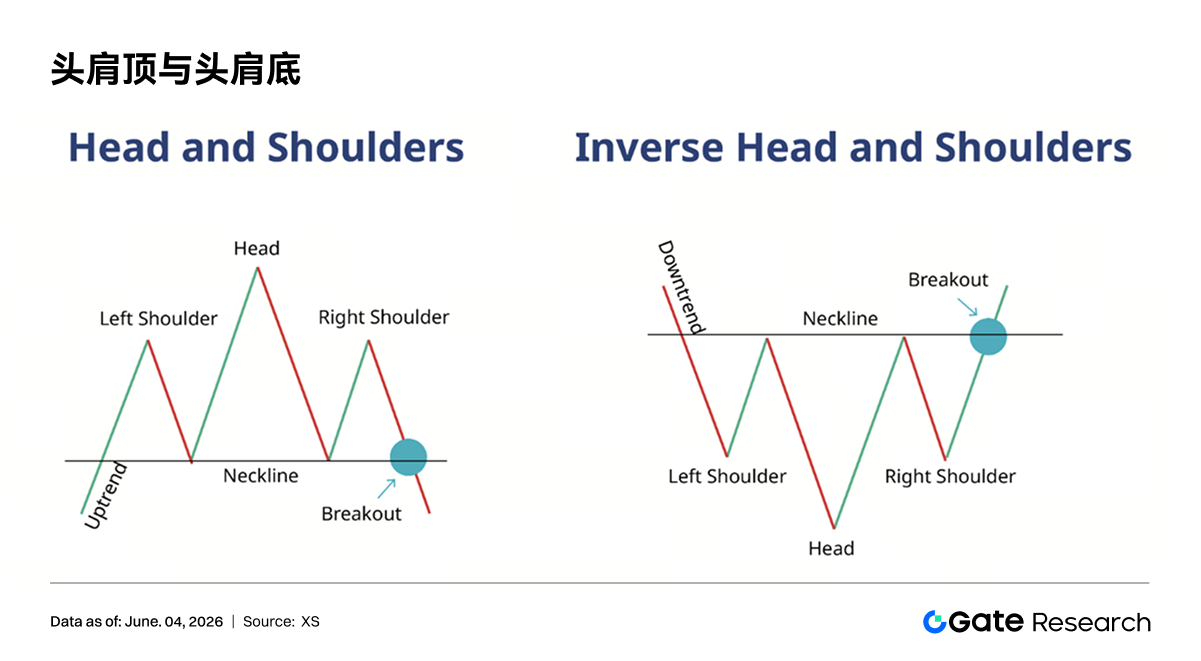
The head and shoulders bottom is the inverse structure of the head and shoulders top, typically appearing at the end of a downtrend. Its structure consists of a left shoulder, a head, and a right shoulder, with a neckline. The head is lower than both shoulders. Its logic and usage are opposite to that of the head and shoulders top.
4. Breakout and Breakdown Trading Strategies
4.1 Definition of Breakout Trading
A breakout occurs when the price moves decisively above a previously established resistance level and continues to move higher. A breakdown occurs when the price moves decisively below a previously established support level and continues to move lower. They are often collectively referred to as breakouts. The core focus of breakout traders is not the volatility within a range, but the extension of the trend after the price leaves the range. The underlying logic of breakout trading is that after a prolonged consolidation or the formation of a clear pattern, once the price effectively breaks out of the range, it can trigger a significant move.
Breakout trading is effective because it reflects market psychology and the herd effect. Many traders place buy or sell orders above resistance or below support. A price move through these levels activates all these pending orders simultaneously, leading to rapid market movement, and this FOMO effect can further fuel the price move.
4.2 Relationship Between Range Trading and Breakout Trading
Range traders typically buy near support and sell near resistance, profiting from the price oscillating within a channel. Breakout traders wait for the price to leave the range and then trade in the direction of the breakout. These two approaches are not contradictory but correspond to different stages of the market.

4.3 Conditions for a Valid Breakout
A valid breakout typically exhibits the following characteristics:
• Price breaks through a clear resistance level or falls below a clear support level;
• There is a clear consolidation range or pattern before the breakout;
• Volume expands during the breakout;
• Price does not quickly fall back into the original range after the breakout;
• If a re-test occurs, the former resistance should turn into support, and the former support should turn into resistance.
In practical application, the validity of a breakout should not be judged solely on intraday price spikes. Instead, focus on the closing price. If the price breaks through resistance intraday but closes back below it, it suggests that selling pressure above remains strong. If the price closes decisively above resistance with a concurrent increase in volume, the signal is of higher quality. For daily timeframe traders, confirmation from the daily close is usually more reliable than an intraday breakout. Short-term traders should also use corresponding timeframe closes for confirmation to avoid being misled by transient volatility.
The quality of the consolidation before the breakout is equally important. A good breakout pattern usually has three characteristics: First, the consolidation range boundaries are clear so market participants can identify similar support and resistance levels. Second, the consolidation period is long enough, implying sufficient exchange of shares. Third, volatility gradually contracts during the consolidation, indicating that a directional decision is imminent. If the price suddenly rises without a clear consolidation or near a critical resistance level, it is more likely a short-term impulsive move rather than a structural breakout.
Breakout signals can be categorized into strong, medium, and weak levels. A strong breakout typically shows a long bullish or bearish candle with high volume, closes far from the breakout level, and doesn't return to the original range. A medium breakout might show a close just above the breakout level, requiring a re-test for confirmation. A weak breakout shows an intraday breakout but an unstable close, insufficient volume, or immediate stalling after the breakout. Different levels of breakouts should correspond to different position sizes, rather than using a single set of position rules.
4.4 Entry and Stop-Loss
Basic trading strategies include:
• On an upward breakout, go long above the high of the first breakout candle;
• On a downward breakdown, go short below the low of the first breakdown candle;
• In range trading, buy near support and sell near resistance;
• In breakout trading, place stop-losses about 1% to 2% below the breakout level, or outside the pattern's key support/resistance level.
Entry methods can be further broken down into three categories. The first is immediate entry on the breakout, suitable for situations with significantly high volume, strong closing prices, and a clear market trend. The advantage is capturing the strongest part of the move; the disadvantage is a higher cost for potential false breakouts. The second is entry after a re-test, suitable when the price breaks out, retraces to test the former support or resistance, and holds. The advantage is a clearer risk-reward ratio; the disadvantage is potentially missing strong trends that don't re-test. The third is scaled entry, taking a partial position on the breakout and adding to it after a successful re-test confirmation, balancing participation opportunities with risk management.
Stop-loss placement should follow the principle: