






1.6 Billion Market Cap Is Just the Beginning: The True Value of Tokenized Stocks Lies in On-Chain Infrastructure


- Core Thesis: The tokenized stock sector holds growth potential, but current issuance primarily relies on a custodial wrapper model, making early-stage investment opportunities difficult for retail investors to access; the true value lies in betting on the proliferation of native on-chain asset tokenization, rather than directly trading tokenized stocks.
- Key Takeaways:
- Tokenized stocks carry multiple risks, including issuer custodial risk, insufficient liquidity, and smart contract risk—exemplified by the xStocks platform's SPCX token plummeting 40% due to a lock-up issue.
- The sector remains extremely small, with a total circulating value of only $1.5 billion (lower than Uniswap's $1.9 billion), and the majority of underlying assets are stocks of mature companies (e.g., Strategy valued at $129 million), not early-stage investment opportunities.
- Standard Chartered predicts that the scale of on-chain tokenized assets will surpass $4 trillion by 2028. The growth of tokenized equities will drive revenue for platforms like Uniswap and grant the crypto industry counter-cyclical characteristics.
- Backpack, through Superstate's Opening Bell, has achieved native on-chain equity issuance, granting holders dividends and voting rights. Its token, BP, is exchangeable for physical equity and has recently surged by 200%.
- Market leader xStocks holds a 60% market share but, following its acquisition by Kraken, launched a points program (xPoints), making its token issuance prospects uncertain. Ondo's ONDO token serves only a governance function and faces nearly 50% token dilution.
- Trading opportunities include engaging in delta-neutral hedging on platforms like Backpack and Variational, or participating in points farming, but caution is advised regarding the risk of platform closures like Ventuals.
Original author: Ignas | DeFi Research
Original translation: Saoirse, Foresight News
In my opinion, there is only one way to make significant money from tokenized stocks.
Of course, you can buy these tokens hoping for a tenfold increase, but apart from a few exceptions like Micron Technology (MU), such a windfall is highly unlikely. Firstly, only about 2,290 stocks have been tokenized, and only around 130 have a total market value exceeding $1 million. The vast majority of tokenized stocks have almost no liquidity on-chain.
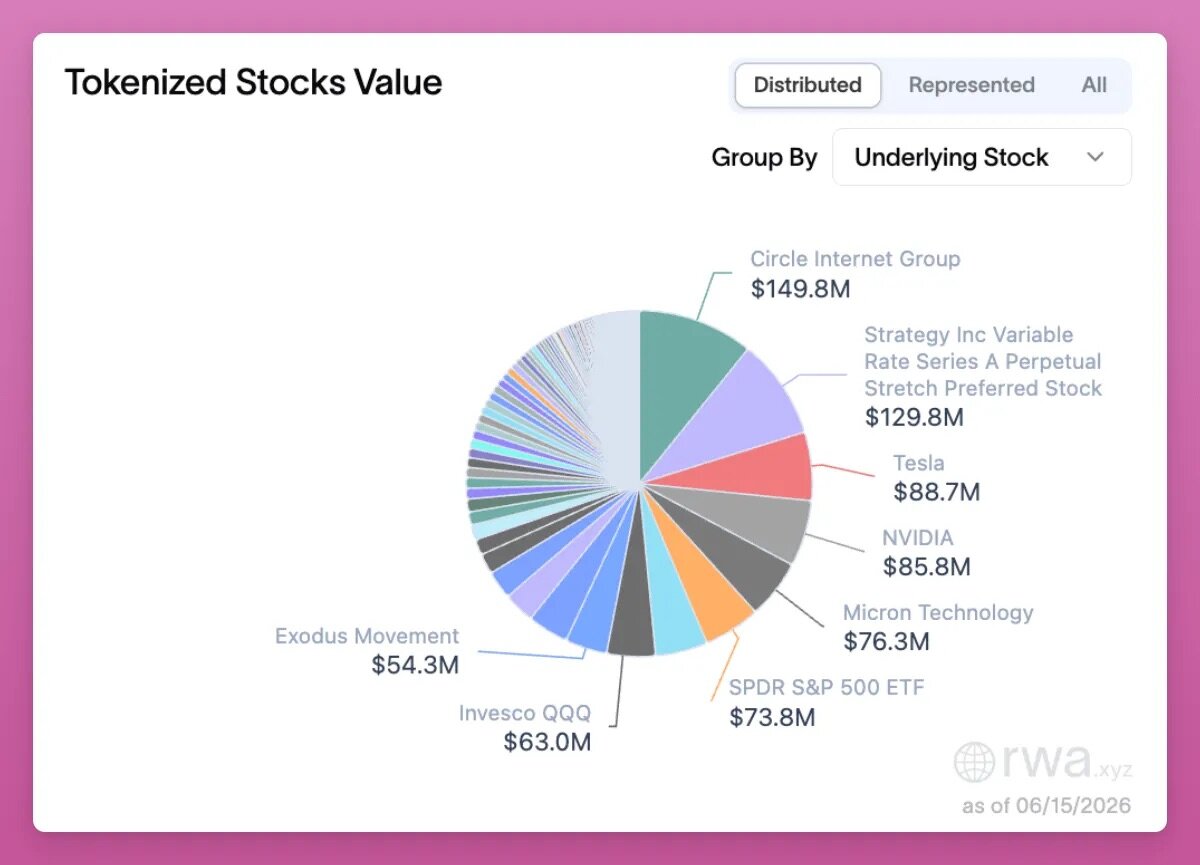
According to RWA data website rwa.xyz, Strategy is one of the largest of these assets, with a total value of $129 million.
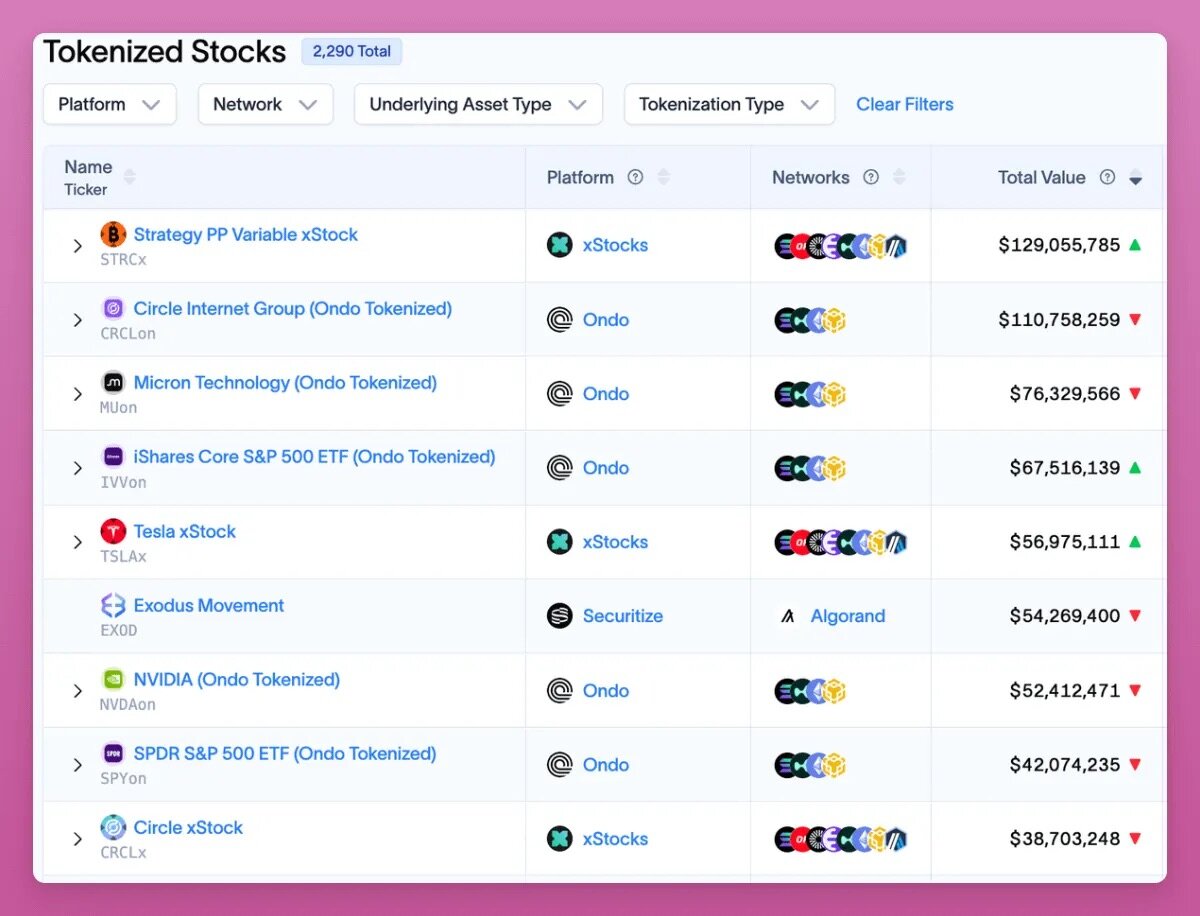
Currently, most tokenized stocks are from established listed companies. If you're looking for undervalued, low-profile stocks, traditional brokers like Interactive Brokers offer more opportunities.
Secondly, holding tokenized stocks introduces many risks that don't exist with traditional brokerage holdings. For example, investors who bought SpaceX tokenized stocks (SPCX) on the PreStocks platform discovered that these tokens need to be locked for 180 days before being redeemable for real shares. This news caused the token price to plummet by 40%.
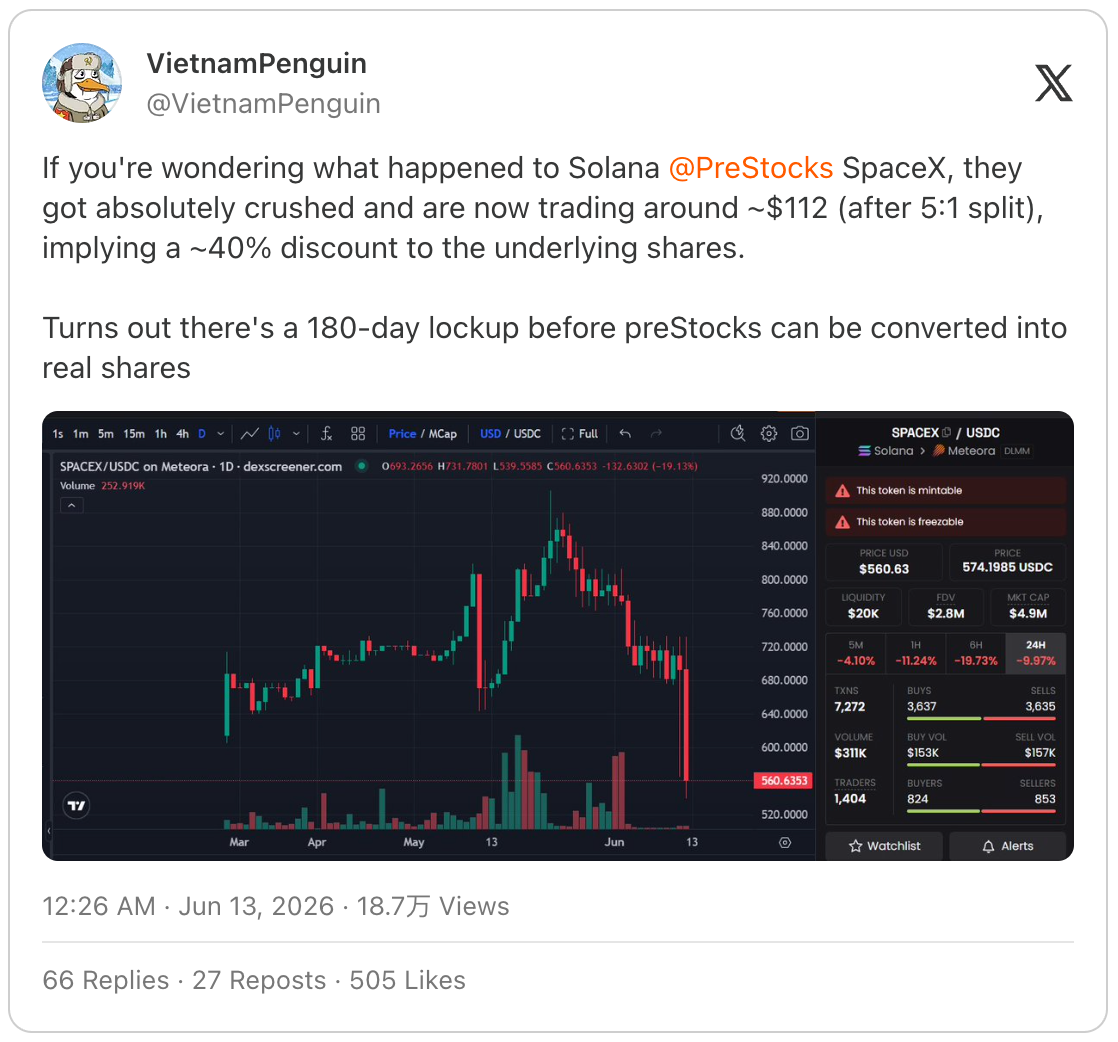
Source: https://x.com/VietnamPenguin/status/2065470925252759680
Therefore, in addition to bearing the inherent crypto risks of smart contract vulnerabilities, self-custody asset risks (without enjoying the benefits of self-custody), and liquidity risks, investors must also bear the risks associated with the issuer and the asset custodian.
However, I am not entirely dismissing the tokenized stock sector. It is one of the most promising sectors in crypto for growth: it can attract new users and retain existing ones who might otherwise cash out their crypto assets to invest in traditional financial markets. Tokenized stocks bring on-chain trading activity and fee revenue to blockchains, attract venture capital and developers to the industry, and generate market attention.
Tokenized stocks themselves offer several opportunities: you can deposit them into Decentralized Exchange (DEX) liquidity pools to earn yields, or use them as collateral for loans. You can also hold SPCX spot tokens on-chain while shorting the corresponding perpetual contracts to earn delta-neutral returns, simultaneously accumulating points from the perpetual DEX platform.
Speaking of hedging strategies, you can buy tokenized stock spot and short them on the Variational platform. The platform's native token, VAR, is arguably the best airdrop opportunity right now:
- 50% of the total token supply will be allocated to the community;
- The points activity ends on September 30th, leaving only about 3.5 months for mining;
- After the token launch, the team plans to use 30% of platform revenue for buybacks and burns;
- The platform is still in closed beta.
Tokenized Stocks are Not an Early-Stage Investment Sector
But my biggest concern with tokenized stocks is this: this sector essentially makes crypto investors the exit liquidity for traditional financial assets.
The reason the crypto industry has produced so many millionaires in the past is that we got in early on new tracks: Bitcoin, smart contract L1s, various project airdrops, NFTs, the Hyperliquid airdrop, and countless others. The tokenized listing process for SpaceX made this issue clear.
Its issuance model is identical to that of hyped-up crypto L2 tokens: low circulating supply, extremely high fully diluted valuation (FDV), and a price decoupled from the company's fundamentals. In the short term, traditional financial markets are currently in a phase where "high FDV is just a gimmick," exactly like the crypto industry two years ago.
Undeniably, rockets, artificial intelligence, and Starlink sound promising, but the company's valuation, equity unlock schedule, revenue data, and governance mechanisms are hardly optimistic.
The core value of tokenization lies in broadening asset distribution channels: anyone with a Phantom, Metamask, or Rabby wallet can hold these tokens. Their volatility is lower than Bitcoin or altcoins but higher than stablecoins pegged to the dollar, offering a risk-return profile in between. For investors outside developed markets, or those who don't want to or cannot convert their crypto assets back into the traditional financial system, tokenized stocks offer an attractive solution.
But this doesn't mean we are capturing early-stage investment opportunities. The former allure of the crypto industry was giving ordinary retail investors access to invest in revolutionary startups. An IPO project valued at $2 trillion is hardly an early-stage investment.
The true long-term growth potential for the crypto industry lies in companies issuing their equity as on-chain tokens from inception. ICOs and fair launches were good attempts, but in the last bull cycle, the industry became increasingly predatory towards retail investors: project private sale valuations were inflated, valuations at TGE were even higher, and the allocation of tokens available to the general public was pitifully small. Cobie analyzed this point very thoroughly in his blog post.
I still participate in investments on Cobie's Echo platform because it genuinely offers early-stage project investment opportunities: my investment in the MegaETH round has already returned 3.85x, even though the market has been sluggish since the token launched.
Apptronic is a humanoid robot company. Despite its high valuation, I also participated in its Series B strategic financing. These types of investment opportunities are not open to ordinary retail investors on traditional financial platforms.
By the way, aside from Echo, I am also very optimistic about the Legion platform, but it still needs to find high-quality investment targets with reasonable valuations, which is not easy.
MetaDAO's model is excellent: the ownership tokens issued by the platform grant holders legal equity, use allowance controls to oversee treasury spending, and unlock tokens based on company performance, perfectly solving the core problems exposed by the ICO craze. This is also why, in the current market environment, the various ICO projects launched on MetaDAO have performed relatively better overall.
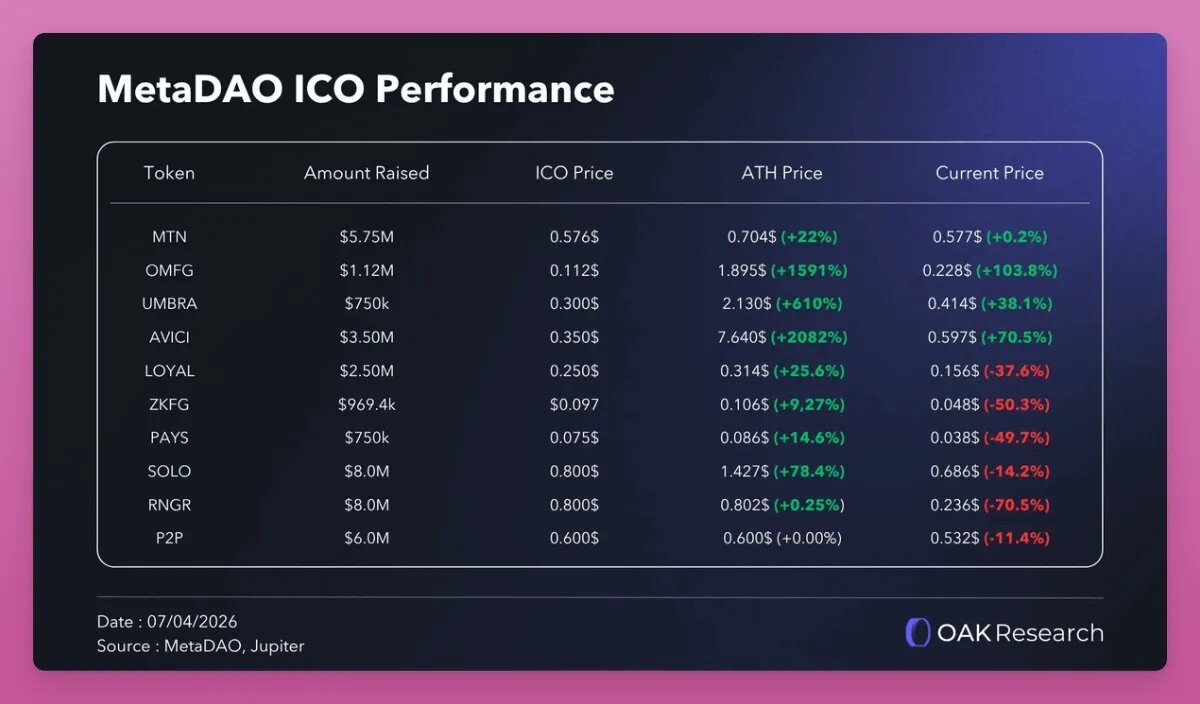
Source: X Platform, OAK Research
Beyond this, there is the native on-chain issuance model, such as Superstate's Opening Bell product line. The first asset is Galaxy stock, where corporate equity is issued compliantly directly on-chain.
Imagine if large companies bypassed the traditional listing process and instead issued equity directly on public blockchains like Ethereum or Solana, rather than just using the blockchain to wrap off-chain legal equity certificates. Then, the immutability and security of the blockchain would become the industry's core competitive advantage, and the value of the tokens we hold would increase accordingly.
MetaLeX is adopting this approach: creating fully programmable on-chain companies where corporate capital, equity, and equity vesting schedules are all managed on-chain.
Back to the point, top centralized exchanges (CEXs) like Binance, Coinbase, and Kraken are heavily expanding into traditional finance, listing tokenized stocks, bonds, and ETFs. However, the xStocks platform failed to deliver the underlying physical stocks, causing Binance, Bybit, and Bitget to delist all SpaceX tokenized stock products, leaving over $1 billion in user orders unfulfilled. In contrast, trading orders on traditional brokers are more reliable.
Stablecoins were initially used for short-term asset storage while waiting to enter crypto-native assets; now stablecoins have become a liquidity exit for absorbing funds from middle-aged and elderly investors in traditional finance.
Some might argue that pre-IPO tokenized stocks allow ordinary people to get in early on top-tier star companies like OpenAI and Anthropic. Indeed, by market cap, these two are the hottest primary market tokenized assets, but both companies are valued near $1 trillion.
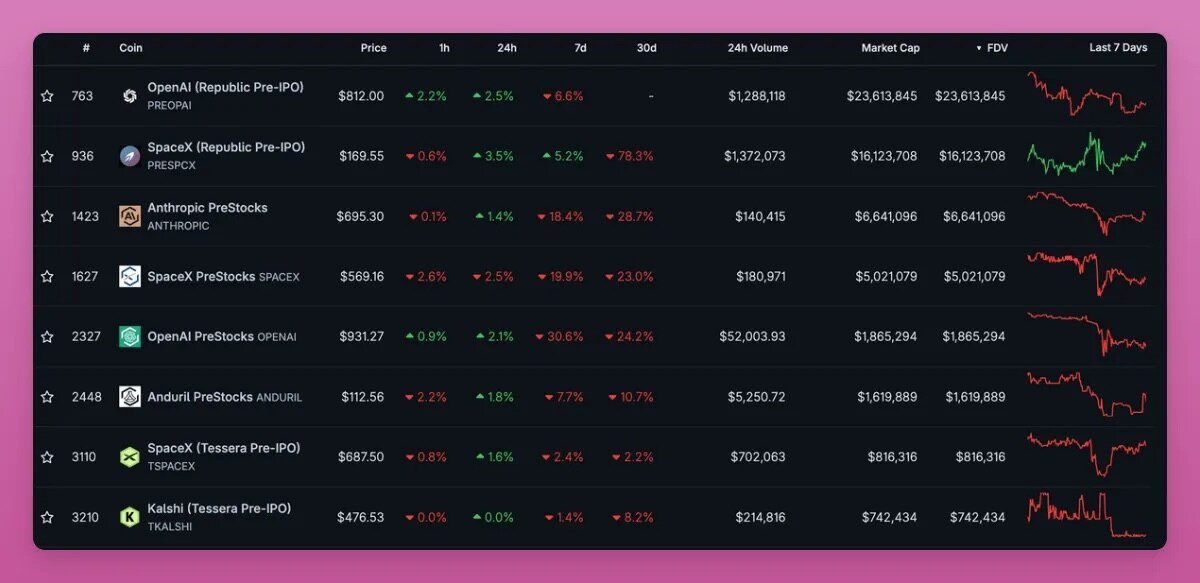
This is hardly an early-stage investment: Anthropic's latest Series H strategic financing round was at a valuation of $965 billion. Funding rounds: Series A, B, C, D, E, F, G, H (latest round).
The Tokenized Equity Sector is Still in Its Infancy
Standard Chartered Bank has given a price target of $100 for the Uniswap token UNI, implying a potential 40x increase! The logic is as follows: the bank predicts that by 2030, the scale of tokenized assets circulating within Decentralized Finance (DeFi) will grow 37 times (from 3.5% of total assets today to 30% by 2030); the total scale of on-chain tokenized assets will exceed $4 trillion by 2028.
As of now, the total freely transferable value of tokenized equities across platforms is $1.5 billion (these assets can be transferred peer-to-peer between wallets, independent of the issuance platform), primarily deployed on Ethereum, BNB Smart Chain, and Solana. But the overall sector size remains tiny: $1.5 billion is even less than the $1.9 billion market cap of the Uniswap token UNI itself.
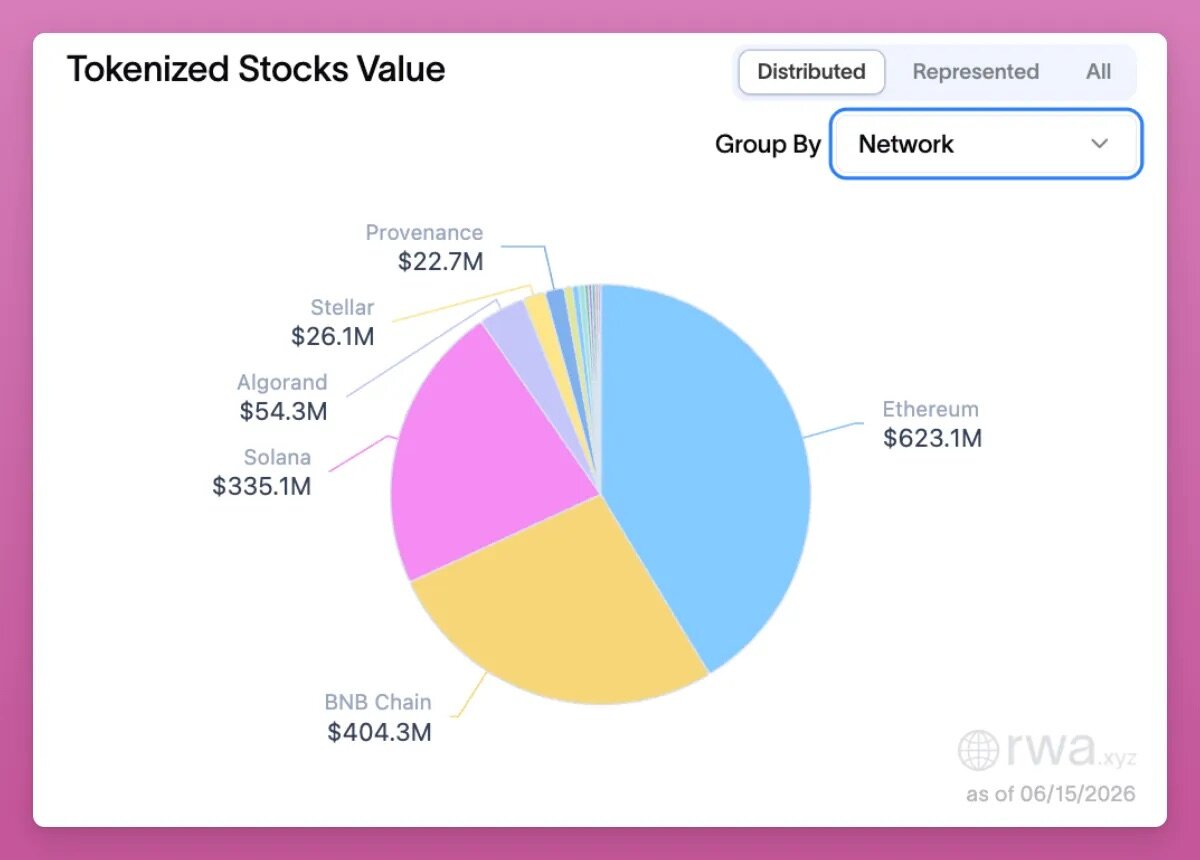
Standard Chartered has a history of extremely optimistic price predictions (previously forecasting Ethereum at $40,000 and Bitcoin at $500,000 by 2030), but the underlying logic for bullishness on UNI is sound: the rising total value locked (TVL) in tokenized equities will drive higher on-chain trading volumes and increased platform fees. These fees are now used to buy back and burn UNI tokens.
Uniswap won't be the only beneficiary. If the tokenized equity sector explodes, the entire crypto ecosystem will profit: lending protocols like Aave, Fluid, and Kamino, as well as DEXs across various L1s like Pancakeswap and Jupiter, will all get a piece of the pie.
The development of tokenized equities could make the crypto industry counter-cyclical: currently, when Bitcoin and Ethereum prices fall, DeFi lending undergoes massive deleveraging, protocol revenues shrink, and their native tokens come under pressure together. Perpetual DEXs were the first sector to benefit from tokenized stocks; spot exchanges will be the next wave of beneficiaries.
Following the Standard Chartered report, the UNI token rose 13% in a single day, but there are more investment opportunities within the sector. Over the past two weeks, Backpack's platform token BP has surged 200%.
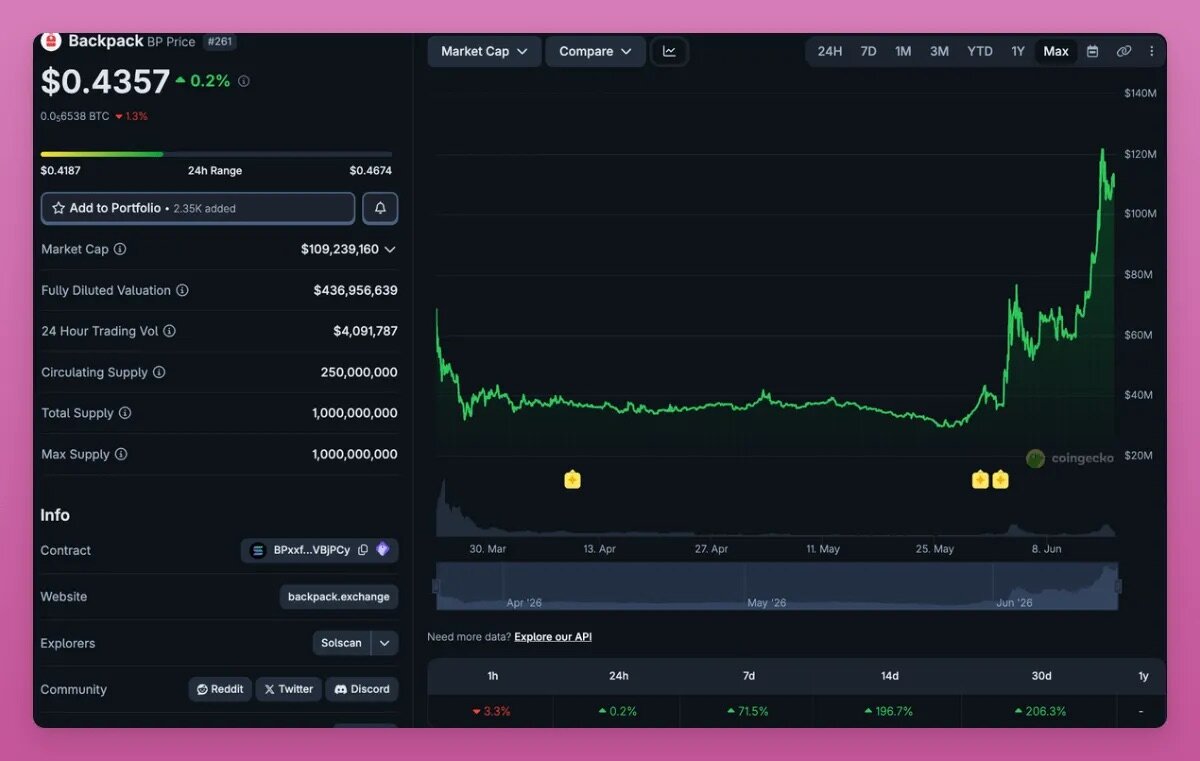
As a centralized exchange, Backpack previously struggled to find a core business that truly fit market demand, having to compete on one side with established top-tier exchanges like Binance and on the other side with decentralized perpetual platforms like Hyperliquid for users. The tokenized asset business seems to have finally given it a core growth trajectory.
The vast majority of tokenized stocks on the market (xStocks, Ondo) operate on a custodial wrapping model: the issuer holds the physical stock and mints a token tracking its price. Users only gain price exposure, not actual equity. Backpack, however, achieves native on-chain issuance through Superstate's Opening Bell product line: these tokens are formally registered equities with the SEC, carrying the exact same rights as stocks listed on Nasdaq. Holders are entitled to dividends and voting rights, and the platform holds a full set of compliance licenses (Backpack's founding team comes from the former FTX Europe division).
This logic extends to the platform's native token BP: staking BP for one year allows conversion into corporate entity equity when the company IPOs or is acquired (with a 7-day redemption window each year).
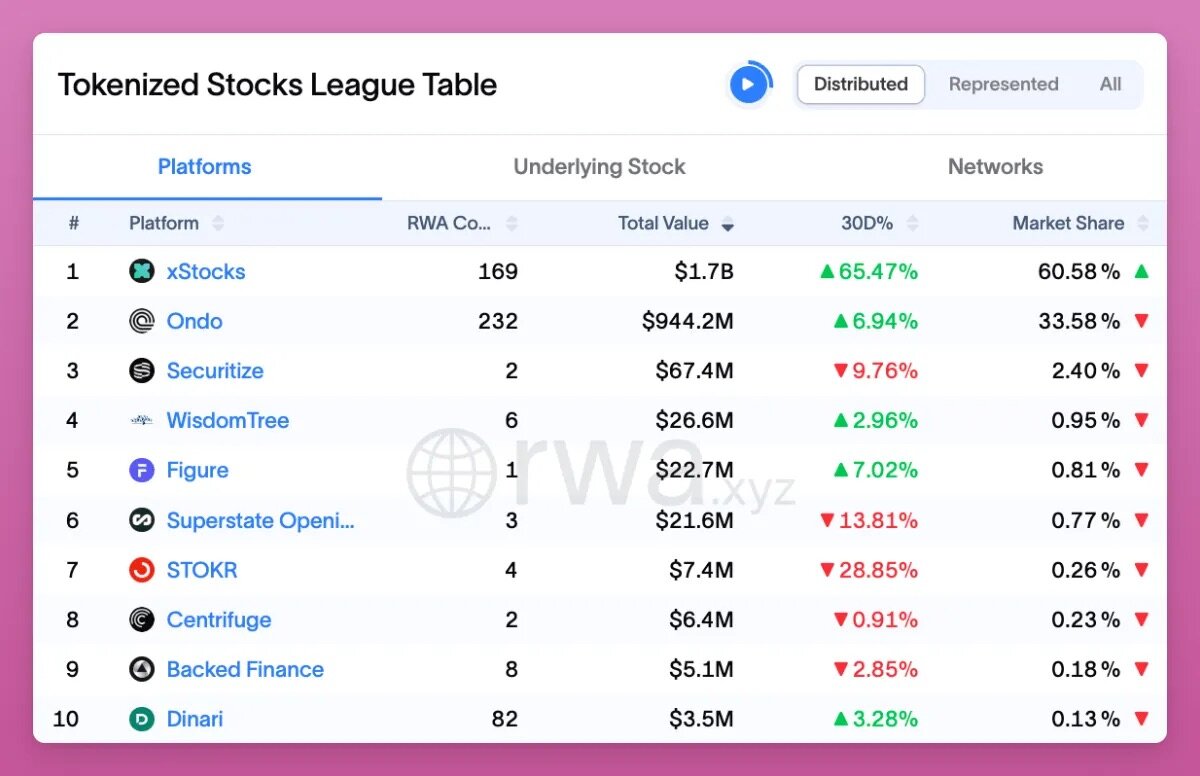
There are also direct trading opportunities in the tokenized equity sector: Ondo ranks second in the industry by total freely circulating value, and the platform has issued a native token, ONDO.
However, ONDO only has governance functionality and almost no value capture capability. All platform revenue belongs to the company and is not distributed to token holders. While there is market discussion about initiating a fee distribution mechanism, its implementation remains uncertain. Moreover, the token faces immense dilution pressure, with nearly 50% of tokens still awaiting unlock until 2029.
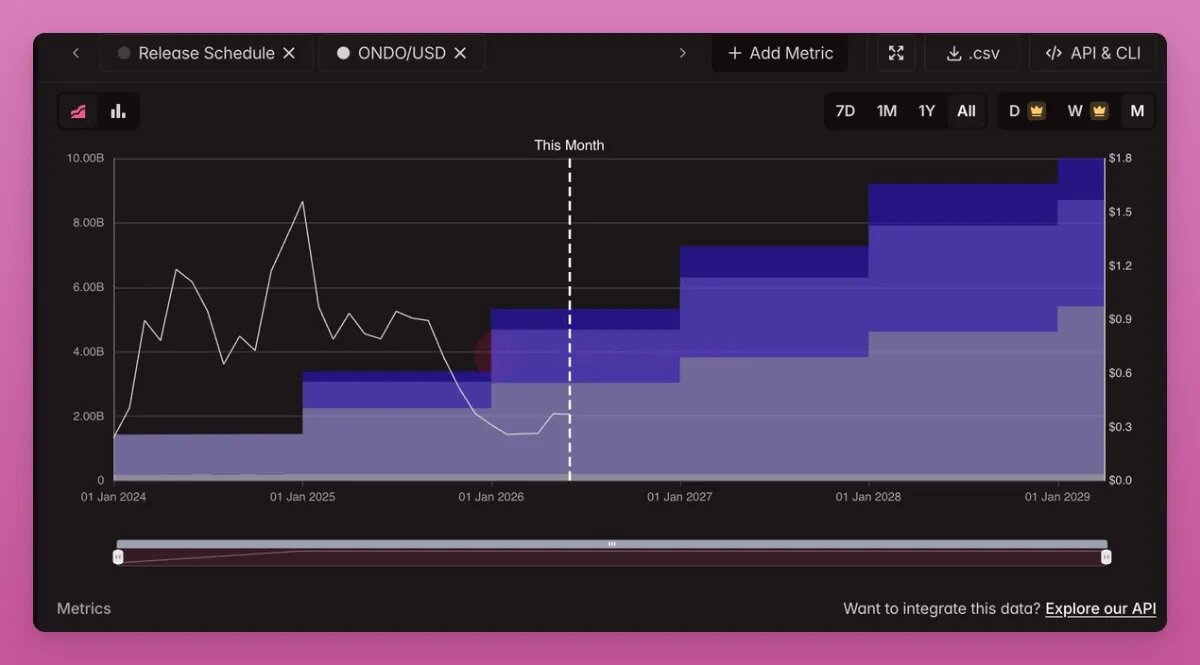
If sentiment warms up in the tokenized equity market, there might be short-term speculative opportunities in ONDO, but I wouldn't hold it long-term.
Industry leader xStocks holds a 60% market share, with a total scale of around $1.7 billion. Backed Finance purchases real stocks and ETFs, places them in a 1:1 reserve with a custodian, and then mints tokens tracking the asset prices. The products are deployed on Solana and Ethereum (a small amount on Arbitrum L2). Users can trade on the Kraken exchange 5 days a week, or 24/7 on-chain, covering about 60 assets. The number of assets is less than Ondo, but the liquidity is better.
Holding an xStock token does not equal holding the underlying physical stock; it is merely a debt claim against the issuing institution. If the platform faces risk, investors are merely unsecured creditors of a cross-jurisdictional wrapping service provider, a model completely different from Backpack's where holders own real equity.
More ironically, Kraken submitted its own IPO application just weeks before acquiring Backed Finance last year, at a valuation of $20 billion at the time. This also raises significant market questions about whether the platform will issue an independent token.
After the acquisition, xStocks launched the xPoints points activity in March. Points programs are usually a precursor to a token launch, but the platform has yet to confirm whether it will launch a token.
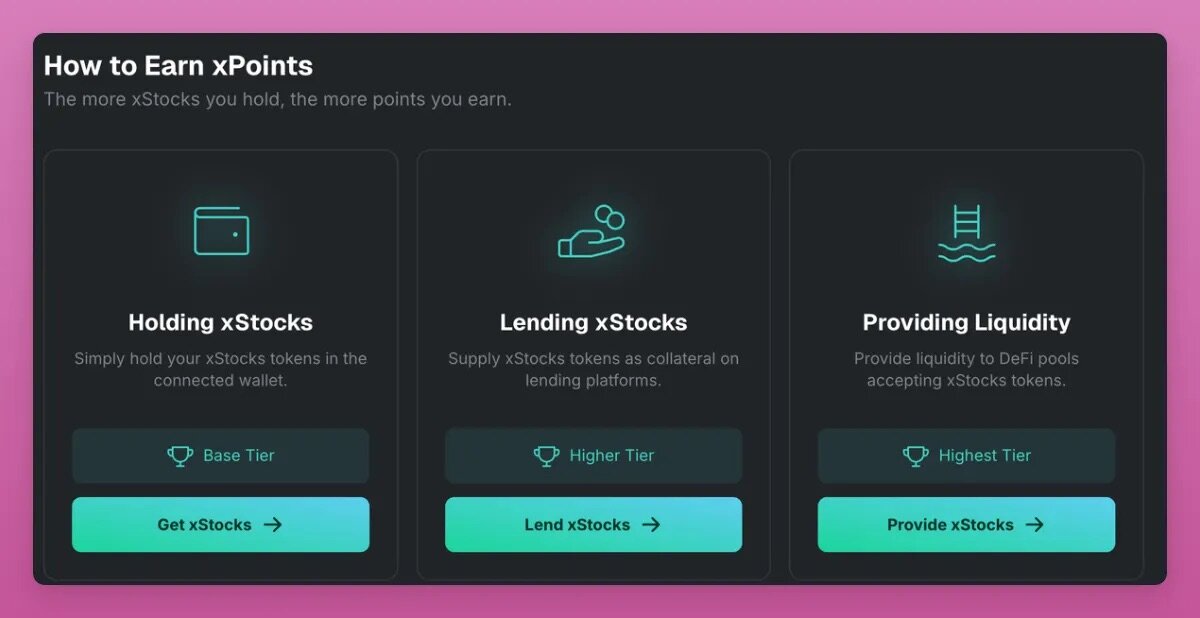
xPoints activity website
This is quite puzzling: since Kraken can sell its own equity through traditional channels, why would it need to issue a separate token for the xStocks platform?
A more plausible explanation for launching the points program is that Kraken has partnered with Nasdaq for tokenized stocks, and the platform needs volume and liquidity to support its business scale, thereby boosting Kraken's overall performance data.
I don't want to be the exit liquidity for this sector again, but if you are willing to participate in points farming, the rules for earning points are as follows:
- Providing liquidity: 7x points (highest tier, supporting Raydium, Orca, Byreal)
- Asset lending: 5x points (on Kamino platform)
- Simply holding tokens: 1x base points
- Trading on the Kraken CEX does not earn points; only on-chain operations accumulate points.
The third largest in the industry is Securitize. I don't plan to participate in its point farming. The company will go public via a SPAC merger with Cantor Equity Partners, with an overall valuation of approximately $1.25 billion, led by BlackRock's $47 million investment. The platform has no native token, so mining points yields no profit.
As mentioned, there are various arbitrage opportunities within the sector: for example, when perpetual contract funding rates are negative, you can short on Hyperliquid (while simultaneously mining trade.xyz points) or Variational, and buy spot tokens; you can also compare funding rates across different exchanges on the Ostium platform (which currently has no token).
If manual position management is too cumbersome, consider the Nado platform: it is an order book DEX supporting spot, margin, and perpetual contracts with unified margin accounts. The development team previously built Kraken, and launched the INK product. The platform will support tokenized stock spots and perpetuals, enabling delta-neutral strategies. It is a low-attention opportunity worth considering for point farming.
But remain vigilant: the primary market token platform Ventuals just announced its closure, informing users that all platform points are worthless. Participating in token airdrop farming now requires more effort, with the uncertainty of returns significantly increased.
The Story is Far From Over
The term "crypto" now covers a vast scope, including sectors like perpetuals, NFTs, prediction markets, and Meme coins; the RWA sector is also continuously expanding, with its sub-sectors worthy of deep independent analysis.
Stablecoins, money market funds, credit, private equity, and tokenized stocks are all different sub-sectors, each with vastly different risk and return profiles.
The unique advantage of tokenized stocks lies in asset turnover efficiency: stocks inherently have price volatility, creating arbitrage and trading opportunities that


