Storage Crash: A Night of Panic


- Core Thesis: After memory giants reported their strongest earnings ever, their stock prices suffered a "Black Tuesday" crash, wiping out nearly $43 billion in market value. This was driven by three pressures: ADR arbitrage, a capital stampede triggered by South Korea's tightened regulations on leveraged ETFs, and market panic stemming from uncertainty over the return on AI capital expenditures by Silicon Valley giants.
- Key Factors:
- Earnings vs. Stock Price Divergence: SK Hynix saw a 257% YoY revenue increase and Micron's revenue surged 346%, but stocks of Samsung Electronics, SK Hynix, and others plunged over 10%, erasing hundreds of billions in market cap.
- Arbitrage Trades & Regulatory Storm: The issuance of SK Hynix ADRs fueled "long US ADR, short Korean underlying stock" arbitrage, compounded by South Korea's tighter rules on single-stock leveraged ETFs, which triggered programmatic selling.
- AI Investment Return Concerns: Google raised capital expenditure guidance but its stock fell. Moody's warned that cloud giants hold $460 billion in debt. The market is repricing the sustainability of the AI cycle and the HBM supply chain.
- "The Big Short" Bearish Thesis: Michael Burry, the inspiration for *The Big Short*, shorted Micron, citing reasons such as the stock price's deviation from its 200-day moving average hitting a record not seen since 1984, a median ROIC of only 4%, and end-market demand relying on off-balance-sheet financing.
- Korea's Mega Expansion Plan: Samsung and SK Hynix plan to invest $516 billion in new fabs, breaking supply discipline. The market expects that overcapacity from 2027-2028 will erode pricing.
Original Author: Su Yang
Original Editor: Xu Qingyang
Original Source: Tencent Tech

Overseas storage giants are caught in the eye of the storm, with their combined market cap plummeting by nearly $43 billion overnight on July 28.
In the past trading day, the stock prices of storage leaders like SK Hynix and Micron experienced a "nightmare." Both SK Hynix and Samsung Electronics fell by over 13%, with their combined market cap evaporating by about $28 billion. On Tuesday's US market, Micron closed down 8.85%, SanDisk plunged 14.25%, Seagate fell 8.53%, and Western Digital dropped over 6.9%, wiping out a cumulative market cap of approximately $14.8 billion.
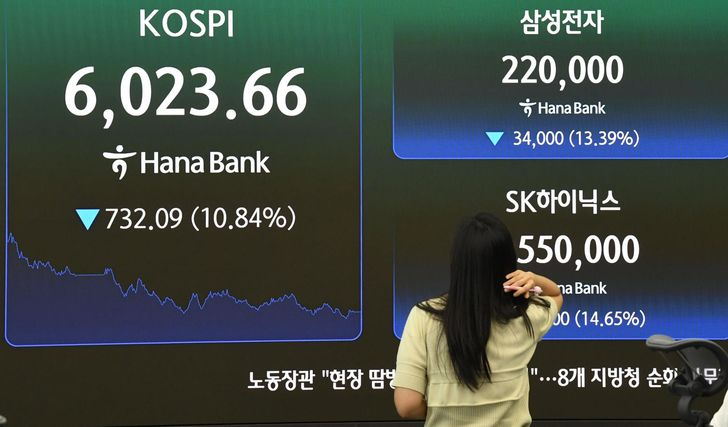
Tuesday, screens within a trading room at Hana Bank in Seoul display the benchmark KOSPI index alongside the closing prices of Samsung Electronics and SK Hynix stocks
Public data shows that SK Hynix has retreated by about 45% to 47% from its June high, with its market cap evaporating by nearly $600 billion; Micron Technology has corrected over 30% from its peak; Japan's Kioxia has shrunk by nearly half within a month.
In stark contrast to the stock price collapse, the storage giants had just delivered the most dazzling earnings reports in their history.
The Logic Where Earnings Can't Support Stock Prices
On July 7, Samsung Electronics released its preliminary second-quarter results, reporting a quarterly operating profit of 89.4 trillion won, a staggering 18-fold increase year-over-year, even surpassing the total profit sum from 2023 to 2025. However, this impressive earnings report not only failed to boost the stock price but instead caused Samsung to plunge over 10% intraday, dragging the KOSPI index down by nearly 5%.
The same anomaly also occurred with other giants.
SK Hynix released its second-quarter earnings on the 29th, showing revenue of 79.3 trillion won, a 257% increase year-over-year; operating profit was 60.5 trillion won, up 557% year-over-year, with the operating profit margin climbing to 76%.
Micron Technology's revenue for the fiscal quarter ending May 2026 reached $41.5 billion, a staggering 346% surge year-over-year, with gross margins soaring to 84.6% and free cash flow hitting $17.6 billion. Micron's management even boldly stated: "Demand far exceeds supply capacity, and this boom will continue until 2028."
Despite the red-hot fundamentals, the stock prices of the storage leaders have collapsed. The first clue and potential trigger is the cross-market pair trading arbitrage activity sparked by SK Hynix's issuance of ADRs in the US market – "going long on US-listed ADRs, shorting domestic Korean stocks."
Bloomberg cited a report from UBS to clients, stating that many global portfolio managers who previously did not include SK Hynix shares listed in Korea in their investment asset classes can now purchase the new SK Hynix ADRs.
"Buying the American depositary receipt and selling the Korean common stock from day one looks like a sure-fire trade," the UBS report wrote.
Another stimulating factor is related to adjustments in South Korean regulations.
On July 16, the South Korean Financial Services Commission suddenly announced tightened regulatory rules for single-stock leveraged ETFs, not only significantly raising the minimum margin requirement from 10 million won to 30 million won but also limiting each person to purchasing a maximum of 20 shares per order.
JPMorgan analyst Nikolaos Panigirtzoglou pointed out that at the time, the position size of memory chip leveraged ETFs relative to the market capitalization of the relevant companies had already reached three times that of ordinary stock ETFs. During the stock price decline phase, the mandatory end-of-day rebalancing mechanism of leveraged ETFs triggered programmed automatic selling, instantly forming a "capital stampede."
That day, SK Hynix fell another over 11%, Samsung slumped over 8%, and the wave of panic quickly swept through Europe and the US.
Looking at a longer timeframe, the pullback in storage concept stocks over the past period is also related to concerns about the "imbalance in investment returns" from Silicon Valley giants' AI investments and related capital expenditures.
On July 22, Google released its Q2 report and raised its full-year capital expenditure from $180-190 billion to $195-205 billion. However, its stock fell in after-hours trading and the following day, primarily because the endless high capital expenditure suppressed free cash flow, creating uncertainty about the returns on AI investments. This is also a common issue that Microsoft, Amazon, and Meta will face next.
Rating agency Moody's also issued a timely warning: the nearly $1 trillion annual AI arms race is forcing cash-rich giants like Google and Microsoft to excessively rely on debt and off-balance-sheet financing. Currently, the total direct debt of the six major cloud service providers has reached approximately $460 billion.
This means that if the giants' guidance falls slightly short of expectations, the market will reprice the highly sensitive HBM supply chain stocks.
Shinhan Securities analyst Kang Jin-hyuk summarized this, saying: "As investors redirect their attention to concerns about the sustainability of the AI investment cycle and the increasing competitiveness of China's storage industry, market risk aversion has been completely ignited."
With all these factors combined, storage concept stocks experienced a "Black Tuesday" on July 28.
Standard Chartered Bank's Chief Equity Investment Officer, Sundeep Gantori, stated that the current sell-off reflects a general deterioration of market sentiment towards the semiconductor sector. Some institutions even predict in their latest reports that storage prices will peak in 2027.
"The Big Short": Boldly Shorting Storage
At the most panicked moment in the market, Michael Burry, the inspiration for "The Big Short," publicly disclosed via his personal column that he is heavily shorting the memory chip sector and is continuously adding to his positions.
Reviewing Burry's position-building trajectory: On July 2, he first established a short position in Micron Technology, entering at a price of around $1,051.87; on July 25, he continued to increase his short positions against Micron (stock price $933.86) and Nvidia (stock price $210.28), while also establishing a short position in the SOXX semiconductor ETF.
Burry's logic for betting heavily on shorting storage is mainly based on three points:
First, valuations are severely deviated from moving averages. Micron, as the only pure DRAM play in the US stock market, has experienced 34 instances of deep corrections exceeding 30% in its 42-year history. The current deviation of its stock price from the 200-day moving average has hit the highest record since 1984, even surpassing the peak of the 2000 dot-com bubble.
Second, returns on capital are extremely mediocre. Micron's long-term median ROIC (Return on Invested Capital) is only 4%, and its ROE (Return on Equity) is only 7%. Historically, about one-third of its quarters have actually been in a state of "capital destruction."
Third, there is a risk of inflated end-user demand. Burry firmly believes that the strong demand triggered by Nvidia does not entirely come from genuine end-user consumption but relies on the illusion driven by off-balance-sheet financing and capital circulation arrangements, citing the Bank for International Settlements' (BIS) 2026 annual report as evidence.
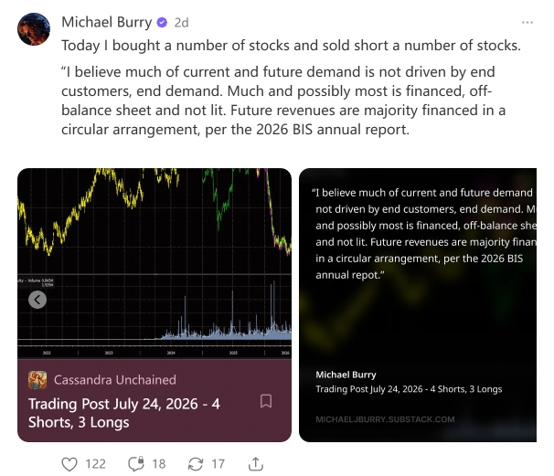
"The Big Short" Burry going short on storage stocks
Regarding the recent expansion plans announced by the Korean giants, Burry even asserted that this is a "landmark turning point from boom to bust" in the semiconductor cycle, predicting that the entire sector will face at least a 30% correction.
However, there is no shortage of opposing voices in the market. The bulls argue that Micron's just-released quarterly report is the best in the company's history, with revenue, margins, and cash flow all setting records.
An analysis by tech media CoinCentral highlighted the real logic behind Burry's bet: he is not betting on an immediate collapse in end-user demand, but rather gambling on uncontrolled capital expenditure by memory manufacturers – Micron's own $27 billion in capital expenditure is sowing the seeds for a "crash" in the next downward cycle.
The High-Stakes Gamble and Its Price
Just a few weeks before the "stampede" occurred, the global storage industry was still immersed in an unprecedented "super alliance."
At the San Francisco AI Summit from July 24 to 25, SK Group signed a long-term agreement worth over $500 billion with Nvidia, locking in HBM supply and joint development of HBM4. Combined with partnerships with Microsoft and Anthropic, the total scale was approximately $750 billion.
Simultaneously, Samsung Electronics signed a memorandum of understanding worth up to $200 billion with Broadcom. These two deals, totaling about $950 billion, were hailed by foreign media as the largest long-term supply lock-in agreements in semiconductor history.
Around the same time, AMD acquired MEXT in an attempt to use flash memory to "disguise" as DRAM to reduce memory costs, while Meta and SanDisk locked in multi-year NAND supply.
This new round of alliances among Silicon Valley giants did not positively influence storage concept stocks. Compared to short-term stock price fluctuations, what truly unsettled long-term capital was a super industrial plan announced by the South Korean government at the end of June – Samsung and SK Group will jointly invest 800 trillion won (approximately $516 billion) to build four new wafer fabs in southwestern South Korea, aiming to double memory chip production capacity within five years.
Including the supporting 550 trillion won HBM packaging hub and data center construction, the total investment scale reaches a staggering 1,350 trillion won (about $880 billion), equivalent to 5% of South Korea's 2024 GDP.
Memory manufacturers ramping up expansion means breaking the "supply discipline" and strict financial discipline maintained by the industry for two years.
Over the past two years, storage manufacturers successfully pushed memory chip prices back to high levels by strictly controlling production and shifting capacity towards high-margin HBM. Now, SK Hynix's 2026 capital expenditure is expected to jump significantly by 43% to 40 trillion won, while Micron's 2026 fiscal year capital expenditure has also doubled year-over-year.
Morningstar analyst Jing Jie Yu warned that as these new capacities come online concentratedly between 2027 and 2028, the industry will inevitably face severe price erosion.
Analysis firm AInvest stated that the manufacturers' expansion is no longer a victory parade driven by AI demand but a replay of the script from the 2022-2023 capacity glut and price plunge cycle.
Although it typically takes 18 to 24 months from construction to mass production for a fab – for example, Samsung's P5 fab mass production is scheduled for the second half of 2027 – TrendForce also judges that the DRAM supply shortage pattern is unlikely to be fundamentally reversed before then. However, the stock market always trades expectations, not the present.
It can be said that South Korea's super expansion plan shattered the market's fantasy of "sustainable high chip prices." The "overnight nightmare" for the storage sector was essentially a disconnect between fundamentals and expectations.
Now, the sensitive capital market has begun pricing in the potential supply glut of 2027 in advance. According to "The Big Short" Burry's expectations, the window between the second half of 2027 and 2028, when South Korea's new fabs begin concentrated mass production, will be the true test for the storage industry.