






七倍超额认购,SK海力士这次能拯救半导体吗?


- 核心观点:SK海力士赴美上市获超七倍认购,反映长期资金仍看好AI基础设施投资周期,但半导体板块短期承压,市场正等待科技巨头财报以验证资本开支增速能否延续。
- 关键要素:
- SK海力士ADR认购倍数超七倍,募资总额约245亿美元,资金将用于韩国本土产能扩张。
- 半导体板块近期回调,主因市场担忧AI资本开支增速放缓,Meta出售算力及黑石取消数据中心项目加剧了此疑虑。
- 认购需求主要来自Baillie Gifford、Coatue Management等全球长线基金,其中“AI股神”Aschenbrenner的基金意向约70亿美元。
- SK海力士股价自6月高点下跌近三成,市场猜测发行前调整或为上市后价格表现创造空间。
- 科技巨头微软、谷歌、Meta等未来季度的财报,将是判断AI投资周期能否延续的关键信号。
Original by Odaily (@OdailyChina)
Author: Azuma (@azuma_eth)
Bloomberg reported this morning, citing sources, that South Korean semiconductor giant SK Hynix's American Depositary Receipt (ADR) offering in the U.S. has been oversubscribed by more than seven times, making it poised to become the largest foreign IPO in U.S. history.
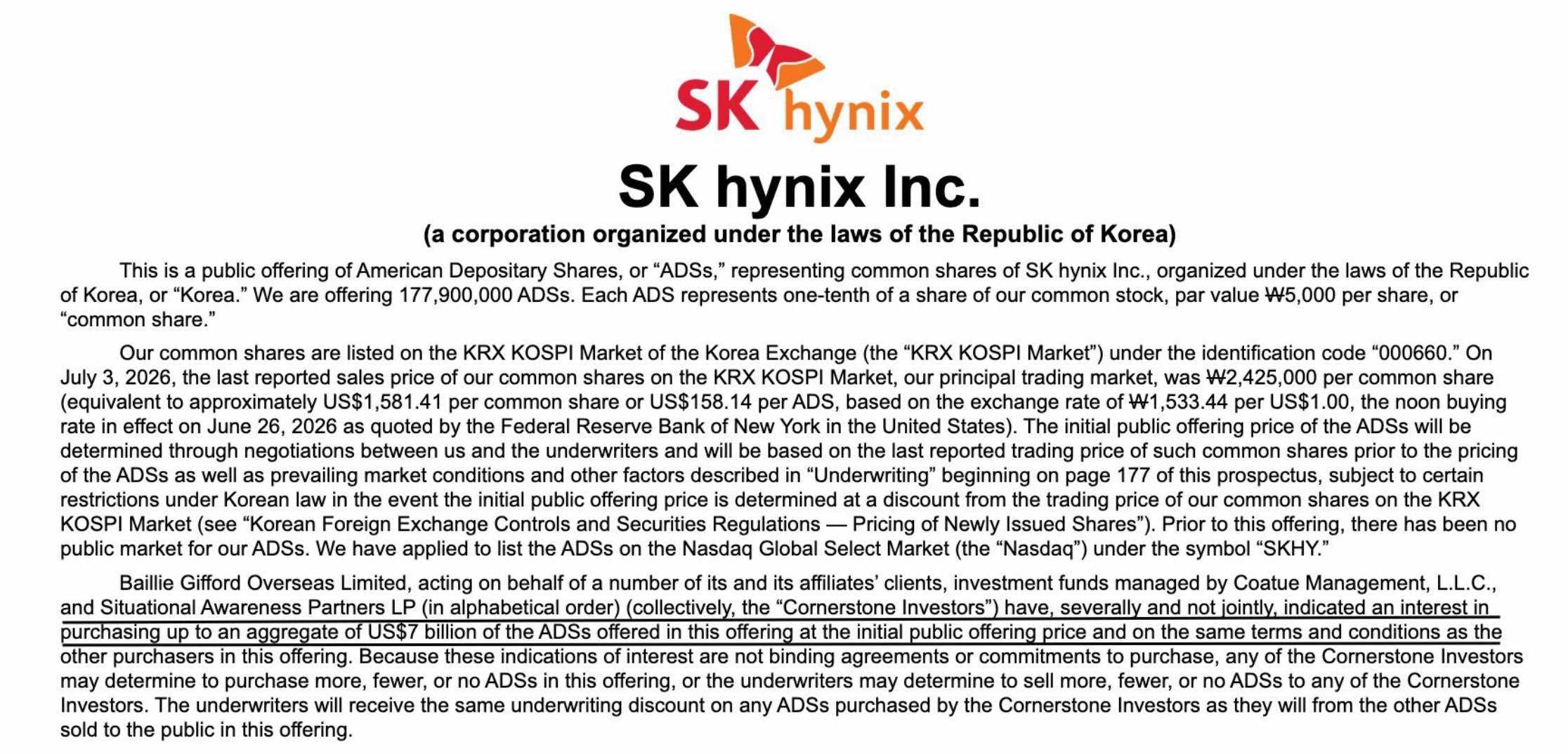
Previously in late June, SK Hynix filed an F-1 prospectus with the U.S. SEC, planning to list on the Nasdaq by issuing 177.9 million ADRs (each ADR representing one-tenth of an ordinary share). Based on Wednesday's closing price of 2,076,000 Korean won (approximately $1,380) on the Korean market, the total fundraising amount is expected to reach around $24.5 billion. All proceeds will be used for domestic capacity expansion in South Korea, including the Yongin wafer fab, the Cheongju advanced packaging line, and investments in EUV and related equipment.
As SK Heads to the U.S., the Semiconductor Sector Is Taking a Dip
While SK Hynix prepares for its U.S. listing, the entire semiconductor sector is experiencing a sharp correction.
Over the past two years, AI infrastructure investment has been the core driver behind the semiconductor sector's rally. Benefiting from the continuously expanding capital expenditures of tech giants like Microsoft, Google, Meta, and Amazon, the industry chain—represented by GPUs, HBM memory, and advanced process equipment—has seen explosive performance growth, propelling stock prices higher.
However, the market has recently begun to re-evaluate the sustainability of this narrative. First, Meta was reportedly planning to sell off some idle computing resources, interpreted by the market as a signal that tech giants are ready to optimize their AI infrastructure investments. Subsequently, Blackstone's previously planned project to build the world's largest data center was also canceled, further strengthening market concerns about a slowdown in data center demand growth.
These events are not entirely equivalent to the end of the "AI investment cycle," but they have triggered a market repricing of a key question: After hundreds of billions of dollars in capital investment, can the AI capital expenditure of tech giants maintain its current growth rate?
Affected by this, the AI industry chain has generally come under pressure recently. From chips and memory to semiconductor equipment, the market's trading logic has shifted from "unlimited demand growth" to "whether future growth can be delivered." SK Hynix's stock price has also seen a significant pullback, falling from a high of 2,917,000 Korean won on June 25 to yesterday's closing price of 2,076,000 Korean won, with a maximum drawdown of nearly 30%.
Secondary Market Under Pressure, Primary Market Extremely Frenzied
Interestingly, amid the ongoing correction in the secondary market, SK Hynix's U.S. stock offering has received far more demand than expected.
As mentioned earlier, the subscription multiple for this ADR offering has exceeded seven times, reflecting strong institutional enthusiasm. According to information disclosed in SK Hynix's roadshow materials, the subscription demand primarily comes from various types of institutions, including global long-term funds, tech-themed funds, sovereign wealth funds, and Asian-themed investors. Among them, institutions like Baillie Gifford, Coatue Management, and Situational Awareness Partners have expressed subscription intentions totaling approximately $7 billion.
Note here: Situational Awareness is a fund controlled by the newly emerging "AI stock guru" Leopold Aschenbrenner. It can be considered the fund with the most explosive performance in this AI cycle. For details, see "SBF's Little Brother Turned $225 Million into $5.5 Billion in One Year" and "A Quick Look at the 24-Year-Old 'AI Stock Guru's' Latest Moves: 60% Position Hedging Against Semiconductor Downturn."
The rush by institutions means that, at least from a long-term capital perspective, the market has not completely dismissed the AI infrastructure investment cycle. In fact, the recent correction in the semiconductor sector is more of an adjustment in valuations and expectations than a reversal of the industry's fundamentals. Investors are worried about a potential slowdown in the growth rate of future capital expenditures, not about whether core products like HBM and AI chips have lost demand.
Additionally, it's worth noting that there has been speculation in the market recently regarding the timing of SK Hynix's listing: Before listing on the Nasdaq, the stock price undergoes a significant correction, perhaps to ensure a smoother performance after listing, benefiting the company, underwriters, institutions, and retail investors alike...
While this logic may not be fully verifiable, from a trading perspective, it could indeed strengthen the market's optimistic outlook for the stock's post-IPO performance. For the issuer, a lower valuation starting point is favorable for price performance after listing; for subscribing institutions, it also implies greater potential upside.
Therefore, SK Hynix's U.S. listing this time could very well become a significant turning point for short-term sentiment in the semiconductor market.
The True Reversal Signal Depends on the Next Report Card from Tech Giants
However, the hot IPO of SK Hynix alone does not seem to fully answer whether the correction in the semiconductor sector is over.
From an industry cycle perspective, the core of the current market debate is not whether AI demand still exists, but whether tech giants can maintain their current level of capital investment. Over the past two years, companies like Microsoft, Google, Meta, and Amazon have continuously increased their AI infrastructure investments, driving global data center investment into a high-growth phase. According to previously announced plans by major tech companies, AI-related capital expenditure will remain high in the coming years.
Yet, as the scale of investment expands, investors are increasingly focused on the question, "When will these massive capital investments translate into actual commercial returns?"
If AI application growth can match infrastructure investment, then the current correction in the semiconductor sector is more like a digestion of valuations after a rally. However, if tech giants start to slow down data center construction and reduce the pace of GPU procurement, the high-growth expectations the market previously assigned to the AI industry chain will face a significant revision. Therefore, the financial reports of tech giants over the next few quarters will be key to determining the direction of the semiconductor market.
In other words, SK Hynix's listing might act as a short-term sentiment catalyst for the semiconductor sector, but the real factor determining whether the AI cycle can continue remains the definitive answers from tech giants like Microsoft, Google, Meta, and Amazon regarding their future capital expenditures.


