






Before heading to the U.S., SK Hynix dropped like a memecoin


- Key Point: On the eve of SK Hynix's U.S. listing, the semiconductor sector saw a sharp decline triggered by panic over news that "Meta may release excess computing power." The article argues that this correction is an emotion-driven liquidity stampede rather than a reversal of the industry trend, and remains optimistic about its long-term value.
- Key Factors:
- SK Hynix has filed an F-1 document, planning to list on Nasdaq through an ADR issuance, aiming to raise approximately $29.4 billion, all of which will be used for capacity expansion in South Korea.
- This U.S. listing aims to leverage the higher valuation premium for AI assets and liquidity advantage in the U.S. stock market, addressing the "Korea discount" issue while converting capital advantages into capacity advantages.
- There is an overinterpretation of the "Meta releases computing power" news; it is essentially an asset utilization optimization move and cannot be directly extrapolated as a sign of industry-wide computing power oversupply or the end of the CapEx cycle.
- Before this decline, the chip sector was at a high level with concentrated trend-following capital, making the market sensitive to marginal information, triggering a leveraged stampede and forced position reductions that amplified the price correction.
- SK Hynix's ADR is expected to begin trading on July 10, jointly underwritten by Bank of America, Citigroup, Goldman Sachs, and JPMorgan, with the market closely watching its post-listing performance.
- SK Hynix holds over 50% market share in the HBM segment and is in a historically strong cyclical upturn, with its solid fundamentals supporting this large-scale financing.
Original: Odaily (@OdailyChina)
Author: Azuma (@azuma_eth)

SK Hynix's US listing process has entered its final stage, but just as the Korean memory giant is about to land on the Nasdaq, the narrative around AI and the semiconductor industry has taken a sudden sharp turn in sentiment.
On the evening of July 1, news that "Meta may release excess computing power" sparked speculation that major tech firms might cut capital expenditures, leading to significant market volatility. As the narrative of "absolute scarcity" of AI computing power began to waver, the semiconductor memory chip sector was directly impacted, with related concept stocks experiencing a massive collective pullback in the secondary market – SK Hynix's Korean stock closed down 14.57%, shedding hundreds of billions of dollars in market value in a single day.
- Odaily Note: See also Has the "Biggest Negative" for Chip Stocks Finally Arrived? Is Meta the First Major Player to Cut CapEx?.
Countdown to SK Hynix's US Listing
On June 30, SK Hynix submitted its F-1 prospectus to the U.S. Securities and Exchange Commission (SEC), planning to list on the Nasdaq by issuing American Depositary Receipts (ADRs), targeting a fundraising scale of approximately 45.45 trillion KRW (about $29.4 billion), which could become one of the largest ADR issuances in history. All proceeds from this fundraising will be used for domestic capacity expansion in South Korea, including the Yongin wafer fab, the Cheongju advanced packaging production line, and investments in EUV and related equipment.
- Odaily Note: An ADR is essentially a trading vehicle for non-US companies in the US stock market. ADRs are not stocks directly issued by the company but are "substitute securities" issued in the US by a depositary bank. They correspond to the underlying common stock of a foreign company. Through ADRs, investors can directly trade shares of foreign companies in US dollars on the US stock market without needing to open cross-border accounts or handle foreign exchange and settlement processes.
The transaction, jointly underwritten by BofA Securities, Citigroup, Goldman Sachs, and JPMorgan Chase, involves issuing a total of 17.79 million new shares (representing 2.5% of its total issued share capital) under the ticker symbol SKHY. Regarding the timeline, the ADRs are expected to begin trading on the Nasdaq on July 10.
SK Hynix's proactive push for a US listing during the current cycle is fundamentally the result of a confluence of three factors: the industrial cycle, the capital window, and the competitive landscape.
First, SK Hynix is currently in a historically strong upcycle. Driven by AI server demand, High Bandwidth Memory (HBM) has become the most critical supply bottleneck. The company holds over 50% market share in this segment, simultaneously pushing its overall DRAM business into a phase of high profitability. This has put its performance and stock price on a concurrent upward trajectory, creating a classic "peak-cycle financing window" – raising capital for large-scale expansion during its fundamental strength phase.
Second, from a capital market structure perspective, the US market remains the primary pricing center for global AI assets. Whether it's Nvidia, AMD, or memory chip companies like Micron, the US stock market generally assigns significantly higher valuation benchmarks and liquidity premiums to the AI industry chain. In contrast, the Korean market has long suffered from what is known as the "Korean discount," where valuations for similar semiconductor assets are generally lower than their US counterparts. Therefore, a core significance of SK Hynix's US ADR issuance is its desire to be re-priced under a higher valuation system.
Finally, memory giants are in an intense capacity expansion race, with growth highly dependent on sustained massive capital investment. SK Hynix's nearly $30 billion fundraising, entirely dedicated to expanding wafer fabs, advanced packaging, and equipment, is essentially an attempt to convert capital advantage into capacity advantage.
Down This Badly, Is Hynix Still a Buy?
Originally, SK Hynix's US listing could have been seen as a historic moment for the memory industry. However, the sharp pullback that began last night has injected tremendous uncertainty into its future performance. Is this an opportunity to buy the dip, anticipating a takeoff after the US listing? Or is it time to decisively reduce positions to avoid a potential bubble burst?
Disclaimer: The following section is purely personal opinion and does not constitute investment advice.
In my personal view, SK Hynix's sharp decline, along with the significant sector pullback, is more akin to a liquidity-driven stampede amplified by sentiment rather than a substantive reversal of the industrial trend.
Let's first focus on the trigger – the news that "Meta may release excess computing power." This news itself was subject to over-interpretation.
Bloomberg's initial headline for this story was "Meta Is Building a Cloud Business to Sell Excess AI Compute," but it was later changed to "Meta Is Planning a Cloud Business Sell AI Computing Power." However, other media outlets, including Reuters, had already republished the story using the first headline.
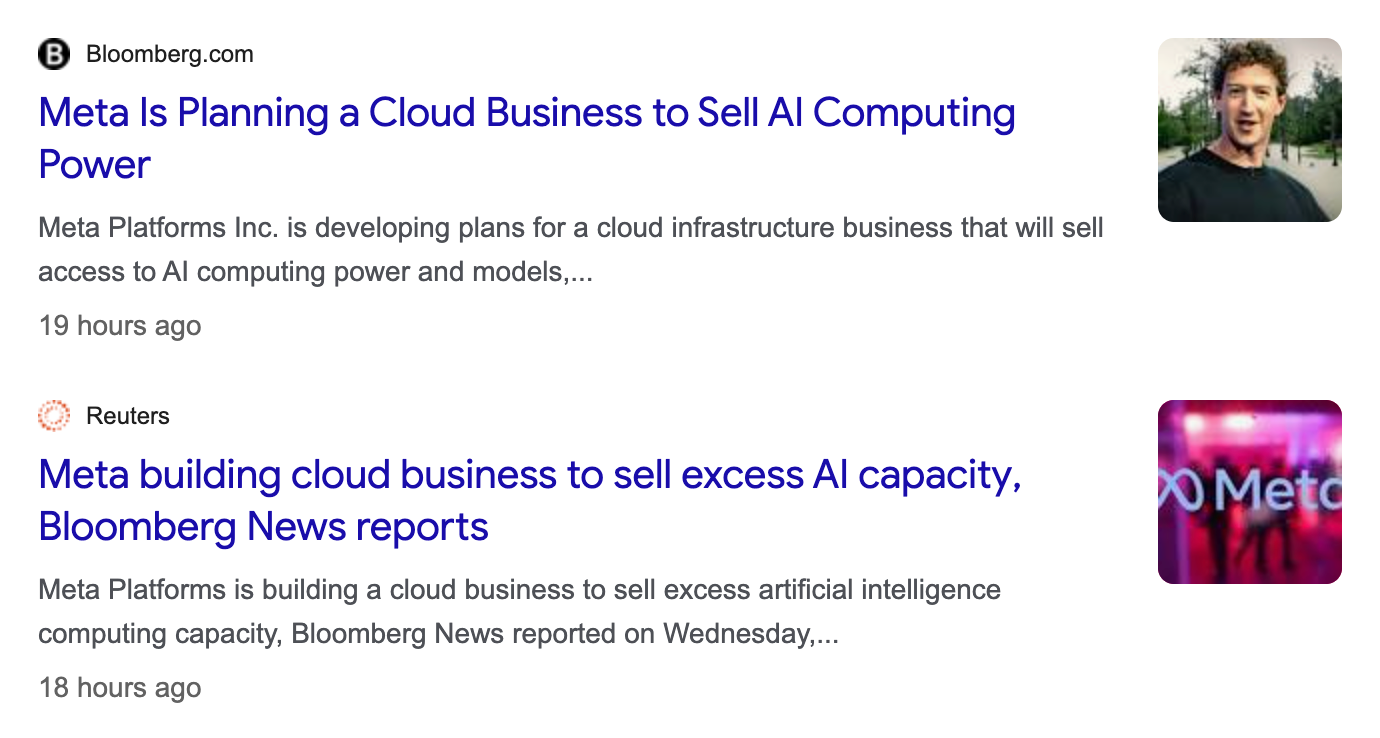
There are two key changes between the headlines. First, changing "is building" to "is planning" directly weakens the report's certainty and timeliness. Second, the removal of the word "excess." However, the initial phrasing was easily interpreted by the market as "computing power is already in excess," leading to a chain reaction of "excess compute → peak CapEx → weakening AI demand," which ultimately caused market panic.
Even if it were confirmed that Meta intends to sell compute power, it would be difficult to constitute a sufficient reason to declare the end of the "AI CapEx cycle." From an industrial logic perspective, Meta itself is relatively behind in the AI race. Its pressures regarding foundational models and compute efficiency objectively determine that Meta has some degree of need for compute scheduling and asset optimization. In this context, the externalization or commercialization of some computing resources is more akin to an asset utilization optimization behavior than a systematic contraction on the demand side.
This kind of "compute redistribution" is not uncommon in the AI industry chain. Two months ago, SpaceX also externalized some of its computing resources for commercial collaboration (e.g., leasing to Anthropic). Essentially, this is just a rebalancing of cost and resource efficiency, not a denial of AI demand itself. Therefore, directly extrapolating a single company's compute scheduling behavior of uncertain scale to "industry-wide excess" represents a significant logical leap.
Another key reason why this news had such a devastating impact lies in the market structure. Prior to this decline, the semiconductor memory chip sector itself was at a relatively high level, with a high concentration of trend-following capital and leveraged ETFs. In this structure, the market's sensitivity to marginal information increases significantly. Once a narrative shock occurs, it can easily trigger amplified deleveraging and forced position reductions, thereby magnifying what should be an "expectation adjustment level" fluctuation into a "price stampede level" pullback.
Therefore, this correction appears more like a typical result of the superposition of "sentiment panic + structural deleveraging." Personally, I am inclined to use this pullback as an opportunity to accumulate positions.
After all, SK Hynix is right in the critical window period for its US listing. With a fundraising scale of nearly $30 billion, whether it's the underwriters or the institutional funds participating in the subscription, they likely do not want the stock price to perform too poorly after the listing.


