






SpaceX falls below $150 on its first day of index inclusion, Wall Street collectively bullish with price target as high as $800?


- Core Viewpoint: SpaceX was rapidly added to the Nasdaq 100 index, but after the positive catalyst materialized, the stock price fell instead of rising, hitting a new all-time low. In the short term, it faces the pressure of a large-scale stock unlock in August, but institutions generally favor its long-term value and have issued buy ratings.
- Key Factors:
- SpaceX was added to the Nasdaq 100 Index on July 7th with a weight of approximately 1.3%, but the stock price fell 6.8% that day to $149.47, a historic closing low.
- The positive catalyst of index inclusion had already been priced in. The $4.3 billion in passive fund inflows estimated by JPMorgan were mostly completed before the inclusion date and failed to drive the stock price up on the day.
- August will face the pressure of a large-scale stock unlock, where internal shareholders can sell up to 44% of their holdings. This bearish expectation has already been suppressing market sentiment in advance. Institutions suggest building positions during the pullback.
- Despite short-term pressure, multiple Wall Street institutions including Goldman Sachs and Morgan Stanley have collectively issued buy ratings with target prices ranging from $200 to $800, bullish on its long-term value.
- Potential short-term positives include the "pump" effect associated with Trump's political connections, and the 13th Starship flight test planned for July 14th, which could boost market sentiment.
Original | Odaily Planet Daily (@OdailyChina)
Author|Golem (@web3_golem)
SpaceX has made history once again: On Tuesday, July 7, SpaceX was officially added to the Nasdaq 100 index, becoming the fastest company to be included in the Nasdaq 100 since its listing, with a corresponding weight of approximately 1.3%. However, this historic achievement did not translate into gains for SpaceX's stock price. According to Gate US stock data, SPCX closed down over 6.8% on Tuesday at $149.47, setting a new all-time closing low since its listing. How will SPCX perform in the future? And what are the judgments from Wall Street institutions?
Index Inclusion's Good News Fades, Leaving Only Bad News; Holding $150 Is Already an Achievement
Before SpaceX was added to the Nasdaq 100, JPMorgan estimated it would trigger at least $4.3 billion in passive fund inflows. Funds tracking the Nasdaq 100 index, totaling over $800 billion, would subsequently continue passive allocations to SpaceX.
Although this is a significant positive development, the narrative of "entering the Nasdaq" has been hyped since SpaceX's first day of listing. Market expectations were already priced in. When the event materialized on July 7, market sentiment lacked the momentum to push the stock higher. On the other hand, the massive buying power behind the Nasdaq did not all hit the market on the inclusion day; in reality, most passive buying was executed before July 7.
Furthermore, historical data also shows that index inclusion does not necessarily constitute a sustained upward signal and has, in some cases, marked a cyclical peak.
Strategy is a typical example. On December 23, 2024, Strategy was added to the Nasdaq 100, but MSTR actually opened higher and closed lower that day, falling about 7.3% to close at $332.23. Strategy then entered a persistent downtrend, with the stock price dipping to $255.43 in February 2025. The passive buying triggered by the Nasdaq inclusion did not become effective support for Strategy's stock price.
And with the positive catalyst of index inclusion exhausted, the widely anticipated negative catalyst of the stock lock-up expiration in August will be magnified. SpaceX's prospectus clearly states that two days after the Q2 2026 earnings report, eligible internal shareholders can sell up to 20% of their locked shares. If the stock price is 30% above the IPO price for five days, an additional 10% can be unlocked. 22V Research strategist Jeff Jacobson estimates that insiders could sell up to 44% of SpaceX shares by early September.
Similar to how the positive expectation of index inclusion was priced in early, the panic surrounding SpaceX's stock unlocking will also inevitably be reflected in the price beforehand. This is a key factor suppressing SpaceX's stock price from a market sentiment perspective, both recently and in the future. BitMine Chairman Tom Lee also specifically mentioned SpaceX's upcoming share unlock in an interview. He believes that investors should not chase SpaceX's highs in the short term and that using the pullback caused by the unlock to build a position is the appropriate choice.
However, at Tuesday's US stock market close, SpaceX was not the only one falling. According to Gate US stock data, all three major US stock indices closed lower. The Dow fell 0.25%, the S&P 500 fell 0.45%, and the Nasdaq fell 1.16%. AI concept stocks also broadly declined: Astera Labs fell 11.52%, Ambarella fell 9.92%, Teradyne fell 9.59%, and AeroVironment fell 8.09%.
In this context, with a broad market sell-off and the positive news fully priced in leaving only negatives, it is already commendable that SPCX managed to hold near the $150 level without breaking its IPO price. Meanwhile, according to OptionCharts data, SPCX's current Put-Call Ratio is 0.92, indicating that market sentiment remains neutral and not explicitly bearish.
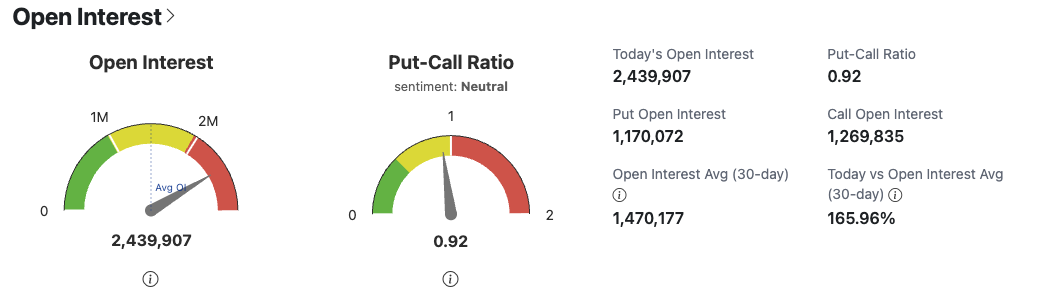
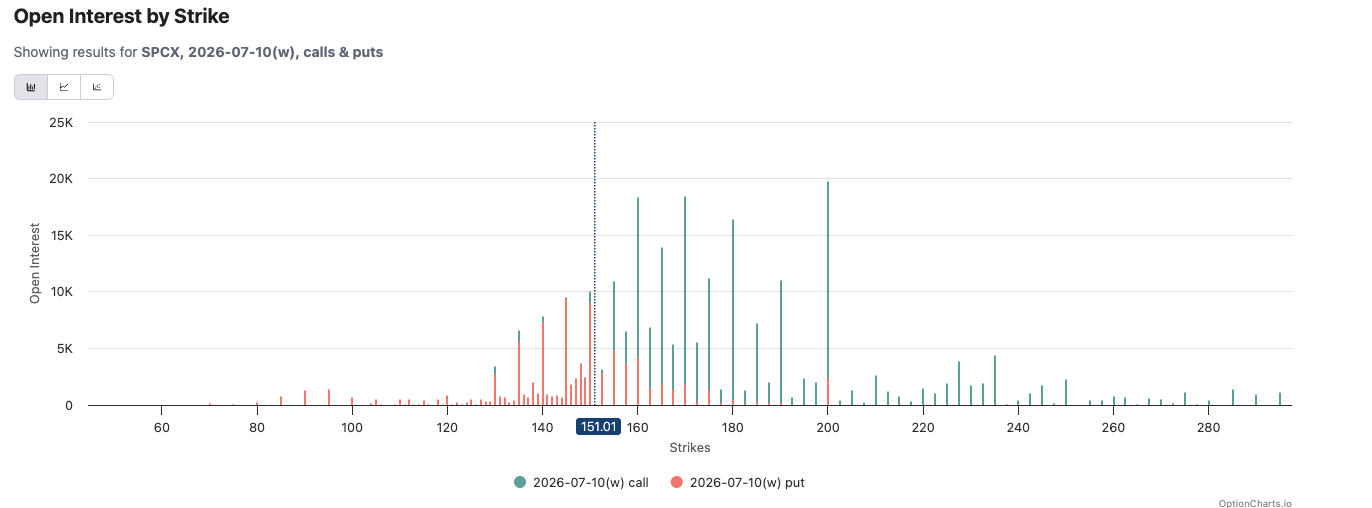
Furthermore, a large volume of call options expiring on July 10 are stacked at $160 and above, making the $150-$155 range a key battleground for bulls and bears.
Institutions Unanimously Give Buy Ratings; Potential Positive Catalysts for SPCX?
It is evident that neither timing nor market sentiment favors the bulls. Over the past month, SPCX has tested the $150 support level multiple times. Previously, $150 was a level for offense; now, it is purely a level for defense. Strangely, however, after the IPO quiet period ended, institutional analysts on Wall Street have collectively given SPCX a Buy rating.
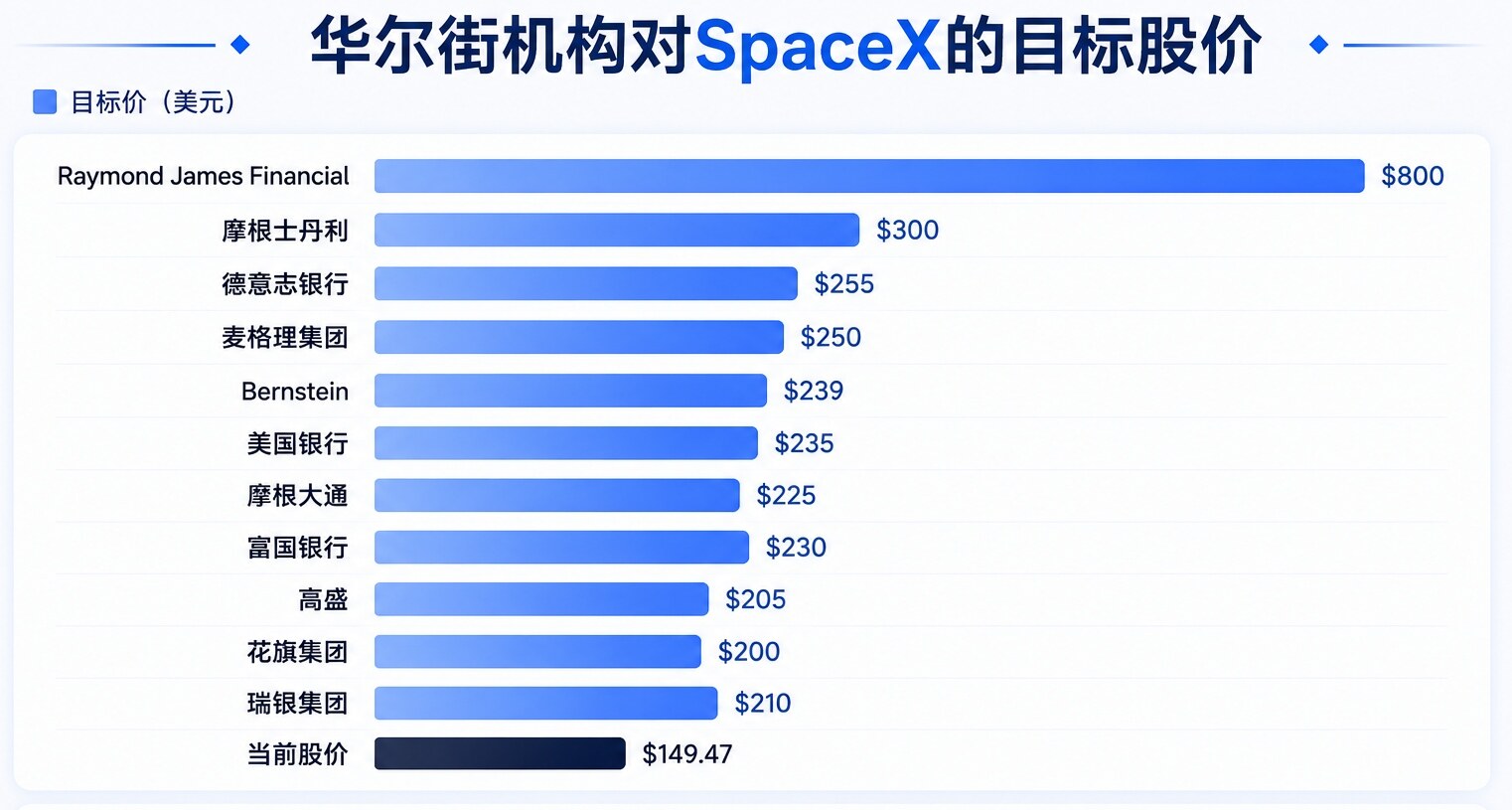
As IPO underwriters, Goldman Sachs and Morgan Stanley both gave SpaceX a Buy rating. Goldman Sachs analyst Eric Sheridan set a price target of $205, while Morgan Stanley analyst Adam Jonas set a target of $300. Additionally, Bank of America initiated coverage on SpaceX with a Buy rating and a $235 price target. Citigroup set a price target of $200 for SpaceX. Bernstein gave SpaceX an Outperform rating with a $239 target. Macquarie Group's target is $250. Deutsche Bank's target is $255. JPMorgan's target is $225. UBS Group's target is $210. Wells Fargo's target is $230.
Raymond James Financial gave the most optimistic forecast, with analyst Brian Gesuale setting a price target of $800 for SPCX, arguing that SpaceX will become "one of the most iconic industrial infrastructure companies of the 21st century."
However, these institutional ratings are primarily based on SpaceX's long-term value, such as its deployments in rocket launches, Starlink, and AI space data centers. In the short term, especially before the August stock unlock wave, what can SpaceX rely on to support its stock price and prevent it from falling below $150 and heading straight towards the $135 IPO price? Foreseeable potential positive catalysts include the following:
First, relying on Trump's endorsement. On July 7, SpaceX President and COO Gwynne Shotwell and her husband announced their participation in the Invest America plan, donating some of their SpaceX shares to Trump accounts for over 2 million American children. This is estimated to involve a donation of about 2 million SpaceX shares, valued at approximately $325 million. Previously, Trump publicly urged Musk to donate SpaceX stock to "Trump accounts." As a businessman adept at value exchange, Trump might "shill" for SpaceX just as he did for Micron and Dell now that the stock has entered these accounts.
Second, SpaceX's Starship flight test planned for July 14. The target launch date for SpaceX Starship's 13th flight test (Flight 13) is currently set for Tuesday, July 14, 2026, with a backup date of July 15. The Federal Aviation Administration (FAA) has issued an operational advisory confirming the NET (No Earlier Than) date of July 14. Rocket launches have always captured public interest. As a globally leading aerospace company, every SpaceX launch receives worldwide attention. If Flight 13 is successfully completed, the space narrative surrounding SpaceX could once again ignite "fan" enthusiasm in the short term, potentially boosting the stock price. Although the community and tracking sites generally believe July 14 is the primary launch target, it could be delayed by a few days to weeks due to technical readiness, weather, or other factors.
But ultimately, what investors might most look forward to is perhaps something Elon Musk himself can do to "save the market."


