







- ประเด็นหลัก: แผนของ Meta ที่จะขายพลังประมวลผล AI ที่เหลือ สร้างความกังวลในตลาดว่าการใช้จ่ายด้านทุนของยักษ์ใหญ่เทคฯ อาจถึงจุดสูงสุด และโครงสร้างพื้นฐาน AI กำลังเปลี่ยนจากการขาดแคลนไปสู่ภาวะล้นเกิน แต่สิ่งที่สะท้อนจริงๆ คือปัญหาความไม่สมดุลในการใช้พลังประมวลผล และคุณค่าของอุตสาหกรรมกำลังเคลื่อนย้ายจาก "การกักตุนพลังประมวลผล" ไปสู่ "การใช้พลังประมวลผลอย่างมีประสิทธิภาพ"
- ปัจจัยสำคัญ:
- Meta ไม่สามารถใช้พลังประมวลผลที่สร้างไว้ล่วงหน้าได้หมดกับโมเดลและผลิตภัณฑ์ที่พัฒนาขึ้นเองในตอนนี้ จึงหันมาขายพลังประมวลผลหรือให้บริการคลาวด์เพื่อเรียกคืนต้นทุน ตลาดตอบรับเชิงบวก (ราคาหุ้นขึ้น 8%) แต่สร้างแรงกดดันต่อผู้ให้บริการคลาวด์บุคคลที่สามอย่าง CoreWeave และหุ้นกลุ่มฮาร์ดแวร์
- ตรรกะ "การขาดแคลนพลังประมวลผล" ที่สนับสนุนตลาดกระทิงเกิดรอยร้าว: พลังประมวลผลส่วนเกินของ Meta ไม่ใช่สัญญาณของอุตสาหกรรมล้นเกิน แต่เผยให้เห็นปัญหาของ "อุปทานระยะยาวไม่ตรงกับอุปสงค์ระยะสั้น" นั่นคือ Meta มีพลังประมวลผลแต่ขาดความสามารถในการเปลี่ยนพลังนั้นให้เป็นโมเดลและผลิตภัณฑ์อย่างมีประสิทธิภาพ
- ในอีก 3-5 ปีข้างหน้า ความต้องการพลังประมวลผล AI ทั่วโลกยังคงมหาศาล (Google, Amazon, Microsoft ต่างวางแผนหลายสิบ GW) พลังประมวลผล 5 GW ของ Meta เป็นเพียงเศษเสี้ยวเดียว ปัญหาหลักคือตลาดขาดแคลนไม่ใช่ GPU แต่เป็นโมเดลและผลิตภัณฑ์ชั้นนำที่สามารถใช้ GPU ได้อย่างมีประสิทธิภาพ
- สิ่งที่ตลาดกังวลจริงๆ คือ "เรื่องหลอน": ผลตอบแทนจากการลงทุน AI ยังไม่แน่นอน ในขณะที่ความแน่นอนของการใช้จ่ายด้านทุนของยักษ์ใหญ่เริ่มสั่นคลอน ตลาดทุนเริ่มให้รางวัลกับบริษัทที่ "ควบคุมต้นทุนค่าเสื่อมราคา" และหันมาให้ความสนใจว่าใครจะใช้พลังประมวลผลได้อย่างมีประสิทธิภาพมากกว่า และสร้างรายได้แบบครบวงจร
- เหตุการณ์ของ Meta เป็นเครื่องหมายว่าอุตสาหกรรม AI กำลังเปลี่ยนจากขั้นตอนการสะสมฮาร์ดแวร์อย่างไร้ทิศทาง ไปสู่การกระจุกตัวของทรัพยากรในกลุ่มผู้เล่นชั้นนำไม่กี่รายที่สามารถสร้างวงจรปิดของ "พลังประมวลผล-โมเดล-ผลิตภัณฑ์-รายได้" การแข่งขันแบบผู้ชนะกินรวบได้เริ่มต้นขึ้นจริงๆ แล้ว
What does the AI bull market fear most?
It's not a specific company's model falling behind for a while, nor a particular chip generation underperforming expectations. It's the market beginning to doubt whether the technology giants' capital expenditures, considered the most certain variable over the past two years, can continue to grow forever.
On July 1st, according to Bloomberg, Meta is preparing a new cloud computing business, planning to sell its potential surplus AI computing power to external customers, while also considering offering managed model services similar to AWS Bedrock.
Following the news, Meta's stock price rose over 10% during trading hours, eventually closing up 8%, while CoreWeave and Nebius fell 13% and 17% respectively. On the other side, selling pressure spread to AI hardware during the Asian session, with South Korea's KOSPI index falling about 7% at one point, and both Samsung Electronics and SK Hynix dropping over 8%.
Overnight, Meta transformed from one of the most aggressive super-buyers in the computing power market into a potential seller.
This sudden industry turmoil has also, for the first time, created a clear crack in a fundamental belief that has underpinned the entire AI bull market over the past two years: Does this mean AI infrastructure has shifted from scarcity to surplus, and that the two-year-long computing power arms race among giants is about to reach an inflection point?
Or has Meta exposed another, harsher reality: What the market is truly short of – is it GPUs, or the ability to transform GPUs into models, products, and revenue?
1. Everyone Else Lacks Computing Power, but Only Meta Has Too Much?
Over the past two years, the underlying logic of this AI rally boils down to one concept: "Scarcity."
More precisely, it's a structural bull market driven by an explosion in demand, a shortage of supply, and a frantic expansion of capital expenditures by tech giants, all working together.
For instance, the earliest shortages were in high-end GPUs and advanced packaging capacity. Then, bottlenecks spread outwards, leading to supply shortages for HBM, high-speed optical modules, and network equipment. This was followed by shortages in data center space, power capacity, gas turbines, electrical equipment, and high-density cooling. Today, the supply-demand tension has transmitted to ordinary DRAM, NAND, enterprise SSDs, and even hard disk drives, once considered "old-era assets."
In a way, the hype across the entire AI supply chain over these two years has been like an ever-lengthening list of out-of-stock items, clearly demonstrating a "barrel effect" and sector rotation. This also implies that as long as demand for model training and inference continues to grow, and new computing power capacity, electricity, and data centers cannot be released in time, each scarce link caught in the middle has the opportunity to gain stronger pricing power. Upstream manufacturers can also raise prices, lock in long-term contracts, and have the incentive to continue expanding production.
For this reason, if we trace further back, the true engines of this bull market are not just NVIDIA, SK Hynix, or power equipment companies themselves, but precisely the continuously growing AI demand expectations and capital expenditures of tech giants like Microsoft, Meta, Amazon, and Google:
How much the upstream giants are willing to spend determines how many GPUs, storage devices, and network equipment they buy, how many data centers they build, and how much third-party cloud computing power and long-term electricity resources they lock in, directly impacting the upper limit of prosperity across the entire AI supply chain.
According to Bridgewater estimates, the combined investments of Alphabet, Amazon, Microsoft, and Meta in expanding AI infrastructure in 2026 are projected to be around $650 billion, nearly 60% higher than the approximately $410 billion in 2025. Meanwhile, Reuters reported in May, citing estimates from Goldman Sachs and Morgan Stanley, that global AI-related capital expenditure covering data centers, power, equipment, and software could reach around $800 billion in 2026.
In a sense, this is a "Food Delivery War" Plus version for the AI world.
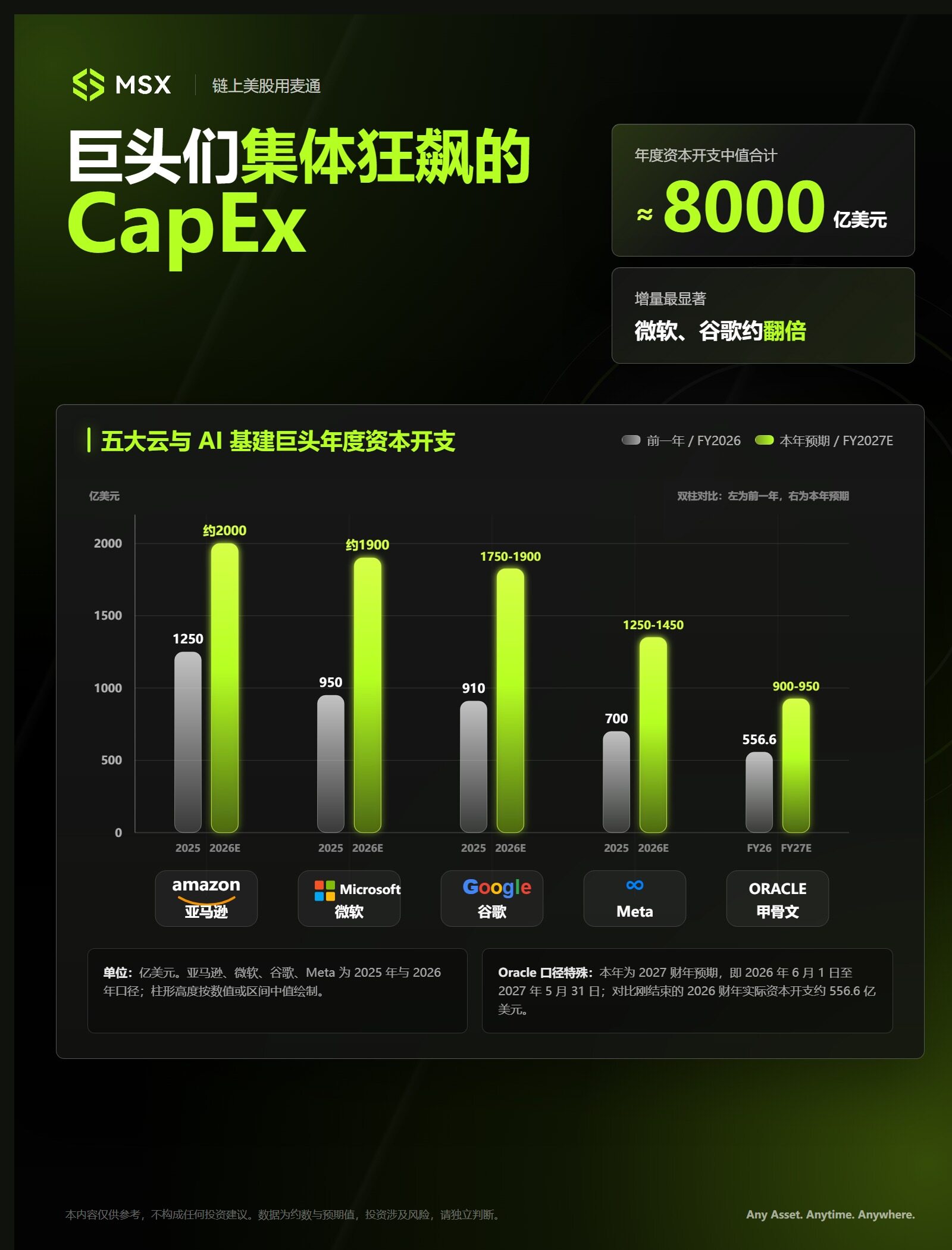
Among them, Meta hasn't shrunk; instead, it has stepped on the accelerator.
It previously raised its 2026 capital expenditure guidance from $115-$135 billion to $125-$145 billion. As of the end of the first quarter this year, Meta also had approximately $237.7 billion in non-cancelable contractual commitments (though these are contractual obligations to be fulfilled over several future years), a significant portion of which is related to servers, data centers, network infrastructure, and third-party cloud computing power.
So, strictly speaking, Meta's current consideration of selling some computing power doesn't mean it suddenly judges the entire industry no longer lacks computing power, nor does it equal its withdrawal from the AI arms race. Quite the opposite. Because data center construction cycles often span several years, Meta must prepare capacity in advance based on more aggressive demand scenarios. However, once the infrastructure is built ahead of time, internal model, product, and traffic demands may not perfectly keep pace simultaneously, potentially leading to a temporary supply-demand mismatch.
To put it bluntly, Meta is building massive computing power for the next few years. But at present, when its self-developed models are temporarily lagging and internal products are not fully operational, some of the already available capacity may not be immediately fully utilized. Rather than letting these expensive GPUs sit idle in data centers, continuously depreciating, it's better to push them to the external market to maximize utilization and recover some costs.
Theoretically, Meta isn't the first AI company to sell its self-built computing power. In May this year, xAI partnered with Anthropic, opening its Colossus 1 supercomputing cluster, equipped with over 220,000 NVIDIA GPUs, to them for $1.25 billion per month.
The economic logic behind this is not complicated. Resources ultimately flow to the enterprises that can best utilize their value. When one cannot fully leverage its own computing power temporarily, as long as another company is willing to pay a sufficiently high price, the most rational choice is not to let the GPUs gather dust, but to rent them out for cash.
However, Meta's symbolic significance far exceeds that of xAI.
Because Meta doesn't lack user entrances. Facebook, Instagram, WhatsApp, Messenger, and Threads together form one of the world's largest matrices of consumer internet products. Theoretically, it should be one of the easiest enterprises to embed AI models into existing products, form a user flywheel, and digest computing power.
But at least at this stage, Meta hasn't seamlessly connected models, products, cloud services, and user entrances like Google has. This creates a rather paradoxical contradictory mirror – while Meta is massively building its own AI infrastructure on one hand, it still needs to purchase external models and computing services like Gemini on the other. Just a few days ago, reports indicated that Meta's demand for Gemini models and computing resources was so large that Google couldn't fully satisfy it, and some internal AI projects were even affected as a result.
At first glance, this seems contradictory. But ultimately, it's a mismatch between long-cycle supply and short-cycle demand. This is mainly because their current large model applications and real-time inference needs still rely on suppliers like Google, as their self-developed models can't fully replace external solutions yet.
Therefore, Meta simultaneously "procuring external computing power" and "selling some of its own computing power" is not contradictory. The real question is whether the computing power it possesses can be matched with truly competitive models and products at the right time and in the right form. In other words, Meta was previously overly optimistic about its own capabilities, built too much computing power, and now its own models/products cannot fully utilize it, leading to the need to sell surplus capacity.
2. Is the Real Shortage of Computing Power, or of Model Products That Can Effectively Use It?
The market's reaction after Meta announced its plan to sell computing power was very interesting.
Meta's stock price rose over 10% during trading, eventually closing up 8%. On the other hand, CoreWeave and Nebius fell sharply by 13% and 17% respectively. The next day during Asian trading hours, sell-offs continued to spread to AI hardware, with South Korea's KOSPI index falling about 7% at one point, and both Samsung Electronics and SK Hynix dropping over 8%.
"Cloud down, hardware down, software up" became the most intuitive market expression at this moment.
And this reaction, at first glance, seems perfectly logical:
- Definitely a short-term positive for Meta: Since its self-developed models and internal products can't fully digest all the computing power for now, renting out part of the resources or offering managed model services similar to AWS Bedrock allows the infrastructure, which would otherwise purely generate depreciation costs, to recover some costs through cloud services. This effectively adds a safety net to hundreds of billions in capital expenditure. At worst, like Apple, they can leverage their traffic and partner directly with the top external model products. After all, Zuck isn't a stranger to "cutting losses to survive";
- But for CoreWeave and Nebius, it's like a bolt from the blue: Meta was a major client. Just in April, CoreWeave had extended its long-term computing agreement with Meta by approximately $21 billion, extending the contract term to 2032. Nebius's relevant agreement with Meta also amounted to up to $27 billion. Then, in the blink of an eye, the major financier sitting across the table signing contracts has moved their chair to the same side and started competing with them for the sub-landlord business. Naturally, this is bad news;
The jittery reaction from the hardware supply chain stems from a deeper, reasonable inference by the market: If even a giant like Meta is starting to sell computing power externally, doesn't that mean computing power is about to be in oversupply? Are the giants about to slash their capital expenditures?
However, we must clarify a core fact: Meta's internal computing power surplus is far from indicating that the entire tech industry's computing power has peaked; in fact, it might even be a massive misunderstanding.
If we broaden our perspective to the long-term cycle of 3 to 5 years, we see that the expansion plans of major hyperscale cloud vendors are still progressing forward along an almost insane compounding curve. To more intuitively see the outcome of this arms race, MSX Maitong has also made a quantitative comparison of the computing power capacity of global core players in the coming years.
Let's look at Meta first. As of the end of 2025, external agencies estimate that Meta's AI computing power is roughly equivalent to 2 to 2.5 million H100 GPUs (corresponding to about 2GW). Based on its 2026 capital expenditure guidance, it will add 2-3 GW of new computing power throughout the year. This means by the end of 2026, Meta's total computing power base will likely be around 5GW.
5GW sounds substantial, but placed against the appetite of the entire industry, it immediately seems insignificant. The true anchor points of market demand are being planned on entirely different scales:
- Google: In May, The Information dropped a bombshell, reporting that Anthropic committed to spending $200 billion on Google Cloud for TPU computing power over the next 5 years. This portion alone corresponds to about 5GW of computing power. If we conservatively assume Anthropic represents 25% of Google Cloud's demand, then Google Cloud alone could be aiming for a total computing power of 20GW by 2028, with Google's overall capacity potentially reaching 25GW;
- Amazon: Similarly backed by the 5GW order from Anthropic and a 2GW order from OpenAI, combined with its internal plan to double computing capacity by 2027 compared to 2025 (6.5GW), the estimated overall demand is also on the scale of 20GW;
- Microsoft: With the $250 billion Azure contract tied to OpenAI, estimated using the same metric, it corresponds to a demand exposure of about 20GW as well. Not to mention OpenAI's own independent deployment plans like Stargate, the 10GW partnership with NVIDIA, and the 10GW partnership with Broadcom (although far from materialized), these are not yet fully included in the cloud vendors' computing power pools;
Putting these data sets together, the conclusion is clear, even somewhat harsh – even if Meta were to make all of its 5GW computing power available externally by the end of 2026, compared to the new computing power plans frequently amounting to 10GW or over 20GW in the next three years, it would be a drop in the bucket.
Zuck himself must be aware of this conclusion. The locomotive driving the industry's computing power construction has long been the demand from super-large model users like Google, Anthropic, and OpenAI. Whether Meta's model remains at the table does not fundamentally affect the direction this train is heading.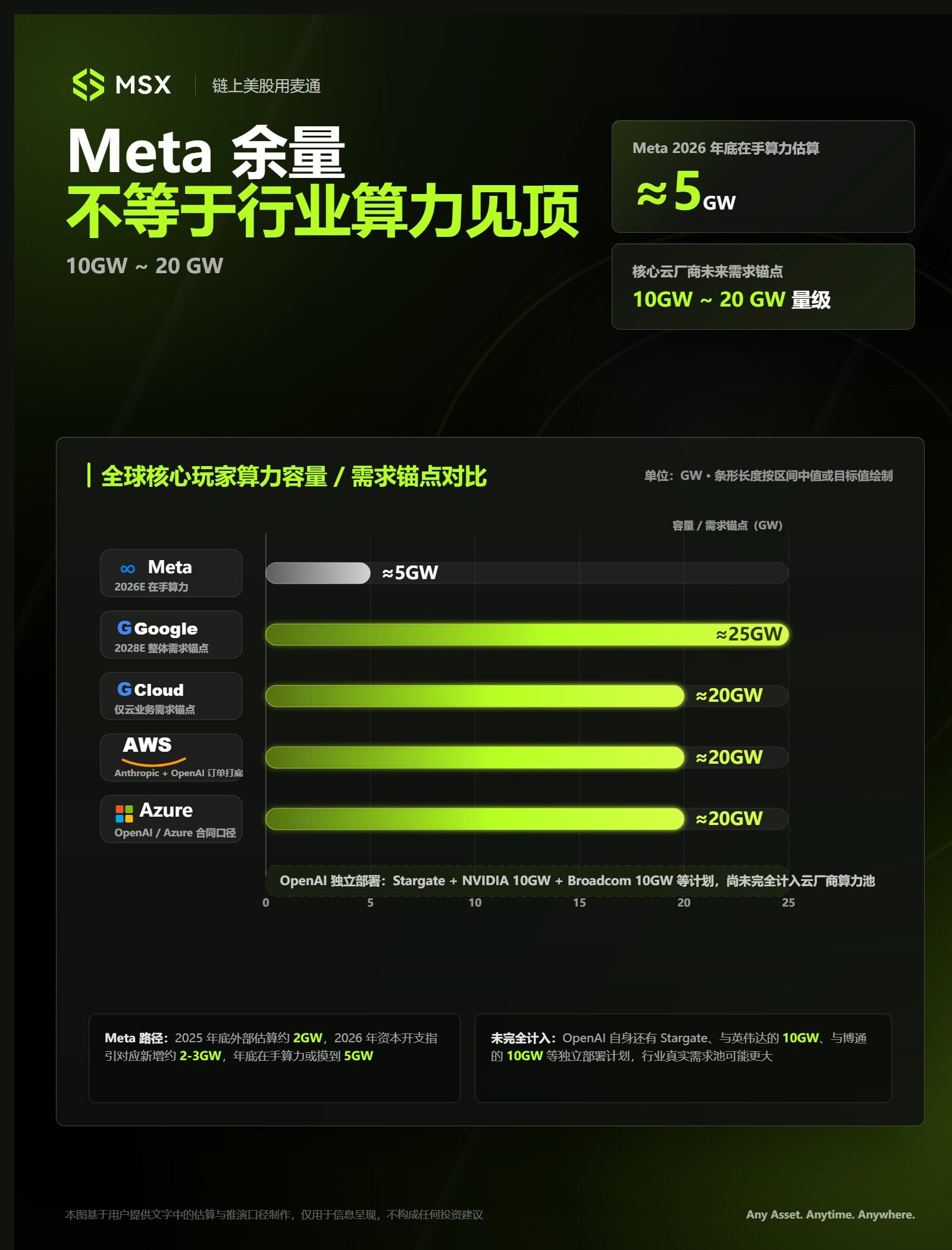
Since the industry doesn't lack demand, why does Meta end up with surplus computing power? This exposes a very thorny question: How can Meta, possessing billions of top-tier global traffic users, not be able to utilize its own 5GW of computing power? What the market truly lacks – is it computing power, or the models and products capable of effectively using it?
From this perspective, we could even argue that Meta's renting out of computing power is not necessarily a leading indicator of an oversupply, but rather might expose the extremely hungry supply-demand state of the current computing power market in full detail:
Just look at the price xAI charges Anthropic for renting computing power: $1.25 billion per month for 500MW capacity. That translates to $30 billion/GW/year. This shows that even if some players temporarily "leave the table" for various reasons, the idle computing power they vacate will be instantly snapped up by leading players with stronger models and shorter monetization paths.
Therefore, MSX Maitong believes that it's still too early to conclude whether Meta's move is the first warning sign of easing computing power supply. What really needs to be observed is whether this computing power will be snatched up immediately once released, and whether the transaction price remains sufficiently high. If everything proceeds as expected, it would actually prove that AI computing power is still in extremely high demand.
At this point, the deeper logic behind "cloud down, hardware down, software up" begins to truly surface. The market is not trading "computing power surplus"; instead, it's trading the restructuring and migration of computing power value within the industry chain.
3. What is the Real "Ghost Story" the Market Should Fear?
Here's something easily misunderstood: Meta selling computing power absolutely does not mean Zuck is giving up on the AI arms race.
On the contrary, the more Meta relies on external models like Google and Anthropic, the more its product ecosystem and lucrative advertising profit margins become vulnerable to external control. The dynamic between AWS and Anthropic has already illustrated this point – once a model company truly masters users and core demand, even a cloud vendor with massive infrastructure might be forced to sacrifice profit margins to retain them.
Zuck can't possibly be blind to this. Otherwise, he wouldn't be reorganizing his management team this year while firmly launching the closed-source MuseSpark model to build a moat, and simultaneously raising capital expenditure guidance again to continue large-scale procurement and deployment.
So, if Meta hasn't conceded, why did the market react with such drastic sector divergence? This is because it has lifted the curtain on the shift in the underlying pricing logic of the industry – the real "ghost story" the market should be afraid of.
As mentioned earlier, for the past two years, the valuation logic of the entire AI


