CZ on Investing: 70% Crypto, 20% AI, 10% Biotech, Has Invested in "Artificial Wombs" and "Knee Regeneration"


- Key Takeaways: CZ reaffirmed the long-term growth trend of the crypto industry, believing that cycle lows are consistently rising. He also emphasized that the integration of crypto with traditional finance is inevitable, and that the development of AI will drive blockchain as a foundational payment and transaction infrastructure. However, he noted that the regulatory challenges facing AI are far more severe than those for crypto.
- Key Elements:
- Cycle Argument: The current bull market has seen a correction of about 50%, but the cycle low has risen from $16,000 in 2022 to approximately $60,000. Each cycle starts from a higher base than the previous one, with previous highs forming future support levels.
- Lower Risk: There have been no institutional bankruptcies in the past six months. Overall industry leverage is better controlled than before, high-leverage products are relatively small in scale, and systemic risk has significantly decreased.
- Integration Path: Crypto and TradFi will interpenetrate, with decentralization and centralization coexisting long-term. Consumers will ultimately choose platforms based on cost, security, and ease of use, with technology driving decentralized progress.
- Ecosystem Competition: The launch of crypto futures by traditional exchanges like CME benefits overall liquidity. Yzi Labs' investment strategy is 70% crypto, 20% AI, and 10% biotech, focusing on social impact rather than just returns.
- AI and Blockchain: The current financial system does not support AI automation. Blockchain, as an API-driven system, will become the underlying payment and transaction network for the AI era. The difficulty of regulating AI far exceeds that of cryptocurrency.
Original Link: CZ on the Future of Crypto
Original Compilation: CryptoLeo (@LeoAndCrypto)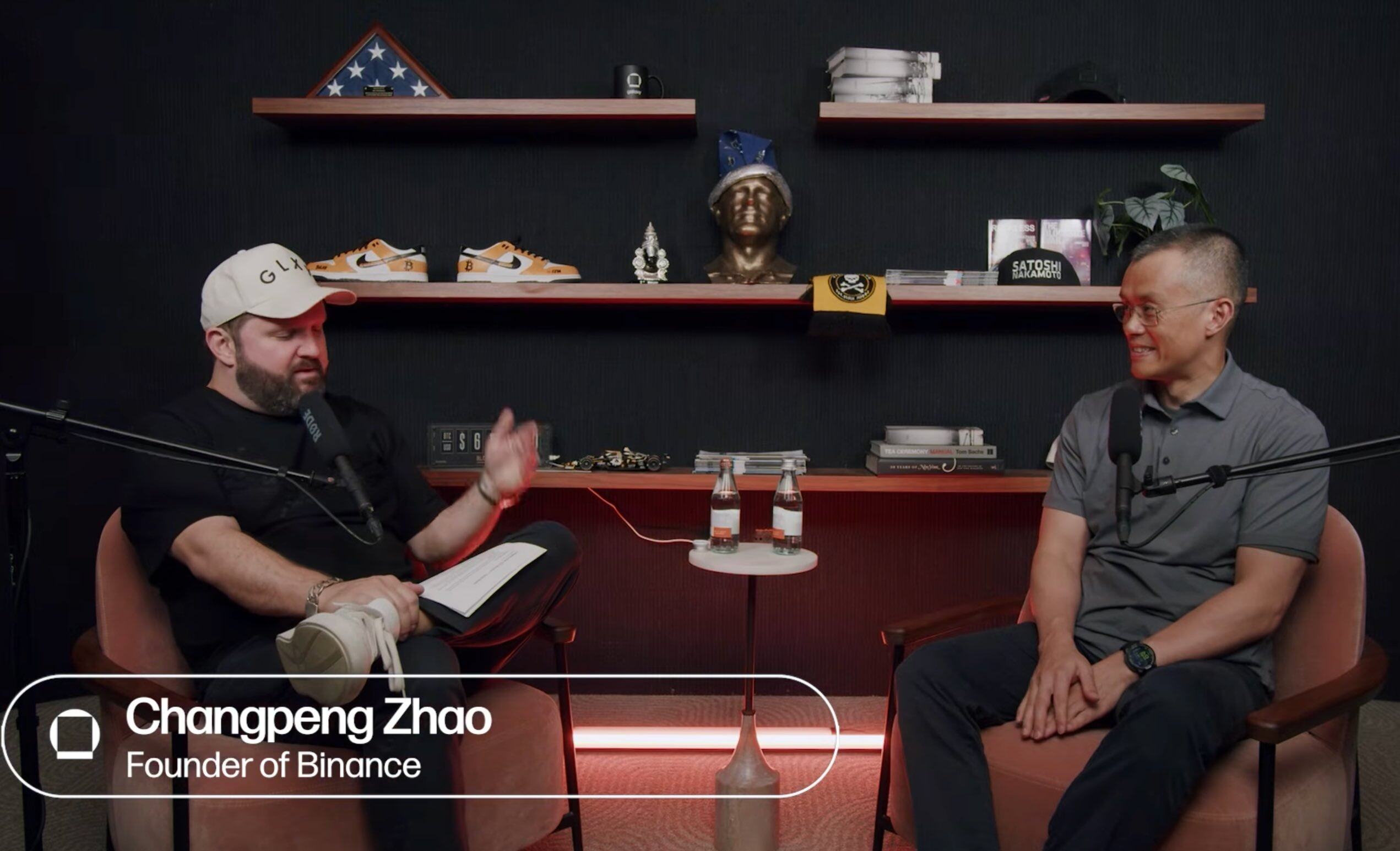
Editor's Note: It’s been a long time since we saw crypto groups actually discussing crypto (all the chats are filled with Micron and SpaceX). Odaily revisits CZ's interview with Galaxy to recharge your conviction — titled "CZ on the Future of Crypto." The dialogue covers the current market cycle, the fusion of traditional finance and crypto, prediction markets, AI development, investment philosophy, and more. It may offer some inspiration for those still holding hope for crypto through the bear market. The full transcript is compiled below:
Q: Regarding the four-year crypto cycle, I’ve done some calculations and found it to be remarkably accurate, almost down to the day. What do you think?
CZ: I think the four-year cycle narrative is accurate. It’s a normal cycle, and prices have retraced about 50% now. In previous cycles, we saw retracements of 80%. For example, in 2022, after the Luna collapse and the FTX crash, crypto hit a low with Bitcoin at $16,000. Now, prices are 4 or 5 times that level, and each cycle trends higher.
Compared to before, we now have countries supporting Bitcoin, many nations embracing crypto, crypto regulation and discussions becoming nationalized, institutional adoption (like BlackRock), including BNB ETF listings, etc. We are truly seeing more real development activity, more developers returning to the U.S., and more countries issuing stablecoins. There’s also RWA, like buying SPCX/pre-IPO tokens on Binance or other platforms.
While we talk about cycles, cycles don't end in the same place. Each cycle starts from a much higher point than the previous one; it’s a cycle of constantly rising bottoms.
I can’t say where the bottom of this cycle is or how long it will last. I don’t like making predictions, but previous highs usually become future support levels. For instance, $60,000 was an all-time high 4 or 5 years ago. In technical analysis, previous highs tend to become support for subsequent lows. There are many theories behind this; I don’t know if they are correct. I’m not a great technical analyst, but that seems to be how it works.
Q: In crypto cycles, there’s always a major “black swan” event that crashes the market from highs to lows. In this cycle, is there any event that comes close to being such a black swan?
CZ: That’s a very interesting question. I’ve been curious about it too, maybe for the past 6 months. But in the last 6 months, no institution has disclosed being close to bankruptcy. The industry as a whole has done a better job controlling leverage. There might be some shocks within the industry, but no one has gone bankrupt.
My knowledge is limited. I don’t see many highly leveraged products. While some stablecoins offer high yields, like circular lending, overall, their scale is relatively small compared to the current industry size. That’s a good thing.
Q: Traditional finance is building its own chains. Crypto is introducing tokenized securities and RWA. Regarding the fusion of TradFi and crypto, where do you see the boundary between centralization and decentralization? Will TradFi make crypto more centralized, or will crypto make TradFi more decentralized?
CZ: I think both will happen because we are already seeing this convergence. Theoretically, crypto is not an independent industry; it’s a new technology, a new tool that facilitates financial transactions with high speed, low cost, and greater transparency. It’s like how there are no pure “internet companies” anymore, but there are internet infrastructure companies like Cisco.
Traditional financial companies can use blockchain. The technology is open to anyone; they can develop their own chains, using various technologies, most of which are open source. For crypto companies, they can offer services very similar to traditional finance. They can now provide lending, savings, stock trading, etc. Transfers, payments — all of these crypto companies can do, and it’s not limited to crypto. Besides stablecoins, there are fiat on-ramps, and crypto companies also handle fiat-related business.
Crypto and traditional finance shouldn't be siloed. This is essentially a fintech industry, so this convergence is inevitable. Regarding centralization and decentralization, I believe that essentially, any platform or company in the industry is part of centralization. Even any team or project, as long as multiple people are involved, is part of centralization.
Humans have network effects; we like working in teams. Very few people can work alone, even with AI. But technology is constantly evolving, becoming more decentralized. So, I think both decentralized and centralized aspects will occur. The binary opposition of centralization vs. decentralization can be reframed as: In a decentralized world, anyone can work together. A decentralized world should be able to accommodate centralized participants.
If centralized participants can provide truly high-quality, secure services at a low cost, they will attract more and more users. That’s the network effect.
Of course, this can lead to small-scale centralization or even monopolies. There are pros and cons. Companies that abuse their monopoly power typically lose their market dominance over time; they simply create opportunities for new market entrants. So, to some extent, centralization and decentralization will always coexist. But I am a firm believer in decentralization, and technology will continue to drive it forward. More and more tools will become increasingly decentralized.
Q: Banks and credit card giants are also building their own chains or crypto businesses. For example, Mastercard announced its test platform MTN. Why don’t they build on BNB Chain, Ethereum, or Solana instead?
CZ: That’s the spirit of decentralization. You can build your own blockchain freely; you don’t have to trade on ETH or BNB. The more diverse blockchains are, the better. To some extent, it’s good for users too. The more choices we have, the better. Over time, users will figure out which blockchains have practical value. It’s unclear yet if most people only care about centralization or decentralization.
I think most people care about fundamental aspects like low cost, security, and ease of use. If those large traditional finance players want to develop their own proprietary blockchains and manage to get people to use them, then kudos to them. But I believe more and more people will demand greater freedom. A truly decentralized crypto world offers higher freedom and lower costs, etc. Which chain to use depends on consumer choice.
Also, many countries aren’t completely comfortable with purely open blockchains; they all want their own national blockchain. I’ve discussed this with leaders from many different countries. They all want a national blockchain but need time to convince themselves: “We are going to give up control over our currency, or give up control over our national financial sector.”
This might be a transitional phase. Over time, for a large country like the U.S., if all the giants on Wall Street use one or two private blockchains, and trillions of dollars flow on these networks, retail investors might be excluded. It’s like the enterprise internet; there’s enough activity on it, and these activities are meaningful, so that's fine.
Decentralization doesn’t mean everyone must use a single, open-source blockchain. Forcing everyone to use Bitcoin is not true decentralization.
Q: Binance offers perpetual contracts. BitMEX was one of the first exchanges to offer them, a very important, efficient, and excellent financial instrument. It seems that as crypto becomes legalized, more platforms like CME will trade crypto. What impact does this have on crypto exchanges? And what impact do crypto stock trading methods have on traditional exchanges?
CZ: First, contracts weren’t invented in crypto; they existed in traditional finance. Perpetual futures first appeared in crypto in 2014, introduced by BitMEX. Binance was late to the game, only offering them in 2019. In between, some other exchanges offered different futures types, but not perpetual futures — they were delivery futures that required settlement and rollover every Friday.
Binance offers these products because it has the largest user base, thus providing the best liquidity, volume, and price slippage. Now, traditional futures giants like CME are also launching futures products. I think this is great because they serve a market Binance never served. Binance never served those institutional clients in the U.S.
If CME or any other U.S. institution can drive all institutions to trade crypto futures, there will be more liquidity. This will fill the liquidity gap, increasing liquidity for crypto trading. I think that’s really good.
I don’t care much about who gets stronger. The more people who can access and trade crypto, the better the liquidity. Better liquidity is actually the best protection for consumers. When liquidity is good, you see fewer crashes and similar events.
I predict that forex trading will also move to the blockchain in the future.
But back to the point, Binance’s user base is very diverse. For example, it’s not easy for most people outside the U.S. to buy U.S. stocks. But which country doesn’t want its stocks to be purchased by everyone in the world? If SpaceX goes public, why wouldn’t you want everyone in the world to buy its shares? Which company, stock exchange, or country wouldn't want everyone globally to buy its government bonds? Why would you stop others from buying your country’s government bonds?
Digging deeper, if one country buys a large amount of another’s government bonds, they are less likely to have conflicts. They have to negotiate on trade rather than attack each other. So, the world is getting smaller, despite geopolitical tensions. Crypto exchanges provide a way for people not in that country to buy its stocks. This doesn't harm the country's existing stock exchange; it actually helps improve liquidity, demand, etc. That’s my view.
Q: Hyperliquid is a large and growing platform. I think it’s more decentralized than Binance, but less decentralized than Uniswap — it sits in between. Have you met Jeff? What are your thoughts on Hyperliquid?
CZ: We find Hyperliquid very interesting, especially regarding Jeff. I’ve never met him personally, but he was actually part of one of the earliest Yzi Labs incubation projects. So, I guess he’s a very smart young man and very capable.
Hyperliquid proved the existence of a new market segment that didn’t exist before. No one else had done that previously. They have a small team but occupy a niche market where Binance can’t compete. They have no KYC, and they claim to be decentralized (I won’t comment on another project). Based on the technology we see, they have significant control over Hyperliquid, using smart contracts for deposits and withdrawals while claiming this is decentralization. In any case, Hyperliquid has some technological innovations that are quite good.
Q: What are your views on prediction markets? Many U.S. jurisdictions are upset with them (sports betting), yet they seem to have considerable utility, especially when you need to trade proxies for events rather than the events themselves. From both a regulatory and product concept perspective, what is your current view on prediction markets?
CZ: I also think it’s a great invention. Prediction markets have been around for a while, like event futures prediction markets. There are different regulations for prediction markets in different regions. But the CFTC chairman’s tone was supportive of prediction markets. Many important people in the U.S. government have expressed support for Polymarket. This is good. It allows people to provide price discovery and liquidity.
I founded an exchange, so I like seeing any tool that provides price discovery and liquidity. I believe Polymarket and Kalshi have licenses in the U.S., so I don’t know about specific states that might dislike it. I steer clear of any jurisdictional disputes. But I think, for consumers and the global crypto industry, this is a good thing. Like any new technology or platform, if it works well, it can be great. Of course, there are always bad ways to do things. But I think the top prediction market projects today are indeed doing very well. And there will be many new prediction markets emerging in the future.
Maybe as many prediction market projects as there are in the crypto space, roughly 100 to 1,000. So, I hope all these projects execute responsibly.
Q: What should we be paying attention to on BNB Chain right now?
CZ: Now that I’m no longer handling exchange operations, I have more time to chat with developers in the community. I’m genuinely excited about some new features they’re developing on BNB Chain. One piece of advice I give to developers is: Don’t do major upgrades during a bull market; do them during the calmer bear market periods. Of course, I recommend this to every blockchain project, not just BNB Chain developers.
Right now, they are working on the next version, which is faster, cheaper, and offers more privacy control options for users. The feature list for the next version is quite long. I’m not driving these features, but when I see the list of everything they are developing, I think they are doing a great job.
Q: Ethereum’s hub-and-spoke model seems a bit strained now. L1 is highly decentralized, so they launched L2s, but current L2s are mainly OP’s single-sequencer rollups, which aren’t truly decentralized. I don’t think they’ve reached Stage 2 decentralization yet. What’s your take on this argument? I know Vitalik seems to suggest maybe more work should be done on L1.
CZ: Yeah, I did sense a shift in Vitalik’s attitude. I recall that about 4-5 years ago, the Ethereum community was very focused on L2 technologies. In the past few years, it seems like they’ve backtracked or stagnated. I think the main reason is that L2s don’t contribute value back to L1.
We did the math and found that the licensing fees BASE paid for choosing the OP technology were more than the L1 fees they actually paid.
Vitalik seems to have realized that L2s don’t help L1. Then Ethereum went through a downturn, and Vitalik had to deal with pressures from the price decline. All these things combined made him realize he still needs to work on L1. So now, he’s shifting his focus a bit, which is normal.
There are still some powerful L2 solutions, but I think the future is on L1. For instance, L1 speed will improve, but then demand will increase, and L1 won’t be able to scale quickly enough. Then, other L2-type solutions might emerge again – a kind of L1-L2 cycle recurring.
Q: Yzi Labs (formerly Binance Labs) is your core investment vehicle. What kind of projects are you focusing on now?
CZ: My guiding principle for Yzi investments is roughly 70% crypto, 20% AI, 10% biotech. I believe these three areas are massive industries that will continue to grow rapidly, and there is much innovation waiting to be discovered, implemented, and built in these fields, which could positively impact our civilization.
Our philosophy is that Yzi wants to invest for impact, not necessarily for ROI. Let me give you an example. Suppose we invest one billion dollars in a drug research company treating common diseases like cancer, and the treatment is very cheap. The company might not make any money, but it could cure one million, ten million, or one hundred million people. I would rather lose that one billion or even tens of billions of dollars in investment. That would make me very happy, because we achieved impact.
Many early-stage projects are a bit crazy; we expect a very high failure rate. Of course, we also invest in some very good projects. There are many crypto companies, but I won't talk about them specifically because many have tokens, and it might be considered promotion.
Beyond crypto companies, we invested in a company working on an artificial womb. You could have a baby in a machine, freeing women from the pregnancy process. It's already been tested on rats, and human application might be 5 to 10 years away.
Recently, there's also a technology for knee cartilage regeneration. They implant a 3D-printed scaffold into the knee cartilage to promote regrowth. Many elderly people have knee problems.
This project is also relatively early. I forget their exact stage – maybe just starting the next phase of human clinical trials. We are also investing in many AI robotics companies, but the biotech ones are what really excite me.
Q: Speaking of AI, what’s your personal favorite model right now? Are there any specific AI features on mobile apps that interest you? And what’s your outlook on the future of AI?
CZ: I have almost all mobile AI apps installed. I use different AIs for different things. OpenAI was the first one installed. Anthropic’s Claude is better for coding and fairly good at answering questions. I travel a lot and find that different A