






A Comprehensive Analysis of On-Chain Treasuries: Across Eight Major Tracks, Who is Rising and Who is Declining?


- Core Insight: The article provides a quantitative analysis of the blockchain "treasury" landscape, breaking it down into eight categories. It points out that while overall TVL has declined by approximately 50% from its peak, RWA treasuries have bucked the trend with a 37.8% increase. The author emphasizes the need to examine the structural shifts in treasuries from perspectives such as modular lending, risk curation, and asset types.
- Key Elements:
- Treasuries are defined as tools for users to access active yield-generating strategies, excluding pure off-chain asset wrappers such as BlackRock's BUIDL.
- Categories like lending, liquid staking, and restaking have been hit the hardest, while RWA treasuries have demonstrated uncorrelated growth due to their lack of crypto-asset exposure.
- The curator model driven by platforms like Morpho is shifting lending treasuries towards modularization, with its TVL on Ethereum and Base exceeding $7.5 billion.
- Risk-curated treasuries are growing rapidly, with a TVL of approximately $6.5 billion, but 75% is concentrated among three top curators: Sentora, Steakhouse, and Gauntlet.
- RWA treasuries have a five-year compound annual growth rate of 231.3%. Platforms like Maple Finance benefit from product composability, but leveraged lending loops face risks of liquidation and redemption delays.
- Perpetual swap LP treasuries, such as Jupiter Perps, have seen TVL decline due to market volatility. Hyperliquid HLP once suffered significant losses from traders manipulating positions.
- Option treasuries are attempting a revival through RFQ systems and optimized designs (e.g., Derive V2), but the overall category remains subdued compared to its peak.
Original Author: Castle Labs
Original Compiled by: Jiahuan, ChainCatcher
This article is excerpted from our research on "The Financialization of Vaults."
Vault Classification
This section of the report provides a quantitative analysis of the vault landscape to offer a comprehensive picture of the field and its evolution. We analyze the ecosystem by category, tracking TVL shifts across different vaults and curators.
We break down curator concentration and provide an outlook on major capital flows, contextualizing the structural shifts that will define vaults this year.
Vaults should not be viewed as a single, all-encompassing market. Instead, they should be evaluated based on their different implementations, each with distinct parameters, risk vectors, and responses to stress tests. Aggregated data only provides a partial picture, necessitating a more granular analytical perspective.
Before starting the analysis, it is important to define the term "vault" as the foundation of our methodology.
Our definition is based on the deployment path. A vault is classified as "a tool for users to actively acquire yield-generating strategies." Any asset that is purely a wrapper for an off-chain instrument is excluded from our analysis.
Maple's syrupUSDC meets the vault criteria: users deposit stablecoins into the protocol, the protocol lends them to institutional borrowers, and accumulates annualized yield through the credit activity of the issued token.
Lido stETH is a vault: users deposit ETH, the protocol earns staking rewards, which are distributed via a rebasing token. Centrifuge JAAA is a vault: users gain exposure to AAA-rated CLO yields through a tokenized wrapper that generates returns through its credit positions.
BlackRock's BUIDL is not a vault by this definition: it is a direct token issuance representing a 1:1 claim on an off-chain US Treasury fund.
Applying this perspective, we have defined eight structural categories: Lending Vaults, Liquid Staking, Restaking, Risk-Curated Vaults, Vault Infrastructure Providers & Yield Optimizers, RWA Credit Vaults, Perpetual LP Vaults, Options Vaults.
For the purpose of this analysis, we treat Risk-Curated Vaults as a standalone category to better understand their dynamics and growth.
Before diving into each category, let's first look at the overall performance of vaults.
Current State of the Vault Ecosystem
The net TVL across all defined vault categories totals $120.4 billion, a decline of approximately 50% from the peak of around $241 billion in October of last year. The downward trend following the October peak was driven by the "October Liquidation Event," which triggered cascading liquidations across DeFi.
Due to overlaps, the vault TVL figure is higher than the current DeFi TVL (approximately $86 billion). For example, liquid staking protocols like @LidoFinance issue stETH, a rebasing asset representing staked ETH yield, which is used as collateral in lending protocols like @Aave and @Morpho.
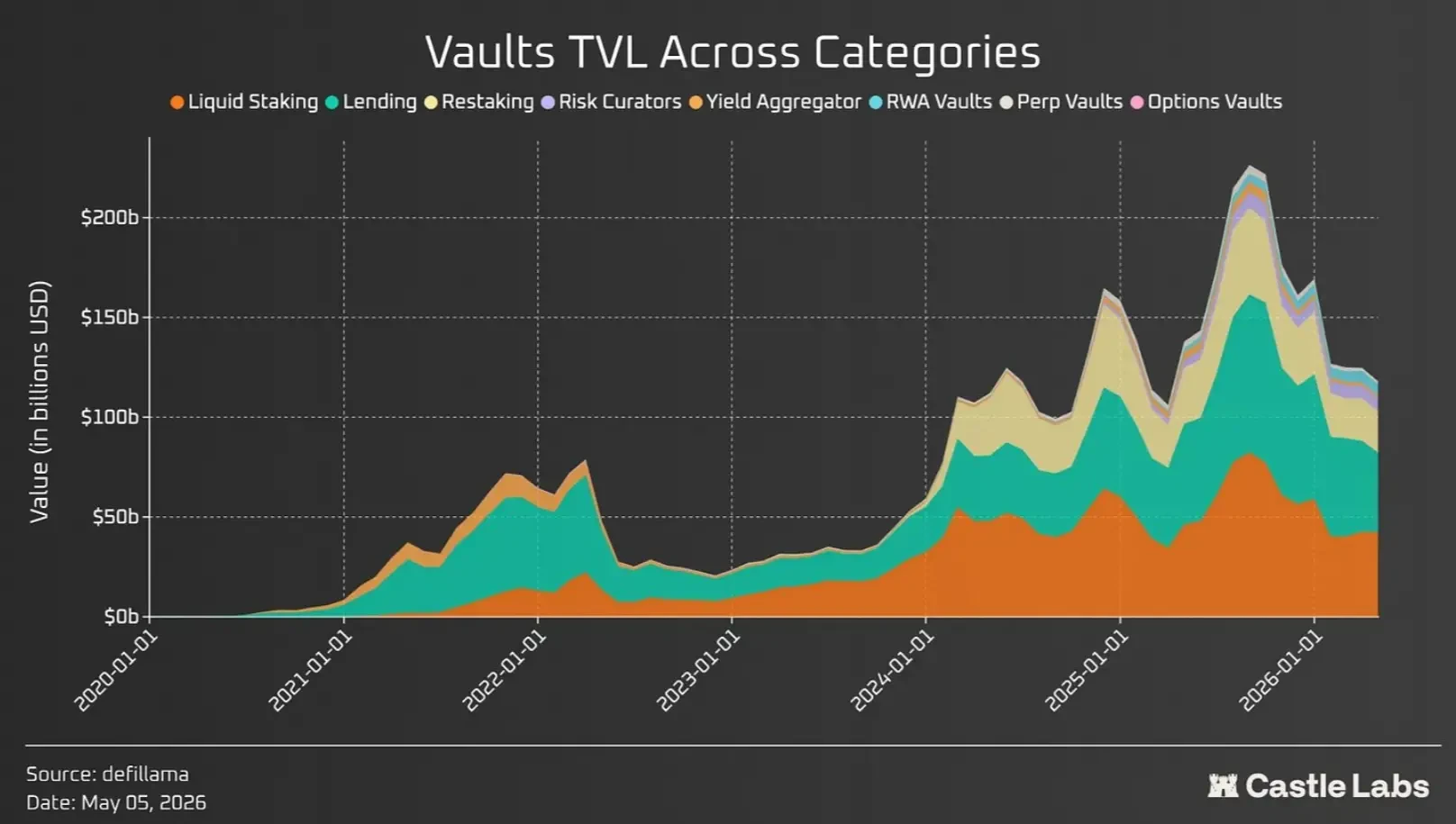
When we move to category-level analysis, the overall picture changes dramatically. Recent events have led to TVL outflows and prompted a broader reality check across the industry regarding security and risk management (hopefully shifting towards a security-first approach).
Categories like Lending, Liquid Staking, and Restaking were hit hardest due to their significant exposure to on-chain assets and their role in driving the on-chain economy; meanwhile, RWA Vaults, having no crypto asset exposure, continue to show uncorrelated growth.
Categories like Options Vaults peaked in April 2022 and have struggled since. Due to the "October Liquidation Event," risk-curator-led vaults suffered equally alongside other major categories. Their TVL peaked around the end of October, followed by a decline after the Stream Finance collapse.
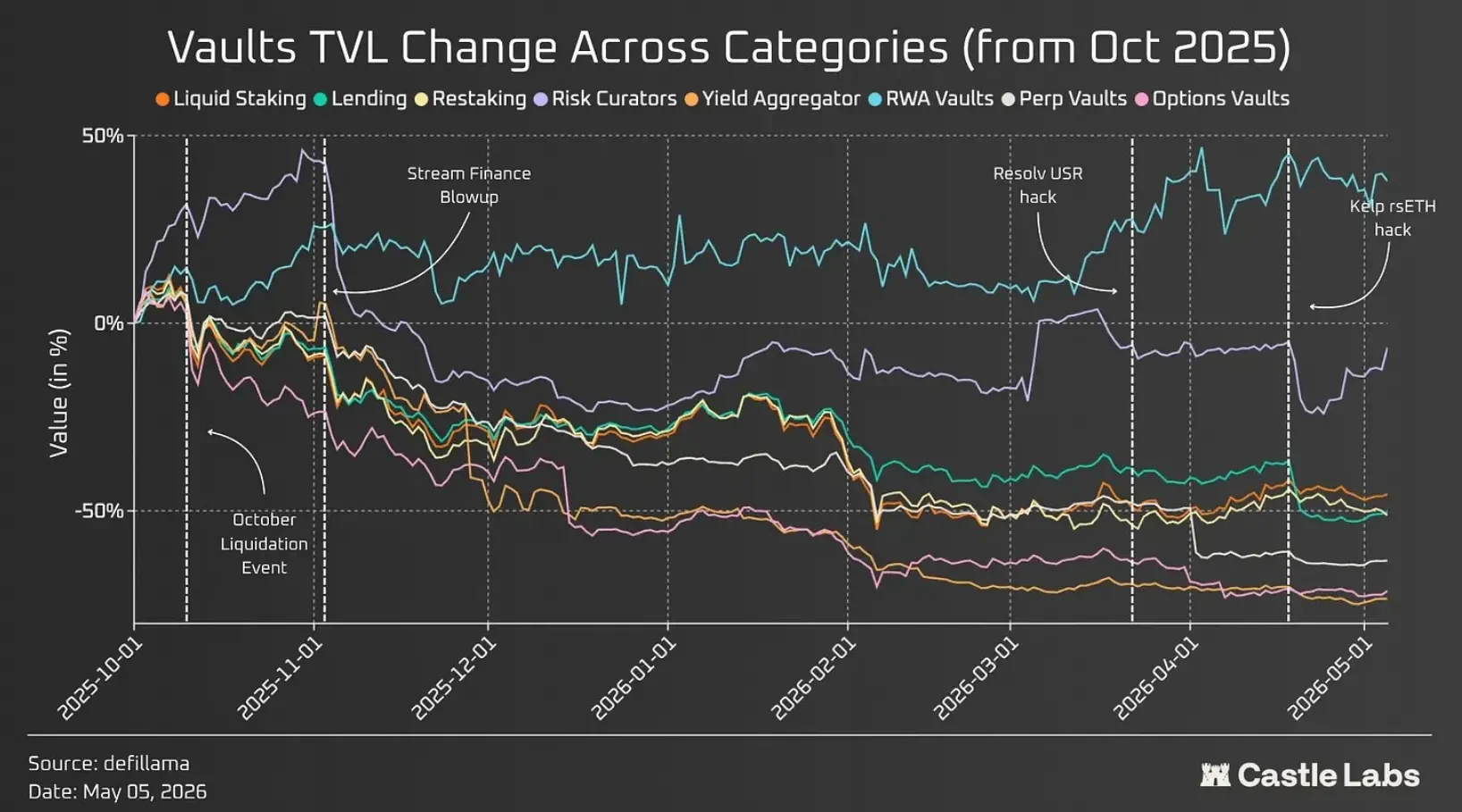
The three events between October 2025 and May 2026 (Stream Finance, Resolv, and Kelp hacks) provide a good stress test window, as these collapses/exploits had cascading effects across DeFi.
In the chart below, we highlight the TVL history of these categories during this specific period. As mentioned, most underperformed, with only RWA Vaults growing by 37.8% during the same period, while other categories experienced significant drawdowns.
Next, we continue to analyze the growth of each vault category, focusing on recent trends and shifts.
Lending Vaults
Lending is the largest vault category, accounting for the vast majority of DeFi TVL. The past year marked a broad shift towards curated vaults, driven by products like Morpho that helped amplify this trend.
On Morpho, curators can create their own vaults that can have exposure to multiple markets and generate yield for depositors. These vaults can ultimately be curated by any provider, including traditional financial institutions.
Morpho's recent Vaults V2 upgrade offers curators more features, including the ability to embed approved adapters to source yield from multiple origins, granular risk controls (e.g., setting absolute or relative caps on vault exposure), built-in KYC controls, and more.
In the same context, Aave also launched its V4 version, introducing an architecture of Spokes and a unified liquidity hub. Spokes offer enhanced capabilities with custom risk parameters, isolated collateral types, and per-market oracle configurations.
It differs from Morpho's curator-led model in that Aave's governance still needs to review and approve these Spoke implementations, whereas Morpho is permissionless. This marks Aave's shift from monolithic to modular lending.
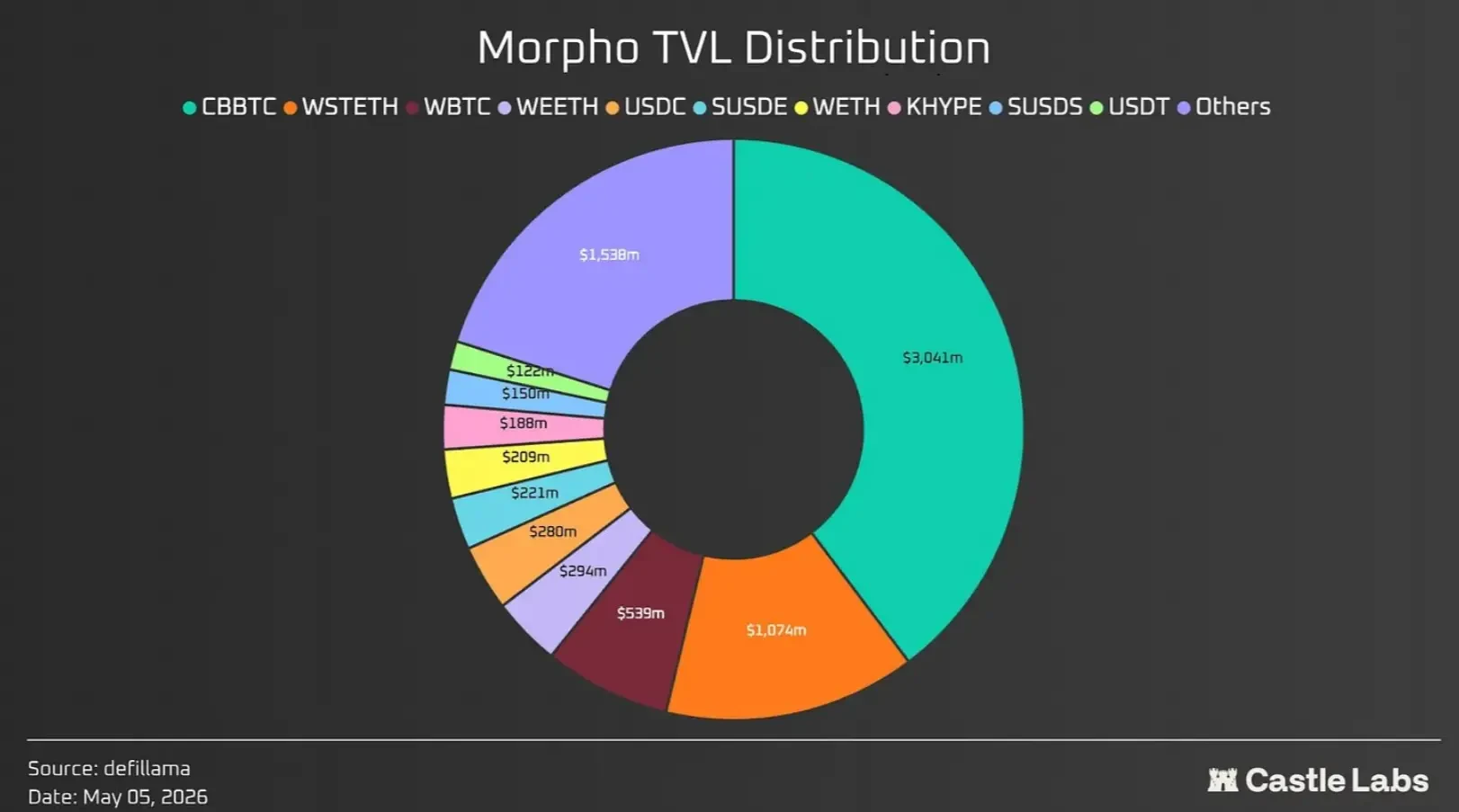
The curator model has enabled Morpho to accumulate over $7.5 billion in TVL on Ethereum mainnet and Base. Base has contributed significantly to Morpho's growth, from $604 million to over $2.8 billion.
This demonstrates the power of the distribution partnerships Morpho has pursued, such as the collaboration with Coinbase: currently, approximately 40% of TVL in USD terms is cbBTC, while it has helped facilitate over $1 billion in loans for Coinbase users.
In response to the curator model finding product-market fit (PMF) with institutional investors, Aave is competing on the institutional track through Horizon, which has accumulated over $350 million in TVL since its launch.
Furthermore, in recent months, Aave has undergone many changes, including service providers like BGD and ACI departing from Aave Labs, and the announcement and approval of the "Aave will Win" framework, directing all revenue from Aave's products to token holders.
None of these events have had a direct major impact on Aave users. The only impact was on Aave's token price performance, but the recent KelpDAO attack changed the situation: Aave lost over $12 billion in TVL, bringing it closer to its competitor Morpho in terms of TVL.
The ratio of Aave TVL to Morpho TVL was previously between 5 and 6 times, but due to this event, it has now fallen below 2.
@sparkdotfi, part of the Sky ecosystem, is also one of the lending protocols that benefited the most from the capital inflows following the rsETH hack.
The chart below shows the TVL changes for the protocol:
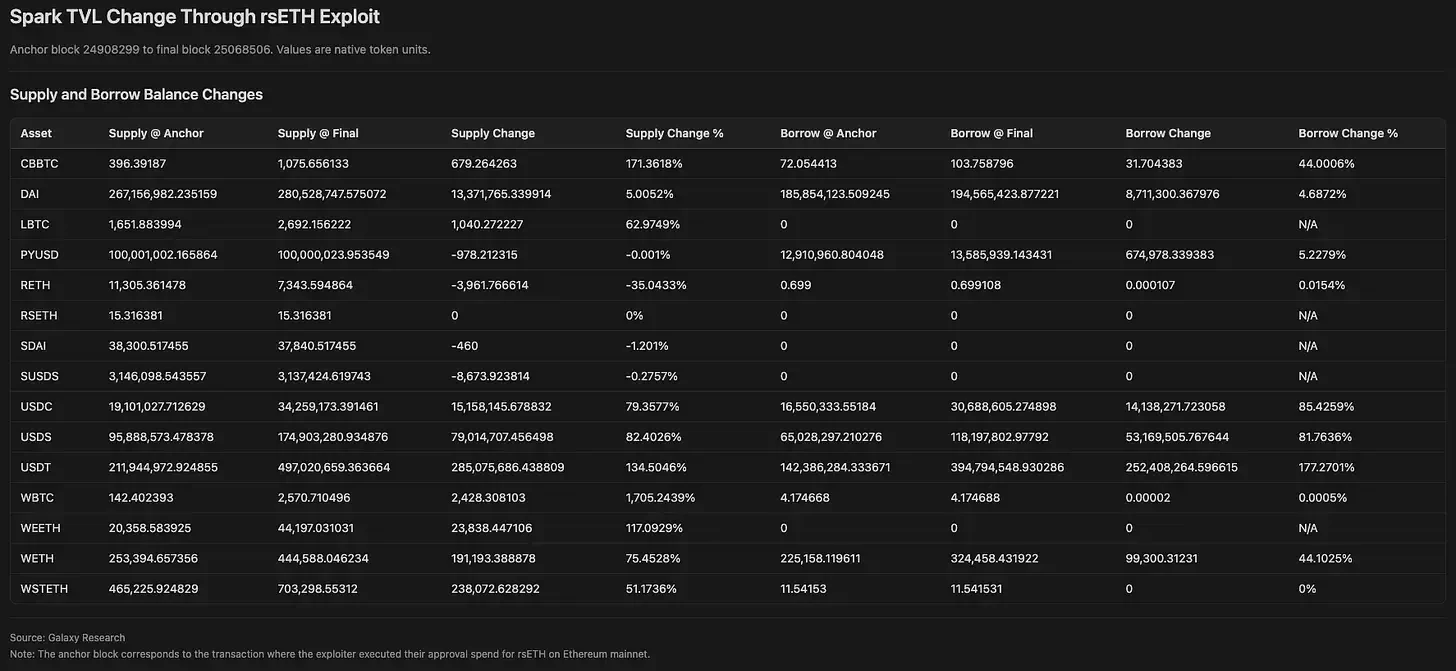
Most notably, Bitcoin supply nearly tripled, stablecoin borrows increased by 78% to $752 million with utilization remaining manageable, and WETH borrows increased by 44.1% to 325,000 WETH.
@0xfluid's unified liquidity layer also introduces a different approach to liquidity design, where lending, borrowing, and DEX share the same pool. User collateral acts as an LP (Liquidity Provider) in the Fluid DEX, earning trading fees, while borrowed funds are deployed as smart debt into DEX pools, earning fees to offset borrowing interest costs.
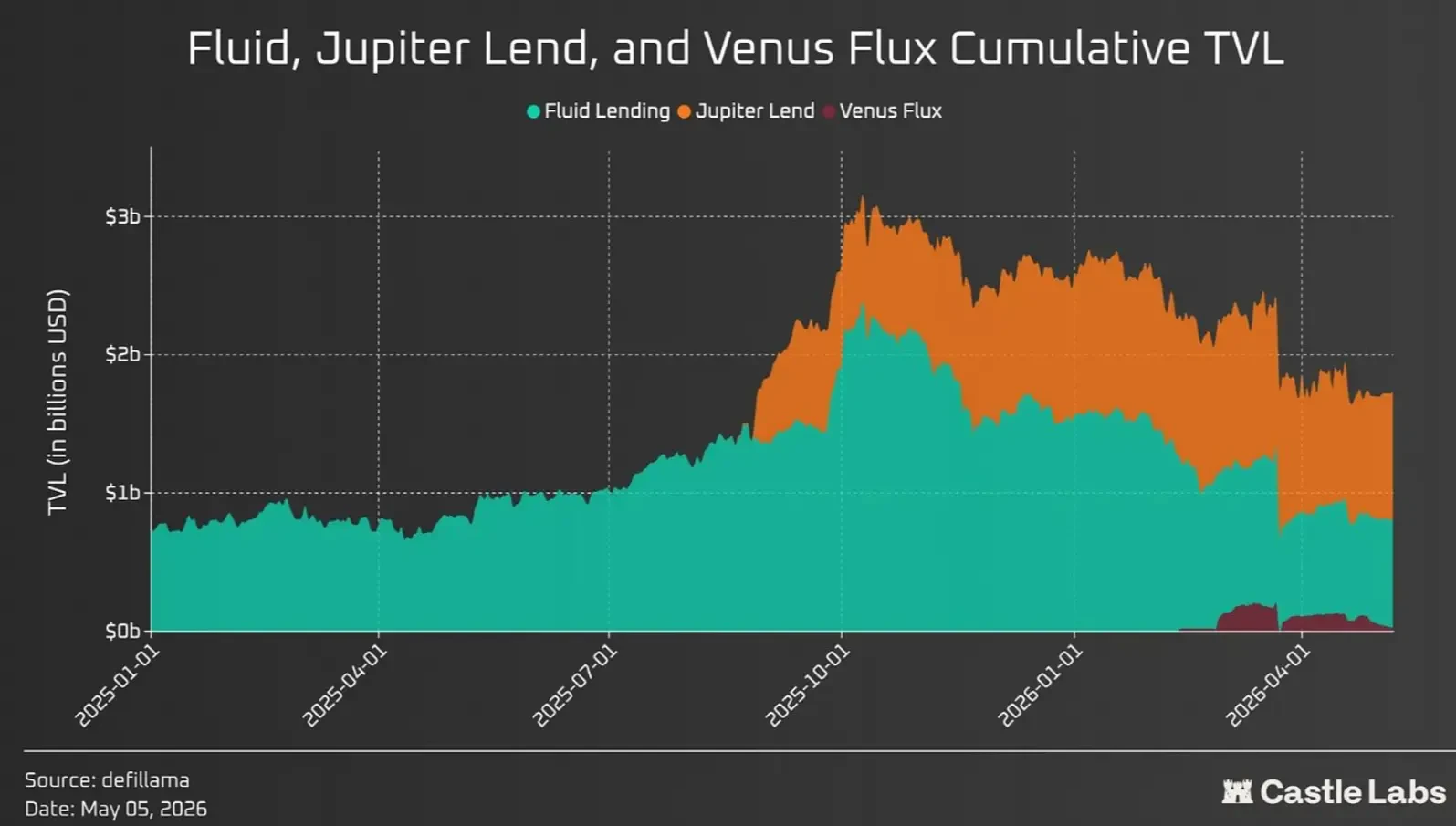
Another interesting move by Fluid is its collaboration with protocols like @JupiterExchange and @VenusProtocol, through which it launched white-label products like JupLend (Solana) and Venus Flux (BSC), currently reaching TVLs of $926 million and $21 million respectively.
This stems from Fluid's broader positioning to partner with key players on various chains and capture more market share, with these partners sharing fees with Fluid.
Worth mentioning are the @kamino vaults, the primary lending stack on Solana with over $1.6 billion in TVL. The protocol has seen significant growth through its K-Lend model (Morpho's equivalent on Solana). This has allowed Kamino to partner with established curators like Gauntlet and target institutional integration.
The largest vault on the platform is currently @SentoraHQ PYUSD, with over $219 million in TVL, and the second largest is RockawayX's RWA USDC vault at just $33 million, indicating significant room for growth for Kamino and Solana as a whole.
Liquid Staking & Restaking
Liquid staking and restaking account for a large share of vault TVL, at $42.4 billion and $20.6 billion respectively.
The main players in liquid staking are Lido ($21.8 billion), Binance Staked ETH ($8.9 billion), @Rocket_Pool ($1.2 billion), and @Coinbase cbETH ($320 million).
Over time, Lido has maintained its dominance, with its issued asset stETH being highly composable across DeFi. Simultaneously, Lido's dominance also marks concentration risk. They expanded their product line by introducing the Earn product, which acts as an aggregation layer, depositing user funds across DeFi to earn yield. However, due to its exposure to $rsETH, this product was impacted after the recent Kelp DAO hack.
Binance Staked ETH, leveraging Binance's user base, has grown by 121.8% since last year.
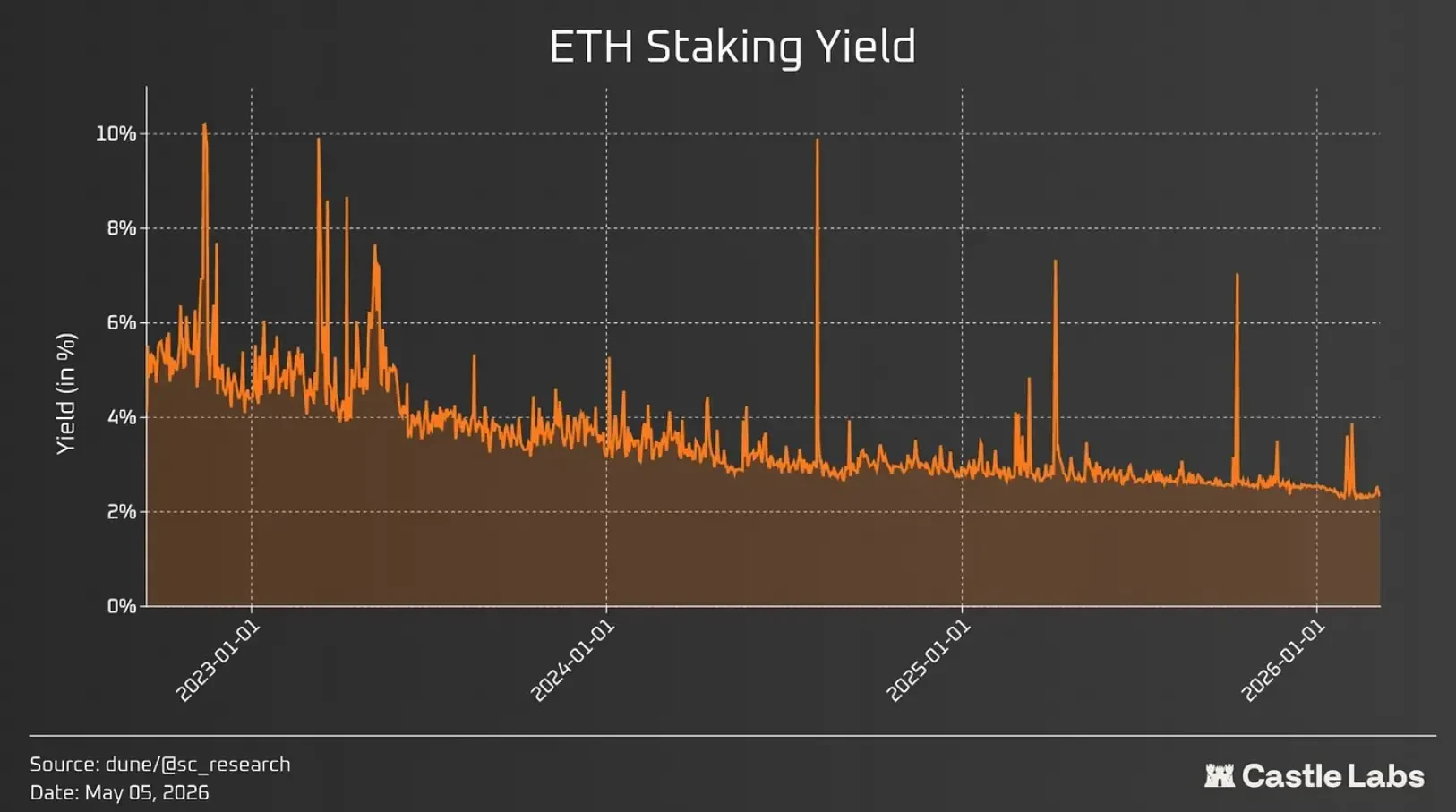
Growth has been slow for other protocols and the category as a whole, coming at the expense of diluted staking yields, with current staking yields around 2.5%.
On the other hand, restaking and liquid restaking grew as a category to enhance the yield earned from liquid staking.
The hack of @KelpDAO, a former liquid restaking protocol, and the broader DeFi cascade meltdown highlighted the composability risks associated with these assets, as they are accepted as collateral throughout DeFi. In this instance, it proved more of a vulnerability than a feature.
The main players in restaking and liquid restaking are @EigenCloud ($7.8 billion), @ether_fi ($5.7 billion), Kelp DAO ($1.6 billion), and Renzo ($167 million).
Restaking products like EigenCloud and EtherFi have expanded over time to encompass more services.
EigenCloud's brand refresh in 2025 helped them position themselves as the AWS of the crypto space, driving verifiable computing forward.
EigenDA, Eigen's data availability layer, is used by several L2s, including @megaeth, @Mantle_Official, and @Celo. Data posted on EigenDA has exceeded 1.8 TB and generated approximately $90,000 in total fees.
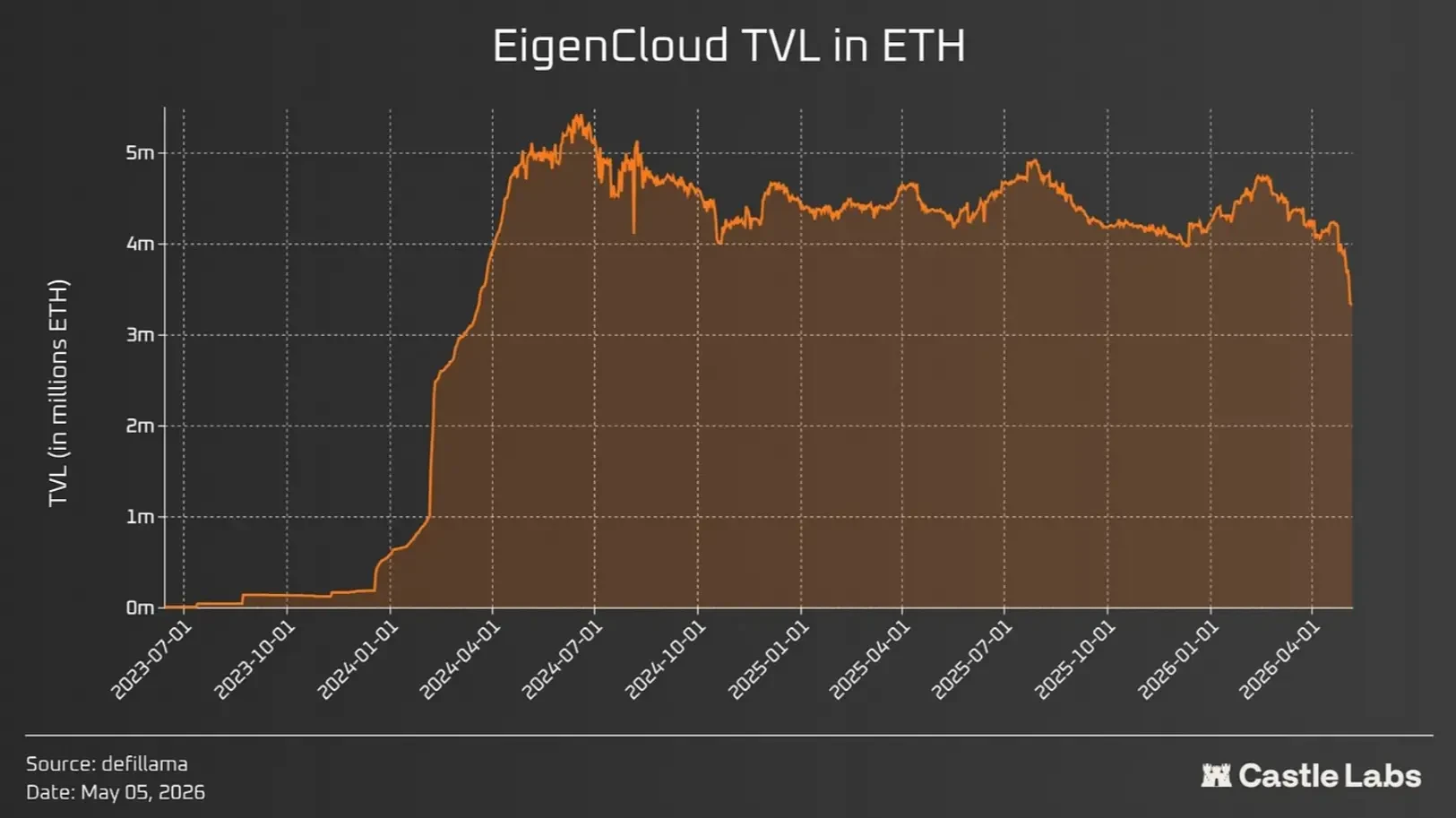
EigenCloud's TVL in ETH terms remained flat for a long time but has recently declined following the Kelp hack, as users tend to withdraw funds during periods of uncertainty.
Similarly, EtherFi expanded into a neobank with thousands of active card users who have cumulatively spent approximately $440 million through their products.
Additionally, they have a Liquid product (remember EtherFi originally launched as a liquid staking protocol) that supports multiple strategies to enhance yields across DeFi. One of its top ETH yield vaults has a TVL of $177.5 million.
Risk-Curated Vaults
Risk-curated vaults are one of the fastest-growing categories, reflecting the shift from monolithic to modular lending. The curated vaults they offer on platforms like Morpho earn them performance and management fees, similar to how traditional finance funds operate, deploying user capital across various strategies to generate returns.
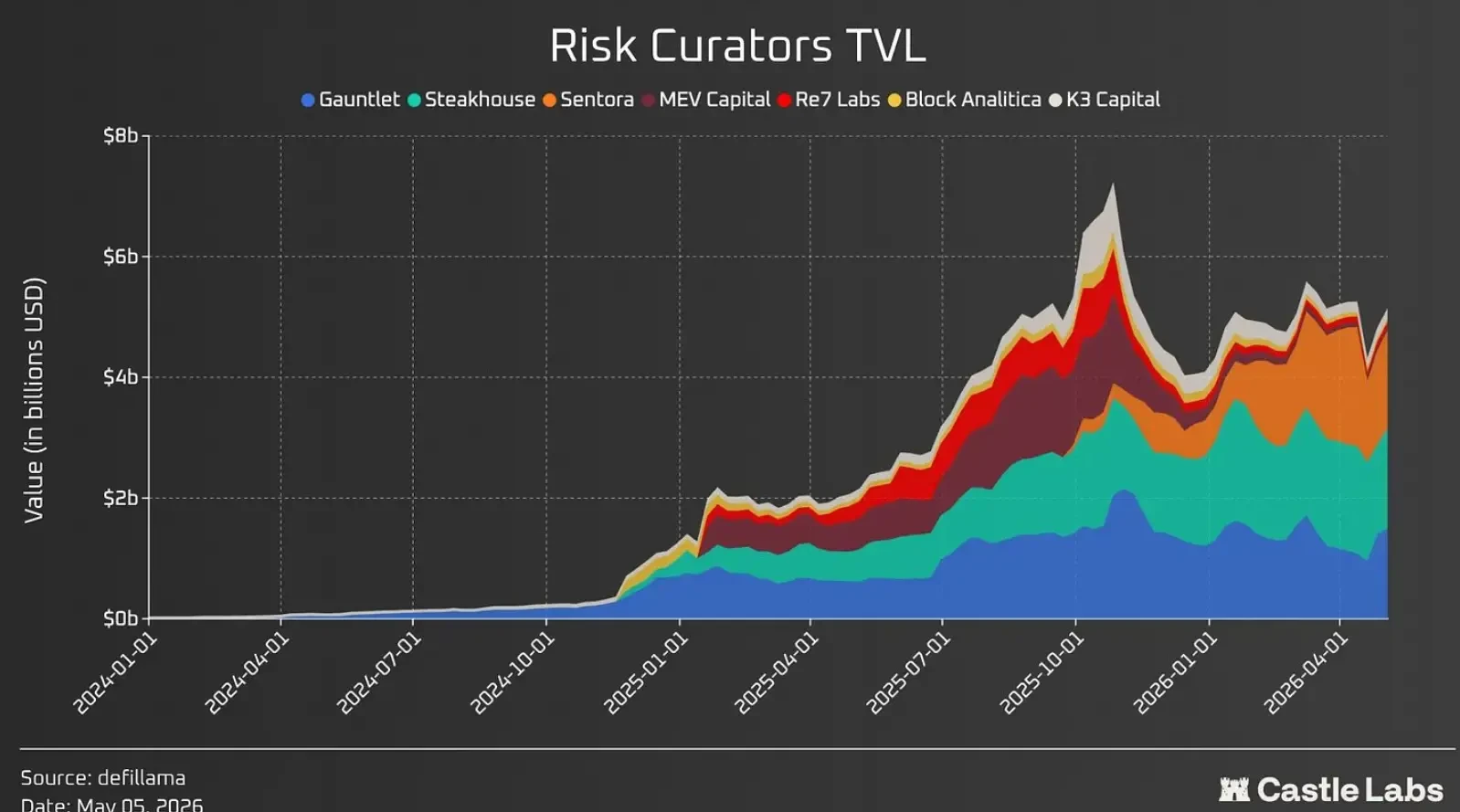
The current TVL for this category is approximately $6.5 billion, with 75% held by three curators: Sentora ($1.85 billion), @SteakhouseFi ($1.63 billion), and @gauntlet_xyz ($1.5 billion), indicating less competition in this category.
These risk curators charge lower fees than traditional finance hedge funds and venture funds, which typically charge management fees (around 1-2% of total AUM) and performance fees (around 10-20% of earned interest). For instance, Steakhouse Financial, the largest curator by revenue, generates $3 million in annualized revenue on $2.13 billion in AUM (an annualized fee rate of approximately 0.14% of total AUM).
These curators typically charge only performance fees, and in some cases management fees, but these fees are currently much lower. This is a result of the competitive landscape, as curators vie to offer the lowest fees to attract the most TVL.
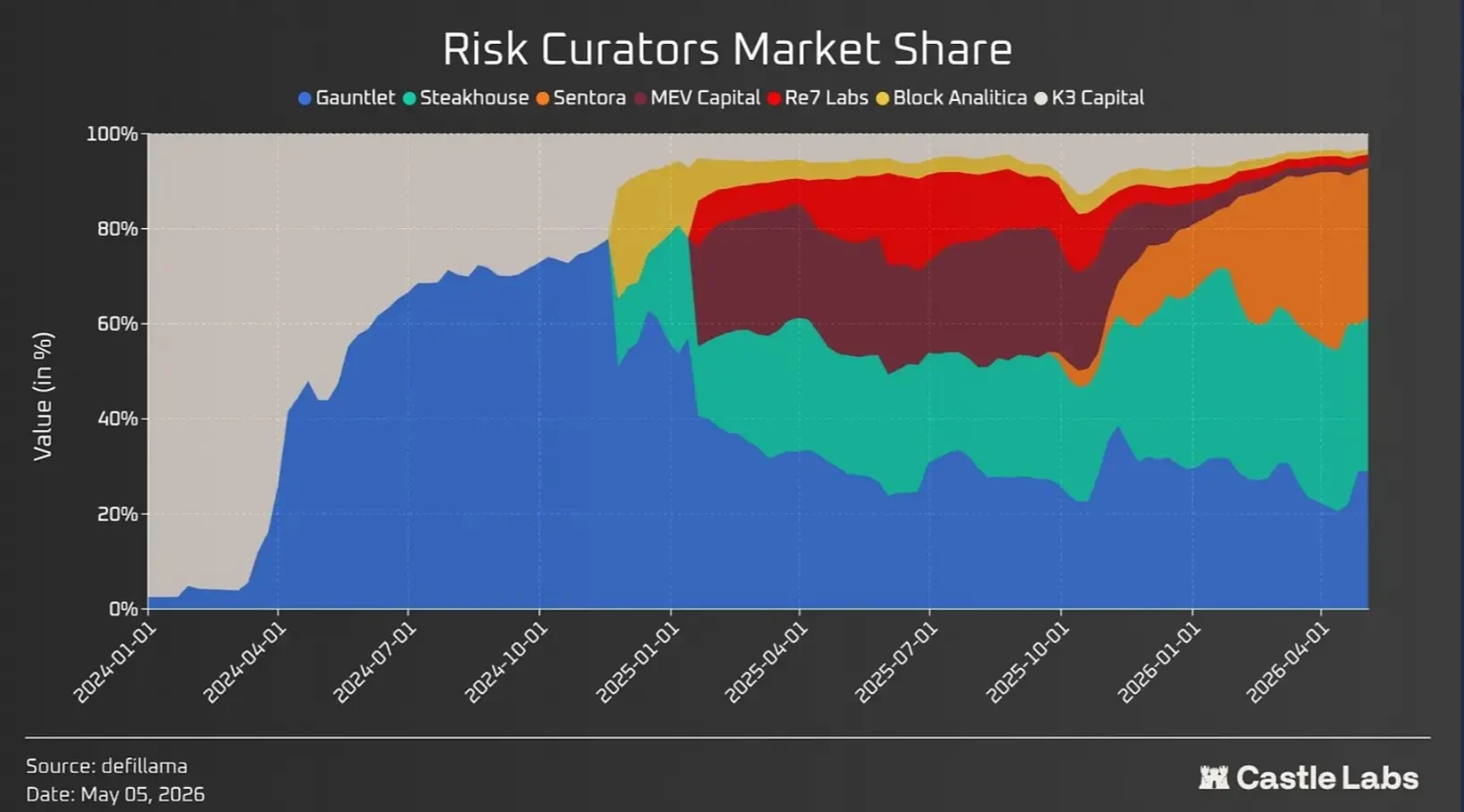
Nevertheless, risk curator concentration is top-heavy, with dominance shared by three providers, which is better than liquid staking where Lido is far ahead.
Furthermore, what does this concentration imply? The Steakhouse team comments: "Concentration will likely follow the power law found in traditional asset management analogues (e.g., ETFs), where most AUM concentrates around leading managers.
This isn't necessarily bad, but rather a reflection of scale and trust compounding around top managers, who compete on performance, product breadth, and fee loads.
The benefit


