






伯恩斯坦解读:50GW算力重估设备股,AI设备超级周期来了?


- 核心观点:伯恩斯坦报告将AI数据中心扩张与半导体设备支出(WFE)相关联,测算在2030年新增50GW算力情景下,2027-2029年相关WFE累计约7360亿美元,其中应用材料等存储设备供应商盈利弹性最大。
- 关键要素:
- 伯恩斯坦测算,每新增1GW/年AI算力约需46K-50K WSPM晶圆产能,其中DRAM占比最高(53%),其次是NAND(20%)和HBM(16%)。
- 在50GW基准情景下,AI驱动WFE在2029年单年可能达到2910亿美元;乐观的100GW情景下,2029年WFE或升至5420亿美元。
- 应用材料在50GW情景下2029年EPS较共识上行约59.5%,远期市盈率降至14.9倍,弹性最大;泛林集团和科磊EPS上行分别约54.4%和37.1%。
- 美国数据中心项目管道容量截至2026年6月已升至338GW,过去12个月增加217GW,远高于当前已投运规模,表明投资意愿仍强。
- 测算模型存在多重风险:管道容量需跨过电力、融资和交付门槛才能转化为真实订单,且设备供应链产能有限,可能拉长交付周期。
TL;DR
- Bernstein estimates that under the 50GW scenario, cumulative related WFE from 2027-2029 will be approximately $736 billion.
- Each additional 1GW/year of AI computing power requires approximately 46K-50K WSPM of wafer capacity, with DRAM and HBM accounting for the majority.
- Applied Materials, Lam Research, and KLA have higher earnings leverage, but pipeline capacity does not equal real orders.
A new report from Bernstein translates AI data center expansion into semiconductor manufacturing equipment orders: if AI data centers add 50GW of computing power annually by 2030, global related WFE spending from 2027-2029 could total approximately $736 billion, with about $291 billion in 2029 alone.
WFE refers to wafer fab equipment spending, a key demand driver for equipment companies like Applied Materials (AMAT), Lam Research (LRCX), KLA (KLAC), ASML (ASML), and Tokyo Electron. For investors, the most direct question from this calculation is: as AI computing power continues to expand, how many new orders and how much earnings leverage will this bring to equipment manufacturers?
When the report was released, semiconductor equipment stocks had already experienced a significant rally, and have recently pulled back from highs. Meanwhile, the US data center construction pipeline continues to expand. Public excerpts show that as of June 2026, the project pipeline capacity increased to 338GW, adding 217GW over the past 12 months, far exceeding the current operational scale.
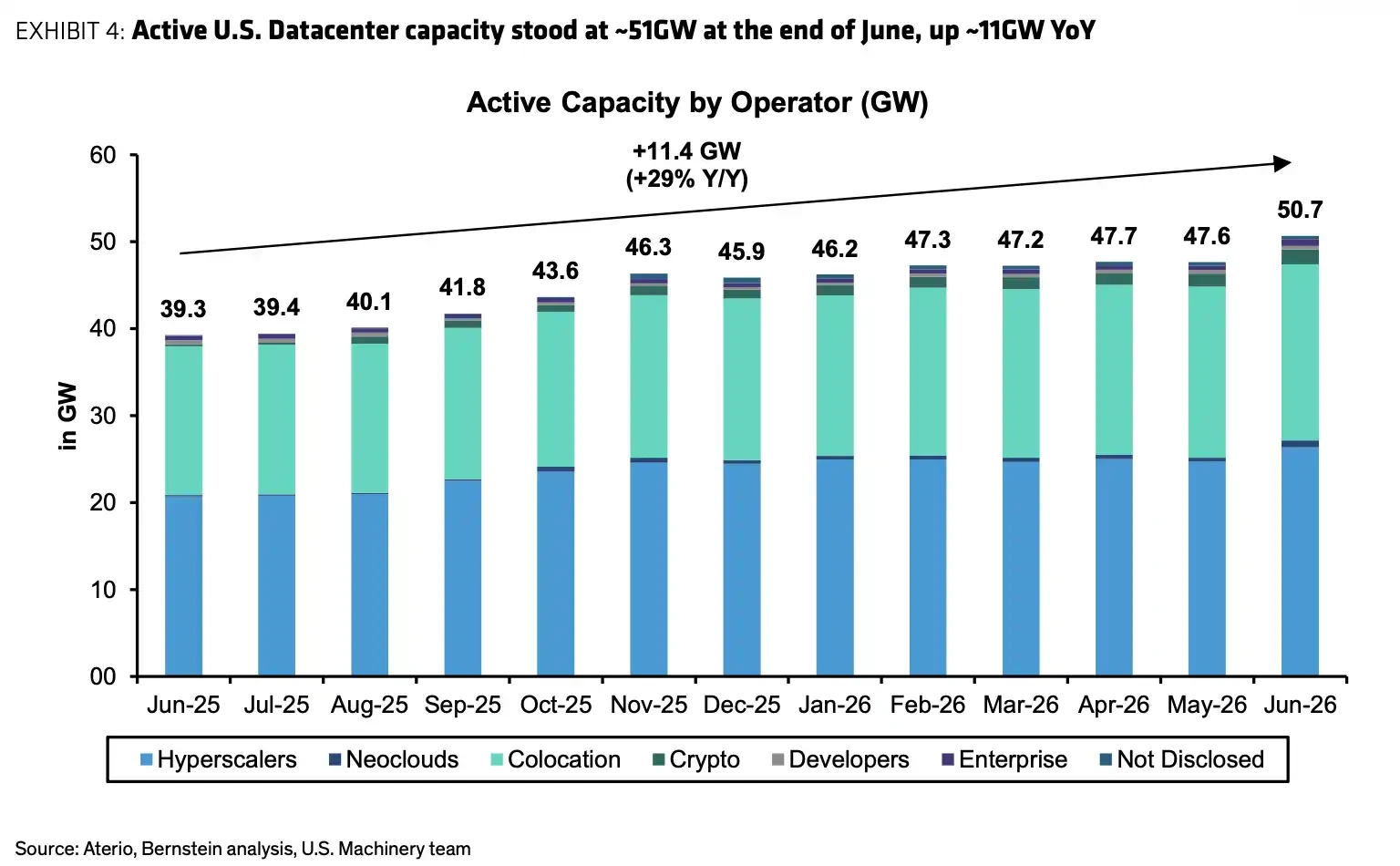
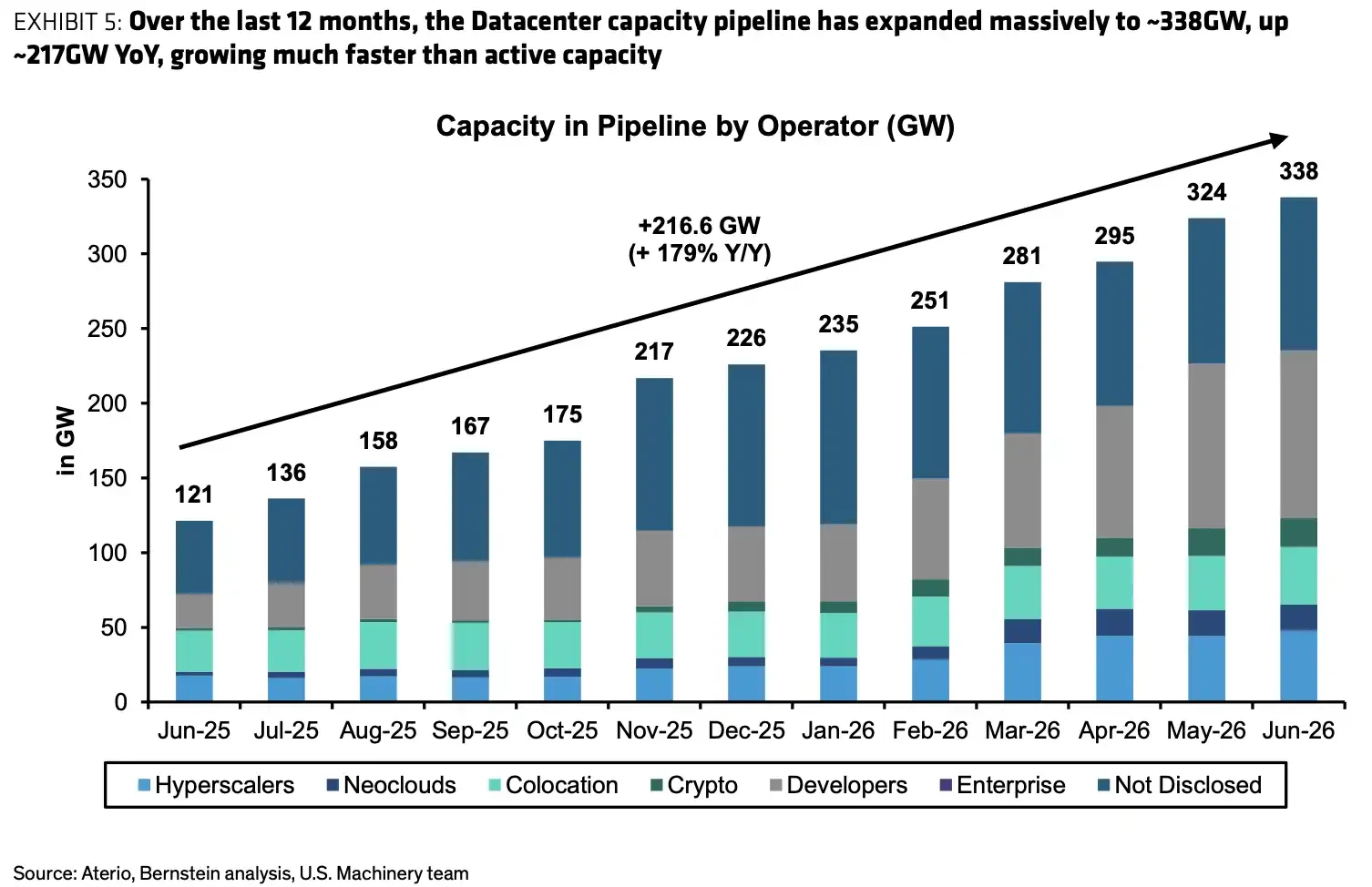
Changes in US data center active capacity and project pipeline, pipeline capacity increased from 121GW to 338GW.
Every Additional 1GW of Computing Power Requires ~50,000 Wafers/Month Capacity
The core conversion in this report is that each additional 1GW/year of AI computing power requires approximately 46K-50K WSPM of new wafer capacity. WSPM stands for wafers started per month, a common measure of fab capacity.
Data center capacity itself does not directly translate into equipment orders. Only when AI servers need more GPUs, HBM, DRAM, NAND, and advanced logic chips will fabs need to expand, and equipment companies see new WFE spending.
Of the ~46K WSPM/GW new demand, DRAM accounts for the highest share at approximately 53%; NAND about 20%; HBM about 16%; and advanced logic about 11%. This means AI data center expansion doesn't just drive GPU advanced process demand, but also significantly boosts memory capacity demand, especially for DRAM and HBM.
This is also why Applied Materials is most favored in these calculations. The incremental wafer demand primarily comes from DRAM, HBM, and NAND. Applied Materials has higher exposure in memory equipment, deposition, and etching segments, giving it more direct earnings leverage.
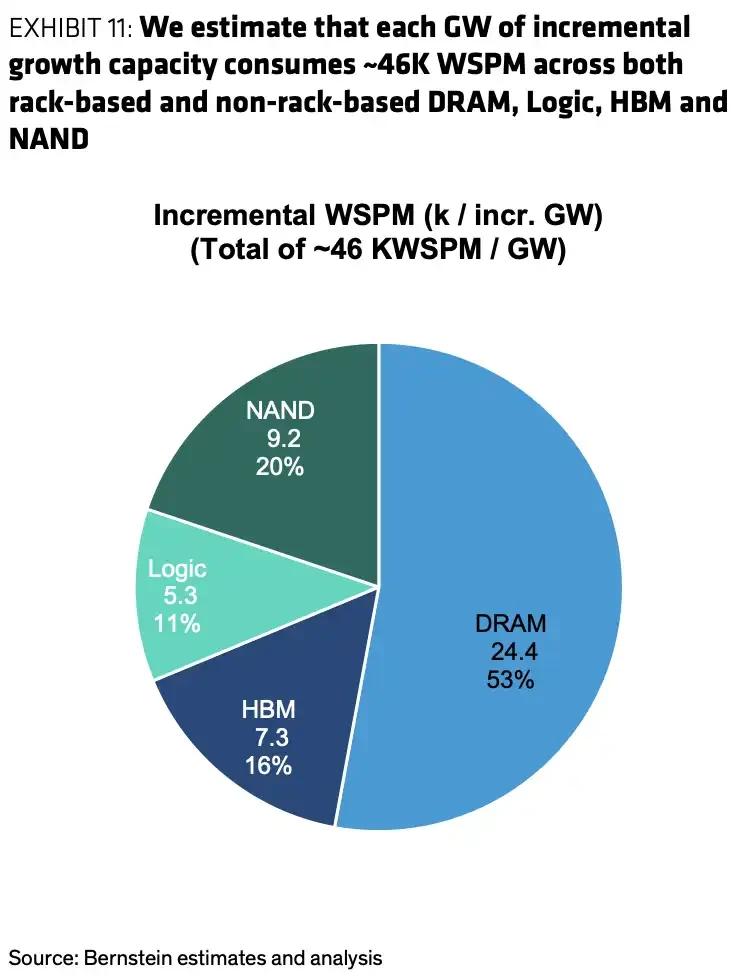
Each additional 1GW of computing power requires ~46K WSPM, DRAM 53%, NAND 20%, HBM 16%, Logic 11%.
Annual WFE in 2029 Could Approach $291 Billion
In the base case scenario, AI data centers add 50GW of computing power annually by 2030 relative to the 2026 baseline. To support this goal, related WFE needs to be deployed gradually from 2027-2029.
Scenario calculations show that AI-driven WFE spending alone would total approximately $376 billion from 2027-2029. Adding approximately $120 billion per year in non-AI baseline spending, total WFE spending over the three years would be around $736 billion. The annual path is approximately $200 billion in 2027, $245 billion in 2028, and $291 billion in 2029.
These figures are higher than equipment spending assumptions in current more conservative models. If the 50GW scenario materializes, WFE in 2029 would approach $300 billion. In higher GW scenarios, equipment spending has further upside potential.
The report also presents more aggressive scenarios. In the 75GW scenario, equipment company earnings could be revised upward by over 100%. In the 100GW scenario, the potential for 2029 WFE spending is even greater, and some companies' valuation multiples might compress to below 10x.
However, these are still model calculations, not confirmed orders. They depend on whether the data center construction pipeline can translate into actual operation, whether AI server shipments can keep pace, whether fabs are willing to expand capacity in advance, and whether the equipment supply chain has sufficient delivery capacity.
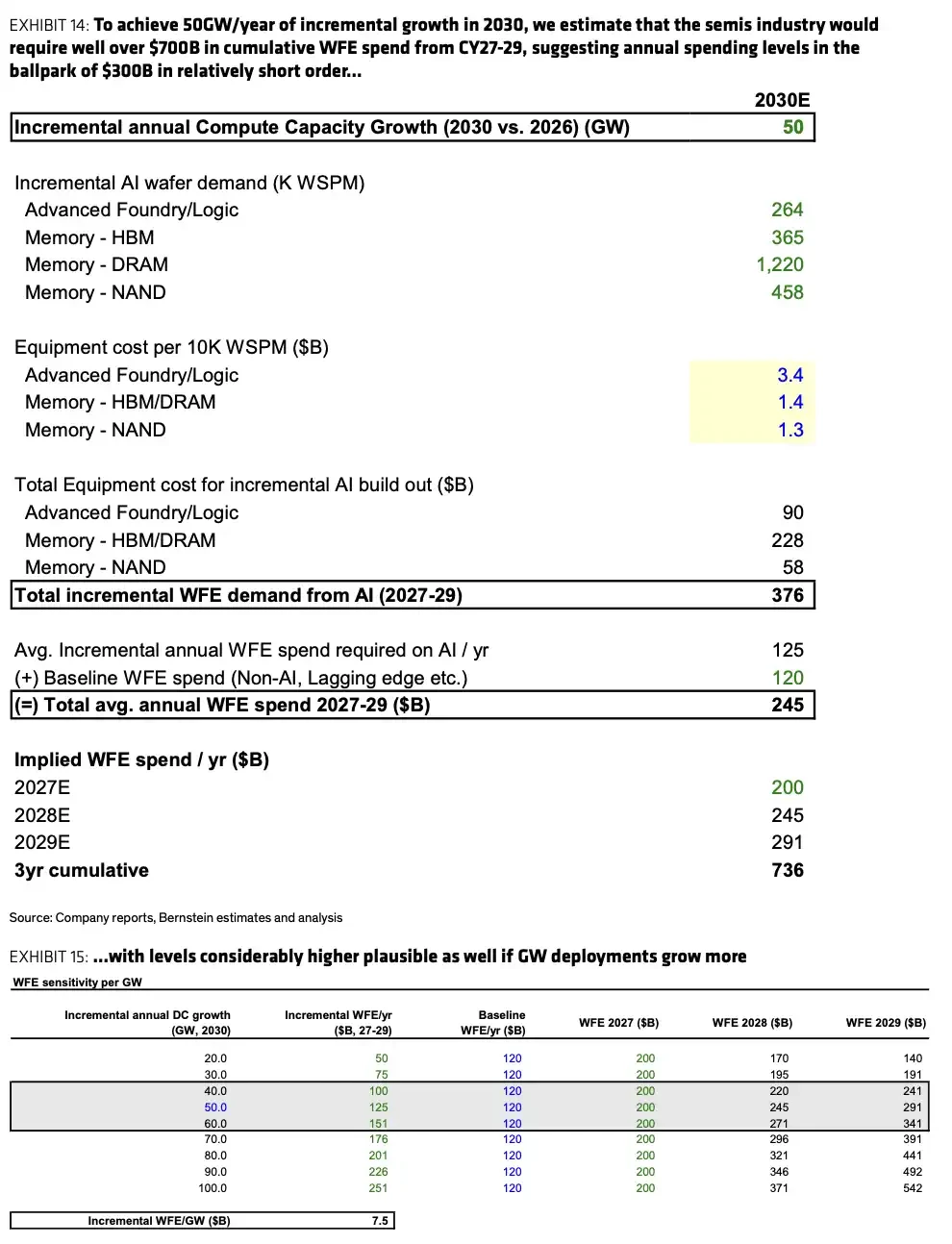
Under the 50GW scenario, cumulative WFE from 2027-2029 is ~$736 billion, with ~$291 billion in 2029; under the 100GW scenario, 2029 WFE is ~$542 billion.
Applied Materials Has the Most Leverage, Lam Research and KLA Also Benefit
The stock impact is primarily focused on Applied Materials, Lam Research, and KLA.
In the 50GW scenario, the EPS of these three companies by 2029 could be approximately 37%-60% higher than current Wall Street consensus. This could lower their forward P/E ratios to the 15-20x range, while equipment stocks generally trade at higher levels currently.
Among them, Applied Materials shows the highest leverage. In the 50GW scenario, its 2029 EPS is nearly 60% above consensus, corresponding to a forward P/E of about 14.9x. Lam Research's EPS upside is about 54%, corresponding to about 18.4x, and KLA's EPS upside is about 37%, corresponding to about 21.2x.
The reason lies in the composition of wafer demand. The new capacity brought by AI expansion is concentrated in DRAM, HBM, and NAND, rather than single advanced logic. Applied Materials has broader coverage in memory-related equipment, allowing it to capture a larger share of the incremental demand compared to companies that only benefit from specific segments.
According to the report, Bernstein maintains Outperform ratings for multiple equipment stocks including Applied Materials, Lam Research, KLA, ASML, and Tokyo Electron, with Applied Materials remaining the top pick. Screen receives a Neutral rating.
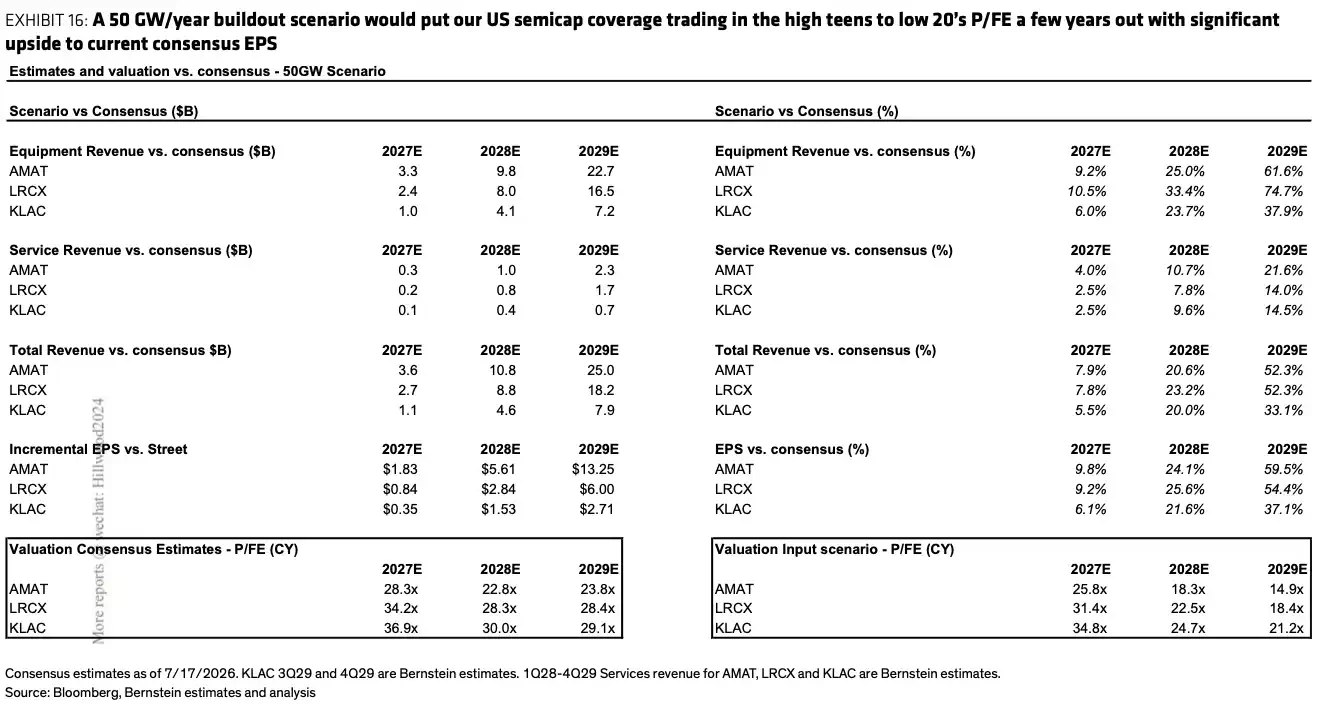
Under the 50GW scenario, AMAT/LRCX/KLAC 2029 EPS versus consensus up 59.5%/54.4%/37.1%, P/FE down to 14.9x/18.4x/21.2x.
Pipeline Capacity Must Overcome Hurdles of Power, Financing, and Delivery
The most easily misinterpreted part of this calculation is treating data center pipeline capacity directly as future equipment orders.
The significant expansion of the US data center pipeline over the past year indicates strong willingness to invest in AI infrastructure. However, there are multiple hurdles between the pipeline and actual operation: power availability, land permitting, financing costs, GPU supply, customer demand, and network and cooling infrastructure will all affect the ultimate deployment speed.
There are also constraints on the equipment side. If WFE scale is to surge towards $300 billion within a few years, equipment companies, component suppliers, and fabs all need to expand capacity synchronously. The semiconductor equipment industry is not one that can ramp up production infinitely fast. Advanced equipment, critical components, installation and commissioning, and customer qualification will all extend delivery lead times.
The model assumptions themselves have boundaries. The calculations are based on specific GPU architectures, power consumption, chip areas, and capital intensity assumptions, and assume WFE must be in place by the end of 2029 to support new computing power in 2030. Changes in architecture, reductions in energy consumption per unit of computing power, improvements in chip yield, and adjustments in capital intensity could all alter final equipment demand.
Deviation in the other direction is also possible. If the demand for replacing older computing power before 2030 is not fully accounted for, equipment demand could have further upside. Conversely, if the monetization of AI applications is slower than expected, or major cloud vendors slow down capital spending, the 50GW, 75GW, or even 100GW scenarios could be overly optimistic.
This report does not provide a definite order book but offers a clearer conversion: each additional 1GW from an AI data center may correspond to approximately 50,000 wafers per month of capacity and roughly $8 billion in incremental WFE demand. Equipment stocks have already priced in some of the AI expectations. The divergence lies in whether data center construction can materialize to a degree that supports an annual WFE level of $300 billion.


