






支持率不足1%,BIP-110仍要将比特币推向软分叉?


- 核心观点:比特币BIP-110提案旨在限制铭文等非货币数据,虽因支持率低面临强制激活,但可能引发链分叉,其最终成败取决于社区共识与矿工算力。
- 关键要素:
- 矿工支持率不足1%,节点支持率仅14.64%,BIP-110支持率极低。
- 若8月激活阈值未达55%,提案将进入强制窗口期,执行节点拒绝不合规区块,可能导致网络分叉。
- 支持方以开发者Luke Dashjr为代表,认为铭文是“垃圾交易”,挤占比特币货币用途,增加节点负担。
- 反对方认为BIP-110不能彻底解决问题,且可能扼杀创新(如BitVM)、违背抗审查精神、引发双花风险及链分裂。
- Ocean算力占比仅2.6%,而F2Pool等主流矿池明确反对,多数矿工利益驱使下可能使BIP-110链因算力不足而“自然死亡”。
- 当前铭文交易占比已降至5%,BIP-110激活后若算力不足,少数链难以成为“最长链”,最终可能独立分叉成新币种。
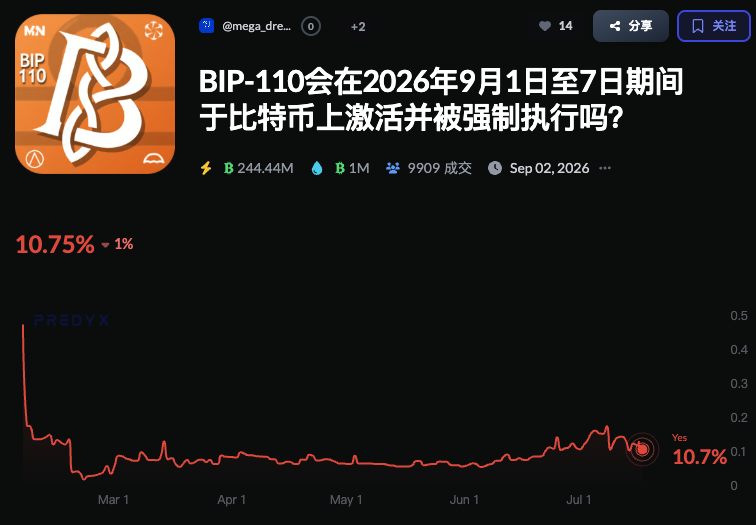
- 预测市场显示BIP-110成功激活概率仅10%,反对派公开下注押其失败。
Original|Odaily (@OdailyChina)
Author|Golem (@web3_golem)
As the August mandatory window period approaches, discussions surrounding the BIP-110 proposal have once again heated up.
BIP-110 was proposed in December 2025 by Dathon Ohm and is supported by Bitcoin Core developer Luke Dashjr. The proposal aims to restrict arbitrary/non-monetary data in Bitcoin transactions within the next year, primarily targeting large-size data storage like Ordinals and Bitcoin NFTs, intending to reduce "spam transactions" on the network and allow Bitcoin to focus on its monetary function.
Since its introduction, the proposal has been controversial, but according to available data, BIP-110 currently lacks support from mainstream miners and nodes. The activation threshold for BIP-110 is 55%. Currently, miner support is estimated at less than 1%, and out of a total of 102,674 nodes on the network, only 15,035 are willing to execute BIP-110, a ratio of 14.64%.
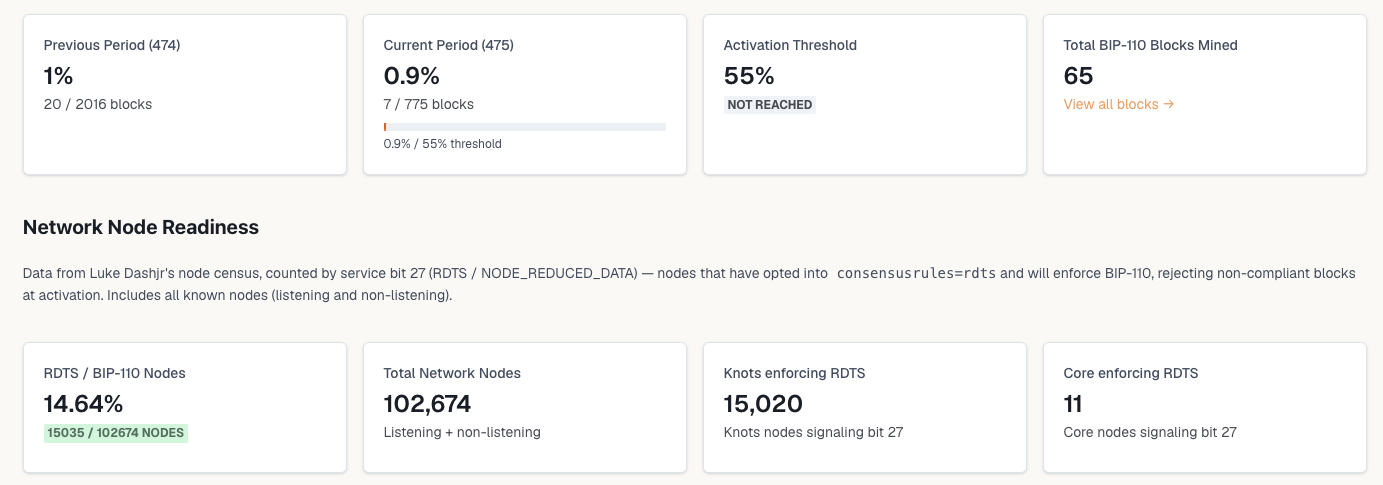
BIP-110 Miner and Node Support Rate
Typically, a proposal with such low support would fail on the Bitcoin network. However, the aggressive nature of BIP-110 is that even without consensus, nodes supporting BIP-110 will enforce it. If BIP-110 does not reach the 55% activation threshold before block height 961,632, it will enter a mandatory window period (block heights 961,632 - 963,647). During this period, nodes running BIP-110 will reject non-compliant blocks, effectively forcing the adoption rate to 100%, allowing BIP-110 to be forcibly activated and executed at block height 965,664.
Based on the current Bitcoin network block generation speed, BIP-110 will enter the mandatory window period in early August. This means that although BIP-110 is a soft fork proposal, it will likely lead to a chain split in the Bitcoin network (a minority chain supporting BIP-110 versus the main chain that does not).
Ongoing Controversy Surrounding BIP-110
According to Bitcoin's "longest chain rule," BIP-110 can only be considered a successful soft fork if the actual mining power supporting BIP-110 constitutes a majority (>50%), thereby forming the longest chain that unifies the entire network under the new rule. Therefore, while BIP-110's forced activation seems inevitable, its long-term sustainability still depends on consensus. Otherwise, BIP-110 will likely share the fate of most Bitcoin soft forks in history: a natural death.
Supporters: BIP-110 is Not a Change, But a Rejection of Change
The main representative of BIP-110 supporters is Luke Dashjr and his mining pool, Ocean. Dashjr has long been a vocal opponent of BRC-20 and inscriptions within the Bitcoin developer community, and he provided the draft proposal for BIP-110.
Luke Dashjr is considered a representative of Bitcoin maximalists. They oppose using Bitcoin block space for any purpose other than Bitcoin transfers. The BIP-110 proposal characterizes the inscriptions that emerged in 2022 as a "Bitcoin attack." Their argument is that allowing arbitrary data to be embedded in Bitcoin transactions imposes a significant and unnecessary burden on nodes. Furthermore, this "spam data" occupies valuable block space, forcing monetary transactions to compete with higher fees for inclusion, thus crowding out Bitcoin's primary monetary use case.
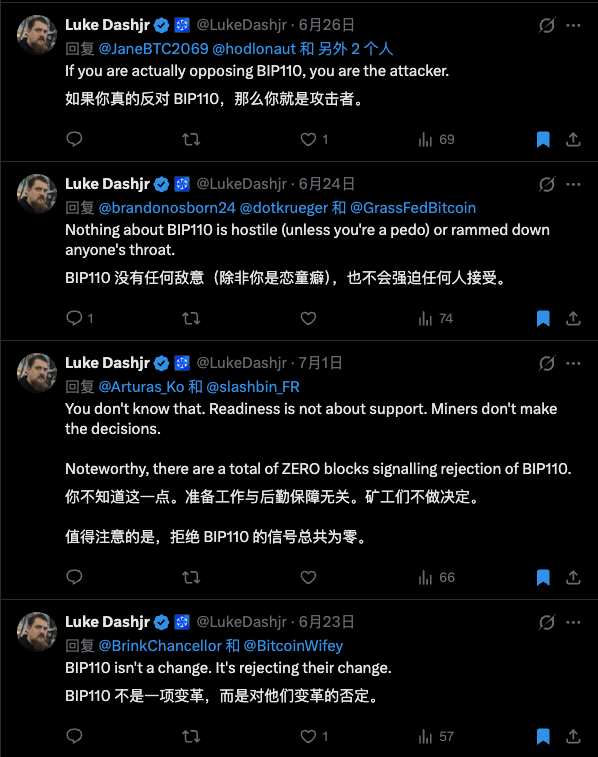
Consequently, Luke Dashjr stated on X that BIP-110 is not a change, but a rejection of change. In responding to opponents, he has also employed sophistry, claiming on one hand that BIP-110 is not hostile and does not force acceptance, while on the other hand suggesting that anyone opposing BIP-110 is the true Bitcoin attacker.
Furthermore, despite the low miner vote approval rate (<1%) for BIP-110, Luke Dashjr remains optimistic, noting that the miner vote directly opposing BIP-110 is also nearly 0%. In his view, miners are not making a decision; once BIP-110 is activated, they will follow.
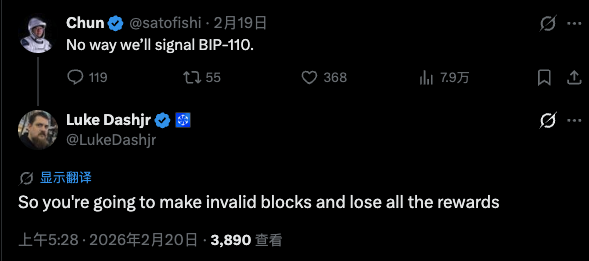
In reality, as of now, the only mining pool publicly supporting BIP-110 is Luke Dashjr's own Ocean. As early as February, F2Pool co-founder Wang Chun publicly stated his firm opposition to BIP-110. Luke Dashjr confidently replied under Wang Chun's post, stating, "Then you will be mining invalid blocks and losing all your rewards."
According to miningradar data, F2Pool is the third-largest Bitcoin mining pool globally, accounting for 13.6% of the total hashrate. Ocean's current hashrate is only 24.6 EH/s, representing 2.6% of the total network hashrate.

Bitcoin Mining Pool Rankings
If Ocean ends up being the only mining pool supporting the fork, they would only be able to produce 3-5 blocks per day. This efficiency and block generation speed would be insufficient for them to become the "longest chain" on the Bitcoin network.
Opponents: BIP-110 Doesn't Solve Problems, It Creates New Ones
Opponents of the BIP-110 proposal do not merely focus on whether it will succeed after activation. They criticize its inability to solve the "spam transaction" problem on the Bitcoin network while simultaneously creating numerous potential new issues. In short, the strong opposition to BIP-110 stems from concerns about its unintended consequences, not from any attachment to Ordinals or inscriptions. Key figures in the opposition include cypherpunk pioneer Adam Back, Bitcoin Core developer Jameson Lopp, and Strategy (formerly MicroStrategy) founder Michael Saylor.
First, opponents argue that BIP-110 cannot fully resolve the "spam transaction" issue on the Bitcoin network. The author of the BIP-110 proposal even acknowledges it can only provide temporary relief. Jameson Lopp believes that Bitcoin's block size limit and the competitive fee market for block space have already mitigated the spam problem to some extent. However, the reason Bitcoin remains a target for various spam attacks is that few people actively use the Bitcoin network, keeping fees low. This prevents the formation of fee pressure sufficient to deter most spam transactions.
At the same time, BIP-110 could stifle future innovation on Bitcoin. The BIP-110 proposal itself acknowledges that restrictions on Taproot could hinder the implementation of advanced features or complex covenants like BitVM on the Bitcoin network. Although BIP-110 is described as a temporary one-year limitation, Jameson Lopp views this as a delaying tactic by Luke Dashjr. He fears that if these restrictions severely limit future Bitcoin upgrades, it could ultimately lead to a hard fork of Bitcoin rather than a soft fork.
Adam Back focuses more on Bitcoin's censorship resistance and decentralized spirit. He argues that BIP-110 would subjectively censor transactions within blocks, with the fundamental goal of regulating others. This runs counter to the neutral and censorship-resistant principles that Bitcoin has upheld since its inception, representing a dangerous step towards centralization and control. Adam Back uses Bitcoin's original principles to negate the Bitcoin maximalists' attempt to change Bitcoin, effectively fighting fire with fire.
Michael Saylor described BIP-110 as a "Bitcoin Iatrogenic Proposal," suggesting that this "cure" itself would harm Bitcoin rather than fix existing problems.
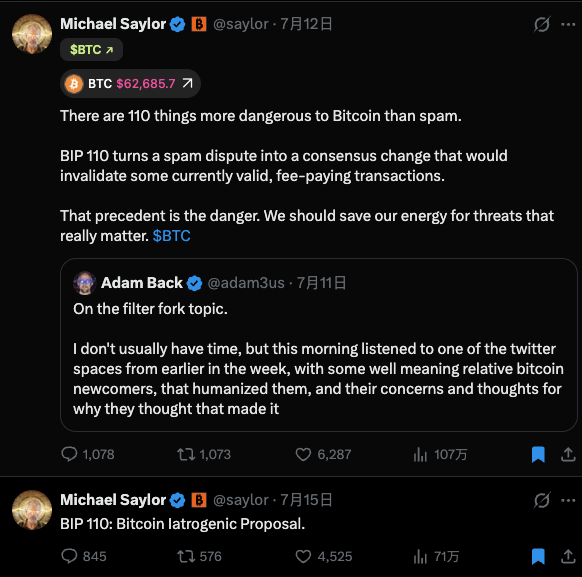
Furthermore, Michael Saylor believes that if BIP-110 becomes consensus, it would render some valid, fee-paying transactions invalid. Creating such a precedent of censorship is the real danger.
Another severe concern for the opposition is that the activation of BIP-110 could split the Bitcoin chain ecosystem. Two competing chains would emerge, each vying for the title of the "real Bitcoin." In such a scenario, the uncertainty surrounding the fork outcome could create a risk of Bitcoin double-spending. Even without double-spending, if BIP-110 eventually evolves into a new chain, it would fragment Bitcoin's developer resources, hashrate, and monetary consensus.
The opposition believes that BIP-110 is attempting to solve a cultural problem with a technical solution, which is likely to generate even more unpredictable problems in the end.
Despite their concerns, opponents remain confident in BIP-110's failure. Jameson Lopp issued a bet against BIP-110 back in February, with a minimum stake of 1 BTC. To date, no BIP-110 supporter has publicly accepted this wager.
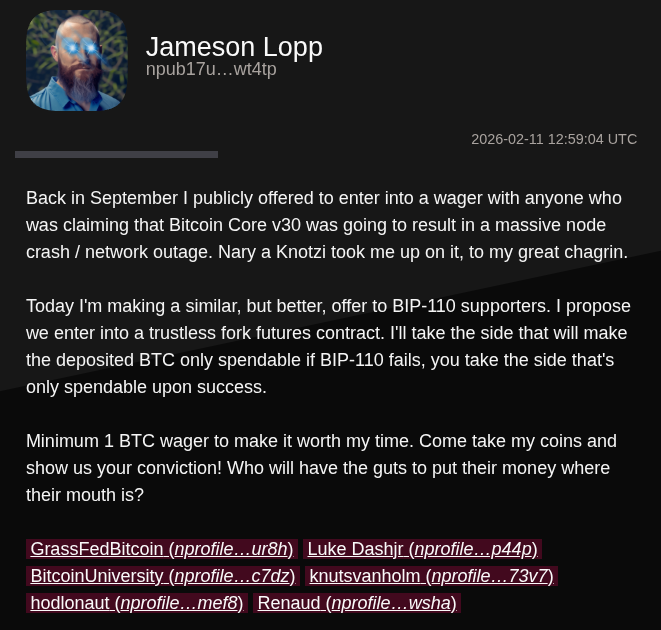
Jameson Lopp's Bet Invitation to BIP-110 Supporters
On the prediction market Predyx, the probability of "BIP-110 activating and being enforced on Bitcoin between September 1 and 7, 2026" stands at 10%. The "Yes" settlement condition requires the BIP-110 chain to become the "longest Bitcoin chain" accepted by a majority of nodes.
What Happens After BIP-110 Activation?
We can consider some hypothetical scenarios for what might occur when BIP-110 is forcibly activated at block height 965,664 (expected between late August and early September).
Scenario One: As described above, upon reaching the activation height, BIP-110 nodes reject main chain blocks. However, without a sufficient proportion of miners producing new blocks compliant with BIP-110 rules, the block generation speed on the BIP-110 chain would be extremely slow, eventually grinding to a halt.
Scenario Two: A certain proportion of miners support BIP-110. Supporters believe they have an "asymmetric advantage." Because BIP-110 rules are stricter, while BIP-110 nodes will reject blocks containing non-compliant data (like inscriptions), non-BIP-110 nodes (mainstream Core nodes) will still consider blocks produced by BIP-110 nodes as valid.
Moreover, inscription transactions currently account for only about 5% of Bitcoin block space, with over 95% being traditional Bitcoin transfer transactions. BIP-110 nodes would still accept a large number of mainstream blocks. This is Luke Dashjr's rationale for believing BIP-110 will eventually become the "longest chain" and unify the network.
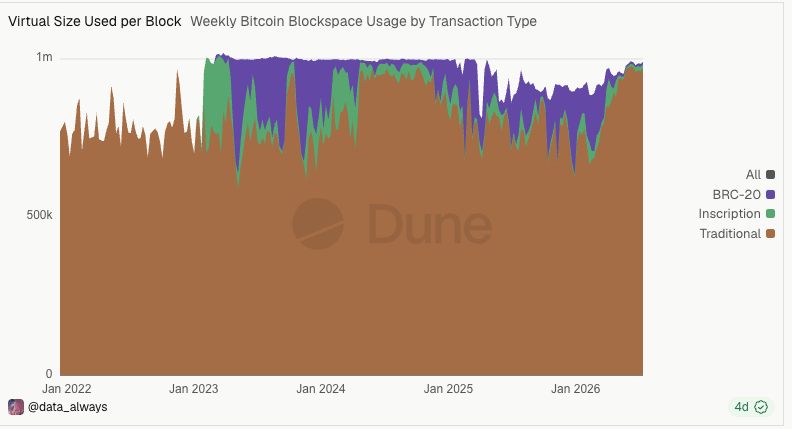
Proportion of Different Transaction Types in Bitcoin Block Space
Scenario Three: A certain proportion of miners support BIP-110, but their hashrate never surpasses the existing majority chain. Typically, miners are highly rational beings; their machines consume electricity costs as soon as they start. In a competition between two chains, miners will weigh the pros and cons. Miners on the BIP-110 chain would be more likely to abandon their sunk costs (mining rewards on the minority chain) and switch to the majority chain, which not only has a longer chain but also accumulates more Bitcoin rewards. This scenario would eventually devolve into Scenario One.
So, what if Luke Dashjr's influence is so strong that miners abandon rationality and persist in mining on the BIP-110 chain? This chain could continue operating independently, though block times might be very slow. Miners would essentially be mining out of ideological conviction, engaging in potentially meaningless energy consumption. The most logical outcome in this case would be for the BIP-110 chain to permanently fork into an independent chain under the BIP-110 supporters, manually adjusting the block difficulty and launching a new network token.
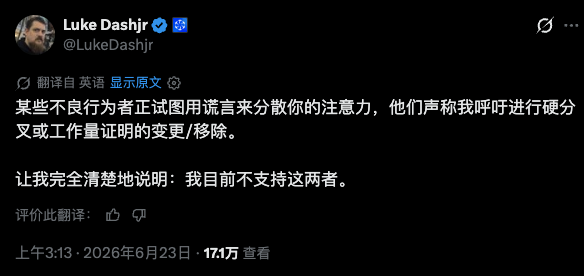
However, Luke Dashjr has repeatedly emphasized his rejection of a BIP-110 hard fork, stating that the time for such a drastic measure hasn't come. But "water can carry a boat, it can also capsize it." By that stage, Dashjr might find himself swept along by the collective will of his supporters, with no choice but to proceed.
Therefore, technically, the minority chain run by BIP-110 supporters could continue to operate. However, it is unlikely to thrive, as its success depends on economic and ecosystem factors, including support from wallets, exchanges, and users. Bitcoin's history has many such examples, most of which ultimately failed. Even in the rare successful cases, their market cap ceiling has been limited to independent coins like Bitcoin Cash (BCH) or Bitcoin SV (BSV).


