每周编辑精选 Weekly Editor's Picks (0704-0710)


- 核心观点:本期文章覆盖宏观经济、AI投资、Web3与传统产业融合及加密货币市场动态,重点分析了高盛看多中国AI板块、印度受AI冲击、特朗普“特朗普账户”受益标的、SK海力士上市热潮及长鑫存储的崛起,揭示了资金流向、技术替代与合规化趋势。
- 关键要素:
- 高盛建议做多中国AI价值链,估算相关市值约4万亿美元,但全球共同基金科技敞口对中国配置仅1.2%,看好低配资金重估机会。
- 印度Nifty IT指数被视为“AI替代人类白领”做空标的,其依赖输出初级工程师的模式因签证限制和AI替代而面临挑战。
- “特朗普账户”接受股票捐赠,早期捐赠主体(如SpaceX)可能受益,直接影响标普500指数和访问路径(纽约梅隆银行、Robinhood)。
- SK海力士在美ADR认购超7倍,预计成历史最大外资上市,但其股价波动与AI资本开支预期密切相关,科技巨头财报成关键。
- 长鑫存储(CXMT)成为苹果、谷歌等巨头供应商,与腾讯签超200亿元DRAM协议,但高利润源于周期而非稳定成长,需谨慎估值。
- MiCA法规落地后,Tether退出欧洲,Circle获合规红利,强调合规身份对稳定币长期资格的重要性。
- Strategy的“卖币”操作不仅限于公开的12.5亿美元额度,其通过会计分类管理资产负债表,比特币已成为维持优先股体系的工具。
Information flows too fast, and in-depth analysis articles are easily drowned out by hot topics. The "Weekly Editor's Pick" column digs out content with judgment value from the vast sea of information, helping you filter out the noise, retain insights, and gain inspiration.
Macro Situation
Goldman Sachs recommends buying into the Chinese AI value chain basket, covering power, semiconductors, AI infrastructure, models, and applications.
Goldman Sachs estimates that the total market cap related to Chinese AI is about $4 trillion, with revenue accounting for approximately 16% of global AI-related revenue, yet global mutual funds have only allocated about 1.2% of their tech exposure to China.
The core of this trade is not a single AI application explosion, but the revaluation opportunity brought about by under-allocated funds, policy investments, and hardware demand combined. The risk lies in the fact that data center investment, storage expansion, IPO financing, and AI hardware exports still need to deliver consistently.
India, the First Country to Be Short-sold by AI
If you were to find a trading target in the global market that most purely expresses the narrative of "AI replacing white-collar workers," the answer lies both in Nasdaq's long list and the short list of the Mumbai Exchange. The former is Nvidia, the latter is India's Nifty IT index.
The essence of the Indian model is wholesaling junior engineers to the world; the commodity is the repetitive labor of junior and mid-level engineers. Rising visa barriers and AI replacing jobs are preventing Indians from going to the US.
Investment & Entrepreneurship
When Big Tech Donates Stocks to "Trump Accounts," Which Targets Will Benefit?
On July 4, the US Treasury officially announced that the long-discussed "Trump Accounts" are now live. American parents and children can download the app and access accounts to view funds in real-time or make donations.
The initial funds for the "Trump Accounts" come primarily from government allocations, private donations, and family savings. The Treasury allows stock donations, and SpaceX has already followed suit. In projects that Trump closely monitors and personally promotes, the earlier a company participates, the more likely it is to receive a presidential endorsement.
Potential beneficiaries mainly fall into three categories: the direct flow of funds from the 'Trump Accounts' – the S&P 500 index; the access pathway to the 'Trump Accounts' – BNY Mellon, Robinhood; and early donors.
For investors, what is truly worth paying attention to might not be the next company named by Trump, but who can occupy the most central position in this decades-long capital pool.
Seven Times Oversubscribed, Can SK Hynix Save the Semiconductor Industry This Time?
The subscription ratio for the American Depositary Receipts (ADR) issued in the US by Korean semiconductor giant SK Hynix has exceeded seven times, potentially becoming the largest foreign listing project in US history. This comes at a time when the entire semiconductor sector is undergoing a sharp correction.
Amidst the ongoing adjustment in the secondary market, SK Hynix's US stock listing has received far greater capital demand than expected. A speculation about the timing of SK Hynix's listing: experiencing a notable price adjustment before landing on Nasdaq might be intended to make the post-listing performance look better, pleasing the company, underwriters, institutions, and retail investors alike...
The earnings reports of tech giants over the next few quarters (with clear capital expenditure commitments for AI's future) will be key to determining the direction of the semiconductor market.
Securitize Drops 40% in a Week Post-Listing, Tokenization Industry Faces Patent War
The SPAC mechanism exposed fundamental issues before fundamentals did: After a SPAC listing, the investor structure undergoes a complete shift, from SPAC subscribers who prefer fixed income to stock holders who look at long-term fundamentals. This churn process itself creates violent volatility.
Tokenization infrastructure company tZERO sent a 'cease and desist and reservation of rights' letter to Securitize, alleging that its two core products, DS Protocol and Vault Registrar, infringe on patents held by tZERO.
This stock price crash reflects that the secondary market doesn't recognize endorsements, only liquidity.
Also recommended: "Trump's 'Payroll' Exposed: Crypto Generated $1.4 Billion, Over 22,000 Stock Trades" "SpaceX Falls Below $150 on First Day of Index Inclusion, Wall Street Unanimously Bullish with $800 Target?".
Web3 & AI
Making 400 Million a Day, Even Apple is Begging to Buy from 'China's SK Hynix'
In the global memory industry ranking, after Samsung, SK Hynix, and Micron comes the unlisted Chinese company, CXMT (ChangXin Memory Technologies).
This Chinese chip company, which was loss-making for nearly a decade, suddenly became one of the most profitable hard-tech enterprises in A-shares. Over the past week, the name CXMT has appeared frequently in global tech media. Apple is lobbying the US government to apply for a special license, planning to include CXMT in the memory supply chain for Macs and iPads. Google has also initiated procurement evaluations of CXMT's DRAM. Other reports indicate that HP and Dell are validating CXMT's DRAM, while Acer and ASUS are requesting Chinese partners to adopt more local memory chips.
In the same week, Reuters reported that Tencent signed a long-term server DRAM supply agreement with CXMT worth over 20 billion RMB, with a duration of three to five years. CXMT's prospectus customer list also includes Alibaba Cloud, ByteDance, Lenovo, Xiaomi, OPPO, vivo, and Honor.
All investors must look at CXMT's valuation with a sobering perspective: in today's windfall profits, cyclical factors contribute more than structural progress. Pricing CXMT as a 'stable growth stock' risks overestimating profit sustainability. Understanding it as a 'new variable emerging from the cycle' is closer to reality.
Prediction Markets
World Cup Quarter-Finals Looming, Who Are the AIs' Picks to Advance?
Different models show high consistency in predicting the semi-finalists: France, Spain, England, and Argentina.
Also recommended: "After Ronaldo's Emotional Farewell with Tears, Polymarket Stages a 'Tear Verification' Drama".
Policy & Stablecoins
MiCA Takes Effect, Tether Exits Europe, Circle Captures Compliance Dividends
Tether did not apply for a MiCA license, calling the regulation "very dangerous for stablecoins." Meanwhile, well before the MiCA transition period ended, Circle had already obtained a French EMI license and placed USDC and EURC within the MiCA framework.
In the future, stablecoins aiming for long-term presence in mainstream trading and institutional scenarios need not only liquidity and user habits but also a sufficiently clear compliance identity. This is precisely Circle's opportunity.
CeFi & DeFi
Strategy's Accounting Trick: The Bitcoin Selling Cap is Far More Than $1.25 Billion
"Replenishing" and "building" reserves – both types of sales ultimately flow into the same reserve pool for the same purpose, they are just classified under different categories.
The previously disclosed "BTC Monetization Program" never limited Strategy to selling only a total of $1.25 billion in Bitcoin; it only limited one of its funding pools – specifically the one used to "build" dollar reserves through BTC sales.
The market needs to start understanding Strategy's "special vocabulary": "building" and "replenishing" are essentially just accounting classifications, but they determine whether Strategy's BTC sales consume the "public quota" seen by the market.
The old Strategy narrative was simple: sell MSTR stock → buy Bitcoin → provide investors with leveraged BTC exposure. But the logic is now different. Today, Strategy is buying and selling different components of its own capital structure to manage the pressures between common stock (MSTR), preferred shares, dollar reserves, and Bitcoin assets (BTC). This dynamic also creates new conflicts of interest.
Bitcoin is no longer just an asset for Strategy to continuously accumulate; it is becoming a balance-sheet lever used to maintain the functioning of the preferred stock system. The market must also deconstruct every term Strategy uses to assess what it means for future BTC sales.
Related reading: "When the Biggest BTC Buyer Becomes a Seller, Who is Catching Strategy's 3,588 Bitcoin?".
The crypto options landscape is a set of adjacent markets with different settlement and payoff types.
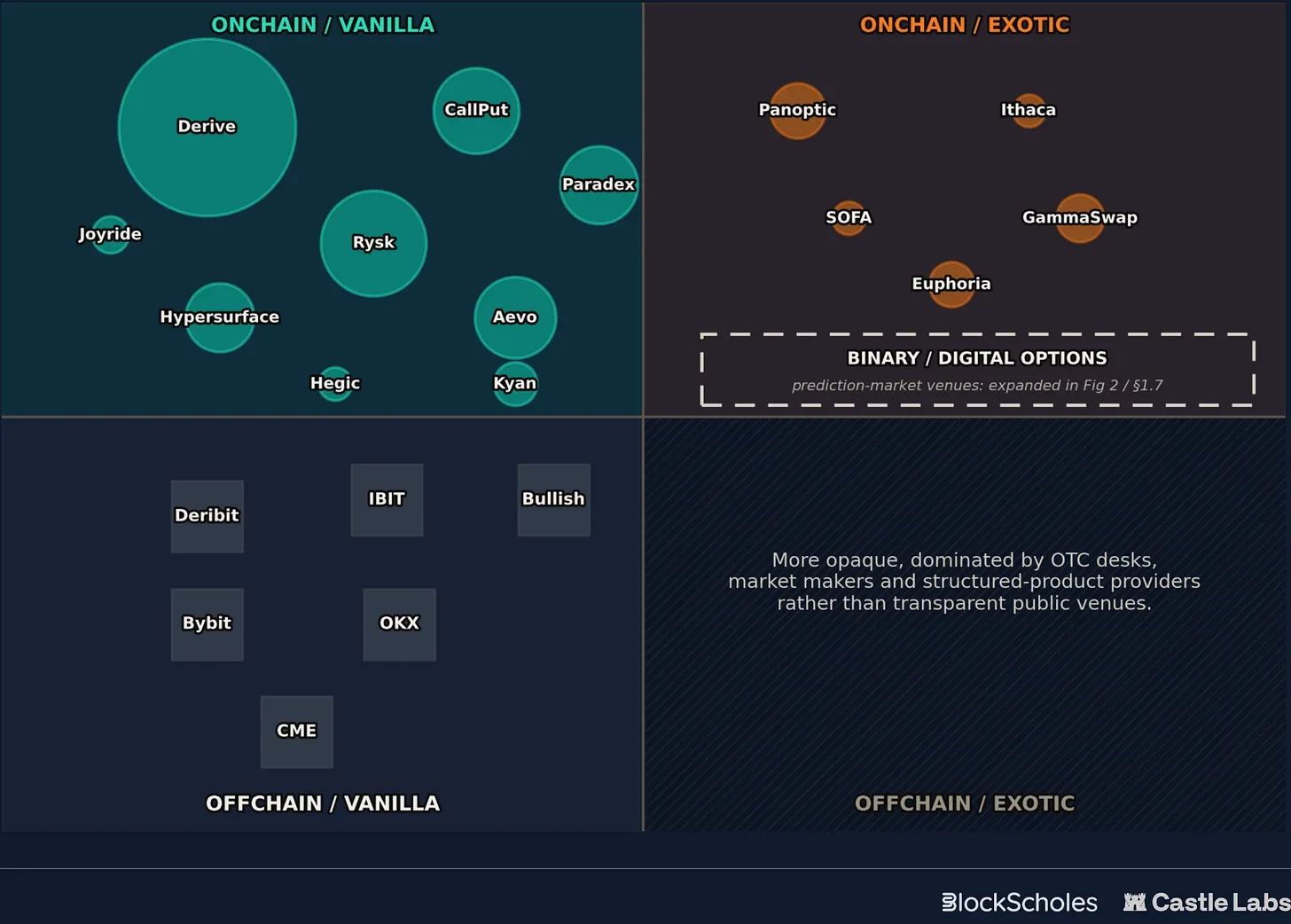
Vertical Axis: Settlement (On-chain to Off-chain); Horizontal Axis: Payoff (Vanilla to Exotic)
Meme
ANSEM Hits New High, CZ Joins In, Meme Summer is Back
Ethereum & Scaling
The Ethereum Foundation is Dead, Long Live a Diversified Ethereum Organization
Weekly Hot Topics Catch-Up
Policy & Macro Markets
Trump discusses Iran: We have already won, especially in the military field;
US MCSA no longer opposes the CLARITY Act, shifts stance to neutral;
Clarity Act not signed into law on July 4, August 7 becomes a key date (Analysis);
US SEC releases 2026 regulatory agenda statement: promotes tokenized securities trading, advances crypto rulemaking;
North Carolina, USA will impose 6% tax on prediction markets, acknowledges CFTC federal regulatory authority;
South Korean stock investors bet on Chinese AI, buying $2.8 billion worth in six months: A-share stocks Naura Technology and Cambricon Technologies are being snapped up;
AI euphoria continues? US tech companies' data center lease commitments hit a record high of $850 billion;
Zhipu AI plans to develop its own AI chips, has approached chip companies to accelerate filling computational power gaps;
Earning more in one year than in the past 40 years combined, Samsung estimated operating profit for this year is about $200 billion;
CXMT launches STAR Market IPO, estimated market cap near 295 billion RMB, first-day lock-up ratio reaches 78%;
Google updates Chrome Web Store policy: bans prediction market extension types;
Opinions & Voices
AI Big Three impact capital markets: SpaceX, OpenAI, Anthropic could create the largest exit wave in US VC history;
Serenity: Humanoid robots may have reached a labor substitution tipping point, VCs and tech giants are adjusting strategies;
Cantor Fitzgerald: Bullish on MSTR-BTC linkage repair, STRC is key to restarting the capital engine;
Vitalik: In the next 5 years, Ethereum will enter an era of simplification, with quantum resistance and privacy becoming top-tier goals;
Institutions, Big Companies & Head Projects
Strategy plans to use a $1.25 billion Bitcoin monetization program to support $1 billion preferred stock buyback;
Polymarket launches Perp trading feature, supports some crypto and stock assets, up to 20x leverage;
Open USD Consortium accused of listing Samsung and other stablecoin partners without consent;