






股价破发,IPO后首飞受挫,SpaceX将何去何从?


- 核心观点:SpaceX 星舰第13次试飞因发动机故障中止,导致股价承压。文章指出,上市后资本市场对 SpaceX “快速试错”的容忍度降低,试飞失败从研发成本变为影响估值和商业预期的事件。
- 关键要素:
- 星舰试飞在点火阶段自动中止,因部分猛禽发动机未启动,马斯克表示将更换发动机,计划下周初复飞。
- 试飞失败消息导致 SpaceX 股价(SPCX)盘后短线跳水至约127.07美元,此前其股价已较IPO发行价下跌近40%。
- 上市前,投资人更看重研发迭代与数据积累,将失败视为工程进展的一部分;上市后,试飞失败直接引发对商业化时间表和收入兑现节奏的担忧。
- 资本市场要求更确定性的增长预期,与航天研发固有不确定性之间的矛盾,迫使其管理策略需兼顾股价稳定与技术探索。
- 分析认为,复飞结果将决定短期股价走向:成功可缓解市场担忧并修复情绪,失败则将导致股价进一步下滑。
Original by Odaily Planet Daily (@OdailyChina)
Author: Azuma (@azuma_eth)
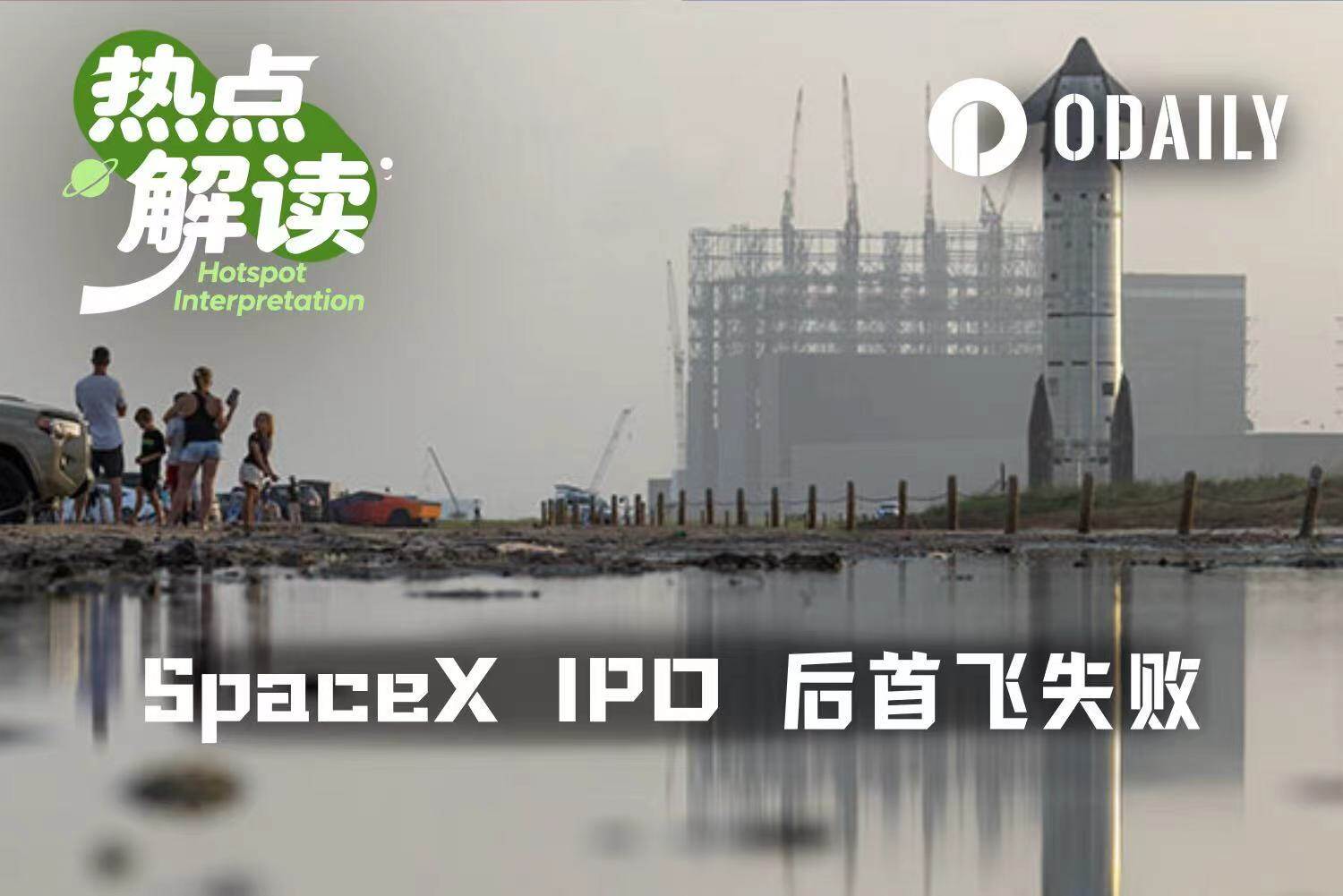
In the early hours of July 17, Beijing time, SpaceX was originally scheduled to conduct the 13th test flight of Starship. However, as the launch countdown entered the final ignition phase, the automatic launch abort procedure was triggered because some Raptor engines failed to start as expected, forcing the cancellation of this test flight.
Elon Musk stated in response that to ensure a smooth flight, SpaceX will remove and replace two Raptor engines, hoping to make another launch attempt in a few days, with the most likely launch time being early next week.
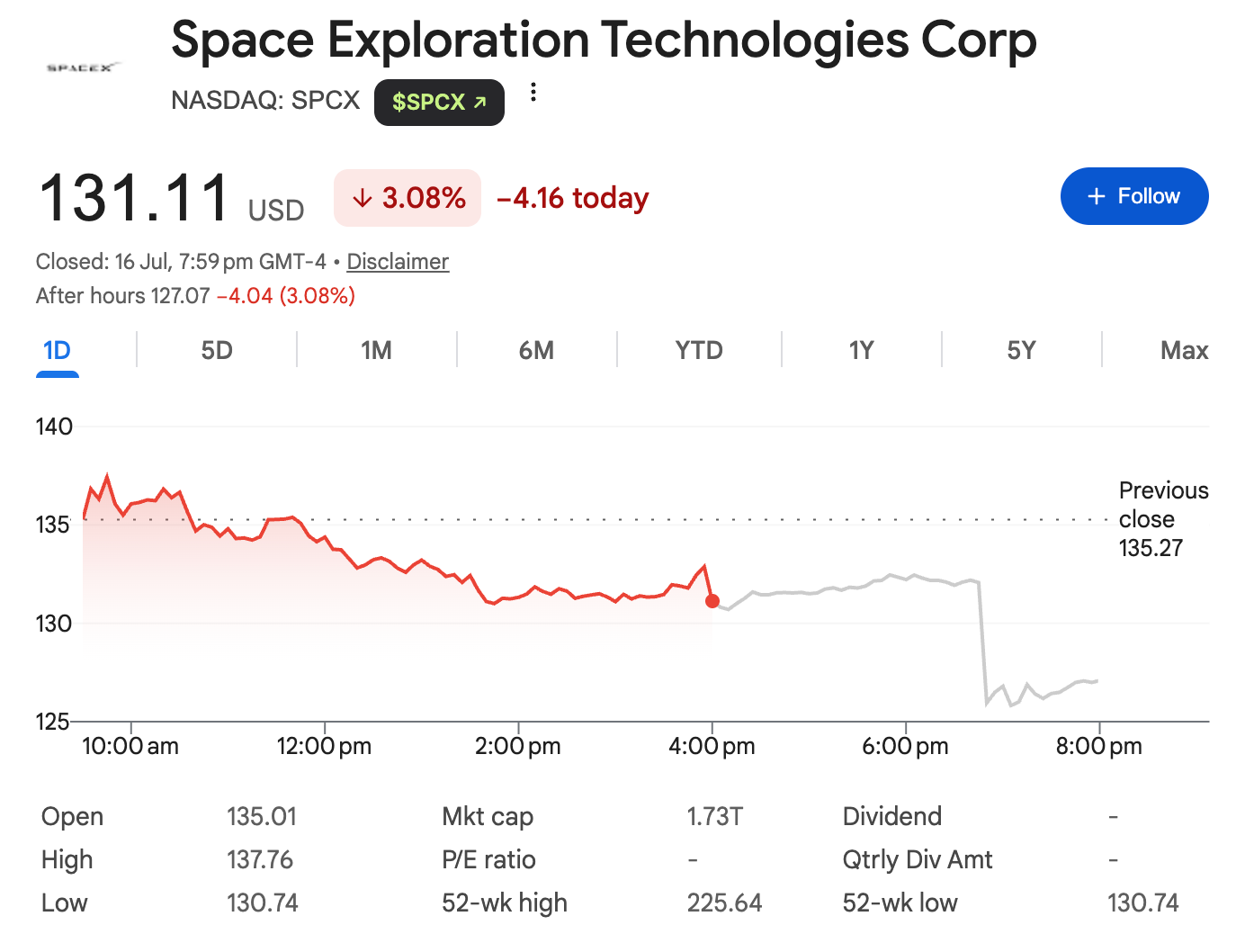
Prior to this test flight, SpaceX's stock price had just fallen below its IPO issue price, with the maximum decline since listing nearing 40%. As the first Starship test flight after SpaceX's IPO, the market had expected it to validate the latest progress of Starship and inject a shot in the arm for the persistently sluggish stock price. However, the failed launch once again dealt a blow to SpaceX's stock price — SPCX experienced a brief post-market dive, currently trading at $127.07.
A failed test flight is nothing new for SpaceX, but judging from the feedback of the secondary market this time, investors are clearly re-evaluating a question: After going public, can SpaceX still afford the luxury of "infinite trial and error"?
Failed Test Flights Are Not New, But Times Have Changed
If we rewind the clock a few years, every failed Starship test flight was almost seen as part of engineering progress. While the community's discussions about Elon Musk "blowing up rockets" were laced with a joking tone, they also carried a certain degree of respect.
For SpaceX, the company has always adhered to a Silicon Valley-style R&D philosophy — build fast, test fast, fail fast, and iterate quickly. Instead of completing all verification on the ground, SpaceX prefers to get the rocket into the air as soon as possible, gather data through real flights, and then continuously optimize the design. As a result, over the past dozen or so Starship test flights, various mishaps — from in-air disintegration and failed booster recovery to orbital verification issues — have been common throughout the entire R&D process, but these setbacks have not prevented Starship from continuously evolving forward.
In the primary market era, this R&D model was also widely recognized by investors. Whether institutional shareholders or employees holding shares, they cared more about whether the R&D pace was consistently advancing and whether the technological moat was continuously accumulating, rather than whether a single test flight succeeded or failed. For them, a failure meant obtaining a new set of flight data, meaning another step closer to final commercialization, which was essentially still part of the R&D cost.
But after going public, the way the capital market views Starship has begun to change. For secondary market investors, Starship is no longer just an R&D project but has become a key variable affecting the company's valuation. A failed test flight not only means replacing engines and rescheduling the launch window but could also mean a delay in commercial deployment, a slowdown in the pace of revenue realization, and an adjustment to future cash flow projections. In the past, engineers saw data accumulated from a test; now, Wall Street sees whether growth expectations can be met on time.
This change does not mean that the capital market demands SpaceX to "only succeed, not fail", but rather that every failure will be factored into the valuation system and recalculated. Especially against the backdrop of the company being listed and the market assigning a high growth premium, any event that could impact Starship's commercialization timeline is more likely to trigger stock price volatility than in the past.
Going Public: A Double-Edged Sword
A month ago, SpaceX completed the largest IPO in human history.
For any heavy-asset, high-investment technology company, the greatest significance of entering the capital market is to gain more stable and lower-cost financing capabilities. For SpaceX, which is still in a phase of rapid expansion, the continuous construction of the Starlink constellation, the advancement of Starship R&D, and the layout of a future larger commercial space network all require massive capital expenditures. The financing channels brought by the IPO can undoubtedly provide more ample "fuel" for these long-term plans.
But the capital market never provides anything for free. When more public investors become shareholders, SpaceX will no longer face mere engineering problems but the continuous scrutiny of the capital market regarding growth, profits, and the timeline for delivering results.
In the past, Musk could tell investors: "Failure is also part of R&D."
Now, every delay, every launch abort, and every test flight incident can quickly reflect on the stock price, further affecting the company's financing ability and market sentiment, and may even indirectly squeeze the management's decision-making space. The capital market naturally seeks certainty, but the biggest characteristic of aerospace R&D is precisely uncertainty, creating a persistent tension between the two.
For SpaceX, going public means acquiring more abundant funds, but it also means shouldering heavier pressure.
The Retry Next Week Is Crucial
Fortunately, this test flight was not a failure after the rocket had lifted off (at least it didn't explode), but rather an automatic abort during the ignition phase, making the problem relatively clear to pinpoint. According to Musk's latest statement, SpaceX will attempt another launch early next week.
For SpaceX's engineers, this may be just another routine launch delay; but for the newly listed SpaceX, this retry carries significance that far exceeds technical verification itself.
If the retry is successful, market concerns about the pace of Starship R&D are expected to be alleviated, and the recently pressured stock price may see a sentiment-driven recovery. Conversely, if another mishap occurs, SPCX could probe even lower levels.


