底部 반등이 이미 3배, Lighter는 어떻게 날아올랐나?


- 핵심 의견: 탈중앙화 무기한 선물 거래소 Lighter(LIT)의 코인 가격이 최근 3개월간 3배 이상 상승한 이유는 규제 진전, Robinhood과의 전략적 제휴, 토큰 경제 모델 재구축, 유통 구조 최적화 등 여러 기본적 내러티브의 공명 때문입니다.
- 핵심 요소:
- 규제 진전: Lighter 창립자가 CFTC 혁신 자문 위원회에 합류하고, 미국 온체인 파생상품 거래 라이선스 신청을 시작하여 '미국 본토' 규제 우위를 부각시켰으며, 이는 경쟁사 Hyperliquid의 역외 리스크와 차별화됩니다.
- 채널 확장: Robinhood Wallet과 깊게 연동되어 무기한 선물 거래의 기본 실행 계층 및 유동성 엔진이 되었으며, Robinhood의 방대한 사용자 기반이 Lighter 서비스에 직접 접근할 수 있습니다.
- 토크노믹스: 프로토콜 수익 전액을 LIT 매입 및 영구 소각에 사용하며, 누적 매입량은 약 1550만 개(유통 공급량의 6.26%)로 Hyperliquid보다 소각 규모가 큽니다. 동시에 생태계 토큰 스테이킹 수익(목표 연 6%)을 도입했습니다.
- 유통 구조: 초기 지속적인 하락 과정에서 바닥권 손바뀜이 이루어져 유통 물량이 분산 상태에서 집중 침전 구조로 전환되었고, 시장 구조가 매도 압력 중심에서 추가 자금 가격 결정으로 전환되며, 공매도 청산이 가격 탄력성을 증폭시켰습니다.
- 시장 성과: LIT는 현재 2.65 USDT에 거래되며 24시간 19.4% 상승, 최근 3개월간 저점 0.78 USDT에서 3배 이상 반등했습니다.
Original: Odaily Planet Daily (@OdailyChina)
Author: Azuma (@azuma_eth)
Decentralized Perp DEX project Lighter (LIT) has shown quite strong price performance recently.
According to OKX market data, as of 14:30 today, LIT is temporarily at 2.65 USDT, with a 24-hour increase of 19.4%. Calculated from its historical low of 0.78 USDT in early April, LIT has achieved a strong rebound of over 3 times in the past three months.
Considering Lighter's recent moves in regulation, products, and tokens, LIT's strong price performance can be attributed to the simultaneous resonance of multiple fundamental narratives.
Regulatory Progress: The Narrative Advantage of a "US-Based" Exchange
The first main storyline of Lighter's current rally is the rapid clarification of its compliance path.
This is particularly evident when comparing Lighter to its biggest competitor, Hyperliquid (HYPE). The latter has long held the top position in the on-chain Perp DEX赛道, but its offshore nature is often seen as a potential compliance risk. Especially against the backdrop of a gradually tightening US regulatory framework, this implies persistent policy uncertainty.
In contrast, Lighter's positioning leans more towards a "trading infrastructure endogenous to the US regulatory system." As a US-based project, Lighter is actively embedding itself within the regulatory framework, thereby gaining a new "compliance premium."
During the Q1 investor conference call in early April, Lighter founder and CEO Vladimir Novakovski explicitly stated that the company has initiated the application process for an on-chain derivatives trading license in the United States. Vladimir bluntly stated on the matter: "To serve traditional financial institutions like Citadel, having a license is essential."
Yesterday, Novakovski again stated on X that he has personally become a member of the US Commodity Futures Trading Commission (CFTC) Innovation Advisory Committee. The significance of this in the market context far outweighs its superficial title. The CFTC's Innovation Advisory Committee essentially serves as an "institutional buffer layer" between regulators and market participants, responsible for providing policy advice to the CFTC on the intersection of technology, law, and finance. Under current regulatory trends, Vladimir's new identity means Lighter is not just "adapting to regulation" but can participate in the early stages of rule-making.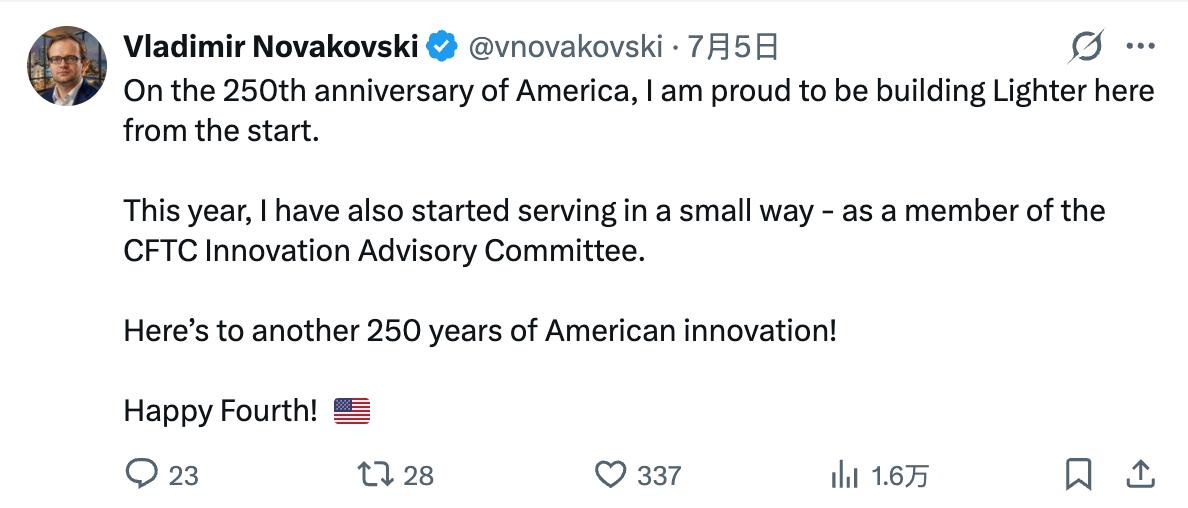
Additionally, another noteworthy piece of information is that newly appointed Federal Reserve Chairman Warsh disclosed holding a certain amount of LIT in his pre-appointment financial disclosure. While this doesn't imply Warsh will use his position for anything specific, this "potential policy network connection" still reinforces the market's pricing imagination regarding Lighter's compliance resource advantages.
New Channel Breakthrough: Deep Integration with Robinhood
Beyond regulatory progress, the second key variable in Lighter's current surge is the opening of new distribution channels, particularly the deep integration with Robinhood.
Last week, Robinhood and Lighter jointly announced that Robinhood Wallet now supports a native Perp trading entry powered by Lighter, allowing users to trade perpetual contracts and tokenized stock assets directly within the wallet, using USDG as the quote asset.
As an investor in Lighter, the market had previously anticipated cooperation between Robinhood and Lighter. However, some users also worried that Robinhood might choose to build its own Perp product, creating a competitive relationship with Lighter. But the latest announcement signifies that Robinhood ultimately decided to integrate its perpetual contract trading capabilities with Lighter.
For Lighter, this means a qualitative shift in its role — it is no longer just an independent DEX but is gradually becoming the default execution layer and liquidity engine within the Robinhood Wallet ecosystem, making its services more accessible to Robinhood's vast user base.
Ansem, a well-known trader recently gaining attention due to the surge of his own Meme tokens, also gave this high praise: "The partnership between Lighter and Robinhood seems to be aiming for something big."

Token Economic Model Reshaped: All Buyback Tokens Burned
Another key recent move by Lighter was the official announcement on July 1st of an update to its token economic model, further strengthening LIT's pricing logic as a "cash flow-driven asset."
In this update, Lighter clearly stated that all protocol revenue would be used to buy back LIT, and the buyback mechanism was upgraded from "programmatic purchasing" to "permanent burning." As of that time, Lighter had bought back approximately 15.5 million LIT, accounting for about 6.26% of the circulating supply, and will execute its first on-chain burn after the end of Q2.
Simultaneously, LIT's staking mechanism has been redesigned. After subsidizing with pre-TGE revenue in the early phase, the team announced a gradual introduction of ecosystem tokens for staking rewards, targeting an annualized yield of about 6%. Given the current staking volume of approximately 125 million LIT, this corresponds to an annual distribution of about 7.5 million tokens.
Under this framework, LIT's economic model presents a relatively clear structure: On one end, stable and continuous protocol revenue ➡️ Full buyback and burn ➡️ Contraction of circulating supply; on the other end, staking rewards for long-term holders ➡️ Targeted distribution in the form of ecosystem tokens.
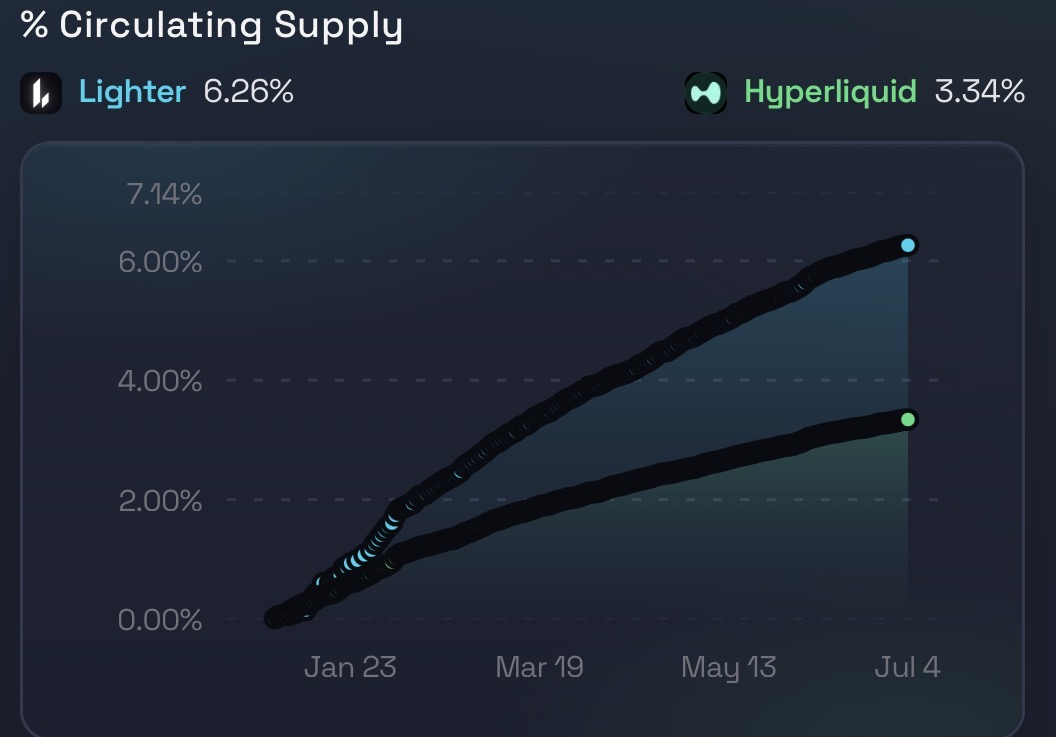
Data analyst ajey.lit, who tracks the Perp DEX赛道, posted a comparison of buyback data between LIT and HYPE, with quite surprising results. Compared to HYPE, which has always emphasized revenue and buybacks, LIT's buyback intensity is relatively stronger — as of now, Lighter's repurchased tokens represent about 6.26% of the circulating supply, significantly higher than Hyperliquid (HYPE)'s approximately 3.34%; calculated by the ratio of buyback amount to market cap, Lighter's buyback ratio is around 4%, also higher than the latter's roughly 1.8%.
Shift in Chip Structure: Handover Complete, Light Load Makes for Easier Lifting
Looking at the three lines of compliance, distribution, and economic model together, it becomes clear that LIT's rise is not driven by a single catalyst, but is a typical process of "delayed pricing + collective revaluation."
And the prerequisite for all this is that LIT's bottom chips have been thoroughly shaken out during the earlier continuous decline.
Since LIT's TGE, impacted by the overall downturn in the cryptocurrency market, fierce competition in the Perp DEX赛道, and continued exits by early airdrop users, LIT formed a typical downward selling pressure structure. Meanwhile, market makers and long-term funds continuously accumulated chips at low levels, causing the chips to gradually shift from "loosely distributed" to "concentrated and settled." This process can essentially be understood as a bottom-level handover.
As Lighter's fundamentals gradually improve, LIT's market structure has also shifted from being "dominated by profit-taking and selling pressure" to "dominated by incremental capital pricing." In this structural change, marginal improvements in fundamentals truly begin to be amplified. Furthermore, this structure overlaps with the concentrated existence of short positions. During the extended period of sideways trading and bearish expectations, some short positions gradually accumulated. When the price began to break through key ranges, market liquidity showed significant asymmetry — insufficient selling pressure above, while short covering became a source of new buying demand, amplifying price elasticity.
In summary, this round of LIT's rise should not be understood as being driven by a single factor but is the combined effect of three levels: First, fundamentals moving from uncertainty to verifiability; Second, the chip structure transitioning from selling pressure dominance to handover completion; Third, shorts and liquidity structure inversely amplifying elasticity.
LIT hasn't "suddenly become stronger"; it is simply "being gradually repriced."