How much longer until the crypto bear market ends?


- Core View: The Coinbase Bitcoin Premium Index has been negative for 46 consecutive days, setting a new all-time record. Combined with the sustained decline in BTC and ETH prices and the loss of key support levels, the current bear market cycle is confirmed and has yet to bottom out, expected to last at least another 2-3 months.
- Key Elements:
- The Coinbase premium index has been negative for 46 consecutive days since May 19, surpassing the previous record of 40 days set in January, reflecting persistently weak demand in the US market.
- Strategy's sale of 32 BTC in early June sparked market panic. Coupled with consecutive net outflows from spot Bitcoin ETFs, this became the direct trigger for the recent sharp decline.
- BTC fell over 16% in the first week of June, dropping below $60,000 and the 200-week moving average, marking its worst weekly performance since the FTX collapse in 2022.
- The loss scale for long-term holders hit a new high, with 10.83 million BTC in a loss position. ETH whales are experiencing overall losses for the first time since 2019.
- Several institutions' previous bottom predictions (e.g., CryptoQuant pointing to $53,600, BIT suggesting an end in August) were invalidated by subsequent downtrends, further dampening market confidence.
- STRC preferred stock prices once plummeted to a historic low of $73. Although Strategy temporarily alleviated the crisis through a buyback plan, the price returning to the $100 anchor remains a key indicator for the bear market's end.
- Analysts are deeply divided: Yi Lihua predicts a bottom in July-August (BTC $43,000-$51,000), while Jiang Zhuoer predicts a bottom in October-December ($42,000-$44,000), with late September to early October serving as a key rebound window.
Original|Odaily Planet Daily (@OdailyChina)
Author|Wenser (@wenser 2010)
According to Coinglass data, from May 19 to today (July 3), the Coinbase Bitcoin Premium Index has been in a "negative" state for 46 consecutive days, setting a record for the "longest consecutive negative streak." Previously, the index was in negative territory for 40 consecutive days from January 16 to February 24 this year, breaking the previous record of approximately 30 consecutive days of negative premiums during last year's "October 11 crash."
Considering that BTC and ETH have recently broken through key support levels such as $58,000 and $1,600, the exact timing of the bear market's end remains unclear. For many, the wait is particularly agonizing.
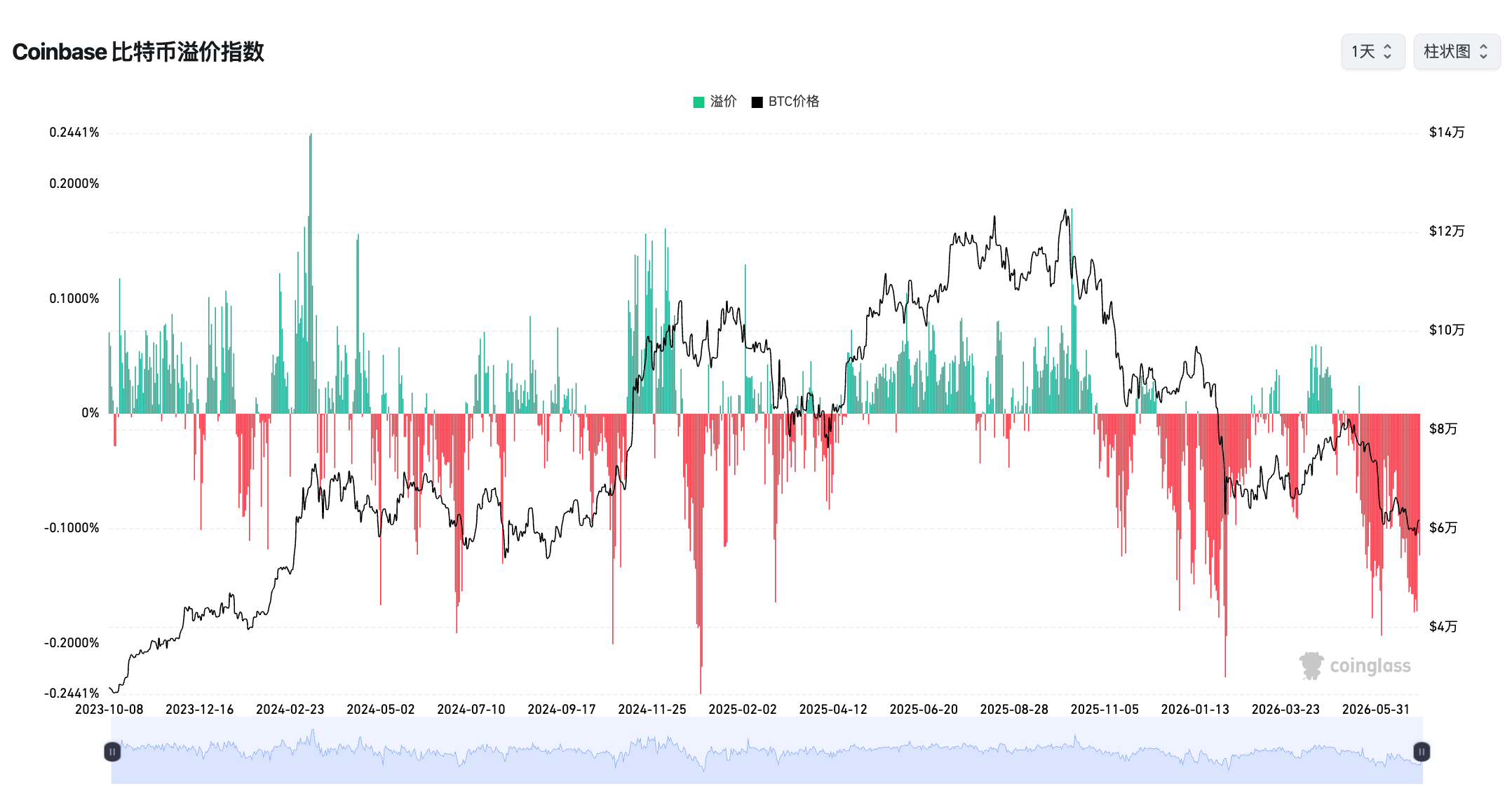
Coinbase Bitcoin Premium Index Overview
The Main Catalyst for BTC's Plunge: Strategy Sells to Survive, Losses Widen
In late May and early June, Strategy, the largest BTC treasury company and leading cryptocurrency concept stock, sold BTC for the first time in three years. This transaction, involving only 32 BTC, quickly sparked panic in the crypto market, acting like the straw that broke the camel's back. Prices of major coins like BTC, ETH, and SOL subsequently plummeted.
Compounded by persistent net outflows from Bitcoin spot ETFs and continuous bleeding in the crypto market, the shadow of the crypto bear market once again looms over the entire industry.
Bear Market Onset: BTC Records Worst Weekly Performance Since 2022 in Early June
In the first week of June, Bitcoin briefly fell below $60,000, recording its worst weekly performance since the FTX exchange collapse in 2022. In the nearly seven days leading up to June 7, Bitcoin fell 16% cumulatively, a decline of over 50% from its all-time high of over $126,000 in 2025.
Regarding data at that time, US spot Bitcoin ETFs recorded net outflows for 13 consecutive trading days, with cumulative outflows of approximately $5.5 billion. At the same time, Bitcoin's price fell below the "200-week moving average," widely considered a key support level, further undermining market confidence.
Paul Howard, Senior Director at crypto trading firm Wincent, described the current market environment as a "silent bear market," believing that breaking below the 200-week moving average is a significant confirmation signal that the market has entered a bearish phase.
Although BTC subsequently rebounded slightly to around $65,000, many market analysts warned at the time that the rebound might be unsustainable, and that Bitcoin may not have reached the cyclical bottom yet. Griffin Ardern, co-founder of Primal Fund, stated that the market is still a considerable distance from a "true bottom."
From the author's perspective, while the market may have harbored hopes for a significant BTC rebound in May, Strategy's decision to sell BTC for survival directly shattered that last glimmer of hope, symbolically raising the curtain on the "bear market confirmation."
Bear Market Continues: Predictions of the End Nears Proven Wrong
On June 11, crypto research institution CryptoQuant stated in a post that Bitcoin might form a bottom around $53,600, which corresponds to the current realized price of Bitcoin – the average on-chain cost basis for all market participants. The report noted that in previous major bear market cycles, Bitcoin typically bottomed near or slightly below its realized price.
On June 12, BIT released its latest weekly report, "Will the FIFA World Cup Be the End of the Bitcoin Bear Market?" It suggested that the current bearish trend of Bitcoin is largely consistent with its outlook from early February 2026, and that the previously predicted A-B-C correction structure has entered its final phase: After the A-wave decline to the $60,000-$69,000 range, Bitcoin rebounded to the $80,000-$90,000 range, peaking temporarily around $83,000, after which the rebound momentum gradually weakened.
BIT pointed out that the current Fear and Greed Index has approached historically low levels of significant reference value, still showing some similarity to the bear market bottom structure of 2022. It maintains its previous view that the seasonal low trading volume during the summer of the 2026 World Cup could mark the final phase of this Bitcoin bear market.
On June 17, crypto research firm K33 stated that the supply of Bitcoin held by long-term holders has reached an all-time high, suggesting the bear market may be nearing its end. It emphasized that the reactivation of old coins has been notably sluggish in 2026, with only 218,421 Bitcoin reactivated as of June 6, indicating a significant reduction in on-chain selling pressure. In contrast, 1.18 million Bitcoin had been reactivated by the same period in 2024. K33 believes that the decline in old coin activity signals a reduced willingness of long-term holders to sell, with patient participants continuing to absorb supply.
However, the further decline of BTC soon shattered the illusions of these viewpoints, as the bear market's march persisted.
Bear Market Indicators: STRC Disconnects from $100, BTC and ETH Long-Term Holder Losses Widen
On June 18, after falling below $95 at the beginning of the month, the price of STRC, a preferred stock issued by Strategy, dropped below $90, closing at $89, marking its lowest daily closing price since its IPO and its lowest dividend-adjusted closing price since November last year.
Subsequently, STRC continued its decline, persistently de-pegging.
On June 26, STRC's pre-market price briefly fell to $73, hitting an all-time low. Market focus then shifted to two events: first, the ex-dividend date on June 30, where eligible holders would receive a dividend of $0.48 per share on July 15; second, the reset of the monthly dividend rate, with STRC's effective yield near 15% at the time, leading investors to expect Strategy to raise the dividend rate from 11.50% to at least 12% or 12.50%.
Three days later, on June 29, Strategy officially announced a $1 billion digital credit securities buyback plan and a board-approved "up to $1.25 billion BTC realization plan." Its dollar reserves also increased to $2.55 billion following the implementation of various fundraising plans, giving it the capacity to service interest on preferred shares like STRC. The immediate discount crisis for STRC was temporarily resolved, and its price rebounded to above $80, currently trading at $87.87.
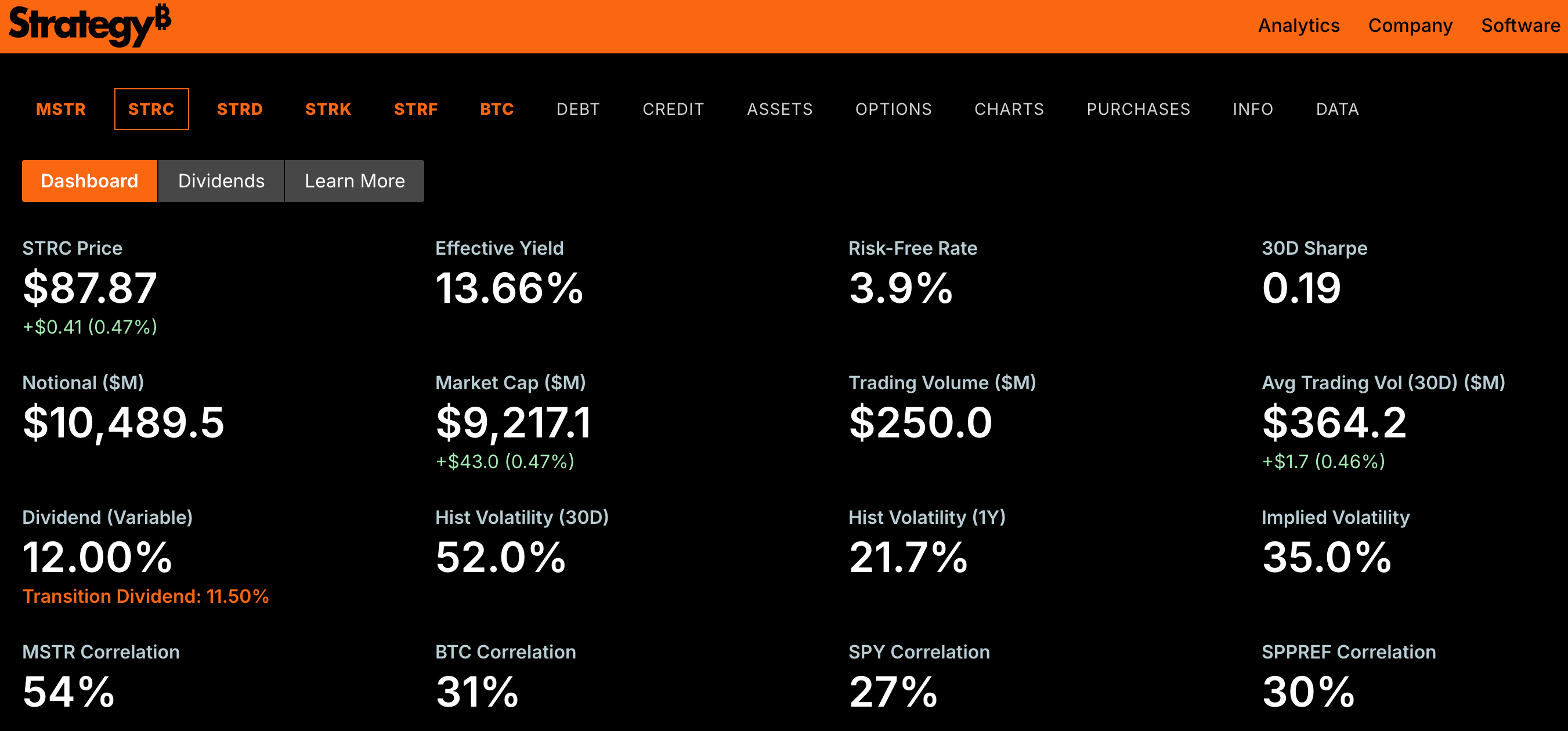
Source: Strategy Official Website
However, due to the continued decline of BTC and ETH, the losses for long-term holders have widened.
On June 25, Bitcoin briefly fell to around $59,100, with 10.83 million BTC in a loss position, an all-time high, surpassing the peak of about 10.5 million during the previous bear market bottom. Long-term holders (holding for at least 155 days) held a record 14.8 million BTC (Note from Odaily Planet Daily: The total circulating supply of Bitcoin is approximately 20 million), with 37% in a loss position. Latest data shows the number of BTC held by long-term holders has grown to 16.61 million BTC today, with the average cost basis dropping to around $49,700.
Data from June 26 showed that ETH whales have fallen into loss territory for the first time since 2019. Even during the 2022 bear market, the largest whale holding over 100,000 ETH remained profitable. Currently, the unrealized profit ratios for all three whale cohorts are negative: -0.26 for the 1,000 to 10,000 ETH range, -0.21 for the 10,000 to 100,000 ETH range, and -0.05 for the over 100,000 ETH range. This condition has persisted for several weeks.
Bitcoin UTXO data from June 28 shows that the ratio of loss-making transactions to profitable transactions in the current market has dropped to the lowest level of this bear market cycle, indicating that investors are entering a clear "capitulation" phase. The last similar low occurred during the depth phase of the mid-2023 bear market, when Bitcoin's price briefly fell to around $26,000.
Previously, due to the sustained price decline, ETH's market cap briefly fell below $185 billion, surpassed by USDT. With the price rebounding above $1,700, ETH's market cap is currently around $207 billion.
In summary, the return of STRC to $100, and BTC and ETH long-term holders exiting loss territory will be key indicators for the end of the bear market.
Speculating on the Bear Market's End: August or December?
Regarding the specific timing of the bear market's end, there is currently no mainstream consensus in the market. Here, we refer only to the views of some industry participants.
Yi Lihua: July-August Could Be a Good Time to Bottom Fish
In late June, TrendResearch founder Yi Lihua stated in a post that the current decline is the third wave since the 1011 top. According to wave theory and cyclical patterns, this could be the last major drop for Bitcoin.
The market is most focused on Bitcoin's bottom price this time, with key factors being the US stock market and MicroStrategy. The Fed's concerns about CPI could lead to changes in expectations for rate cuts or even hikes, potentially causing a continued pullback in US stocks. Secondly, past bear market tails often featured black swan or blow-up events, which have not yet occurred in this cycle, requiring close observation.
Calculated from Bitcoin's high of $126,000, a 60% decline corresponds to $51,000, and a 66% decline corresponds to $43,000. Regardless, July to August should be the final window and the best time to buy the dip, potentially the most worthwhile opportunity in the next three years.
Jiang Zhuoer: BTC Will Bottom at $42,000-$44,000 Between October and December
On June 25, LakeBTC mining pool founder Jiang Zhuoer posted a prediction that this BTC bear market would bottom at $44,016 on October 31 this year. Incorporating the pattern where mNAV leads the coin price by 6 months to a bottom, he revised the bottoming window to October to December 2026, with a bottom price range of $42,000 to $44,000.
He explained the underlying logic: the mNAV (ratio of stock price to BTC value per share) of Strategy's common stock MSTR has fallen to 0.72, close to the previous cycle's low of 0.7 on May 11, 2022. Based on recent market sentiment events like the significant de-pegging of STRC, this period can be predicted as the lowest mNAV zone for this cycle. However, mNAV doesn't bottom at the same time as BTC price. In the previous cycle, mNAV bottomed at 0.7 on May 11, 2022, when BTC was $31,017, but BTC bottomed at $15,476 on November 21, 2022, when mNAV was 1.2, a six-month gap.
BTC Price Indicators: 4-Year Average Price, 200-Week Moving Average Heatmap
According to Coinglass data, the BTC 4-Year Average Price index showed that from June 25 to June 30, affected by BTC briefly falling below $59,000, the index dipped to 0.95. It has since recovered to around 1 as BTC rebounded above $61,000.
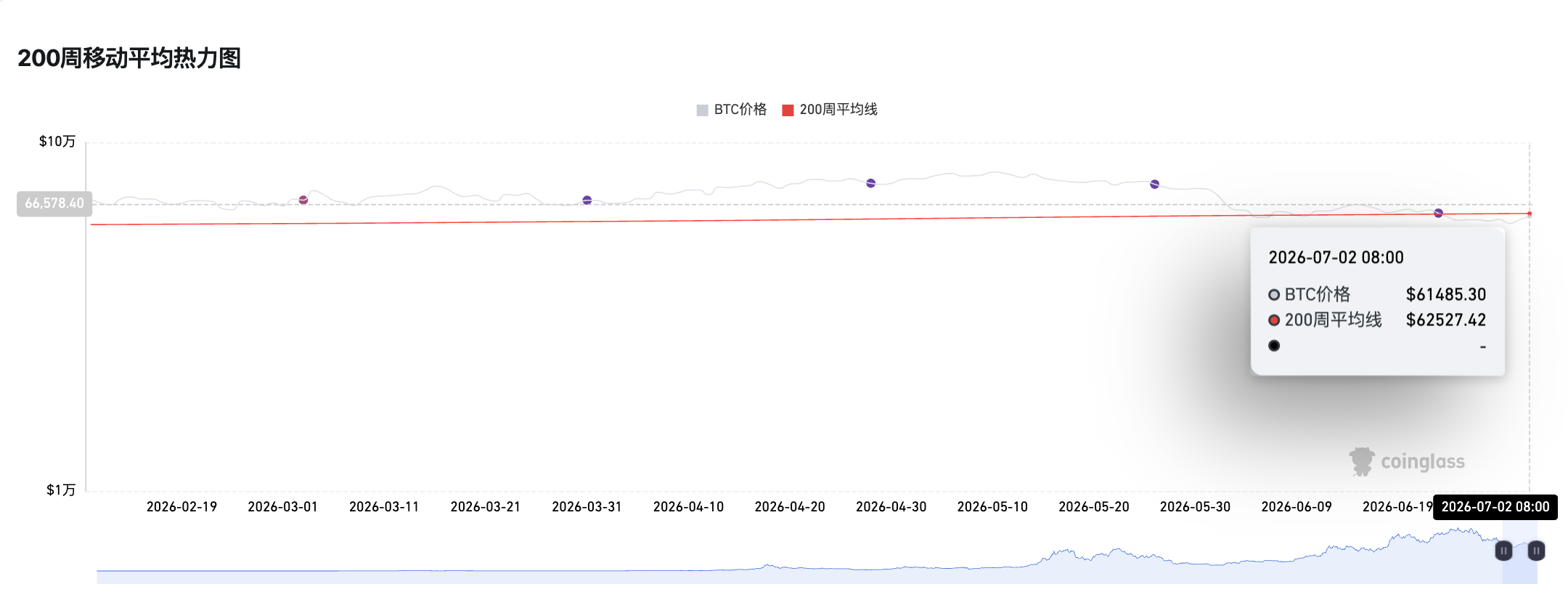
According to the BTC 200-Week Moving Average Heatmap, the current BTC price is roughly in line with the 200-week average, and has been consistently below this average since June 23, potentially suggesting a price bottom.
Additionally, returning to the Coinbase Bitcoin Premium Index mentioned at the start of the article, it is currently still around -0.123%. Based on previous positive ranges, BTC's price would need to rebound to around $77,000 for the index to have a chance of turning positive.
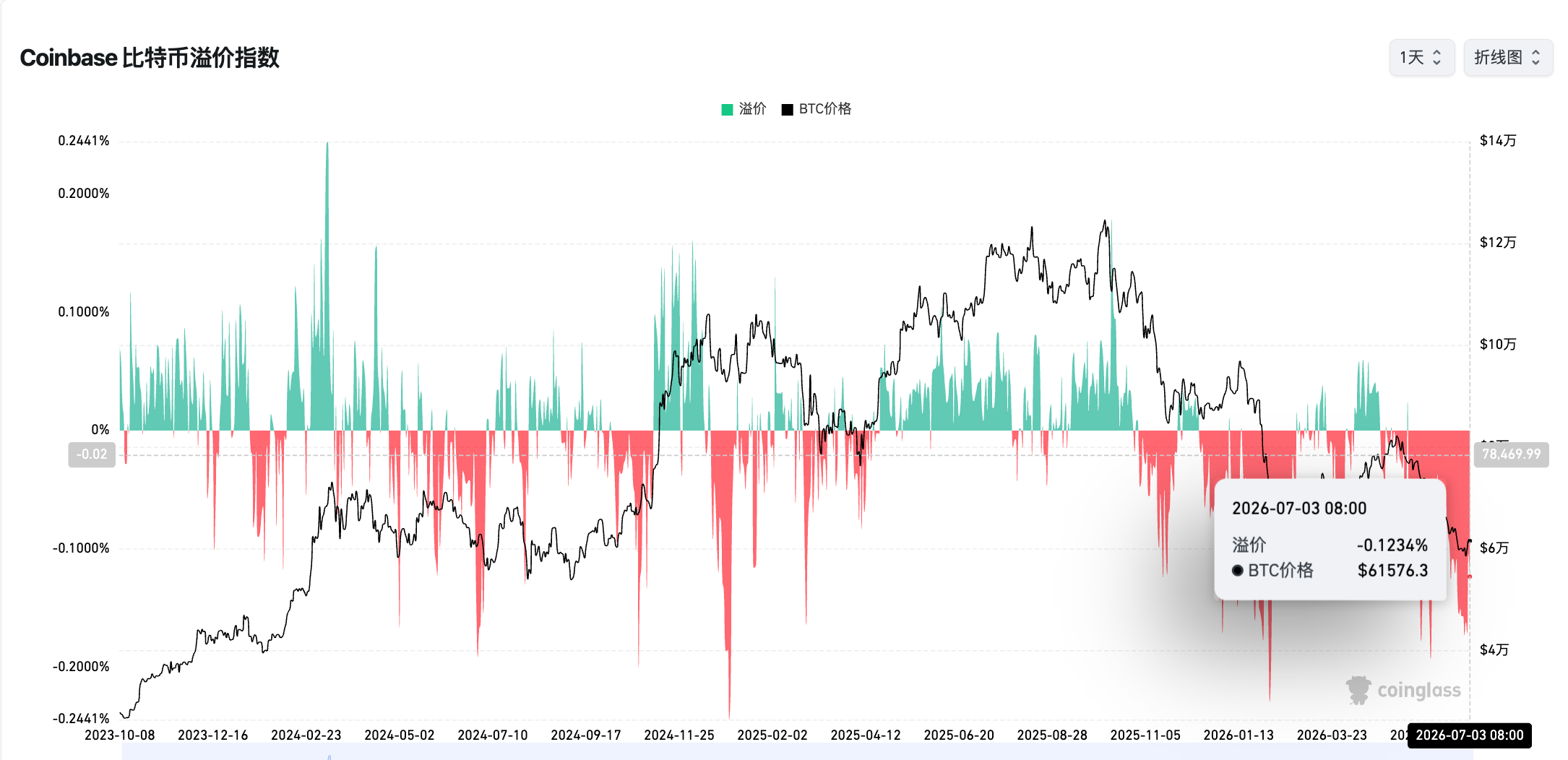
In summary, without strong external positive catalysts, this bear market is likely to persist for at least another 2-3 months. Late September to early October will be a critical window to determine if BTC can rebound.
Recommended Reading
4 Classic Bottom-Fishing Indicators All Fail; Do 3 New Ones Signal a Buying Opportunity?