






The eight major Pre-IPO platforms have been most comprehensively evaluated. Which ones offer real equity, and which are mirror notes?


- Key Insight: As the anticipated IPO wave of 2026 approaches, the market has seen the emergence of various Pre-IPO pre-listing trading platforms. By tokenizing equity, these platforms bridge crypto liquidity with traditional markets, offering users low-barrier, high-liquidity trading opportunities in unlisted company shares. However, there are significant differences among platforms in terms of compliance, asset variety, and trading mechanisms.
- Key Elements:
- Pre-IPO platforms can be categorized into three types: specialized platforms (e.g., PreStocks, Jarsy, Tessera), crypto exchange channels (e.g., Bitget, Gate), and RWA platforms (e.g., Maitong, xStocks, Hyperliquid), each with representative projects.
- PreStocks is the largest on-chain platform, with trading volume nearing $920 million and no minimum capital requirement. However, its assets are limited to a few popular equities like SpaceX, and its reliance on an offshore SPV structure poses compliance risks.
- Jarsy has the strictest compliance and the most assets (including ByteDance), with a minimum entry point of $10. However, its fees can reach as high as 5%, and some assets have a 6 to 12-month lock-up period.
- Bitget, in partnership with Republic, has launched the IPO Prime product, with SpaceX fundraising exceeding $177 million. It supports both primary subscription and secondary trading, but the tokens represent debt instruments, not direct equity.
- RWA platforms like Maitong and Hyperliquid offer different entry points. Maitong focuses on Asia and has a lock-up period, while Hyperliquid offers 3x leveraged contracts but has limited liquidity and carries the risk of liquidation.
Original|Odaily Planet Daily (@OdailyChina)
Author|Wenser (@wenser 2010 )
With the disclosure of SpaceX's prospectus, 2026, a "big year for IPOs," is set to witness a wave of public offering frenzies.
Against this backdrop, numerous Pre-IPO trading platforms have emerged, kicking off their own "pre-IPO liquidity arms race." In light of this, Odaily Planet Daily will provide a brief overview of the eight major Pre-IPO platforms currently in the market, focusing on project introductions, advantages, and disadvantages to help readers participate in pre-IPO trading based on their own circumstances.
To clarify the differences between platforms, this article categorizes Pre-IPO platforms into three types: Dedicated Pre-IPO Trading Platforms (focusing on tokenized Pre-IPO), Crypto Exchanges/Wallet Pre-IPO Channels (leveraging CEX traffic and compliant partnerships), and Pre-IPO Assets and DeFi Protocol Assets Listed on RWA Platforms (tokenized equity under a broad RWA framework). Representative projects for each category are summarized below.
Dedicated Pre-IPO Platforms: PreStocks, Jarsy, Tessera
In previous articles such as "Kalshi's Pre-IPO Stock Price Surges: Is It Too Late to Buy?" and "Crypto Bear Market Entrepreneurship Guide Part 1: The Stock Pre-IPO Price Spread Market," we briefly introduced the pre-IPO prices and arbitrage opportunities of some stocks on these platforms. Currently, trading volumes on such platforms are steadily growing, making them a solid bridge connecting crypto liquidity with traditional financial market equities. Today, we will briefly review three representative platforms.
PreStocks (formerly PrePO): The Largest On-Chain Pre-IPO Platform
Website: https://prestocks.com/
In March 2022, PreStocks completed a $2.1 million strategic funding round, led by IOSG Ventures and Republic Capital, with participation from MEXC, AscendEX, Shima Capital, HoneyDAO, NeptuneDAO, GCR, and founders from projects like Gnosis, 1inch, Moonbeam, Zapper, Gelato, BarnBridge, Immunefi, Thales, and Dapp.com.
After years of development, the platform has seen an explosion in business activity since the second half of last year. Currently, the total trading volume of Pre-IPO assets on the platform is close to $920 million, with nearly 17,000 users, and a total market cap of around $23 million.
Underlying Assets: Indirectly holds shares of the corresponding company through an underlying SPV structure, with tokens mapped 1:1 on-chain. These assets carry no voting rights, dividend rights, or information rights.
Platform Advantages: No minimum investment threshold for asset trading (as low as $0.01); over 60 ecosystem partners and multiple trading channel entry points (e.g., Jupiter, Binance Wallet); free on-chain token trading with relatively deep liquidity; 24/7 trading; transaction fee of only 0.01%.
Disadvantages: SPV equity relies on offshore structures, posing certain compliance and regulatory risks; platform assets are limited to a few high-profile equities like SpaceX, Kalshi, OpenAI, and Anthropic.
Example: SpaceX Pre-IPO price is $721 per share, with a liquidity pool of $1.26 million and cumulative trading volume of $210 million.
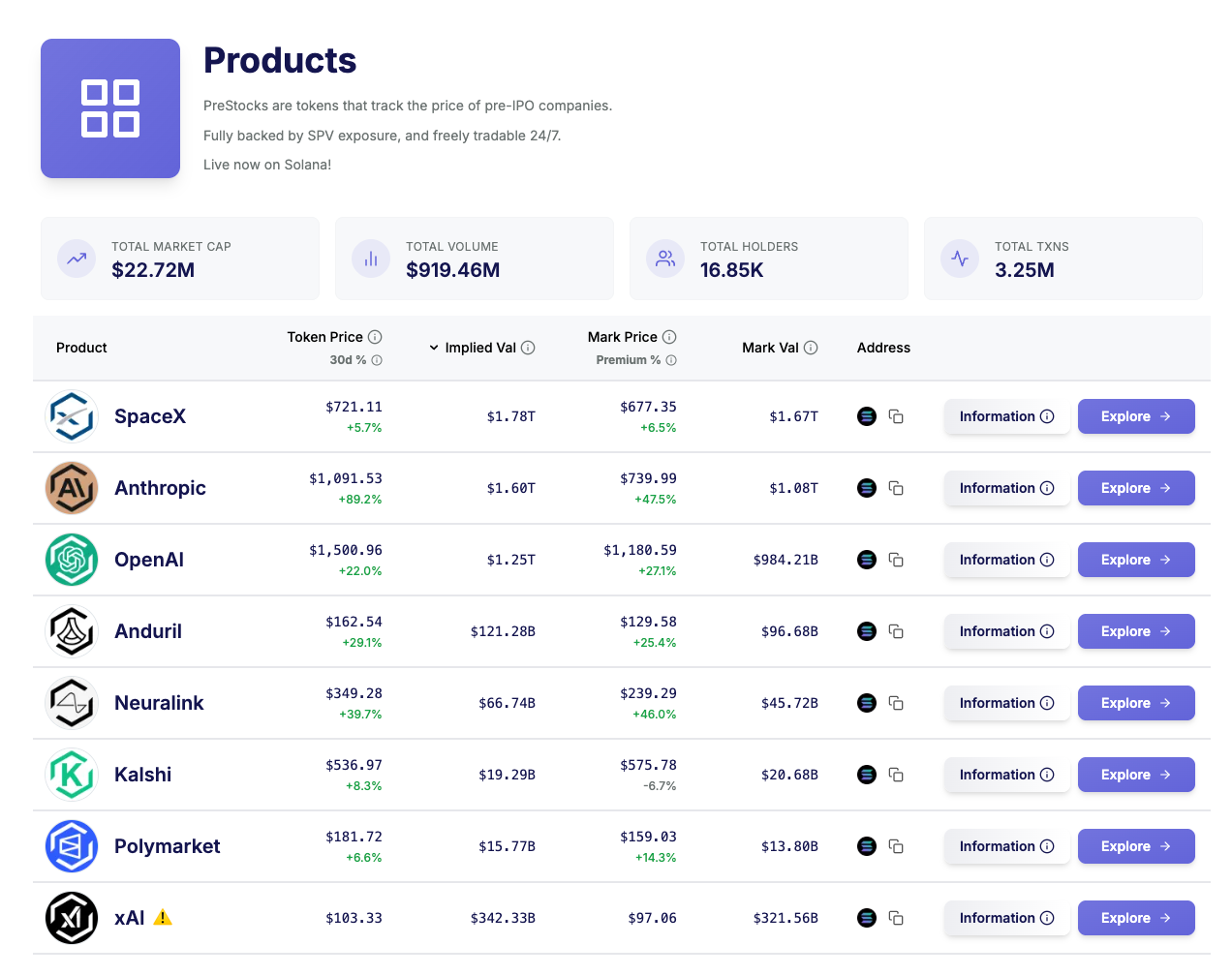
PreStocks Platform Asset Information
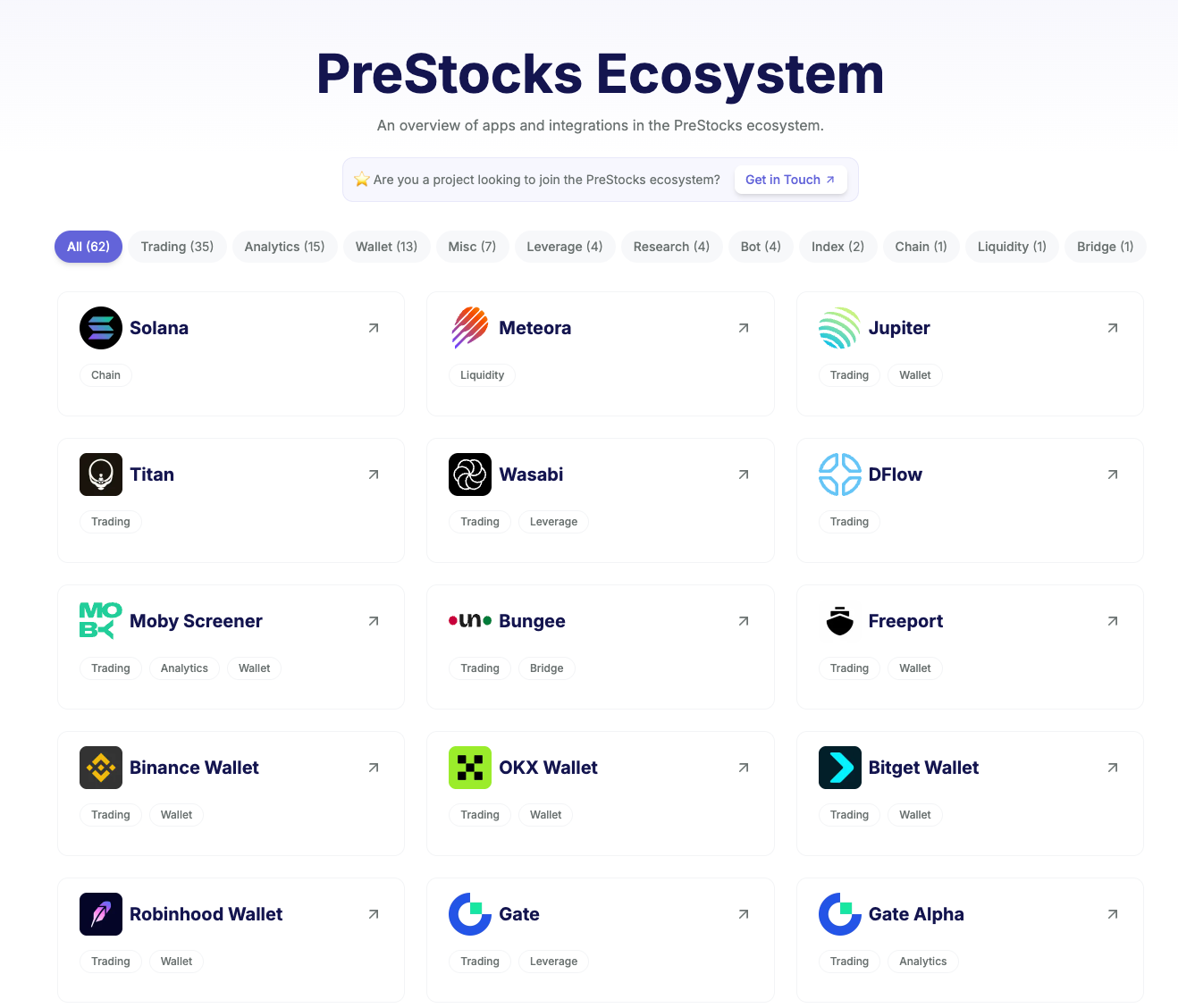
PreStocks Ecosystem Partners
Jarsy: The Most Compliant Pre-IPO Platform with the Most Assets
Website: https://www.jarsy.com/
According to the official introduction, Jarsy's founding team consists of former Silicon Valley tech giants and seasoned blockchain professionals. It offers trading opportunities to global investors, including those from the US, with a relatively clear compliance framework. It operates an order-book-based trading system where users submit buy requests, and the platform procures shares at specific times for settlement according to set schedules. Additionally, the platform covers the widest variety of assets, including hot companies like SpaceX, Anthropic, and OpenAI, as well as internet platforms like Discord, Canva, Figma, ByteDance, and Xiaohongshu, and scarce unlisted equity in companies like Stripe, Cursor, Shein, Kraken, and Revolut.
Underlying Assets: Each equity token is backed 1:1 by the economic interests of the corresponding shares held by Jarsy Delaware LLC. Ownership documents, equity certificates, and transfer vouchers are all publicly disclosed. Token supply and transaction records can be independently verified on-chain. Notably, users purchase the economic interest in the shares, not shareholder status. In other words, when equity is settled, the platform sells the corresponding shares and returns the equivalent USD to holders proportionally based on their holdings.
Platform Advantages: Supports wire transfers, Coinbase accounts, and cryptocurrency deposits; minimum purchase threshold is $10 equivalent in platform tokens; supports KYC with mainland China passports; wide variety of covered assets; platform asset pricing carries a certain premium.
Disadvantages: High transaction fees, including a 5% one-time platform fee and a 1%-10% carried interest fee; relatively limited liquidity; longer transaction times relying on order book matching; some assets may have a 6-12 month potential lock-up period.
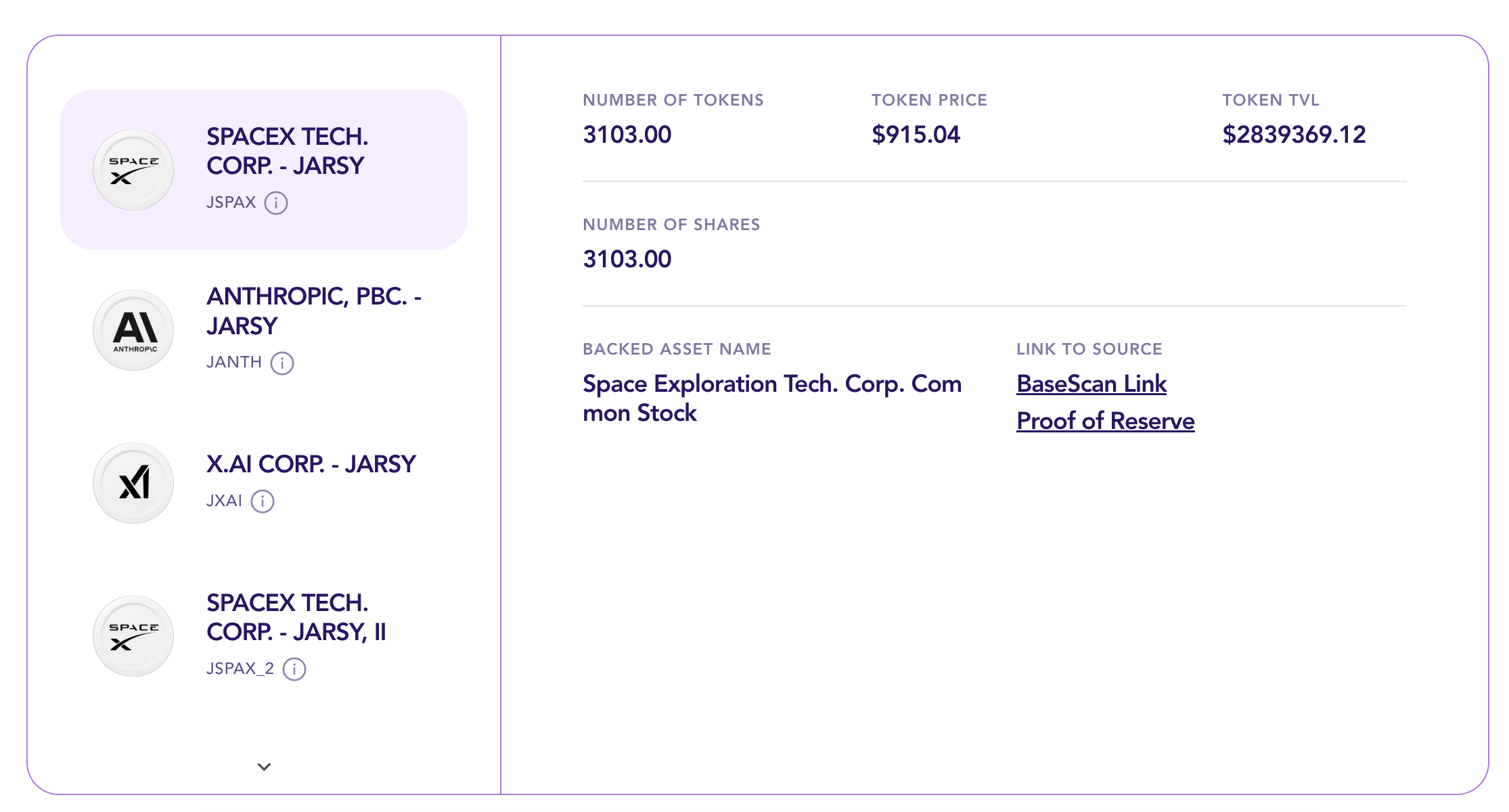
Example: SpaceX Pre-IPO mid-price is around $915 per share, with approximately 3,100 equity tokens issued.
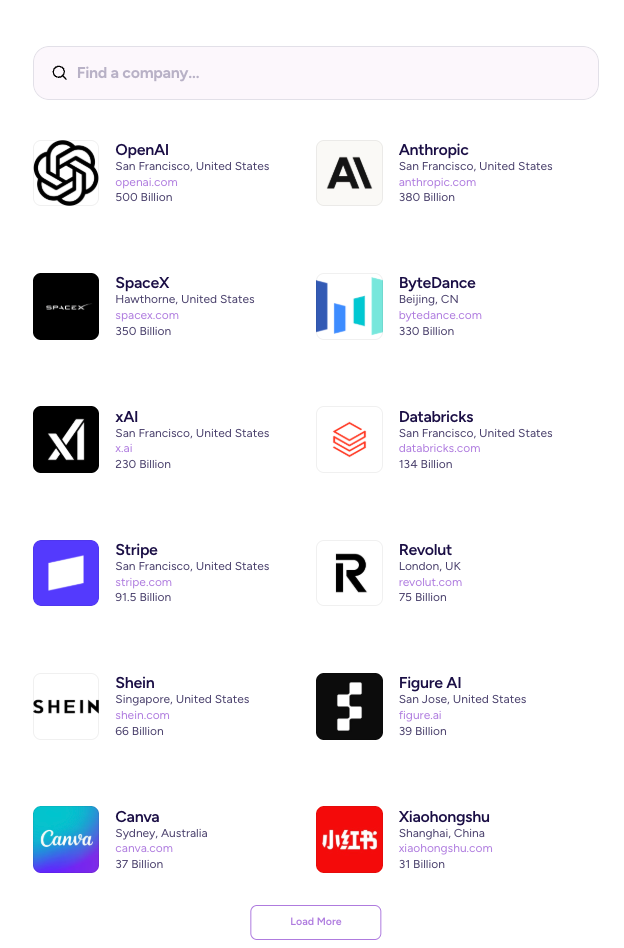
Jarsy's Partial Equity Assets and Corresponding Companies
Tessera: A KYC-Free On-Chain Pre-IPO Platform
Website: https://www.tessera.pe/
Positioned as a permissionless, KYC-free on-chain Pre-IPO equity token trading platform, Tessera has a relatively short history and a limited selection of assets. However, its previous SpaceX equity fundraising was valued at only $800 billion, which is attractive compared to the current Pre-IPO valuations often exceeding $1.5 trillion and even the $1.8 trillion range expected at IPO.
Currently, if the platform can address its asset variety shortfall, its instant settlement and $1 minimum purchase threshold could still make it a dark horse in the Pre-IPO sector.
Underlying Assets: Equity assets issued through an SPV structure.
Platform Advantages: Low entry barrier of just $1; no KYC required; no lock-up on equity tokens; supports 24/7 instant settlement.
Disadvantages: Transaction fee is 0.2% (0.16% for whitelisted users); limited asset types (SpaceX equity tokens issued, second project is prediction market Kalshi, not yet launched); limited share of equity assets (previous SpaceX Pre-IPO fundraising was only $200,000).
Example: SpaceX Pre-IPO current token price is around $650, with a TVL of only around $620,000.
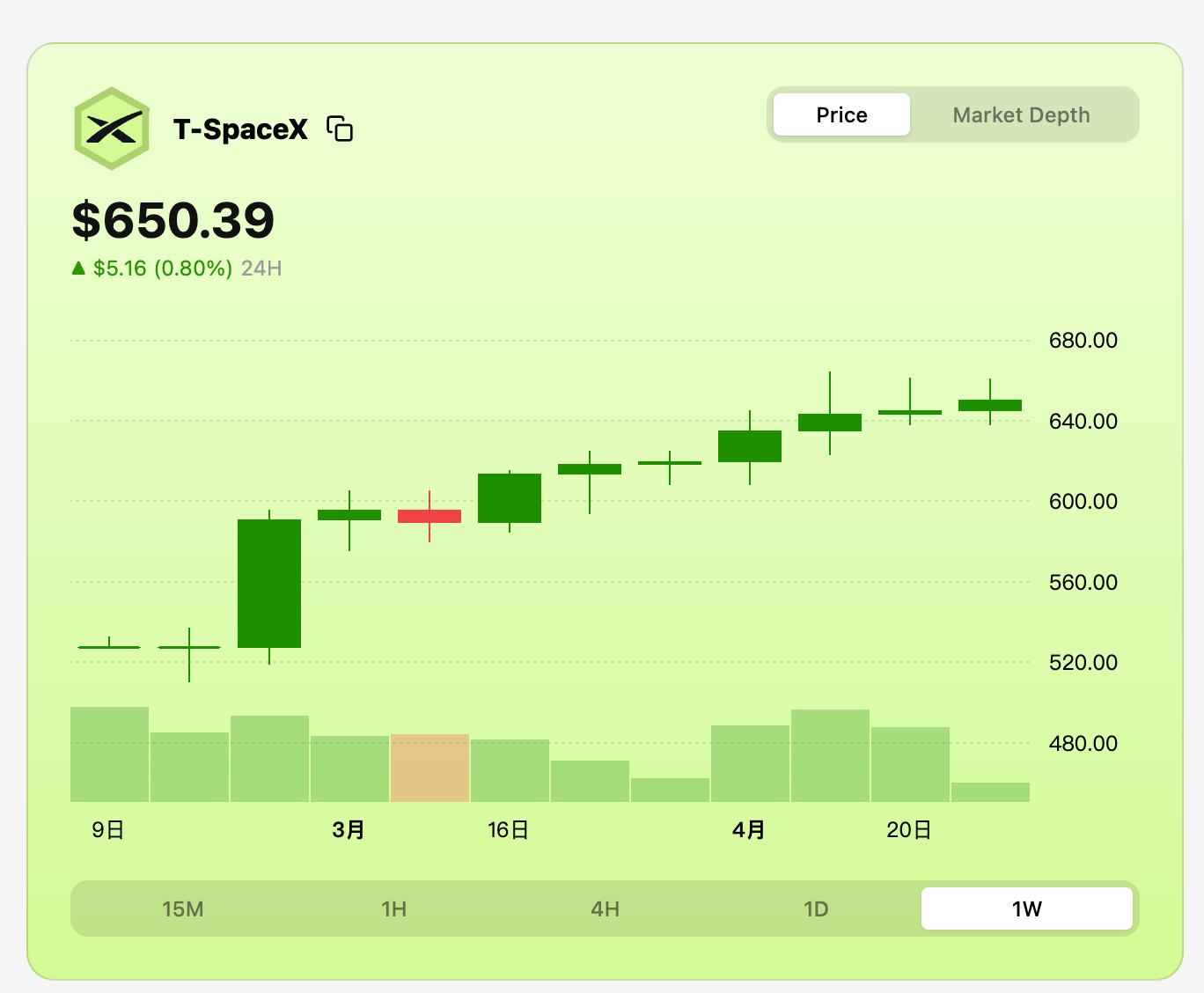
SpaceX Equity Token Price K-line Chart
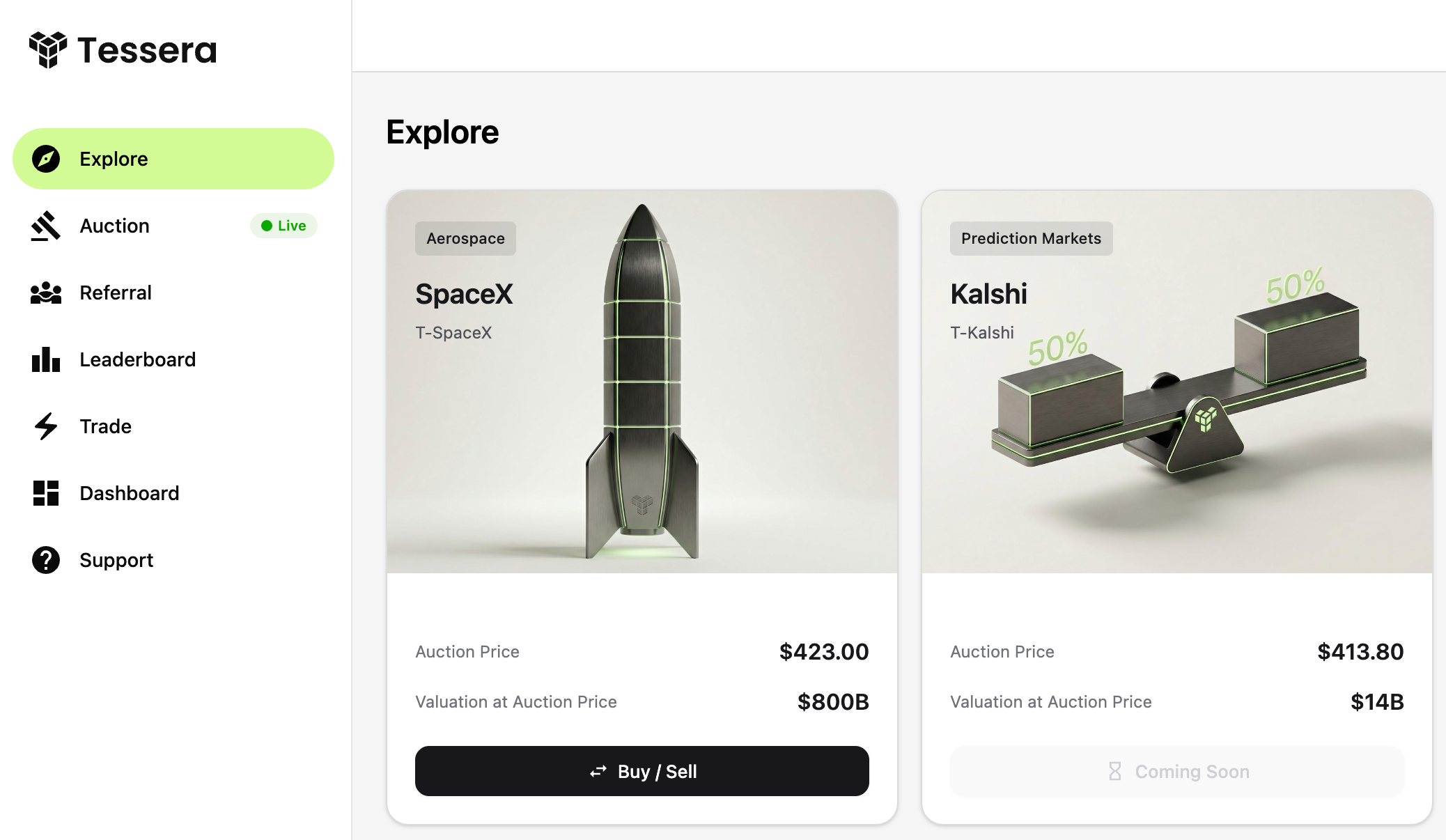
Tessera Platform Asset Page
Crypto Exchange Pre-IPO Channels: Bitget, Gate
As US stock and TradFi trading become an integral part of the crypto market, major exchanges have joined the fierce battle for Pre-IPO liquidity. Apart from Binance Wallet's earlier partnership with PreStocks, Bitget and Gate have recently opened Pre-IPO fundraising channels within their exchanges, aiming to attract on-exchange capital and boost activity.
Bitget (IPO Prime): Inclusive Pre-IPO Products from Compliant Issuers
Website: https://www.bitget.cloud/zh-CN/spotlight/ipo-prime
According to an earlier introduction by Bitget CEO Gracy Chen, the IPO Prime product launched in collaboration with Republic offers four advantages:
In terms of underlying assets, genuine SpaceX equity is held via an SPV and tokenized, with Bitget backing the token redemption as a participant.
Regarding compliance, Republic has a complete compliance system and extensive Pre-IPO issuance experience (Note from Odaily Planet Daily: Republic is a US-compliant entity, a licensed platform under SEC/FINRA standards, which has previously issued Pre-IPO asset products for well-known companies like Neuralink, Kraken, Stripe, and Revolut). For participation methods, it simultaneously supports primary market subscription and secondary market circulation, allowing users to acquire tokens at lower prices. In terms of liquidity, it secured approximately $61 million in allocation, significantly higher than other market platforms. Ultimately, the SpaceX Pre-IPO attracted over 14,400 participants, with a total investment exceeding $177 million.
Underlying Assets: The preSPAX equity tokens are unsecured or contingent redemption instruments issued by Republic, pegged to the price of the underlying asset, with no voting or dividend rights. (Note from Odaily Planet Daily: Bitget's official statement—holding IPO Prime subscription tokens represents a debt instrument from the issuer to the holder, designed to reflect the company's performance. It is not a real share of the company, and holding the token does not represent holding company equity, nor does it confer voting rights, dividend rights, or any shareholder rights.)
Platform Advantages: Supports stablecoin subscriptions (USDT or USDGO); compliant issuance by Republic with a friendly regulatory framework; low subscription threshold (minimum $100, maximum $300,000, subscribing to SpaceX equity tokens at a $1.5 trillion valuation); tokens support instant trading.
Disadvantages: Initially limited asset variety; equity token derivatives track the price rather than direct equity, posing synthetic product volatility risks; subscription quotas and airdrop benefits vary by VIP level.
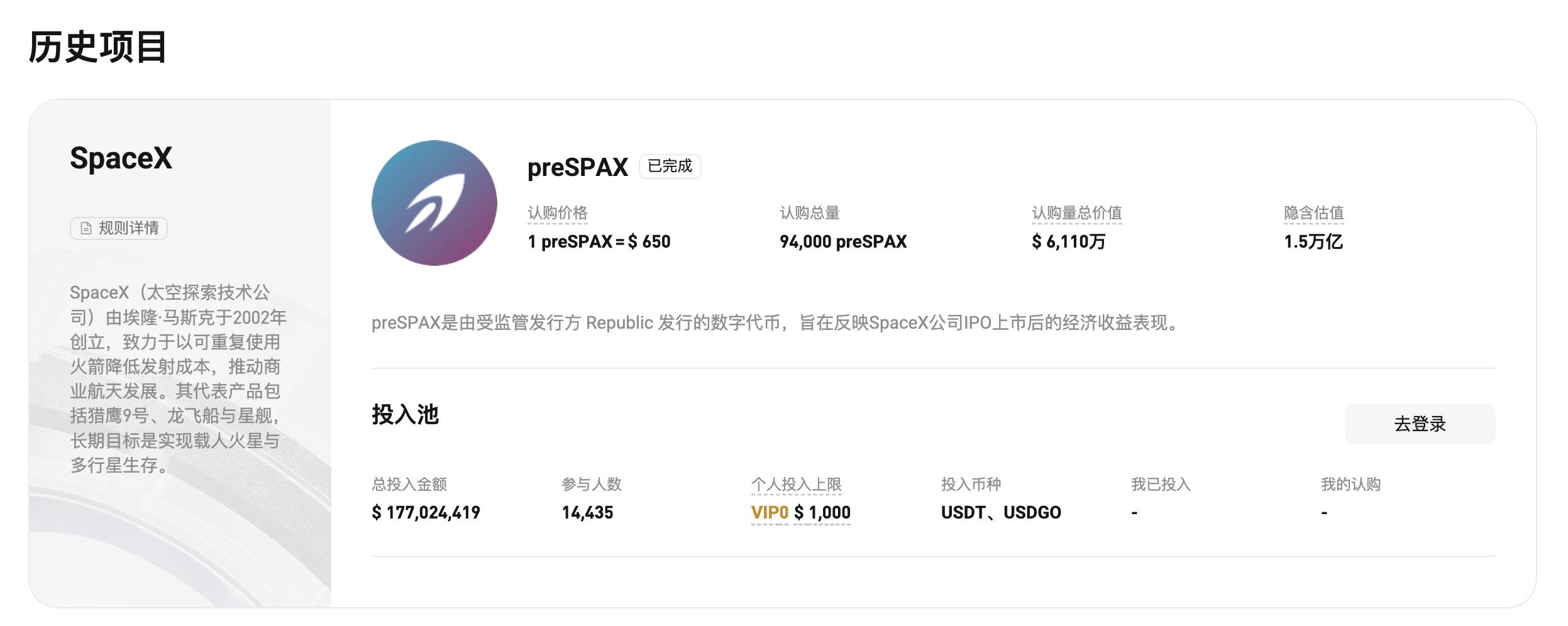
Bitget IPO Prime Inaugural Project - SpaceX (preSPAX)
Gate Pre-IPO: Mirror Note Pre-IPO Channel
Website: https://www.gate.com/zh/ipos
Following Bitget's initial move in the Pre-IPO liquidity battle, Gate quickly launched its own "Pre-IPO channel window." According to previous official announcements, Gate's first Pre-IPO project, SpaceX (SPCX), had a total fundraising scale of nearly $395 million. Users participating in the GUSD liquidity pool staking can also enjoy an annualized yield of approximately 2.90%, further improving capital efficiency.
Underlying Assets: SPCX tokens are mirror mapping notes and do not represent actual SpaceX stock or shares.
Platform Advantages: Lowest subscription price in the market, token price of only $590 per share; minimum subscription threshold of 100 USDT or 100 GUSD; single-user limit of 339 SPCX equity tokens, with quota linked to VIP level; all fees and custody charges waived; 100% unlocked distribution; supports instant trading.
Disadvantages: Not direct equity; relies on OTC trading price reference standards.
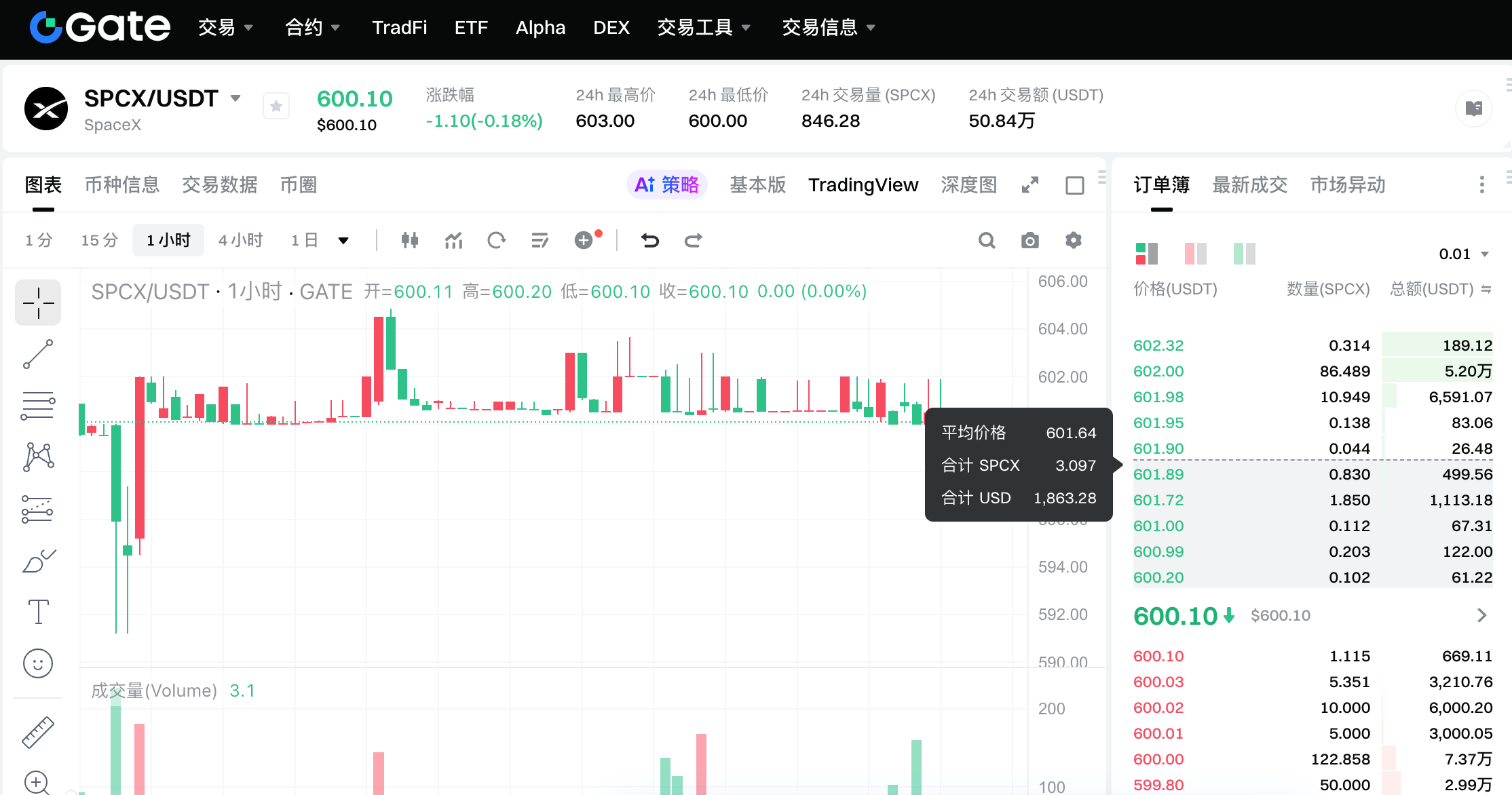
Gate SPCX Trading Interface
RWA Platform Pre-IPO Entry Points: Maitu (msx.com), xStocks, Hyperliquid
Apart from specialized Pre-IPO platforms and crypto exchange Pre-IPO channels, many RWA platforms have also deeply ventured into the Pre-IPO sector this year, with Maitu (msx.com), xStocks, and Hyperliquid being the most representative examples.
Maitu (MSX): Decentralized RWA Trading Platform Pre-IPO Zone
In March of this year, Maitu launched its Pre-IPO section, positioned as a "low-barrier entry point focusing on the Asian market, tokenizing Pre-IPO equity through Republic's compliant SPV structure." The initial batch of offerings included SpaceX ($3 million allocation), ByteDance ($2 million), Lambda Labs ($1 million), and Cerebras Systems ($500,000).
Underlying Assets: Equity assets issued by compliant issuance partners through an SPV structure.
Platform Advantages: Low subscription entry barrier of just $10; platform's cumulative RWA asset trading volume exceeds $31.4 billion.
Disadvantages: Equity tokens have a lock-up period until June 9 or post-IPO, preventing instant trading (compared to other instant trading platforms).
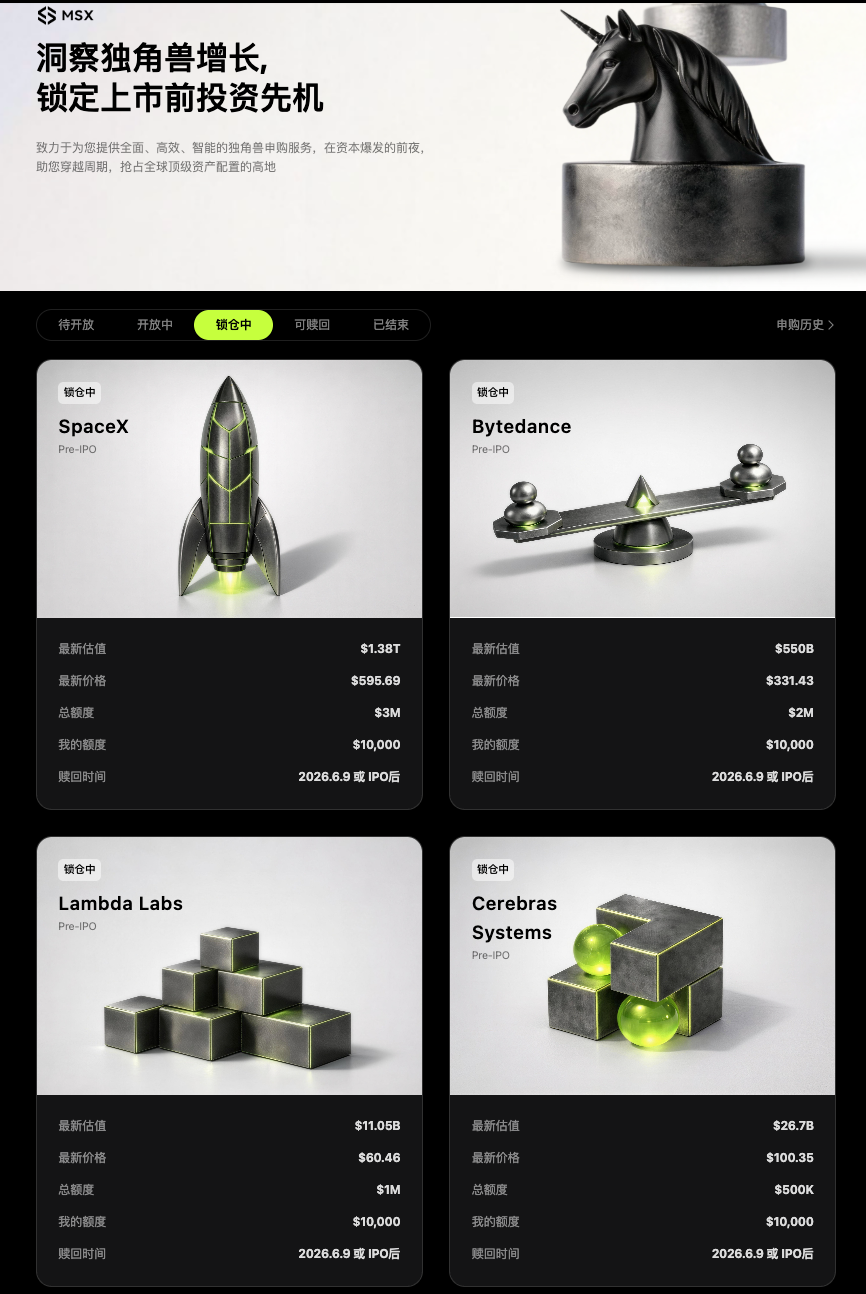
msx.com Official Website Interface
xStocks: Pre-IPO Assets Under Fund Equity Token Exposure
As a leading US stock tokenization platform, xStocks could not afford to ignore Pre-IPO asset opportunities. However, unlike other platforms' approach of single-asset equity tokenization, xStocks chooses to gain Pre-IPO exposure through VCXx (VCX private equity fund equity tokenized assets), indirectly introducing unlisted equity assets like OpenAI.
Underlying Assets: Indirect exposure to private equity fund venture risk assets.
Platform Advantages: Backed by a real fund; supports automatic dividend reinvestment; relatively regulatory-friendly.
Disadvantages: Pre-IPO exposure is indirect (fund structure), not pure single-company equity; carries risks of fund-level lock-up and valuation adjustments (Note from Odaily Planet Daily: VCX token price has now fallen below $100); liquidity is highly dependent on ecosystem partner support; management fees include a 1.85% annual management fee and other operational expenses. Currently, the tracking token itself charges no management fee, but a fee of up to 0.25% annually may be introduced in the future; buy/sell transactions may incur up to 0.5





